Introduction
Imagine you're a federal employee five years from retirement. You've maxed out your TSP contributions, you're counting on your FERS pension, and you know Social Security is coming—but you still have a lump sum sitting idle and you'd like it to grow. The problem: full stock market exposure feels reckless at this stage, but locking everything into a fixed product means leaving real money on the table.
Indexed variable annuities were built to fill that gap. Known formally as Registered Index-Linked Annuities (RILAs)—and sometimes called buffer annuities or structured annuities—these products have exploded in popularity.
According to LIMRA, 2025 RILA sales reached $79.5 billion—up 20% year over year and the tenth consecutive record-setting year for the category. The SEC has described RILAs as the fastest-growing segment of the annuity market.
This article covers what indexed variable annuities are, how their core mechanics work, their benefits and risks, how they compare to other annuity types, and who they suit best.
Key Takeaways
- Returns link to a market index (S&P 500, Russell 2000, etc.) — you don't own the underlying assets
- They offer partial downside protection via a "buffer" (not full principal protection like a fixed indexed annuity)
- Gains are capped, so you trade some upside for downside cushioning
- IVAs are regulated as securities by the SEC and FINRA—stricter oversight than standard fixed annuities
- Fees, surrender periods (often 6–10 years), and insurer financial strength all matter
What Is an Indexed Variable Annuity?
An indexed variable annuity is a contract between an investor and an insurance company where growth is tied to the performance of one or more market indexes—but the investor does not directly own any index assets. The insurer credits returns based on how the index performs, subject to defined limits. Where an IVA fits relative to other annuity types helps clarify both its appeal and its trade-offs.
Where IVAs Sit on the Annuity Spectrum
Annuities span a wide risk-return spectrum, and IVAs occupy a specific position within it:
- Fixed annuities: guaranteed rate, zero market exposure, full principal protection
- Fixed indexed annuities (FIAs): index-linked growth with 100% principal protection, lower upside
- Indexed variable annuities (IVAs/RILAs): index-linked growth with partial protection, higher upside potential, real downside risk
- Traditional variable annuities: full market participation via subaccounts, no floor or buffer
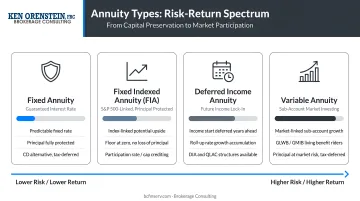
That positioning—more upside than an FIA, more downside protection than a traditional variable annuity—is precisely what draws growth-focused pre-retirees to IVAs.
What's in a Name?
You'll encounter several terms for the same product:
- Registered Index-Linked Annuity (RILA)
- Buffer annuity
- Structured annuity
- Hybrid annuity
The labels differ by carrier and marketing, but the core mechanics are identical.
Regulatory Status
Because IVAs expose investors to real market risk, the SEC classifies them as securities. They're regulated by both the SEC and FINRA at the federal level, in addition to state insurance oversight. FINRA's 2025 Annual Regulatory Oversight Report covers RILAs explicitly under annuity securities products—including Regulation Best Interest obligations for advisors recommending them. Standard fixed annuities face only state insurance regulation.
That dual oversight also shapes how the contract itself is structured.
Two Contract Phases
- Accumulation phase: premiums are deposited and growth is credited based on index performance within the contract's defined terms
- Distribution phase: the investor receives income through withdrawals, annuitization, or a lifetime income rider
How Indexed Variable Annuities Work: Caps, Buffers, and Participation Rates
Three mechanics determine what you actually earn—or lose—in an IVA: the cap rate, the downside protection structure (buffer or floor), and the participation rate. Each one shapes your outcome independently, and they interact in ways that aren't always obvious from a sales summary.
Cap Rate
The cap is the maximum return credited in any given period, regardless of how well the index performs.
- Index gains 20%, cap is 10% → you're credited 10%
- Index gains 6%, cap is 10% → you're credited 6%
Caps reset at the start of each contract term, meaning they can change year to year at the insurer's discretion. Real-world examples from SEC-filed prospectuses show wide variation—Equitable's Structured Capital Strategies Plus 21 lists minimum performance cap rates of 12% for certain 6-year segment options.
Buffer vs. Floor
These are two different downside protection structures. Most RILAs (Registered Index-Linked Annuities) use one or the other, not both.
Buffer: The insurer covers the first losses up to a stated percentage; you absorb anything beyond that.
- 10% buffer + index drops 18% → you absorb 8% (insurer covers the first 10%)
- 10% buffer + index drops 7% → you absorb 0% (fully within the buffer)
Floor: Sets the maximum loss you can experience. With a -10% floor, the insurer absorbs every loss beyond that threshold.
Buffers are more common in the current RILA market. Both structures leave investors exposed to losses under certain conditions. The key distinction: a buffer absorbs losses first (up to its limit), while a floor caps the maximum loss you can take.
Participation Rate
The participation rate is the percentage of the index's gain that gets credited to your account.
- Index gains 10%, participation rate is 80% → you're credited 8%
- Index gains 10%, participation rate is 100% → you're credited 10% (subject to any cap)
Rates below 100% are common when contracts offer higher buffers or lower caps — insurers balance these levers to manage their own exposure.
In practice, all three mechanics apply simultaneously. The table below shows how they interact across different market scenarios.
A Combined Example
| Scenario | Index Return | Cap | Buffer | Participation Rate | Your Credit |
|---|---|---|---|---|---|
| Strong up year | +20% | 10% | 10% | 100% | +10% |
| Modest up year | +7% | 10% | 10% | 100% | +7% |
| Small loss | -8% | 10% | 10% | 100% | 0% |
| Large loss | -25% | 10% | 10% | 100% | -15% |
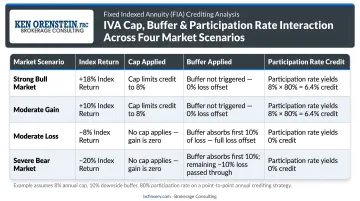
The buffer cushions moderate downturns but doesn't eliminate loss in severe markets.
Benefits of Indexed Variable Annuities
Partial Downside Protection
Unlike traditional variable annuities, the buffer absorbs a defined portion of market losses. For investors who want index-linked growth but can't stomach a 30% portfolio drop, that defined loss boundary has real psychological and financial value.
Higher Growth Ceiling Than Fixed Indexed Annuities
Because IVA investors accept some downside risk, insurers can offer more favorable terms. RILAs tend to offer higher caps and participation rates than FIAs—the tradeoff for that improvement is the absence of full principal protection.
Tax-Deferred Growth
Like all annuity types, IVA earnings accumulate on a tax-deferred basis. IRS Publication 575 confirms that annuity payments are generally taxable as ordinary income upon distribution, with tax-free recovery of your original investment in the contract. For investors who've already maxed out a 401(k), TSP, or IRA, this additional tax deferral can meaningfully compound over a long accumulation period.
Flexible Distribution Options
Once your money has grown, IVAs offer several ways to access it:
- Systematic withdrawals draw regular income directly from the account value
- Annuitization converts the contract into a guaranteed income stream for life or a fixed period
- Lifetime income riders provide guaranteed withdrawal benefits at an additional fee, without requiring full annuitization
Each option serves a different retirement income need, so the right choice depends on your timeline and spending goals.
Risks of Indexed Variable Annuities
Principal Is Not Guaranteed
This is the most misunderstood point about IVAs. Investor.gov states explicitly that investors can lose money in a RILA, including principal. The buffer absorbs only the first layer of losses—anything beyond it comes out of your account.
The SEC's 2023 investor testing report found widespread confusion around this point. In response, the SEC's final rule now requires prominent front-cover disclosure that a RILA is a complex investment involving potential loss of principal.
If you're considering an IVA expecting full principal protection, you're looking at the wrong product. A fixed indexed annuity provides that guarantee; an IVA does not.
Cost and Complexity
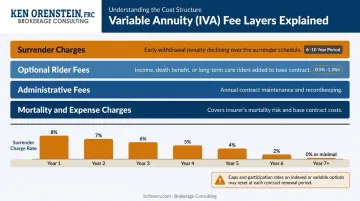
IVAs carry multiple fee layers:
- Mortality and expense (M&E) charges — ongoing cost deducted from account value each year
- Administrative fees — flat or asset-based charges for policy maintenance
- Optional rider fees — lifetime income guarantees and enhanced death benefits add 0.5%–1.5%+ annually
- Surrender charges — typically spanning 6–10 years with steep early exit penalties
SEC-filed prospectuses document real examples: Allianz Index Advantage ADV uses a 6-year withdrawal charge schedule starting at 6.5%, while Equitable's Series B runs 7 years. Caps and participation rates can also be reset by the insurer at each term renewal, introducing ongoing uncertainty about future returns.
Liquidity and Tax Penalties
Surrender periods lock your principal for years. Withdrawals before the surrender period ends trigger charges. Beyond surrender charges, taxable distributions taken before age 59½ may incur a 10% IRS early withdrawal penalty on top of ordinary income tax.
Insurer Credit Risk
Every guarantee in an IVA—including the buffer itself—is an obligation of the issuing insurance company, not a government guarantee. If the insurer's financial strength deteriorates, those contractual commitments could be at risk. Before purchasing, review the carrier's financial strength ratings from AM Best, Moody's, S&P, and Fitch — a lower-rated insurer introduces meaningful counterparty risk that no buffer can offset.
Indexed Variable Annuity vs. Other Annuity Types
| Feature | Fixed Annuity | Fixed Indexed Annuity (FIA) | Indexed Variable Annuity (IVA/RILA) | Traditional Variable Annuity |
|---|---|---|---|---|
| Principal protection | Full | Full | Partial (buffer only) | None |
| Market linkage | None | Yes (index) | Yes (index) | Yes (subaccounts) |
| Upside | Fixed rate | Capped, lower | Capped, higher | Uncapped |
| Downside | None | None | Buffer absorbs first losses | Full investor exposure |
| Regulatory status | State insurance | State insurance | SEC + FINRA securities | SEC + FINRA securities |
| Complexity | Low | Moderate | High | High |
The most common point of confusion: FIAs and IVAs both link returns to an index, but only the FIA protects 100% of principal. An IVA's buffer is not principal protection—it's a defined loss-sharing arrangement.
Traditional variable annuities sit at the other end of the risk spectrum. They offer the broadest investment flexibility through subaccounts resembling mutual funds, but the investor absorbs every dollar of market loss.
That contrast is where the IVA earns its place. It suits investors who find FIA caps too restrictive but aren't willing to accept full downside exposure — typically those within 5–15 years of retirement who still need meaningful growth without betting everything on market performance.
Who Should Consider an Indexed Variable Annuity?
The Right Investor Profile
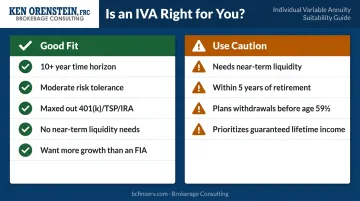
IVAs generally fit investors who:
- Have a 10+ year time horizon before needing the funds
- Carry moderate risk tolerance—comfortable absorbing some loss, but not full market exposure
- Have already maximized other tax-advantaged accounts (401(k), TSP, IRA)
- Don't need immediate liquidity from the invested amount
- Want more index growth potential than an FIA can offer and can accept the corresponding risk
Who Should Be Cautious
- Anyone who needs high liquidity in the near term
- Investors within 5 years of retirement with limited other income sources
- Anyone expecting to access funds before age 59½
- Those who prioritize guaranteed lifetime income above growth—simpler products often serve that goal more directly
How IVAs Fit Into a Federal Employee's Retirement Plan
For federal employees balancing a FERS pension, TSP, and Social Security, any annuity product sits as a supplement to existing benefits—not a replacement. The core retirement architecture is already in place; the question is whether an IVA makes sense for discretionary funds that have a longer runway. That answer depends on individual circumstances, including:
- Risk tolerance and comfort with potential loss
- Existing income coverage from pension and Social Security
- Near-term liquidity needs
- Overall tax situation
Working through those factors is where a personalized review matters. Brokerage Consulting, led by Ken Orenstein—a Federal Retirement Consultant and author of The Informed Fed: A Survival Guide to Federal Employee Benefits—helps federal employees and individuals evaluate tax-efficient retirement income strategies, including whether an IVA belongs in the mix. Initial consultations are available at no cost by phone at (888) 315-3608 or at bcfinserv.com.
Frequently Asked Questions
Is there a variable-indexed annuity?
Yes. An indexed variable annuity (also called a variable-indexed annuity or RILA) is a distinct product category that combines elements of both variable and indexed annuities. It offers market-linked growth with partial downside protection through a buffer or floor mechanism.
What is the difference between a fixed indexed annuity and an indexed variable annuity?
The central difference is principal protection. Fixed indexed annuities guarantee your principal will never fall below zero. Indexed variable annuities only absorb losses up to the buffer amount; losses beyond that threshold are absorbed by the investor.
Can you lose money in an indexed variable annuity?
Yes. If market losses exceed the buffer percentage, the investor absorbs the remainder. Early withdrawal surrender charges and IRS penalties before age 59½ can also reduce account value beyond market-related losses.
What fees are associated with indexed variable annuities?
Common fees include mortality and expense risk charges, administrative fees, and optional rider fees for benefits like lifetime income guarantees. Surrender charges also apply, typically for 6–10 years following the initial premium deposit.
Are indexed variable annuities regulated by the SEC?
Yes. Because RILAs involve real market risk to the investor, the SEC classifies them as securities. They're regulated by both the SEC and FINRA federally, in addition to state insurance oversight, which makes disclosure requirements more rigorous than for standard fixed annuities.
How are indexed variable annuities taxed?
Growth accumulates tax-deferred. Withdrawals are taxed as ordinary income, and distributions taken before age 59½ may trigger a 10% IRS early withdrawal penalty on top of regular income tax.