
Introduction
According to Allianz Life's 2025 research, 64% of Americans worry more about running out of money in retirement than death itself. Yet most people have never heard of the financial tools built specifically to eliminate that risk.
Guaranteed Income Annuities (GIAs) are purpose-built for one job: converting your savings into a guaranteed paycheck that lasts as long as you live. They're widely misunderstood — often confused with investment accounts or savings products — but the mechanics are straightforward once you see how they work.
This guide covers the essentials: what a GIA is, how it works, the main types, the real benefits and tradeoffs, and how to figure out whether one belongs in your retirement plan.
Key Takeaways
- A GIA converts a lump sum into guaranteed regular income payments — for life or a set period — regardless of market conditions
- GIAs eliminate longevity risk: no matter how long you live, payments continue
- Three primary types (SPIA, DIA, and QLAC) suit different retirement timelines and tax situations
- Tradeoffs include limited liquidity and lower growth potential compared to investment accounts
- Federal employees can use GIAs to add a third income layer alongside FERS and Social Security
What Is a Guaranteed Income Annuity (GIA)?
A GIA is a contract between you and an insurance company. You hand over a premium — either a lump sum or a series of payments — and the insurer commits to making regular income payments back to you. Those payments continue either for a specified period or for the rest of your life, regardless of what financial markets do.
The "Guaranteed" Part Actually Means Something
Unlike a stock portfolio or a mutual fund, GIA payments don't fluctuate with the market. The guarantee is backed by the claims-paying ability of the issuing insurance company — which is why the insurer's financial strength is critical.
Before purchasing any GIA, verify the insurer's ratings from agencies like A.M. Best, S&P, Moody's, and Fitch. At Brokerage Consulting, Ken Orenstein reviews these ratings across all four agencies as a standard step before recommending any annuity carrier. That same process applies to MYGAs, SPIAs, and all guaranteed income products.
Clearing Up the Biggest Misconception
Many people assume that if they die early, the insurance company keeps their money. That's only true for "life-only" structures. Most GIA contracts offer alternatives that protect unused funds:
- Guaranteed period options — payments continue to beneficiaries for a set term (10 or 20 years) even if you die early
- Cash refund features — the unused premium balance passes to named heirs
- Joint-life coverage — payments continue to a surviving spouse
Who Uses GIAs?
GIAs appeal most to people who want a predictable income floor and don't want to worry about markets eating into their retirement paycheck. A GIA works like a personal pension: you convert a lump sum into a guaranteed monthly payment that continues for life. Paired with Social Security, it creates a stable income floor that doesn't depend on market performance.
Only about 24% of civilian workers and 14% of private-industry workers have access to a traditional defined benefit pension. For the majority without one, a GIA fills that gap.
How a GIA Works
The Basic Mechanics
The process is straightforward:
- You pay a premium — single lump sum or multiple payments over time
- The insurer calculates your payments using your age, life expectancy, current interest rates, and your chosen payout structure
- Payments begin — either immediately or at a future date you select
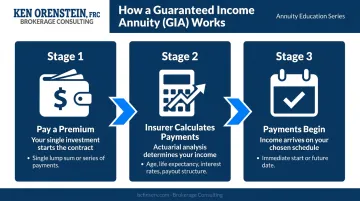
Your monthly payment amount is the insurer's way of spreading your premium across your expected remaining lifetime, plus a return based on interest.
Why Age at Purchase Matters
The older you are when payments begin, the higher your monthly payment — because your statistical life expectancy is shorter, and the insurer anticipates making fewer payments. That leads some people to assume waiting is always the smarter move. It usually isn't — every month you delay is a month of payments you forfeit, and the slight increase in future payment size rarely offsets what you missed.
As a benchmark: the CANNEX PAY Index (April 2026) reported that $100,000 into an immediate income annuity generates approximately $617/month at a 7.41% implied yield — though actual quotes vary by age, sex, payout structure, and carrier.
Payment Structure Options
GIA holders typically choose from:
- Payment frequency — monthly, quarterly, semi-annual, or annual
- Coverage type — single-life or joint-life (critical for married couples protecting a surviving spouse)
- Guaranteed period — payments continue to beneficiaries if you die within the guaranteed term
- COLA rider — payments increase 1–5% annually to offset inflation; starting payments will be lower, but income grows substantially over a 20–30 year retirement
Tax Treatment
How you structure payments also affects what you owe at tax time — and the rules differ significantly depending on how the annuity was funded:
| Funding Source | Tax Treatment |
|---|---|
| Pre-tax dollars (IRA, 401k) | Payments fully taxable as ordinary income |
| After-tax dollars (non-qualified) | Only the earnings portion is taxed; the rest is return of premium |
IRS Publication 575 governs qualified annuity taxation; Publication 939 covers the exclusion ratio calculation for non-qualified contracts. Always consult a tax advisor before purchasing.
Types of Guaranteed Income Annuities
Single Premium Immediate Annuity (SPIA)
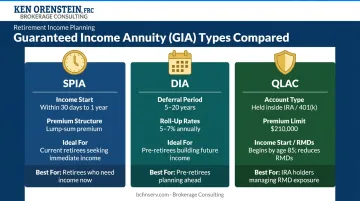
A SPIA is the most straightforward GIA. You make one lump-sum payment and income begins — typically within 30 days, always within one year.
SPIAs suit retirees who need income to start now — common candidates include 401(k) rollover recipients, pension buyout recipients, and federal retirees supplementing an existing pension.
Brokerage Consulting structures SPIAs with multiple payout options: period-certain (10 or 20 years), joint-life with survivor percentages typically ranging from 50% to 100%, cash refund features, and inflation-adjusted COLA riders.
Deferred Income Annuity (DIA)
With a DIA, you pay premium today but delay income to a future date — often 5, 10, or 20 years out. The longer the deferral, the higher the eventual payment.
DIAs work well for pre-retirees who want to lock in future income security today, particularly those targeting a specific activation age or retirement milestone.
Roll-up rates on DIA income riders commonly range from 5% to 7% (simple or compound). A 55-year-old locking in a DIA today, for example, can build a significantly larger income base by age 65 than someone who waits until 62 — the deferral window does the heavy lifting.
Qualified Longevity Annuity Contract (QLAC)
A QLAC is a specialized DIA held inside a qualified retirement account (IRA or 401k). Its defining feature: the premium used to fund the QLAC is excluded from Required Minimum Distribution (RMD) calculations — up to the IRS limit.
Key QLAC facts for 2026:
- Premium limit: $210,000 (per IRS Notice 2025-67)
- Latest income start date: Age 85
- RMD benefit: Excluded balance reduces taxable RMDs in early retirement years
Ken Orenstein actively works with QLAC placement inside IRAs and qualified plans, positioning them to cover late-retirement income from ages 80–85 — the period when other assets may be depleted and longevity risk is highest.
Variable Annuity with Guaranteed Lifetime Withdrawal Benefit (GLWB)
Unlike the pure income vehicles above, this hybrid type invests premiums in market-linked subaccounts for growth potential while a GLWB rider guarantees a minimum income floor regardless of investment performance.
Key caveats:
- More complex than pure GIAs
- Rider fees typically run 1.0–1.5% annually on the income base, with total all-in VA costs sometimes exceeding 3% per year
- Income is drawn from a notional benefit base, not your actual account value
Given those costs, Ken Orenstein evaluates GLWB riders alongside Guaranteed Minimum Income Benefit (GMIB) and Guaranteed Minimum Accumulation Benefit (GMAB) riders — assessing whether the income floor justifies the expense, or whether a Fixed Indexed Annuity would deliver better value for the same goal.
Benefits and Risks of a GIA
Key Benefits
Lifelong income security. A GIA is one of the only financial products that contractually guarantees you won't outlive your income. According to SSA actuarial data, a 65-year-old man has a life expectancy of roughly 17 more years; a woman, about 20 more. Many people live significantly longer. A GIA pays regardless of how long you live.
Market independence. GIA payments don't drop when the S&P 500 drops. That stability makes GIAs a reliable income floor in a retirement portfolio that also includes Social Security, TSP withdrawals, and investment accounts.
Zero ongoing management. Once set up, a GIA requires no rebalancing, no market monitoring, and no ongoing decisions. For retirees who want predictable income without active portfolio management, that's a meaningful advantage.
Those benefits come with real tradeoffs, though. Here's what to weigh before committing.
Limitations to Consider
Illiquidity. Once you fund most GIAs — especially SPIAs — that lump sum is committed. You can't withdraw it in an emergency. Keep separate liquid savings (typically 6–12 months of expenses) before allocating funds to a GIA.
Inflation erosion. A fixed $2,000/month payment will buy less in 15 years. A COLA rider addresses this, but starting income will be lower. Weigh the tradeoff based on your timeline.
Insurer credit risk. The guarantee is only as strong as the company behind it. State guaranty associations provide a backstop — NOLHGA-member associations provide $250,000 or more in annuity benefits per person, per company — but this is not a substitute for choosing a financially strong insurer. In 2024, AM Best reported five U.S. life/health insurer impairments industry-wide, down from ten in 2023 — a low but non-zero risk worth managing through proper carrier screening.
Is a GIA Right for You?
The Income Gap Framework
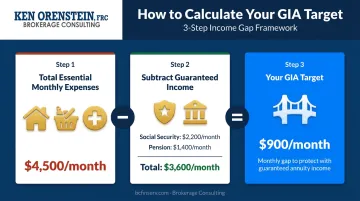
Start with a simple calculation:
- Add up your essential monthly retirement expenses — housing, food, healthcare, utilities
- Subtract your guaranteed income — Social Security plus any pension
- If a gap remains, that's your potential GIA target
Example: Essential expenses of $4,500/month minus Social Security of $2,200/month and FERS pension of $1,400/month leaves a $900/month gap. A GIA funded to cover that amount turns an uncertain shortfall into a guaranteed paycheck.
Who Is the Best Fit?
GIAs tend to make the most sense for:
- Retirees without a pension who need to build their own income floor
- Those with longer life expectancies or family longevity history
- People uncomfortable managing market risk as their primary income source
- Federal employees who want to supplement FERS and Social Security with a third guaranteed layer
- Anyone receiving a lump sum — 401(k) rollover, pension buyout, inheritance — and needing to convert it to income
Getting Professional Guidance
GIA options vary significantly by insurer, age, interest rate environment, tax situation, and payout structure. What looks like the same product from two carriers can differ sharply in rider terms, surrender schedules, and income payout factors. That complexity makes professional review worth the time before you commit.
Ken Orenstein at Brokerage Consulting specializes in federal retirement planning and guaranteed lifetime income strategies — working with clients to map out the full income architecture (Social Security + FERS + GIA + TSP) and evaluate which annuity type, if any, belongs in the plan. Ken offers no-cost initial consultations by phone, virtually, or in person. You can reach the office at (888) 315-3608 or request a consultation at bcfinserv.com.
Frequently Asked Questions
What is a GIA annuity?
A GIA is an insurance contract where you pay a premium to an insurance company and receive regular income payments in return, either for a set period or for life. It converts savings into a predictable, guaranteed paycheck.
How does a guaranteed income annuity differ from a deferred annuity?
A GIA is an income delivery vehicle — its purpose is paying you on a schedule. A deferred annuity is an accumulation vehicle that grows over time, with income access decided later. The design intent is fundamentally different, even when deferred annuities offer GIA-style conversion options.
Can I lose money in a guaranteed income annuity?
GIA payments are not affected by market performance, but the underlying risk is insurer insolvency. This is why checking financial strength ratings (A.M. Best, Moody's, S&P, Fitch) before purchasing is essential. State guaranty associations provide additional protection up to set limits, but are not a substitute for insurer quality.
What happens to my GIA when I die?
It depends on the structure. With a life-only payout, payments stop at death. With a guaranteed period or cash refund option, remaining payments or unused premium pass to named beneficiaries. Joint-life contracts continue payments to a surviving spouse.
Are GIA payments taxable?
Qualified GIAs (funded with pre-tax IRA or 401(k) dollars) are fully taxable as ordinary income. Non-qualified GIAs tax only the earnings portion; the rest is treated as a return of premium. Consult a tax advisor before purchasing.
Who is a guaranteed income annuity best suited for?
GIAs work best for retirees and near-retirees who want predictable income, lack a pension, worry about outliving their savings, or want a guaranteed floor to complement Social Security. Federal employees are a natural fit as well — FERS and Social Security cover the baseline, but a GIA can fill the gap left by TSP market exposure and unpredictable withdrawal timing.