This guide covers what the conversion involves, how lump sum values are calculated, how the rollover process works, what factors shape your outcome, and when conversion may not be the right move.
Key Takeaways
- Converting a lump sum to an annuity turns a one-time payment into guaranteed lifetime income by transferring funds to an insurance carrier
- A direct rollover is the cleanest path—it avoids triggering taxes at the time of transfer
- IRS-mandated interest rates and mortality tables drive the actuarial calculations that set lump sum values
- The right annuity type depends on when income is needed, your tax situation, and survivor planning priorities
- Conversion isn't always the right call: liquidity needs, a shorter expected lifespan, or existing guaranteed income can make alternatives the better fit
Why Convert a Lump Sum to an Annuity?
The Longevity Problem
Outliving your savings is the central retirement risk—and most people underestimate it. According to the Society of Actuaries, 43% of retirees underestimate their own life expectancy by at least five years. Per SSA data, a 65-year-old man can expect to live to roughly 84; a woman to 87. Those are averages—half of retirees live longer.
That math matters. EBRI research found that 40–43% of middle- and high-asset retirees had less than half their starting assets remaining by years 21–22 of retirement. Among those with guaranteed income streams, 54% preserved more assets later in retirement.
A guaranteed annuity solves this problem at its source: payments continue regardless of how long you live, shifting longevity risk to the insurance carrier instead of your portfolio.
Predictability and Tax Deferral
Beyond longevity protection, annuities offer two practical advantages:
- Predictable income — A monthly annuity payment works like a retirement paycheck. It eliminates investment management decisions in later years and removes exposure to poor market timing — a real risk when you're drawing down rather than accumulating.
- Tax-deferred growth — Rolling a lump sum directly into a qualified annuity defers taxation entirely. Taking the cash instead triggers immediate income tax and potentially a 10% early withdrawal penalty for those under 59½.
Why This Matters Specifically for Federal Employees
FERS employees often face a multi-layered distribution decision at retirement: TSP balances, unused annual leave payouts, and pension income all arrive around the same time. Converting TSP distributions strategically can complement the FERS basic annuity and support optimal Social Security timing.
Ken Orenstein of Brokerage Consulting works with FERS employees on this type of multi-source income coordination — mapping TSP distributions, pension income, and Social Security timing into a single tax-efficient plan, comparing options across multiple carriers rather than defaulting to one product.
How the Lump Sum to Annuity Conversion Works
How Lump Sum Values Are Calculated
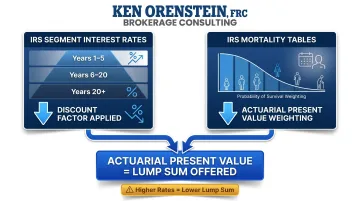
The lump sum value of a pension or retirement benefit isn't arbitrary. Actuaries calculate an actuarial present value using two inputs:
- IRS segment interest rates — Each future monthly payment is discounted back to today's dollars using three segment rates published monthly by the IRS under IRC Section 417(e)(3)(D): the first-segment rate for payments within the first 5 years, the second-segment rate for years 6–20, and the third-segment rate beyond year 20.
- IRS mortality tables — Each payment is weighted by the statistical probability the retiree will be alive to receive it.
The lump sum equals the sum of all these discounted, probability-weighted payments. This is why higher interest rates produce lower lump sums—a higher discount rate reduces the present value of each future payment.
Two Conversion Pathways
| Method | What Happens | Tax Result |
|---|---|---|
| Direct rollover | Funds transfer plan-to-carrier; you never touch the money | No taxes due at transfer; full tax-deferred status preserved |
| Cash distribution | Plan withholds 20% for federal taxes; you receive the net amount | Full distribution becomes taxable income; 10% penalty if under 59½ |
Always elect the direct rollover. The 20% withholding on a cash distribution is mandatory. Even if you plan to roll over the funds within 60 days, you must deposit the full pre-withholding amount — you'll need to replace the withheld 20% from other funds out of pocket. Miss that threshold and the entire distribution becomes taxable income.
Step 1: Confirm Lump Sum Eligibility, Value, and Deadlines
Contact your plan administrator and request the official election kit. It will include:
- The lump sum estimate and the interest rate and mortality assumptions used to calculate it
- Your election deadline and required forms
- Notarization requirements if you're married
One critical detail: pension lump sum values change month to month as IRS segment rates fluctuate. A rate shift of even half a percentage point can meaningfully change your offer — so timing your election matters as much as making it.
Step 2: Select the Right Annuity Type and Structure
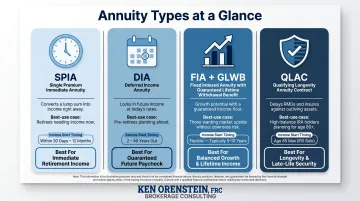
Match the annuity type to your income timeline:
- SPIA (Single Premium Immediate Annuity) — Income starts within 12 months. Best for those who need a paycheck now.
- DIA (Deferred Income Annuity) — Locks in future income at a later date. Best for early retirees who don't need income immediately.
- FIA with GLWB rider — Growth potential with guaranteed lifetime income. Best for those 5–10 years from needing income who want principal protection alongside upside.
- QLAC — A DIA purchased within an IRA that's excluded from RMD calculations. Useful for managing RMD exposure in later years.
Always compare multiple carriers before committing. Payout rates, rider costs, and contract terms vary enough between insurers that skipping this step is one of the most common — and costly — mistakes retirees make.
Step 3: Execute the Rollover and Confirm the Contract
Once you've selected a carrier and product, coordinate the paperwork carefully. The annuity carrier's rollover instructions must be included with your pension election forms so the plan sends funds directly to the carrier, not to you. Once funded, confirm:
- Contract issue date and income start date or deferral period
- Beneficiary designations
- Any liquidity provisions (most contracts allow penalty-free withdrawals of 10% annually)
Key Factors That Affect Your Conversion Outcome
Age and Break-Even Analysis
The break-even point is when cumulative annuity payments equal the original lump sum. For most SPIA structures, this typically falls 10–20 years after the annuity start date. Given that a 65-year-old has 17–21 years of average remaining life expectancy (SSA data), healthy retirees have a statistically meaningful probability of reaching break-even—and surpassing it.
Those with serious health conditions or a family history of shorter lifespans face a different calculus. A useful starting point: ask your advisor to model break-even against your actual health profile and family history, not just average life expectancy tables.
Interest Rate Environment
Annuity payout rates move directly with interest rates. Higher rates mean more monthly income for the same lump sum. U.S. annuity sales reached $464.1 billion in 2025—a record—driven in part by the higher rate environment improving payout rates on income products.
One practical nuance for pension holders: the same rising rates that increase annuity payouts often decrease pension lump sum values (because the discount rate is higher). The result: a smaller lump sum that may still convert into better monthly income than what was available two years prior. Understanding this tradeoff is central to timing a pension buyout decision well.
Tax Bracket and Income Stacking
Interest rates affect what you receive; taxes affect what you keep. When annuity income starts, it layers on top of Social Security, required minimum distributions, and any pension income — and this stacking effect can push retirees into higher brackets unexpectedly.
Strategic tools to manage this:
- Defer up to $200,000 of IRA assets using a QLAC, removing that balance from RMD calculations until as late as age 85 (indexed for inflation under SECURE 2.0)
- Use a DIA to activate income at a future date, spreading distributions across lower-income years rather than concentrating them
- Execute Roth conversions during the gap between retirement and Social Security claiming, filling lower brackets before other income sources kick in
- Layer these strategies in sequence to manage your effective tax rate across each phase of retirement
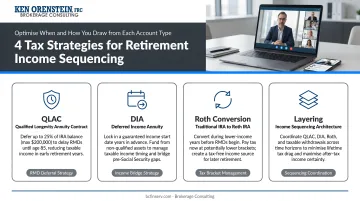
Ken Orenstein's practice incorporates QLAC and DIA strategies as part of tax-efficient retirement income sequencing for federal retirees managing FERS pension, Social Security, and TSP distributions simultaneously.
Carrier Financial Strength
Annuity guarantees are only as strong as the carrier backing them. Before committing, evaluate:
- Ratings from A.M. Best, S&P, Moody's, and Fitch
- State guaranty association coverage — most states protect up to $250,000 per insurer per policyholder
For large conversions, splitting across two highly rated carriers can keep each contract within guaranty association limits. As an independent broker, Ken Orenstein reviews carrier financial strength ratings across all four major agencies as a standard part of every annuity recommendation.
Common Misconceptions and Mistakes
"You lose everything when you die." Not accurate for most contracts. Many annuities include period-certain guarantees (income for at least 10 or 20 years regardless of death), cash refund riders that return unpaid premium to beneficiaries, and joint-and-survivor options that continue payments to a spouse. The "forfeit at death" concern applies only to bare-bones structures with no death benefit features.
Treating all annuities as interchangeable. SPIAs, DIAs, FIAs, variable annuities, and QLACs have fundamentally different cost structures, income mechanics, and risk profiles. A high-fee variable annuity (which can carry all-in costs exceeding 3% annually) is a completely different product from a low-cost income-focused fixed or fixed indexed annuity.
Accepting the first quote without comparing across carriers and product types is a common error with real financial consequences.
Product selection isn't the only place errors occur. Procedural mistakes during the transfer itself can be just as costly.
Taking the rollover check payable to yourself. The tax trap here is mechanical: the plan must withhold 20% when a distribution is made payable to you. Even if you intend to complete a 60-day rollover, you'd need to replace that withheld 20% from other funds to roll over the full pre-withholding amount. Three consequences follow if you miss that window:
- The entire distribution becomes taxable income for that year
- A 10% early withdrawal penalty may apply
- You lose the tax-deferred compounding on the withheld amount permanently
When Lump Sum to Annuity Conversion May Not Be Right
Annuity conversion isn't the right move for everyone. Before committing, consider whether any of these three situations apply to you.
Your guaranteed income already covers the essentials. If Social Security, a FERS pension, or other sources fully fund your fixed living costs, converting additional savings to an annuity may sacrifice liquidity with little added security. Ken Orenstein's income planning framework uses a "flooring" approach — only convert enough to cover the gap between guaranteed income and essential expenses.
Health, liquidity, or estate goals take priority. Those facing large upcoming healthcare costs, significant debt, or a serious chronic illness may not reach the annuity break-even point. If your primary goal is maximizing what you pass to heirs, estate planning vehicles typically serve that purpose better than annuitization.
You're being pushed to decide quickly. Employer buyout windows, high-pressure sales environments, and single-carrier product offerings are all warning signs. Working with an independent advisor who compares multiple carriers helps protect against a rushed or misaligned decision.
Frequently Asked Questions
Can I roll my lump sum pension into an annuity?
Yes. Most qualified pension lump sum distributions can be rolled into a qualified IRA annuity via direct rollover without triggering taxes at transfer. The pension plan must allow a lump sum election, and the funds must go directly from the plan to the annuity carrier to preserve tax-deferred status.
Can I take 100% of my pension as a lump sum?
Many defined benefit and cash balance plans allow a full lump sum election, but some restrict it based on benefit value or limit elections to specific windows — it depends on the plan document. For PBGC-trusteed plans terminating in 2024 or later, lump sums are only automatically available for benefits valued at $7,000 or less.
Is it better to get a lump sum or annuity from a pension?
Neither is universally better. The right choice depends on health, life expectancy, existing income sources, tax situation, and survivor planning needs. An annuity provides lifetime income security; a lump sum offers flexibility but transfers all longevity and investment risk to the individual.
How can I minimize taxes on a lump-sum pension payout?
Execute a direct rollover into a qualified IRA or annuity, which defers all taxes. If partial Roth conversion is part of the strategy, spreading conversions across multiple lower-income years reduces the overall tax impact compared to converting a large sum all at once.
How is a lump-sum pension value calculated?
It uses actuarial present value: each future monthly payment is discounted to today's dollars using IRS-mandated segment interest rates, then weighted by the statistical probability the retiree will be alive to receive it. The sum of all discounted, probability-adjusted payments equals the lump sum offered.
Do variable annuities get a step-up in basis at death?
No. Variable annuities do not receive a stepped-up cost basis at death the way stocks or real estate do. Gains pass to beneficiaries as ordinary income — classified as income in respect of a decedent (IRD) — making this a key factor in estate and beneficiary planning.
For federal employees evaluating TSP distributions or pension lump sum decisions, Ken Orenstein at Brokerage Consulting offers no-cost initial consultations by phone, virtually, or in person at the Flemington, NJ office. Reach his office at (888) 315-3608 or visit bcfinserv.com to request a consultation.