
But these products are among the most complex in the financial services landscape. The mechanics that make them valuable are also the mechanics that most buyers misunderstand — sometimes at significant cost. This article breaks down how GLWB riders actually work, what the guarantee covers, how income amounts are calculated, what these products cost, and which clients are genuinely well-suited for them.
Key Takeaways
- A deferred variable annuity has two phases: tax-deferred accumulation and guaranteed-income distribution
- The GLWB guarantee is based on a benefit base — a contractual value separate from your actual account balance — used solely to calculate guaranteed income
- Withdrawals continue for life even if your account value drops to zero
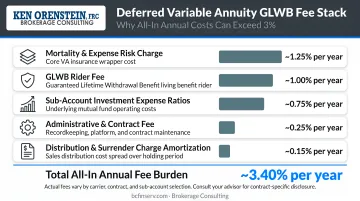
- All-in annual costs can exceed 3%, including M&E charges, rider fees, and subaccount expenses
- Ideal for pre-retirees who want market growth with a protected guaranteed income floor
What Guaranteed Benefits Actually Mean in a Variable Annuity
A deferred variable annuity is a contract between you and an insurance company. During the accumulation phase, your premium is invested in subaccounts — typically stock, bond, and money market funds — and grows tax-deferred. At some point, you enter the distribution phase, where you begin taking withdrawals, either as periodic income or a lump sum.
Where things get nuanced is with the GLWB rider — an optional add-on that guarantees a minimum income stream regardless of how the underlying investments perform. The word "guarantee" matters here: it applies to the income stream, not to your account balance. Confusing the two leads to real financial miscalculations at the moment you need income most.
Two Values That Drive Everything
Every GLWB contract operates around two distinct numbers:
- Cash value (account value): The actual market value of your subaccounts. It rises and falls with investment performance, and it's what you receive if you surrender the contract.
- Benefit base: A contractually defined number used only to calculate your guaranteed withdrawal amount and rider fees. As SEC filings for Protective Life's SecurePay rider explicitly state, the benefit base is not cash value, surrender value, death benefit, or a minimum return — it exists purely as a calculation tool.
These two values often diverge significantly, especially after market downturns. If your cash value drops to $60,000 while your benefit base stands at $140,000, you cannot withdraw or surrender that $140,000 — it only determines how large your guaranteed income payments will be.
How the Benefit Base Grows
Understanding how the benefit base accumulates makes the cash value distinction concrete. At contract inception, the benefit base typically equals your initial premium. It then grows via whichever of two methods produces the higher value on each contract anniversary:
- Roll-up rate: A guaranteed annual percentage increase applied during the deferral period. Protective Life's SecurePay Advantage, for example, increases the benefit base by up to 5.0% per contract anniversary during its roll-up period.
- Step-up to high-watermark: If your subaccount investments outperform the roll-up rate, the benefit base "ratchets" up to the higher cash value, locking in that gain permanently.
Numeric example — 7-year deferral with 5% roll-up:
| Year | Benefit Base (5% Roll-Up) |
|---|---|
| 0 (premium) | $100,000 |
| 1 | $105,000 |
| 2 | $110,250 |
| 3 | $115,763 |
| 4 | $121,551 |
| 5 | $127,628 |
| 6 | $134,010 |
| 7 | $140,710 |
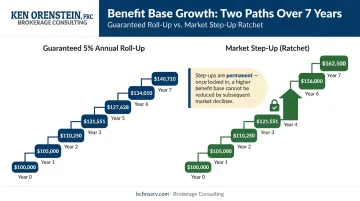
If markets performed well and your cash value exceeded these figures on any anniversary, the benefit base would step up to that higher number instead — permanently increasing your future guaranteed income.
Key Mechanics: How the GLWB Rider Works
Accumulation Phase: Strong vs. Weak Markets
The benefit base behaves differently depending on market conditions, and understanding this contrast is essential.
Strong market scenario: Your subaccounts grow faster than the roll-up rate. On each contract anniversary, the benefit base ratchets up to the cash value. These step-ups are permanent; a market decline after a step-up cannot pull the benefit base back down.
Weak market scenario: Your subaccounts underperform or decline. The roll-up rate still applies to the benefit base, so it continues growing at the contractual rate. However, your cash value is falling. The gap between the benefit base and the cash value widens. The insurance guarantee becomes more valuable in this scenario, but your actual account is being depleted faster by fees and poor returns.
Distribution Phase: How Guaranteed Income Is Calculated
When you activate withdrawals, your guaranteed annual withdrawal amount (AWA) is calculated as:
Benefit Base × Withdrawal Rate Percentage = Annual Guaranteed Withdrawal
The withdrawal rate percentage is age-banded and set at the time distributions begin. Using Protective Life's SecurePay Advantage as a reference point:
| Age at Activation | Single Life Rate | Joint Life Rate |
|---|---|---|
| 59½–74 | 5.0% | 4.5% |
| 75+ | 6.0% | 5.5% |
So if your benefit base is $140,710 (from the example above) and you begin withdrawals at age 68, your annual guaranteed amount would be $7,036 — paid for life, even if your account value eventually drops to zero.
The Longevity Protection Mechanism
Once distributions begin, you draw from your cash value. If poor markets and ongoing fees deplete the cash value to zero, the insurance company steps in and continues paying your guaranteed annual amount from its own reserves, for the rest of your life. This is the core insurance function the rider provides.
Critical exception: If the account value reaches zero due to an excess withdrawal (taking more than your AWA in any contract year), the rider terminates. No further benefits are paid. This is one of the most consequential contract terms and one of the least understood.
The Excess Withdrawal Rule
Taking more than your AWA in any contract year sets off a chain of permanent consequences:
- Benefit base reduction: The base is cut proportionally to how far you exceeded the limit, not as a flat dollar subtraction.
- Lower future income: Every guaranteed payment going forward is permanently reduced, because it's calculated from that smaller base.
- Rider termination: If the account value reaches zero as a direct result of an excess withdrawal, the guarantee ends entirely. No further payments.
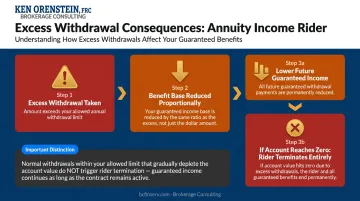
The distinction matters: a depleted account from normal withdrawals keeps the guarantee intact. A depleted account from excess withdrawals ends it.
Factors That Shape the Guaranteed Income Amount
The dollar amount you'll receive isn't fixed at purchase — several variables determine your eventual guaranteed income:
Age at activation directly affects your withdrawal rate percentage. Waiting from 65 to 72 before activating distributions can noticeably raise your annual guaranteed income — the rate percentage steps up and the benefit base has had more time to compound.
Deferral period length compounds the benefit base through the roll-up rate over time. Some contracts also increase the withdrawal rate percentage itself for each year you wait. Protective's pre-2009 SecurePay riders, for example, moved single-life rates from 5.0% to 6.0% when the Benefit Election Date was 10 or more years after the rider effective date. If income isn't immediately needed, deferring has a direct financial payoff.
Market performance and step-ups interact through the ratchet mechanism: strong subaccount gains lock in permanent benefit base increases, which translate directly into higher guaranteed income. Poor performance doesn't reduce the benefit base, but cash value depletes faster once withdrawals begin — accelerating the timeline to when you're living entirely off the insurance guarantee.
Fee drag works against cash value continuously — M&E charges, rider fees, administrative fees, and subaccount expense ratios all apply regardless of market performance.
In a prolonged down market, that drag can deplete the cash value toward zero faster than expected. That's exactly when the guarantee becomes most valuable, but it also means you're depending on the insurance company's claims-paying ability sooner than projected.
Costs, Limits, and Common Misconceptions
The Full Fee Stack
Deferred variable annuities with GLWB riders carry multiple layers of costs. According to the SEC's guide to variable annuities, the typical components include:
- Mortality & Expense (M&E) charge: ~1.25% annually
- Administrative fees: ~$25–$30/year or ~0.15% annually
- GLWB rider fee: Varies by product; Protective Life's SecurePay rider ranges from 0.50%–1.00% currently, with maximums of 0.95%–1.60%
- Subaccount expense ratios: Additional underlying fund costs
When combined, all-in costs can exceed 3% annually. Ken Orenstein at Brokerage Consulting uses that threshold as a benchmark when evaluating whether an income guarantee justifies the fee load for a given client.
The Most Critical Misconception
Many buyers believe the guaranteed benefit protects their principal or account balance. It does not. The GLWB guarantee protects the income stream only. If you surrender the contract, you receive the cash value — which may be significantly below the benefit base, especially after a prolonged market decline. There is no lump-sum access to the benefit base figure.
Two Additional Limits Worth Understanding
- Surrender charges typically last 6–8 years, sometimes up to 10. The SEC cites a common structure: 7% in year one, declining 1 percentage point annually until it reaches zero — making these fundamentally long-term commitments.
- Inflation risk is real: a fixed $7,000 annual payment buys less in year 20 than year one. Some contracts offer inflation-adjustment features, though they usually come with lower initial payouts or added cost.
Who Should Consider a Deferred Variable Annuity with a GLWB Rider
Profiles Where It Makes Sense
LIMRA data shows the average guaranteed living benefit buyer is 62.5 years old, with a majority seeking guaranteed lifetime income to supplement pensions or Social Security. A GLWB rider tends to fit clients who:
- Are within 5–15 years of retirement and want continued market exposure
- Have a meaningful gap between anticipated Social Security or pension income and living expenses
- Have sufficient assets — Brokerage Consulting's typical minimum for annuity placement is $250,000 deployable
- Can commit to a long time horizon that justifies the fee structure
- Already have a base layer of guaranteed income and want supplemental market-linked growth
For federal employees with FERS or CSRS pensions, that pension already provides a defined income base. A GLWB rider can function as a complement — filling remaining income gaps while preserving some market upside — rather than serving as the primary retirement income source.
Profiles Where It's a Poor Fit
A GLWB rider is likely inappropriate for:
- Investors with very long time horizons who can ride out market cycles without an income floor
- Anyone who may need to access their full account value before the surrender period ends
- Retirees placing the annuity inside an existing IRA, where the tax-deferral benefit is redundant — FINRA notes this specifically as a suitability concern
- Clients whose total fee load would require exceptional market performance just to break even
These products involve enough moving parts — benefit base mechanics, withdrawal rate tiers, step-up provisions, fee structures, surrender schedules — that no two contracts compare cleanly on the surface. A side-by-side review of specific contract terms is the only reliable way to evaluate fit.
Ken Orenstein at Brokerage Consulting works with multiple carriers to assess whether a deferred variable annuity with guaranteed benefits belongs in a client's retirement income plan.
Frequently Asked Questions
What is the difference between the benefit base and the account value?
The benefit base is a contractual number used only to calculate guaranteed withdrawals — it grows via roll-up rates or step-ups and does not represent accessible cash. The account value reflects actual subaccount market performance and is what you receive if you surrender the contract.
Can I lose money in a deferred variable annuity with a GLWB rider?
Yes. The cash value can decline due to poor subaccount performance and ongoing fees. Surrendering the contract early returns the market value, which may be well below the benefit base. The GLWB protects only the income stream, not the account balance.
What happens to my guaranteed income if the account value drops to zero?
That's the rider's core purpose. Once the account value is exhausted through normal withdrawals or fees, the insurance company continues paying your guaranteed annual amount for life, based on its claims-paying ability. Note that excess withdrawals — beyond the guaranteed limit — can void this protection.
How are withdrawals from a deferred variable annuity taxed?
Earnings withdrawn from a nonqualified annuity are taxed as ordinary income on a last-in, first-out basis — not at capital gains rates. Per IRS Publication 575, withdrawals before age 59½ also incur a 10% early withdrawal penalty on the taxable portion.
Are deferred variable annuities with GLWB riders a good fit for federal employees?
Federal employees with FERS or CSRS pensions already have a defined income base, which may make a GLWB rider useful for filling remaining income gaps. Whether it fits depends on the individual's full retirement picture — pension amount, Social Security timing, TSP strategy, and risk tolerance — and should be evaluated alongside all existing federal benefits.
What fees should I expect with a deferred variable annuity GLWB rider?
Expect multiple layers: an M&E charge (~1.25%), a GLWB rider fee (0.50%–1.60%), administrative fees, and subaccount expense ratios — combined costs often exceed 3% annually. Always request a complete fee disclosure schedule before purchasing, since total cost load directly affects how long your account value lasts.