
The short answer: no, non-qualified annuity premiums are not tax deductible. Because you fund them with money you've already paid income tax on, the IRS treats those dollars as after-tax contributions — not as a deductible expense.
That said, non-qualified annuities do offer a meaningful tax advantage, just not at the front end. This article explains what a non-qualified annuity is, why premiums aren't deductible, what tax benefits you do get, and exactly how withdrawals are taxed when you eventually take money out.
Key Takeaways
- Non-qualified annuity premiums are paid with after-tax dollars, so no IRS deduction is available.
- Earnings grow tax-deferred inside the contract until withdrawal.
- On withdrawal, only the earnings portion is taxable as ordinary income; your original premium comes back tax-free.
- Partial withdrawals follow a LIFO (earnings-first) rule, meaning gains come out before your principal does.
- Early withdrawals before age 59½ trigger a 10% IRS penalty on the taxable (earnings) portion.
What Is a Non-Qualified Annuity?
A non-qualified annuity is a contract purchased with after-tax money, outside of any qualified retirement plan such as a traditional IRA or 401(k). The word "non-qualified" is a tax-law classification — it refers to how the annuity is funded, not the quality of the product itself.
Under IRC Section 72, which governs annuity income, basis recovery, and withdrawal rules, non-qualified status means the contract sits outside tax-qualified arrangements like Section 401(a), 403(b), or 408 plans.
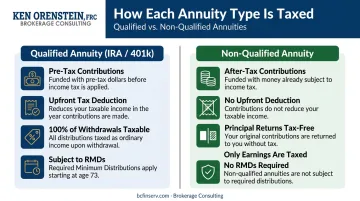
A qualified annuity, by contrast, lives inside a traditional IRA, 401(k), or similar plan and is funded with pre-tax dollars. Because those contributions were never taxed, 100% of withdrawals are taxable as ordinary income. Non-qualified annuities work the other way: you pay tax on contributions upfront, so your principal comes back to you tax-free later.
Key Features of Non-Qualified Annuities
Three features distinguish non-qualified annuities from both qualified plans and standard investment accounts:
- Funded with after-tax dollars, which establishes your "cost basis" or "investment in the contract"
- No annual IRS contribution limits — unlike IRAs (capped at $7,000 in 2024) or 401(k)s, you can deposit as much as the carrier allows
- No required minimum distributions (RMDs) during the owner's lifetime, giving you full control over when you draw income
Are Non-Qualified Annuity Premiums Tax Deductible?
No. Premiums paid into a non-qualified annuity are never tax deductible.
The IRS does not grant a deduction because the money was already taxed when you earned it. Under IRC Section 72(c)(1), those premiums become your investment in the contract — the cost basis you'll eventually recover tax-free on withdrawal. IRS Topic 410 confirms this directly: after-tax amounts paid into a pension or annuity are returned to you tax-free; you only pay tax on the earnings portion.
How This Differs from Pre-Tax Retirement Accounts
With a traditional IRA or 401(k), contributions reduce your taxable income in the year you make them. Put in $7,000 and your taxable income drops by $7,000. Non-qualified annuities offer no such benefit — contributions have zero impact on your current-year tax bill.
A Common Point of Confusion: State Premium Taxes
Some states impose a premium tax on annuity contracts — charged to the insurer at purchase or annuitization. This is a state-level insurance tax — it creates no federal deduction for you as the buyer. The two are entirely separate.
What You Get Instead
With state premium taxes off the table, the real story is how your after-tax contributions are treated at withdrawal. The tradeoff for no upfront deduction is straightforward:
- Your principal is never taxed again — cost basis returns to you free of federal income tax
- Only the growth is taxable income when you take distributions
- The exclusion ratio determines what portion of each payment is tax-free vs. taxable during annuitization
This structure rewards patience. The longer your money grows tax-deferred, the more favorably that split works in your favor at withdrawal.
The Tax Advantage Non-Qualified Annuities Do Offer: Tax-Deferred Growth
While premiums aren't deductible, the earnings inside a non-qualified annuity — interest, dividends, or investment gains — are not taxed in the year they're earned. They compound without any annual tax drag. That's the real tax advantage.
As SEC Investor.gov explains, variable annuities are tax-deferred: no federal taxes on income and gains until withdrawal, income payments, or death benefit payment. The same deferral principle applies to fixed and fixed indexed annuities held in a non-qualified structure.
What "Tax-Deferred" Actually Means
Tax-deferred is not the same as tax-free. When you eventually withdraw earnings, they're taxed as ordinary income (not at the lower long-term capital gains rates that apply to stocks held in a taxable brokerage account). That distinction matters most when comparing annuities against other long-term investment vehicles.
The real benefit of deferral comes down to timing. Money that would otherwise go to taxes each year stays in the contract, earning returns on a larger base. Over a 20- or 30-year accumulation period, that compounding effect can be substantial.
The advantage is most pronounced for investors in higher tax brackets during accumulation who expect lower rates in retirement — which makes bracket planning an essential part of evaluating this structure.
Who Benefits Most from This Structure
For investors already navigating that bracket calculus, non-qualified annuities offer a practical next step. They're particularly useful for people who have maxed out their IRA and 401(k) contributions and want additional tax-deferred accumulation. Because there are no IRS annual contribution limits on non-qualified contracts, they can accept deposits far exceeding what qualified plans allow.
At Brokerage Consulting, Ken Orenstein regularly works through this decision with clients — determining whether a non-qualified annuity fits as a complement to existing qualified retirement savings, rather than a replacement for them.
How Non-Qualified Annuity Withdrawals Are Taxed
The core rule is simple: only the earnings portion of each withdrawal is taxable. Your original after-tax premium (cost basis) comes back to you tax-free, because you already paid income tax on it.
How that plays out in practice depends on whether you're taking partial withdrawals, annuitizing, or surrendering the contract outright.
Partial Withdrawals: The LIFO Rule
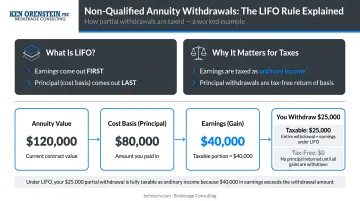
For partial withdrawals from a deferred non-qualified annuity, the IRS applies a Last In, First Out (LIFO) rule under IRC Section 72(e). Earnings are distributed first, before any principal.
This means early or partial withdrawals tend to be more heavily taxed — you're pulling out the growth portion first, and it's all ordinary income. Principal only starts coming back after all accumulated earnings have been distributed.
Example: You invest $100,000 in a non-qualified annuity that grows to $160,000. Your $60,000 of earnings represents the taxable portion. If you take a partial withdrawal of $20,000, the entire $20,000 is likely taxable under the LIFO rule — you haven't reached your principal yet.
Annuitized Payments: The Exclusion Ratio
If you convert the annuity to a stream of income payments (annuitize it), the LIFO rule no longer applies. Instead, the IRS uses the exclusion ratio under IRC Section 72(b):
Exclusion Ratio = Cost Basis ÷ Total Expected Return
This fraction determines what portion of each payment is a tax-free return of principal versus taxable earnings. Once your full cost basis has been recovered, all remaining payments become fully taxable.
Example: $100,000 cost basis with a $200,000 total expected return produces a 50% exclusion ratio. Half of each payment is tax-free, and half is taxable ordinary income — until the principal is fully recovered.
Full Surrenders
Unlike partial withdrawals or annuitization, a full surrender taxes the entire gain — cash value minus cost basis — as ordinary income in the year you exit the contract.
Concentrating that gain in a single year can push you into a higher bracket. In many cases, annuitization or systematic withdrawals are more tax-efficient than a lump-sum exit. A retirement advisor familiar with annuity tax treatment can help you map the most cost-effective withdrawal path for your situation.
Early Withdrawal Penalties and Other Tax Rules
The 10% Early Withdrawal Penalty
Under IRC Section 72(q)(1), withdrawals taken before age 59½ are subject to a 10% additional tax on the portion includible in gross income — meaning the taxable earnings, not your after-tax principal. This mirrors the penalty structure on qualified accounts, with one important distinction: in a non-qualified annuity, your cost basis is never penalized.
Exceptions to the 10% Penalty
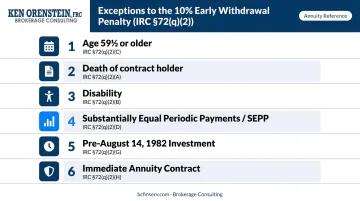
IRC Section 72(q)(2) lists several situations where the penalty does not apply:
- Distributions made on or after age 59½
- Distributions made after the death of the holder
- Distributions attributable to disability under Section 72(m)(7)
- Payments under a series of substantially equal periodic payments (SEPP / 72(t)) made at least annually over life or life expectancy
- Amounts allocable to investment in the contract before August 14, 1982
- Distributions from an immediate annuity contract (single premium, payments beginning within one year of purchase)
Inherited Non-Qualified Annuities
Non-qualified annuities do not receive a fair-market-value step-up in basis at the owner's death. Under IRC Sections 1014(b)(9) and 1014(c), annuity contracts are excluded from the general step-up rule — whoever inherits the contract owes ordinary income tax on those accumulated earnings.
Distribution requirements depend on the beneficiary's relationship to the owner:
- Non-spouse beneficiaries — IRC Section 72(s)(1)(B) requires the full contract to be distributed within five years of the owner's death (when death occurs before the annuity starting date)
- Designated beneficiaries — Section 72(s)(2) allows distributions over life or life expectancy, provided payments begin within one year of death
- Surviving spouses — Section 72(s)(3) permits the spouse to continue the contract as if they were the original owner
Beneficiary designation strategy and annuitization timing can significantly reduce the tax impact on heirs. Ken Orenstein at Brokerage Consulting provides annuity beneficiary analysis and tax-efficient payout structuring as part of the full annuity advisory process. A no-cost consultation is available at bcfinserv.com or by calling (888) 315-3608.
Frequently Asked Questions
Are non-qualified annuity premiums tax deductible?
No. Because they're funded with after-tax dollars, the IRS treats premiums as your cost basis — not a deductible expense. The tradeoff is that your principal is never taxed again when you withdraw it; only the earnings portion is taxable.
How are non-qualified annuity withdrawals taxed?
Only the earnings are taxed, as ordinary income. For partial withdrawals, the LIFO rule applies — earnings come out before principal, so early withdrawals are typically more taxable than later ones. Once annuitization begins, the exclusion ratio determines how much of each payment is tax-free.
What is the 5-year rule for non-qualified annuities?
When a holder dies before the annuity starting date, non-spouse beneficiaries generally must withdraw the entire contract within five years. An exception allows distributions over life or life expectancy if payments begin within one year of the owner's death.
Do non-qualified annuities have required minimum distributions (RMDs)?
No. Unlike traditional IRAs and 401(k)s, non-qualified annuities are not subject to IRS RMDs during the owner's lifetime. This gives the owner full control over withdrawal timing.
What is the exclusion ratio and how does it work?
The exclusion ratio equals your cost basis divided by your total expected return. That percentage of each annuitized payment is returned to you tax-free; the rest is taxable ordinary income. Once the full cost basis is recovered, all subsequent payments are fully taxable.
Can you avoid taxes on a non-qualified annuity entirely?
No — earnings will eventually be taxed as ordinary income. You can, however, defer taxation across the contract's life, spread income through annuitization to avoid large single-year tax hits, and apply the exclusion ratio to reduce your taxable amount each year.