
The honest answer is that "safe" depends on what you're protecting against. A fixed annuity is genuinely well-suited to shield your principal from market swings. It is not, however, immune to every risk. Understanding what's actually protected — and what isn't — is the only way to know whether this product belongs in your retirement plan.
This article covers both sides: the real protections fixed annuities offer and the risks that don't show up in the sales pitch.
Key Takeaways
- Fixed annuities protect your principal from market losses and credit a guaranteed interest rate for the contract term.
- Not FDIC insured — protection comes from state guaranty associations and insurer financial strength ratings.
- Real risks include surrender charges, early withdrawal tax penalties, inflation erosion, and (rarely) insurer insolvency.
- Best suited for conservative, income-focused retirees — but weigh liquidity needs and inflation expectations before signing.
What Makes Fixed Annuities Safe?
The Core Guarantee
A fixed annuity is a contract with an insurance company, not a market-linked investment account. The insurer credits a guaranteed interest rate for the duration of the contract — regardless of how its investment portfolio performs. That structural separation from market performance is the foundation of the fixed annuity's safety case.
Multi-Year Guaranteed Annuities (MYGAs), a specific subtype, lock in a rate for a defined term — typically 3, 5, 7, or 10 years — functioning similarly to a CD but with tax-deferred growth and often better rates than comparable bank products.
State Regulation and Reserve Requirements
Insurance companies operate under strict state-level solvency standards, not federal banking regulation. The NAIC's Risk-Based Capital framework requires insurers to maintain minimum capital levels based on their size and risk profile , a statutory floor that regulators monitor annually. The Standard Valuation Law further requires state commissioners to value reserve liabilities for outstanding annuity contracts each year.
This framework differs from federal banking oversight, but it carries real weight — state regulators treat solvency monitoring as a primary responsibility, not a formality.
State Guaranty Associations
If an insurance company fails, state guaranty associations step in to protect policyholders. According to NOLHGA's 2024–2025 safety-net materials, all member guaranty associations offer $250,000 or more in annuity benefits, with some states providing higher limits. Coverage applies based on the policyholder's state of residence at liquidation.

For most retirees, that coverage level is sufficient — though investors with larger balances may want to spread contracts across multiple carriers to stay within each state's limit.
The FDIC Question, Answered Directly
Fixed annuities are insurance products, not bank deposits , so FDIC insurance doesn't apply. That's a factual category difference, not a gap in protection. The safety mechanism is different: state guaranty funds plus insurer financial strength, in place of federal deposit insurance.
Death Benefit Provisions
Most fixed annuity contracts include a death benefit as part of the standard guarantee structure. Key features typically include:
- Remaining contract value paid to the named beneficiary if the holder dies before recouping principal
- Calculated as original premium plus earned interest, minus any withdrawals or fees
- Relevant for estate planning goals where passing on unspent retirement assets matters
For pre-retirees evaluating fixed annuities, this benefit is worth factoring into the overall risk-versus-safety comparison.
Key Risks of Fixed Annuities You Shouldn't Ignore
Surrender Charges and Limited Liquidity
Most fixed annuities carry a surrender period — commonly 5 to 10 years — during which withdrawing more than the allowed free withdrawal amount triggers a penalty. The NAIC's Buyer's Guide to Fixed Deferred Annuities confirms that surrender charges apply when withdrawals exceed the allowed threshold, and notes that many contracts permit up to 10% of contract value per year without charge.
A typical 10-year MYGA surrender schedule might look like this: 9-8-7-6-5-4-3-2-1-0% — starting at 9% in year one and declining to zero by the final year. Withdraw a large sum in year two and you're paying an 8% penalty on the excess. Anyone who misjudges their liquidity needs will feel that cost directly.
Early Withdrawal Tax Penalty
Surrendering or withdrawing from an annuity before age 59½ doesn't just trigger a surrender charge — it also triggers a 10% federal income tax penalty on the taxable portion, on top of ordinary income taxes owed. Per IRS Publication 575, this additional tax applies unless a qualifying exception exists. The combination of a 9% surrender charge plus a 10% IRS penalty can make early access genuinely expensive.
Inflation Risk
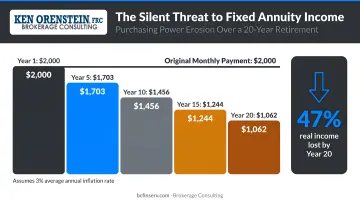
Inflation risk is the one most retirees underestimate. A fixed annuity credits a set rate that doesn't automatically adjust for inflation. BLS CPI data shows that from 2005 to 2025, cumulative inflation ran approximately 64.9% — meaning a fixed dollar payment lost roughly 39% of its purchasing power over 20 years.
Over a long retirement, that erosion is material. Some contracts offer cost-of-living adjustment (COLA) riders — at rates of 1%, 2%, 3%, or CPI-linked adjustments — but they come with a lower starting payment. More long-term protection means less income upfront. Whether that trade-off makes sense depends on your expected retirement timeline and other income sources.
Insurer Insolvency Risk
Insurance companies rarely fail, but it does happen. AM Best's 2026 impairment report noted five U.S. life/health companies became impaired in 2024. In an insolvency, payments can be delayed or partially reduced beyond what the state guaranty association covers.
The primary defense is buying from a financially strong insurer. Four major agencies rate claims-paying capacity:
- AM Best — Scale: A++ (Superior) down to B+ (Good); target A or better
- Moody's — Investment-grade range: Aaa through Baa
- S&P — Investment-grade range: AAA through A
- Fitch — Uses the same AAA-through-A investment-grade framework
None of these ratings are guarantees. An insurer rated A or better by AM Best carries far lower insolvency risk than one rated below investment grade, but no rating eliminates the risk entirely.
No Market Upside
In a period of strong equity performance or rising interest rates, a fixed annuity holder doesn't benefit. The guaranteed rate is the ceiling as well as the floor. Certainty of outcome is the product's core value — and its core limitation. For retirees who prioritize predictable income over growth, that limitation is acceptable. For those with a long time horizon and higher risk tolerance, it's worth weighing before committing.
Fixed Annuities vs. Other Annuity Types: A Safety Comparison
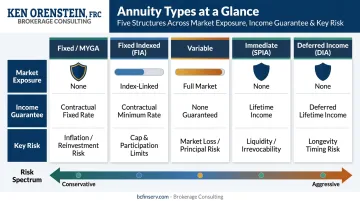
| Annuity Type | Market Exposure | Income Guarantee | Key Risk |
|---|---|---|---|
| Fixed / MYGA | None | Contractual rate for term | Liquidity, inflation |
| Fixed Indexed (FIA) | Linked to index, floor at 0% | Minimum rate guaranteed | Capped upside, complexity |
| Variable | Full market risk via sub-accounts | None on principal | Market loss |
| Immediate (SPIA) | None | Lifetime income from day one | Liquidity, inflation |
| Deferred Income (DIA) | None | Guaranteed income starting later | Insurer solvency, inflation |
Fixed annuities and income annuities (SPIAs and DIAs) sit at the conservative end of this spectrum — no market exposure, contractual guarantees, backed by the issuer's claims-paying ability. Variable annuities sit at the other end.
Fixed deferred annuities and income annuities serve different purposes:
- Fixed deferred annuities prioritize accumulation and preserve some liquidity access during the contract term
- Income annuities (SPIAs/DIAs) prioritize guaranteed lifetime income, with little to no flexibility once funded
Neither type is inherently safer than the other. The better fit depends on whether you need access to your money or certainty of income — two goals that rarely point to the same product.
How to Evaluate a Fixed Annuity Before You Buy
Step 1: Check the Insurer's Financial Strength
Start by looking up the issuing insurer's rating from at least two of the four major agencies:
- AM Best: A++ (Superior) → A- (Excellent) → B++ (Good)
- Moody's: Aaa (Exceptional) → Aa (Excellent) → A (Good) → Baa (Adequate)
- S&P: AAA (Extremely Strong) → AA (Very Strong) → A (Strong)
- Fitch: AAA (Lowest default risk) → AA (Very low risk) → A (Low risk)
Ratings are opinions, not guarantees — AM Best explicitly states its Financial Strength Rating is not a recommendation to purchase any contract. But an insurer with consistent A-range ratings across multiple agencies is meaningfully lower-risk than one with spotty or lower ratings.
At Brokerage Consulting, Ken Orenstein cross-checks carrier financial strength ratings from all four agencies alongside rate comparisons for every MYGA evaluation — so clients know the guarantee is backed by a financially sound issuer, not just an attractive headline rate.
Step 2: Read the Surrender Schedule Before You Sign
Ask for the full surrender charge schedule in writing. Confirm:
- How many years the surrender period lasts
- The starting percentage and how it declines year by year
- How much you can withdraw annually without triggering a charge (typically 10%)
- Whether the free withdrawal provision resets each year
Match that schedule against your anticipated liquidity needs for the next 5–10 years. If there's any chance you'll need significant access to funds before the surrender period ends, a shorter-term MYGA or a different product may be more appropriate.
Step 3: Distinguish the Guaranteed Rate from the Teaser Rate
Some fixed annuities advertise an attractive initial "bonus" rate that resets lower after the introductory period. Two numbers matter here:
- Guaranteed minimum rate — the contractual floor the insurer must credit for the life of the contract
- Promotional rate — the higher introductory rate that may reset after the first year or two
The NAIC confirms that fixed annuities may credit interest above the minimum, but only the minimum is guaranteed. Ask for both figures in writing before signing.
Who Should (and Shouldn't) Consider a Fixed Annuity?
Strong Candidates
- Conservative retirees or near-retirees (typically ages 65–73) seeking predictable, principal-protected growth or income to supplement Social Security or a pension
- Those who have received a lump-sum distribution — 401(k) rollover, pension buyout, TSP distribution — and want to preserve capital while earning a guaranteed rate
- Federal employees with FERS or CSRS pensions looking to add a private guaranteed income layer to their existing federal benefits structure
- Investors who have maxed out tax-advantaged accounts and want additional tax-deferred accumulation
Ken Orenstein's Federal Retirement Consultant practice focuses heavily on the federal employee segment — helping FERS and CSRS employees integrate fixed annuities into a layered income architecture alongside Social Security, pension income, and TSP distributions.
Poor Candidates
- Younger investors who need liquidity and can accept market risk for higher growth potential
- Anyone who may need access to more than the free withdrawal provision allows during the surrender period
- Retirees with long time horizons and significant inflation exposure, for whom a fixed nominal payment may deteriorate significantly in real purchasing power
The Right Context for the Decision
A fixed annuity decision should never be made in isolation. It belongs within a comprehensive retirement income plan that accounts for:
- Social Security claiming strategy
- Existing pension or TSP income
- Healthcare and long-term care costs
- Estate and beneficiary planning goals
- Liquidity reserves outside the annuity
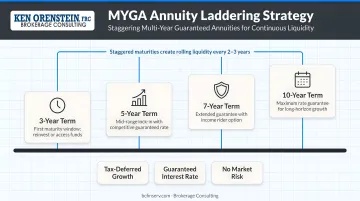
An annuity laddering approach staggers multiple MYGA contracts across different term lengths — typically 3, 5, 7, and 10 years. This keeps capital accessible in stages as each contract matures, balancing liquidity with guaranteed returns without triggering surrender charges.
Frequently Asked Questions
How much will a $100,000 fixed annuity pay per month?
Monthly payouts vary based on the annuity type, contract interest rate, payout option (lifetime, joint life, or period certain), and the annuitant's age at annuitization. An advisor or insurer can provide a personalized income illustration based on current rates and your situation.
Are fixed annuities safe?
Fixed annuities are among the more stable retirement vehicles available — they protect principal from market losses and credit a contractually guaranteed interest rate. They carry other risks (liquidity constraints, inflation erosion, insurer financial strength) that are important to understand before purchasing.
What is the safest type of annuity?
Fixed annuities and income annuities (SPIAs and DIAs) are the most conservative options — they carry no market risk and offer contractually guaranteed interest or income. Variable annuities involve full market exposure and carry the most risk.
Can you lose money in a fixed annuity?
You cannot lose principal due to market performance. That said, exceeding the free withdrawal limit during the surrender period triggers surrender charges. Withdrawals before age 59½ also incur a 10% IRS penalty on top of ordinary income taxes owed on the earnings portion.
Are fixed annuities FDIC insured?
No. Fixed annuities are insurance products, not bank deposits. They are protected by state insurance guaranty associations up to state-specific limits ($250,000 or more per NOLHGA), and by the financial strength of the issuing insurance company.
What happens if the insurance company holding my annuity goes bankrupt?
State guaranty associations step in as a safety net — NOLHGA reports all member associations cover $250,000 or more in annuity benefits. Visit NOLHGA.com or your state's guaranty association for current, state-specific limits.