This matters most to people approaching or already in retirement who worry about outliving their savings. According to the Federal Reserve's 2024 household survey, only 35% of non-retirees feel their retirement savings are on track — and just 51% of current retirees receive any pension income. For the other half, an annuity rollover may be the closest substitute.
But the rules governing this process are easy to get wrong. Tax consequences, early withdrawal penalties, and eligibility pitfalls can turn a well-intentioned move into a costly mistake. This article covers IRS eligibility rules, how to execute the rollover correctly, tax treatment by account type, which annuity types qualify, and when this strategy actually makes sense.
Key Takeaways
- A 401(k) can roll into a qualifying annuity tax-free via direct trustee-to-trustee transfer
- RMDs, hardship distributions, and loan-treated amounts are ineligible for rollover
- Indirect rollovers trigger 20% federal withholding and must complete within 60 days
- QLAC rollovers are capped at $210,000 in 2026 and allow RMD deferral to age 85
- Most advisors recommend partial rollovers rather than full conversions
IRS Rules for Rolling Your 401(k) Into an Annuity
Eligibility: When Can You Roll Over?
Most 401(k) plans require a triggering event before they'll release funds — typically separation from service, reaching age 59½, disability, or plan termination. Some plans allow in-service distributions while you're still employed, but this depends entirely on your specific plan document. Confirm your eligibility with your HR department or plan administrator before proceeding.
The 60-Day Rule for Indirect Rollovers
If you take possession of the funds yourself rather than arranging a direct transfer, the IRS gives you 60 days to deposit the full gross distribution into a qualifying annuity. Miss that window and the entire amount becomes taxable ordinary income. If you're under 59½, add a 10% early withdrawal penalty on top.
Three mechanics make indirect rollovers tricky:
- 20% withholding: Your plan withholds 20% for federal taxes when cutting you a check
- Full deposit required: You must deposit the complete original amount — covering that withheld 20% out of pocket
- Recovery at filing: The withheld amount is credited back when you file your return, but you need the cash to bridge the gap in the meantime
The One-Rollover-Per-12-Months Rule
This rule applies only to IRA-to-IRA indirect rollovers — not to 401(k)-to-IRA rollovers. If you're rolling directly from a 401(k) into an annuity, you face no frequency restriction. Direct transfers are exempt entirely, which is another reason to avoid the indirect method.
The RMD Exclusion Rule
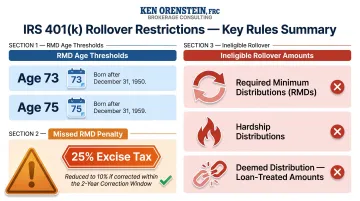
Required minimum distributions cannot be rolled over. Under SECURE Act 2.0:
- Age 73: RMDs start for anyone who turned 72 after December 31, 2022
- Age 75: RMDs start for anyone who turns 74 after December 31, 2032
If you're subject to RMDs, you must withdraw the current year's required amount before initiating any rollover. Rolling it over anyway creates an IRS compliance problem — and missing an RMD carries a 25% excise tax (reduced to 10% if corrected within two years under SECURE 2.0).
The QLAC Rollover Cap
If your goal is purchasing a Qualifying Longevity Annuity Contract (QLAC) to defer RMDs to age 85, the IRS caps what you can contribute. For 2026, the limit is $210,000 per person across all eligible retirement accounts — up from the original $200,000 base set by SECURE 2.0, which also eliminated the prior 25% account-balance restriction.
No dollar cap applies to non-QLAC annuities in a direct transfer.
How to Execute the 401(k) to Annuity Rollover: Direct vs. Indirect
The direct rollover (trustee-to-trustee transfer) is the only method worth serious consideration. Funds move straight from your plan administrator to the receiving insurance company — no withholding, no 60-day clock, no temporary cash shortfall risk.
The indirect rollover puts the check in your hands first, triggering mandatory withholding and a strict deadline. The table below shows why advisors consistently steer clients away from it:
| Feature | Direct Rollover | Indirect Rollover |
|---|---|---|
| Federal withholding | None | 20% mandatory |
| Time limit | None | 60 days |
| Tax risk if deadline missed | Minimal | Full income tax + possible penalty |
| Check payable to | Receiving institution | Participant |
Step 1: Select Your Annuity Type and Insurance Company
Before anything moves, decide what you're buying. Your options — fixed, fixed indexed, variable, immediate, or deferred — depend on your income timeline, risk tolerance, and what you're trying to solve.
Key evaluation criteria:
- Financial strength ratings from AM Best, Moody's, or S&P — the insurer's ability to pay out guarantees decades from now is non-negotiable
- Cap rates and participation rates for indexed products
- Income rider terms (GLWB/GMIB roll-up rates) for deferred products
- Surrender schedules and free-withdrawal provisions
- Fee structures — variable annuities typically carry total costs of 2–3.5% annually versus lower embedded costs in fixed and indexed products
Working with an independent broker who represents multiple carriers — rather than a single company — makes side-by-side product comparison significantly easier at this stage.
Step 2: Take Your RMD First (If Applicable)
If you're 73 or older, withdraw your current year's RMD before initiating anything. That amount is ineligible for rollover and must stay out of the transfer. Skipping this step triggers an IRS excess contribution problem that's difficult to unwind.
Step 3: Request a Trustee-to-Trustee Direct Transfer
Contact your 401(k) plan administrator and request a direct rollover to the receiving insurance company. Critical detail: if a check is issued, it must be made payable to the annuity issuer — not to you personally. A check payable to you triggers indirect rollover treatment automatically.
Expect to complete:
- A distribution or withdrawal form from your plan administrator
- The insurer's transfer/application packet
- Any required suitability disclosure forms
Step 4: Confirm Funding and Maintain Records
Transfers typically take several weeks depending on how quickly the plan administrator processes requests. Once complete:
- Verify the exact amount received matches what was transferred
- Confirm the contract issue date
- Retain all transfer documentation — distribution confirmations, rollover receipts, and annuity contract copies — in case of an IRS audit
Tax Implications: Is a 401(k) to Annuity Rollover Tax-Free?
Traditional 401(k) to Qualified Annuity
A direct rollover from a pre-tax 401(k) into a qualified annuity is a tax-deferred transaction. No income taxes are due at the time of transfer. The annuity preserves the same tax-deferred status the 401(k) held — taxes only apply when distributions begin, and they're taxed as ordinary income at that point.
Roth 401(k) to Roth Annuity
Roth contributions were already taxed, so a properly executed rollover into a Roth annuity carries no immediate tax liability. Future distributions are also tax-free, provided the account meets the IRS's qualified distribution criteria: at least five taxable years since the first Roth IRA contribution and age 59½ or older. Note that rolling into a new Roth IRA starts a fresh five-year clock for that account.
State Tax Considerations
Beyond the federal picture, where you live adds another layer to consider. Once distributions begin from a traditional (pre-tax) annuity, payments are taxed as ordinary income federally — but state rules vary widely:
- No income tax at all: Alaska, Florida, Nevada, South Dakota, Tennessee, Texas, Washington, Wyoming
- Full exemption for retirement distributions: Illinois, Mississippi, Pennsylvania
- Partial exemptions based on age or income: numerous other states
Retirees in high-tax states should account for state income tax on annuity payments when evaluating whether a rollover makes sense. Confirm your state's specific rules with a tax advisor before initiating the transfer.
Which Types of Annuities Can You Roll a 401(k) Into?
Any annuity structured as a qualified contract within an IRA or eligible retirement plan can receive 401(k) rollover funds. The main options:
| Annuity Type | Best Suited For | Fee Range |
|---|---|---|
| Fixed / MYGA | Risk-averse retirees wanting predictable returns | Low (embedded in credited rate) |
| Fixed Indexed (FIA) | Those wanting market-linked growth with downside protection | Low to moderate |
| Variable | Higher growth potential accepted with market risk | ~2–3.5% annually total |
| SPIA (Immediate) | At or in retirement, income needed now | No ongoing fee |
| DIA / QLAC | Pre-retirees deferring income to 80s | Low |
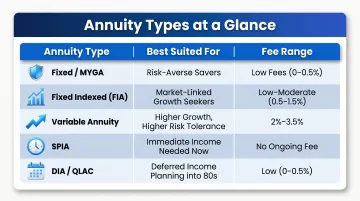
Each subtype serves a different retirement income goal. FIAs with guaranteed lifetime income riders (GLWB/GMIB) work well for clients who want both growth potential and a guaranteed income floor. SPIAs suit those who've just retired and want immediate, reliable income without managing ongoing investments. Brokerage Consulting works across all of these structures to match clients with the right rollover destination.
One option growing in availability: some employers now offer in-plan annuity options directly within their 401(k) lineup, letting contributions flow into an annuity without a formal external rollover. The SECURE Act's fiduciary safe harbor provisions were specifically designed to encourage this. Plan sponsor adoption remains limited — check whether your current plan offers this before initiating an external rollover.
When a 401(k) to Annuity Rollover Makes Sense — and When It Doesn't
Good Candidates for a Rollover
A 401(k)-to-annuity rollover tends to fit well when:
- You have no pension and Social Security alone won't cover essential monthly expenses
- Longevity runs in your family — SSA actuarial data shows women reaching 65 live an average of 20.3 more years, meaning roughly half will reach 85
- A surviving spouse depends on the income continuing after your death
- You want a guaranteed income floor without managing investment withdrawals month to month
Poor Candidates for a Rollover
The strategy is a worse fit when:
- Sufficient guaranteed income already exists from a pension or other source
- Near-term liquidity needs are significant (medical costs, home repairs)
- Life expectancy is shorter than average due to health conditions
- Converting most liquid wealth into an annuity would leave no reserve for emergencies
The Partial Rollover Strategy
Most advisors — Ken Orenstein included — recommend a partial rollover rather than full conversion. It works in four steps:
- Map your guaranteed income sources (Social Security + any pension)
- Calculate your essential monthly expenses
- Annuitize only enough to close the gap between #1 and #2
- Keep the remainder invested for growth, liquidity, and legacy
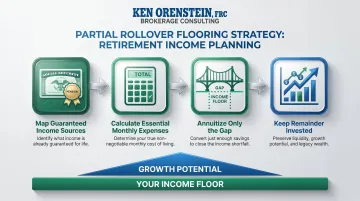
That four-step structure is sometimes called the "flooring" approach — guaranteed income covers non-negotiable costs, and everything above that floor stays accessible for unexpected needs and potential estate transfer.
Weighing income guarantees against liquidity, fees, and tax efficiency is where the details matter most. Ken Orenstein at Brokerage Consulting offers no-cost consultations to help individuals compare annuity options across multiple carriers and match them to their specific retirement income picture.
Frequently Asked Questions
Can you roll over a 401(k) into an annuity?
Yes. A 401(k) can be rolled into a qualifying annuity as long as IRS rules are followed. The most straightforward path is a direct trustee-to-trustee transfer, which avoids withholding and eliminates the 60-day deadline risk entirely.
Can I roll my 401(k) into an annuity without paying taxes?
A direct rollover from a traditional 401(k) into a qualified annuity is tax-deferred, with no taxes due at transfer. A Roth 401(k) rolled into a Roth annuity can be fully tax-free. The indirect rollover method risks 20% withholding and must close within 60 days to avoid a taxable event.
Should I roll over my 401(k) into an annuity?
It depends on your income sources, longevity risk, liquidity needs, and risk tolerance. Most advisors recommend a partial rollover — enough to cover the gap between guaranteed income and essential expenses — while keeping the rest invested.
Should I roll over my 401(k) to a fixed indexed annuity?
A fixed indexed annuity offers market-linked growth potential with principal protection — no direct market exposure. Cap rates, participation rates, and income rider terms vary significantly across carriers, so comparing multiple products before committing is essential.
Can a variable annuity be rolled over into an IRA?
Yes, a variable annuity held inside a qualified account can be rolled into an IRA, provided the annuity is a qualified contract and the receiving IRA accepts the transfer. Be aware that surrender charges from the insurer may apply if the contract is still within its surrender period.
Can you transfer an annuity to an IRA tax-free?
A qualified annuity can transfer to a traditional IRA on a tax-deferred basis through a direct rollover; a Roth annuity rolls into a Roth IRA without tax consequences. The contract must be qualified — pre-tax or after-tax — to maintain its tax-advantaged status.