
This is longevity risk — the very real possibility that you outlive your savings. And it's growing as Americans live longer.
Longevity annuities were designed specifically for this problem. In plain terms: you pay a lump sum to an insurance company today, and in exchange, you receive guaranteed monthly income starting at a future date you choose — commonly age 75, 80, or 85. The income is guaranteed for life, no matter how long you live.
This article covers how longevity annuities work, how they compare to immediate annuities, the pros and cons, who they're best suited for, and how to decide whether one belongs in your retirement income plan.
Key Takeaways
- A longevity annuity converts a lump-sum premium into guaranteed lifetime income starting at a future date you select
- Longer deferral periods produce significantly higher monthly payments
- A QLAC is an IRS-recognized longevity annuity funded from an IRA or 401(k) that lowers your required minimum distributions
- Best suited for retirees with sufficient early-retirement savings who want a guaranteed income floor in later years
- Not ideal for everyone; health status, liquidity needs, and legacy goals all factor into the decision
What Is a Longevity Annuity and How Does It Work?
A longevity annuity — also called a deferred income annuity (DIA) or longevity insurance — is a contract between you and an insurance company. You pay a single premium upfront. The insurer agrees to pay you a guaranteed monthly income for life, beginning at a future date you choose when you buy the contract.
The mechanics are straightforward:
- Choose your premium — typically a lump sum from savings or a rollover
- Select an income start date — commonly age 75, 80, or 85
- Lock in your payments — the insurer calculates guaranteed monthly income based on your age, gender, deferral period, and life expectancy
- Wait — the contract is irrevocable; the income start date is fixed
Once purchased, market conditions don't affect your payment amount. The monthly figure is locked in at the time of purchase, giving you a level of predictability that an investment portfolio can't guarantee.
Why Payments Are Higher Than Immediate Annuities
The deferral period does two things that dramatically increase monthly income. The insurer invests your premium for years before payments begin. More importantly, mortality credits come into play.
As Finke and Pfau explain in the FPA Journal, pooled premiums from annuity buyers who don't survive to their income start date effectively subsidize higher payments for those who do. The longer the deferral, the more pronounced this effect — and the larger your monthly check.
The American Academy of Actuaries puts concrete numbers to this. A 65-year-old male investing $100,000:
| Income Start Age | Monthly Payment |
|---|---|
| Immediate (now) | $602/month |
| Age 75 | $1,311/month |
| Age 85 | $4,235/month |
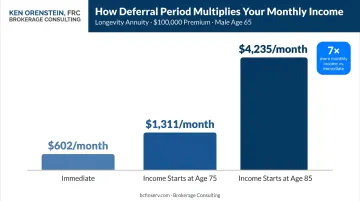
That's not a typo. Deferring to 85 produces more than seven times the monthly income compared to taking it immediately.
What Is a QLAC?
A Qualified Longevity Annuity Contract (QLAC) is a specific type of longevity annuity with IRS recognition. It's funded using pre-tax money from a traditional IRA, 401(k), 403(b), or governmental 457(b), and it comes with a meaningful tax benefit.
Key QLAC rules under current IRS guidance:
- Premium cap: $200,000 lifetime across all qualified accounts (the former 25% limit was repealed for contracts purchased on or after December 29, 2022)
- Maximum deferral age: Income must begin no later than the first day of the month after you turn 85
- RMD exclusion: QLAC funds are excluded from the account balance used to calculate required minimum distributions until payments begin
- Tax treatment: Funds transfer tax-free from your qualified account; payments are taxed as ordinary income when received
The IRS confirms that QLAC balances are excluded from pre-payment RMD calculations, but as Michael Kitces notes, QLACs aren't particularly efficient as a pure RMD-avoidance strategy. They work better as longevity protection that happens to reduce near-term RMDs as a secondary benefit.
For federal employees with large TSP or IRA balances, Brokerage Consulting regularly evaluates QLAC placement as part of broader RMD management and late-retirement income planning.
Longevity Annuity vs. Immediate Annuity: What's the Difference?
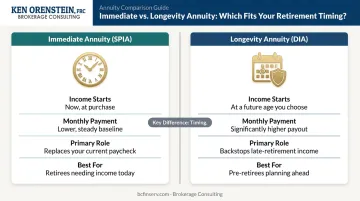
Both products provide guaranteed lifetime income. The difference is timing — and that timing changes everything about how you use them.
| Feature | Immediate Annuity (SPIA) | Longevity Annuity (DIA) |
|---|---|---|
| Income start | Within 30-60 days of purchase | 5-20+ years after purchase |
| Monthly payment | Lower (same premium) | Significantly higher |
| Primary purpose | Replace income now | Backstop income in late retirement |
| Best for | Retirees who need income today | Pre-retirees planning for later |
The Planning Use Case for Each
An immediate annuity makes sense when you've stopped working and need reliable income to cover essential monthly expenses — essentially replacing a paycheck. It's straightforward: convert a lump sum, start receiving income.
A longevity annuity serves a different purpose. Knowing that guaranteed income will begin at age 80 gives you a defined time horizon for how long your other savings need to last. Instead of spending conservatively throughout retirement out of fear of running out, you can draw from your portfolio more confidently during your 60s and 70s, knowing a guaranteed income floor is already in place.
The Trade-Off
Longevity annuities produce much higher monthly payments, but you're accepting two risks: illiquidity (that premium is gone) and mortality risk (if you die before the income start date, you may receive nothing without a death benefit rider).
Immediate annuities pay less per month but begin immediately, reducing the period during which you might receive nothing. Your health history and how early you're planning matter more here than almost any other factor — which is why running the numbers across carriers before committing is worth the time.
Brokerage Consulting works through this exact comparison — reviewing both product types across multiple carriers and factoring in your health, income needs, and timeline — during a no-cost initial consultation.
Benefits and Risks of Longevity Annuities
Potential Benefits
- Lifetime income guarantee — Regardless of markets, interest rates, or how long you live, the monthly payment continues. For many retirees, that certainty alone reduces a significant source of financial anxiety.
- Defined spending horizon — Knowing income starts at 80 or 85 lets you draw down early retirement assets more deliberately. EBRI research supports this: retirees with guaranteed income streams tend to preserve more assets in later years.
- QLAC tax advantage — Excluding up to $200,000 from your RMD calculation during the deferral period reduces taxable income. This can have downstream effects on Social Security taxation thresholds and Medicare premium surcharges (IRMAA) — though the impact depends on your specific situation and is worth reviewing with an advisor.
Risks and Limitations
The benefits come with real trade-offs that deserve equal attention.
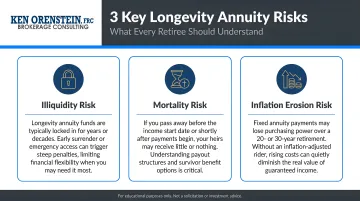
- Illiquidity — Once purchased, that premium is committed. There's no withdrawal option if circumstances change. Keeping adequate liquid savings outside the annuity isn't optional — it's a prerequisite for this strategy to work.
- Mortality risk — If you die before the income start date — or shortly after — you may receive little or nothing without a death benefit rider. Per the American Academy of Actuaries, adding one raises effective cost by roughly 11% when income starts at 75, and about 26% when income starts at 85. That cost reduces your monthly payment.
- Inflation erosion — A fixed payment that looks adequate today can lose real value over a 15-to-20-year deferral period. Some contracts offer annual increases of 2% to 3% compounded, but activating this rider lowers your starting payment.
Payout Options and Optional Features
Most longevity annuities offer several payout structures. The right choice depends on your health, marital status, and legacy priorities.
Life-only: Pays the highest possible monthly income for as long as you live. Payments stop at death — best for single individuals or couples less focused on leaving assets to heirs.
Joint-life: Covers two lives, typically spouses, with payments continuing until the last survivor dies. Monthly income runs lower than life-only, but protects a surviving spouse.
Return-of-premium / cash refund: If you die before collecting your full premium in payouts, the remaining balance passes to named beneficiaries. This adds certainty at the cost of a lower monthly payment.
Inflation protection rider: Increases income by a fixed percentage each year (typically 2–3%). Useful for longer deferral periods, though your starting payment will be meaningfully lower.
Choosing the right structure is only half the equation — the carrier backing that guarantee matters just as much. Brokerage Consulting compares payout structures across multiple carriers and reviews financial-strength ratings from A.M. Best, Moody's, S&P, and Fitch. A higher monthly payment from a financially weaker insurer is a trade-off worth understanding before you commit.
Who Should (and Shouldn't) Consider a Longevity Annuity?
The Ideal Candidate
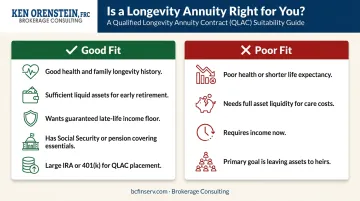
- In good health with family history of longevity
- Has sufficient liquid assets to fund early retirement without the annuity income
- Wants guaranteed protection against outliving savings
- Already has Social Security and/or pension income covering essential expenses
- Holds a large traditional IRA or 401(k) and wants to reduce taxable RMDs through a QLAC
Ken Orenstein at Brokerage Consulting typically works with pre-retirees aged 55-68 and retirees in their 60s who have at least $250,000 in deployable capital for annuity placement. For federal employees with substantial TSP balances, QLAC evaluation is integrated with TSP distribution planning and broader FERS retirement income coordination.
Who Should Likely Avoid It
- Retirees in poor health or with shorter life expectancies
- Those who need all assets to remain liquid for potential medical or care costs
- Individuals who need income now, not in 15-20 years
- Those whose primary goal is leaving assets to heirs rather than maximizing lifetime income
A financial advisor can help weigh these factors against your individual circumstances. Determining fit requires a full-picture review that spans:
- Social Security timing and pension elections
- RMD schedule and qualified account balances
- Investment portfolio composition
- Income needs across different retirement phases
These variables interact — and missing one can undermine the others.
Ken Orenstein at Brokerage Consulting builds coordinated, tax-efficient retirement income strategies that connect annuity placement with Social Security timing, RMD planning, and portfolio design. Consultations are no-cost and available by phone, virtually, or in person. Reach the office at (888) 315-3608 or request a consultation at bcfinserv.com.
Frequently Asked Questions
What is a longevity annuity?
A longevity annuity is a type of fixed deferred income annuity where you pay a lump sum today in exchange for guaranteed monthly income starting at a future date you choose (typically age 80 or 85). It's also called longevity insurance or a deferred income annuity (DIA).
How much does a $100,000 longevity annuity pay per month?
It depends on your age at purchase, gender, and chosen income start date. Per American Academy of Actuaries data, a 65-year-old male investing $100,000 could receive $1,311/month starting at 75 or $4,235/month starting at 85. Quotes vary by insurer, so comparing multiple carriers is essential.
What do financial experts say about longevity annuities?
Most financial planners and academics view them favorably as an efficient tool for protecting against outliving savings. Research from Finke and Pfau shows that allocating around 10-15% of assets to a longevity annuity can deliver spending security comparable to a much larger immediate annuity position.
Is a longevity annuity the same as a QLAC?
No — a QLAC is a specific type of longevity annuity that meets IRS requirements and must be funded with pre-tax money from a qualified account like a traditional IRA or 401(k). All QLACs are longevity annuities, but not all longevity annuities are QLACs.
What are the main risks of buying a longevity annuity?
Three primary risks: the premium is illiquid and irrevocable, you may receive little or nothing if you die before the income start date (without a death benefit rider), and fixed payments lose purchasing power to inflation over long deferral periods.
Can I name a beneficiary on a longevity annuity?
Most contracts don't include a death benefit by default. You can add a return-of-premium or cash refund rider at purchase, which ensures a beneficiary receives any remaining value if you die before payments begin. The trade-off is a lower monthly income amount.