
Introduction: The Case for a Middle Path
Markets gave retirees a rough reminder in 2025. The VIX spiked above 60 during the April tariff shock — one of the sharpest fear readings in years — and the S&P 500 corrected more than 10% in Q1 2025, its 21st such correction in the past 50 years.
For anyone already retired or within five years of retirement, that kind of volatility is a structural threat to long-term income, not just an uncomfortable quarter to wait out.
That leaves a growing number of retirees caught between two bad choices: stay fully invested and absorb the next drawdown at the worst possible time, or move to cash and sacrifice the growth needed to fund a 25–30 year retirement.
Fixed Indexed Annuities (FIAs) are drawing serious attention as a third option — products that protect principal from market losses while maintaining some link to index performance. FIA sales hit $127.9 billion in 2025, a new record and the fifth consecutive year of growth.
This guide explains how FIA downside protection actually works, what the 2026 environment means for retirees evaluating them, and the real trade-offs you need to understand before buying.
TLDR: What You Need to Know About FIAs
- Your principal is protected by a contractual 0% floor — market declines cannot reduce your account value
- Growth tracks an index like the S&P 500, but participation rates and cap rates limit how much you actually capture
- Annual reset locks in credited gains each year; future downturns cannot erase them
- Surrender charges (typically 7–10+ years) create real liquidity constraints that must fit your situation
- Best suited for retirees and near-retirees who prioritize downside protection and predictable lifetime income
What Is a Fixed Indexed Annuity and How Does Downside Protection Work?
An FIA is an insurance contract — not a security — issued by a life insurance company. Your premium is never directly invested in the stock market. Instead, the insurer credits interest based on how a linked index performs. This structural separation is exactly why your principal is protected.
The 0% Floor: How It Actually Works
The NAIC's Buyer's Guide for Fixed Deferred Annuities states it plainly: the interest rate on an FIA is guaranteed to never be less than zero, even if the market goes down.
In practice, this means:
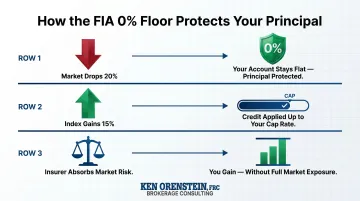
- If the S&P 500 drops 20% in a contract year, your account stays flat (minus any applicable rider fees)
- If the index gains 15%, you're credited up to the cap or participation rate limit
- The insurer absorbs the market risk — which is the trade-off for capping your upside
This is the core distinction from a variable annuity, which exposes your principal to market losses. It's also different from a traditional fixed annuity, which offers a set guaranteed rate with no market linkage. FIAs sit between the two: protected principal with conditional upside.
How Interest Gets Credited
Understanding how gains are credited is the other half of the downside protection story. The most common method is annual point-to-point: the insurer compares the index value at the start and end of a contract year, then credits the gain (if any) up to the applicable limit. Other methods include monthly averaging and monthly point-to-point, each with different risk/reward characteristics.
Crediting structures vary significantly by carrier and product. Brokerage Consulting's FIA consultations walk through each approach — annual point-to-point, monthly point-to-point, monthly average, and monthly sum — along with participation rates, caps, and spreads, so clients can compare on an apples-to-apples basis.
FIA growth also accumulates tax-deferred. You owe no taxes on credited gains until withdrawal — a real compounding edge over a retirement horizon that may span three decades.
Why 2026 Market Conditions Are Driving Retirees Toward FIAs
Three forces are converging to make FIAs relevant right now.
Sequence of Returns Risk Is the Real Danger
Most retirees underestimate this one. Sequence of returns risk describes the danger that a major portfolio loss early in retirement — combined with ongoing withdrawals — can permanently damage your ability to sustain income, even if markets fully recover later.
Research published in the Journal of Financial Planning found that retirement portfolios are order-sensitive in a way accumulation portfolios aren't: the timing of losses matters as much as their size. A retiree withdrawing 4–5% annually who absorbs a 30% loss in year one faces a fundamentally different outcome than one who takes the same loss in year ten. As Benzinga summarized in February 2026, the first five years of retirement are the most critical period.
The FIA's 0% floor addresses this directly. You cannot be forced to withdraw from a depleted account because the account doesn't deplete due to market activity — eliminating sequence risk for the portion of savings held inside the contract.
The Rate Environment Makes FIA Terms Competitive
With the federal funds rate holding at 3.50%–3.75% through April 2026, insurers can offer meaningful crediting terms. Current S&P 500 annual point-to-point cap rates range from approximately 8%–10.50% depending on carrier and term. Participation rates run 60%–90% on some products.
Compare that to 2020–2021, when historically low rates compressed FIA caps to ranges that made the upside trade-off much harder to justify. The current environment restores that case.
Longevity Makes the Math Different
Society of Actuaries research shows a 65-year-old woman has better than a 50% chance of living to 85, and roughly 1 in 4 people reaching 65 will live past 90. Planning for a 25–30 year retirement isn't conservative — it's the baseline.
Over that horizon, the FIA's annual reset mechanism works in your favor: gains credited each year lock in permanently, and the next year starts from that higher floor — not from the original starting point. A bad market year doesn't erase prior gains. That's a meaningful difference when your retirement stretches across three decades.
Taken together, these three forces — sequence risk, competitive crediting terms, and longevity exposure — explain why FIAs are getting a second look from retirees who would have dismissed them in a low-rate environment.
The Mechanics: Floors, Caps, and the Annual Reset
Caps and Participation Rates
These are the insurer's mechanism for balancing the cost of providing the 0% floor guarantee.
| Crediting Structure | How It Works | Example |
|---|---|---|
| Cap rate | Maximum annual credit, regardless of index gain | Index gains 18%; cap is 10% → you earn 10% |
| Participation rate | Percentage of index gain credited | Index gains 15%; rate is 60% → you earn 9% |
| Spread | Insurer deducts a fixed % before crediting | Index gains 12%; spread is 2% → you earn 10% |
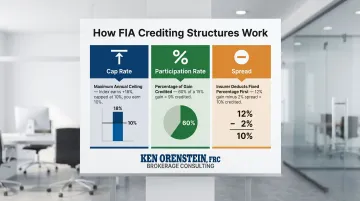
Some products use one structure, some use a combination. Spreads tend to favor the policyholder more in high-return years (no ceiling), while caps are more predictable. Evaluating all three structures against your income needs and risk tolerance is a critical step before selecting a product.
One important caveat: cap rates are not fixed forever. Insurers can adjust them at contract renewal. Always review the contractual minimum cap — not just the current offered rate.
The Annual Reset: Gains That Stay Locked
At the end of each contract year, any credited interest becomes part of your new account value. The following year's calculation starts from this higher baseline. Future index declines cannot reach back and erase what was already credited.
That locked-in baseline is a genuine structural advantage, with compounding implications that grow more meaningful across a 20- or 30-year retirement.
Income Riders (GLWBs)
Many FIAs include optional Guaranteed Lifetime Withdrawal Benefit (GLWB) riders that add a guaranteed income dimension. Key points:
- The rider creates a separate income benefit base — not the same as your cash value
- This base grows at a fixed roll-up rate (typically 5%–7% annually, simple or compound depending on the carrier)
- The income base is used solely to calculate your guaranteed withdrawal amount — it is not accessible as a lump sum
- Rider fees (typically in the 1.0%–1.5% annual range) reduce your account value and can cause it to decline in flat or zero-gain years
Comparing roll-up rates, payout percentages by age, joint-life options, and fee structures across carriers is where the real planning work happens — and where Brokerage Consulting's carrier analysis adds the most value over a 20+ year income horizon.
The Real Trade-Offs: What Downside Protection Costs You
Surrender Charges and Illiquidity
FIAs are long-term commitments. The NAIC's draft Buyer's Guide notes that many FIAs carry surrender periods of 10 years or more, and the Minnesota AG's office has filed lawsuits against insurers — including a $10 million Allianz settlement — for selling long-term products to seniors unlikely to outlive the surrender period.
Standard provisions typically include:
- 10% of account value withdrawable annually without penalty (free withdrawal allowance)
- Surrender charges often structured as 9-8-7-6-5-4-3-2-1-0% over 10 years
- Worst-case penalties reaching 25% of principal, per Minnesota AG documentation
Before purchasing any FIA, you need a clear answer to this question: what portion of these funds can I genuinely leave untouched for the full surrender period?
Capped Upside in Bull Markets
If the S&P 500 gains 28% in a year and your cap is 10%, you earn 10%. In extended bull markets, an FIA will significantly underperform a diversified equity portfolio — and for retirees who rely heavily on growth to fund spending, that gap can matter.
FIAs work best as a portion of a retirement strategy, not the whole thing. That limitation connects directly to the next trade-off: how these products are sold and what complexity costs you.
Complexity and Commission Risk
FIAs are one of the most complex insurance products on the market. Commissions typically run 3%–6% for FIA products, compared to 1.5%–3% for simpler MYGAs. That gap creates an incentive structure that doesn't always align with client suitability.
The NAIC's best-interest standard (Model Regulation #275, updated November 2025) provides regulatory protection, but the practical safeguard is this: always ask for the contractual guarantees illustration, not just the hypothetical projections. Hypothetical numbers assume index performance. Contractual guarantees are what you actually own.
FIAs vs. Other Downside Protection Options in 2026
| Feature | FIA | MYGA | RILA |
|---|---|---|---|
| Principal protection | 100% (0% floor) | 100% (fixed rate) | Partial (buffer only) |
| Upside potential | Capped (8%–10.50%) | None (fixed rate) | Higher caps than FIA |
| Current rate/cap | 8%–10.50% cap | 4.85%–5.75% guaranteed | Generally above FIA cap |
| Lifetime income option | Yes (GLWB riders) | Typically no | Some products |
| Complexity | High | Low | Moderate–High |
| Regulation | State insurance | State insurance | SEC (security) |
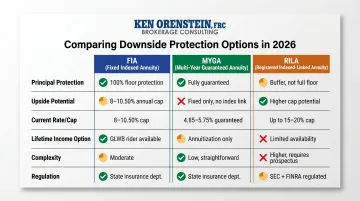
MYGAs make sense for retirees who want a guaranteed, predictable return with no market exposure at all — think of them as a CD alternative with tax deferral. In flat or down markets, a MYGA's guaranteed 4.85%–5.75% outperforms an FIA that earns 0%. In strong markets, the FIA's upside potential wins.
For retirees willing to accept some defined downside risk, RILAs (Registered Index-Linked Annuities) offer higher cap rates in exchange for partial — not full — principal protection. RILA sales surged 20% to $79.5 billion in 2025, reflecting growing appetite for higher upside potential. The critical distinction: with a RILA, losses beyond the buffer are possible. With an FIA, they are not.
Who Is (and Isn't) a Good Fit
Strong Fit Profile
- Retirees or near-retirees, typically ages 55–75
- Have savings they can leave untouched for the full surrender period
- Want principal protection without abandoning all upside potential
- Need or want a guaranteed lifetime income stream as part of their retirement architecture
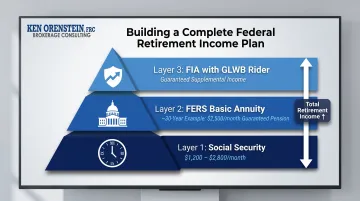
Federal employees deserve a specific mention here. The FERS basic annuity formula delivers roughly 1% of high-3 salary per year of service — a 30-year federal employee earning $100,000 receives approximately $30,000–$33,000 annually from the basic annuity. With average TSP balances around $217,300, an income gap often exists between guaranteed federal income and pre-retirement spending.
An FIA with a GLWB rider can fill that gap as a Layer 3 income source: sitting below Social Security and the FERS pension, converting TSP or other savings into guaranteed supplemental income rather than leaving those funds exposed to market volatility. Ken Orenstein at Brokerage Consulting works with federal employees across New Jersey and the broader Northeast on exactly this type of integrated planning — modeling how FIAs fit alongside FERS, TSP, and Social Security to build a complete income picture.
Poor Fit Profile
- Retirees who need full liquidity access to their savings
- Those in or near their 80s where surrender periods extend beyond any practical planning horizon
- Anyone seeking equity-comparable growth — FIAs can't deliver that
- Federal employees or others whose pension and Social Security already cover all essential expenses — the income rider may add cost without adding necessary value
Questions to Ask Before Buying
- What are the contractual guarantees — specifically the minimum cap and guaranteed income amount?
- What is the full surrender charge schedule and the free withdrawal allowance?
- Can the cap or participation rate be adjusted by the insurer, and what is the contractual floor?
- What does the income rider actually guarantee versus what the illustration projects?
Frequently Asked Questions
Can I lose money in a fixed indexed annuity?
Your principal cannot decline due to market losses — the 0% floor contractually prevents that. However, annual rider fees can reduce account value in flat or zero-credit years, and early withdrawals beyond the free withdrawal allowance trigger surrender charges that can reduce what you receive.
What is the difference between a cap rate and a participation rate in an FIA?
A cap rate sets a maximum annual credit ceiling — if the index gains 25% and your cap is 10%, you earn 10%. A participation rate credits a percentage of the gain — 60% participation on a 15% gain equals 9%. Some FIAs use one or the other; some combine both, and some apply a spread structure instead.
How does the annual reset work in a fixed indexed annuity?
At each contract anniversary, credited interest locks in and becomes the new account value baseline. Future index declines cannot erase previously credited gains — each year starts fresh from the new, higher floor.
Are fixed indexed annuities a good option for federal retirees?
When FERS pension and Social Security income falls short of spending needs, FIAs can protect TSP savings from market risk while generating guaranteed supplemental income. Suitability depends on your income gap, surrender period tolerance, and liquidity needs.
What are the biggest risks of fixed indexed annuities for retirees?
The three risks retirees most often encounter:
- Surrender charge illiquidity — funds are committed for 7–10+ years
- Capped upside — FIAs underperform equities in strong bull markets
- Product complexity — contractual terms can obscure unsuitable features if not reviewed carefully
How much of my retirement savings should I put into a fixed indexed annuity?
No universal rule applies. FIAs work best as a defined portion of a diversified retirement strategy — sized to what you can genuinely leave untouched for the surrender period while maintaining liquidity for emergencies, healthcare, and other needs.