
Introduction
The decisions you make before retirement income begins often matter more than the decisions you make after. For anyone using a deferred annuity as part of their retirement strategy, the accumulation period is where those foundational choices play out — how much you contribute, how growth is credited, and how long you let compounding work before you start drawing income.
Get this phase right, and your payout period can deliver the income it was designed to provide. Misunderstand it — or make early withdrawals without realizing the cost — and you can significantly undercut that outcome.
Here's what this article covers:
- What the accumulation period actually is and how it works
- How growth is credited across fixed, indexed, and variable annuity types
- What drives the length and size of your accumulation
- What to watch out for before you transition to income
Key Takeaways
- The accumulation period is the growth phase of a deferred annuity — only deferred annuities have one; immediate annuities skip it entirely.
- Growth comes from contributions, credited interest or investment returns, and compounding — all tax-deferred until withdrawal.
- Annuity type determines how growth is credited: a guaranteed rate (fixed), a market-linked index with downside protection (indexed), or market-based subaccounts (variable).
- Duration, contribution size, and credited rate or market performance all shape the final payout amount.
- Early withdrawals trigger surrender charges and potential tax penalties — both of which erode long-term compounding gains.
What Is the Annuity Accumulation Period?
The accumulation period is the phase in a deferred annuity contract during which the contract holder makes contributions — either as a lump sum or through ongoing payments — and the annuity's value grows before any income payments begin. It ends when the owner elects to start distributions, at which point the contract transitions into the payout (annuitization) phase.
This phase exists only in deferred annuities. Immediate annuities (SPIAs), as defined by Investor.gov, convert the premium into income payments within one month to one year of purchase — there's no waiting period and no distinct growth phase. If you need income soon, a SPIA is the straightforward choice; if retirement is years away, a deferred annuity's accumulation period is where real compounding leverage builds.
Three Mechanisms Driving Growth
During the accumulation period, value builds through three key drivers:
- Contributions — either a single lump-sum premium or flexible periodic payments over time
- Interest or investment returns — credited based on the annuity type (fixed rate, index-linked, or subaccount performance)
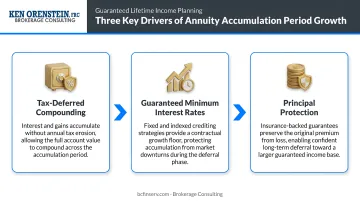
- Compounding — prior earnings generate additional returns, and because nothing is withdrawn or taxed annually, the compounding base keeps growing
Tax Deferral: A Key Accumulation Advantage
All earnings inside a deferred annuity grow tax-deferred — no annual tax drag reduces the compounding base. Taxes apply only when funds are withdrawn or annuitized.
A historical illustration from Prudential's educational guide shows what this means over time: $2,000 invested annually for 30 years at 8% in a 28% tax bracket grows to $244,692 tax-deferred versus $160,326 in a taxable account — a difference of over $84,000, before fees. (2008 carrier illustration; excludes fees — actual results vary.)
When distributions begin, earnings are taxed as ordinary income. For nonqualified annuities — purchased with after-tax dollars outside a retirement account — the original principal (cost basis) comes back tax-free; only the gains are taxable.
Flexibility Within the Accumulation Period
The contract holder largely controls how long the accumulation period lasts. It can be shortened if income is needed earlier or extended if employment income continues. Most deferred annuity contracts place no formal cap on contributions, so savers can increase deposits during high-income years and reduce them during leaner ones without losing the contract's tax-deferred status.
Annuity Accumulation Methods: Fixed, Indexed, and Variable
The accumulation method determines how growth is credited to an annuity's value — and the choice made at purchase has lasting consequences for both risk exposure and retirement income potential.
According to LIMRA's 2025 U.S. retail annuity sales data, fixed-rate deferred annuities led the market at $165.3 billion, followed by fixed indexed at $127.9 billion and traditional variable annuities at $63.1 billion — reflecting a clear preference for predictability and principal protection in current market conditions.
Fixed Rate Accumulation
Fixed annuities — including Multi-Year Guaranteed Annuities (MYGAs) — credit a declared interest rate set by the insurance company for a specified period. The growth is predictable, guaranteed, and entirely insulated from market downturns.
The trade-off: lower potential upside in exchange for certainty. MYGAs lock in a rate for a defined term — commonly 3, 5, 7, or 10 years. Blueprint Income's fixed annuity page (last updated May 21, 2026) listed MYGA rates as high as 6.30% for a 5-year term. Rates change frequently and vary by carrier, state, term, and credit rating.
Best for: Clients who want predictable, principal-protected growth and have already taken risk off the table in their broader portfolio.
Fixed Indexed Accumulation
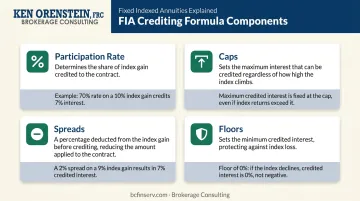
Fixed indexed annuities (FIAs) link credited interest to the performance of a market index — commonly the S&P 500 — while protecting against losses when the index declines. The contract owner doesn't invest directly in the market. Instead, as FINRA explains, credited interest is calculated using formulas involving:
- Participation rates — for example, a 70% participation rate credits 7% if the index gains 10%
- Caps — a maximum amount credited regardless of index gains
- Spreads — a deducted percentage that reduces the credited amount
- Floors — often 0%, meaning the annuity doesn't lose value even when the index drops
FIAs sit between fixed and variable accumulation in terms of both risk and return potential.
Best for: Clients who want competitive returns without direct market exposure or the risk of principal loss.
Variable Accumulation via Subaccounts
In variable annuities, the owner allocates premiums to subaccounts — investment options that function similarly to mutual funds — and the account value rises or falls with actual market performance. The unit of measurement tracking the owner's share of each subaccount's value is called an accumulation unit.
This method carries the highest growth potential alongside the highest risk, including the possibility of loss. Best for: Clients with longer time horizons, higher risk tolerance, and an existing base of guaranteed income from Social Security, pensions, or fixed/indexed annuities.
Quick Comparison
| Feature | Fixed / MYGA | Fixed Indexed | Variable |
|---|---|---|---|
| Growth mechanism | Insurer-declared rate | Index-linked formula | Market subaccounts |
| Downside protection | Full | Full (floor at 0%) | None |
| Upside potential | Lowest | Moderate | Highest |
| Risk level | Lowest | Low–moderate | Highest |
What Affects Your Accumulation Period's Length and Growth
Duration: The Most Powerful Lever
Time is the single most powerful variable in accumulation. Using the Prudential illustration as a reference point: the same investment scenario that reaches $98,844 at 20 years reaches $244,692 at 30 years — adding just 10 years nearly 2.5x the outcome under identical assumptions, thanks to tax-deferred compounding working uninterrupted across a longer runway.

For pre-retirees who can defer drawing on an annuity for even a few additional years, the impact on eventual account value can be meaningful.
Contribution Level and Frequency
- Lump-sum premiums start compounding immediately across the full balance — every dollar earns from day one
- Periodic contributions build value incrementally over time — still effective, but the earliest dollars do the most work
- Most deferred annuity contracts don't cap total contributions, giving savers flexibility to increase their position over time
Larger contributions earlier in the accumulation period generally produce better outcomes. More principal working for more time simply produces a larger result.
Market Performance (Indexed and Variable)
For variable and indexed annuities, market conditions during accumulation directly shape the outcome:
- Strong markets during accumulation can push eventual account value considerably higher
- Sustained downturns compress it — sometimes significantly, depending on timing
This is the core trade-off between the predictability of fixed accumulation and the growth potential of indexed or variable methods, and it's worth weighing carefully based on your timeline and risk tolerance.
Interest Rate Environment (Fixed and MYGA)
For fixed annuities and MYGAs, the credited rate is locked in at purchase based on prevailing interest rates. Buying during a higher-rate environment — as many clients have been able to do recently — can lock in stronger guaranteed returns for the full contract term. Rate environments shift, which makes purchase timing a meaningful decision — one worth reviewing with an advisor who tracks current rate trends.
Accumulation Period vs. Payout Period: Key Differences
The accumulation period builds value. The payout period converts it into income. These are distinct phases — and the payout options you choose at that transition point directly affect your income for the rest of your life.
When the accumulation period ends and the owner elects to begin income, several payout options are typically available:
- Life-only income — highest periodic payment, but stops at death with no residual benefit
- Life with period certain — payments continue for life and at least a stated period (10 or 20 years); lower than life-only but provides a death benefit floor
- Joint and survivor — income continues while either covered person is alive; lower than single-life options but protects a surviving spouse
- Lump sum withdrawal — full or partial access to accumulated value, subject to taxes and contract terms
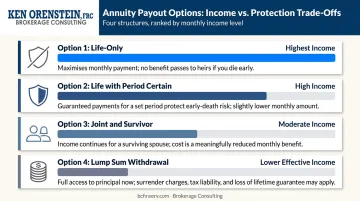
As FINRA notes in its guidance on selecting retirement payout methods, life-only pays the most per period, but offers no continuing benefit after the annuitant's death.
One critical point: annuitization — the formal conversion of the accumulated value into a payment stream — is irreversible in most standard contracts once elected. There's no switching back to accumulation after the income phase begins. That's why working through payout scenarios with a financial advisor before annuitizing — not after — tends to make a material difference in long-term income outcomes.
Withdrawals, Taxes, and Common Mistakes During Accumulation
The Two Layers of Early Withdrawal Cost
Accessing funds during the accumulation period is possible, but it comes with real costs:
- Surrender charges — typically a percentage of the withdrawal, declining over the surrender period. The SEC cites a common example of a 7% charge in year one, declining by 1 percentage point annually until it reaches zero. FINRA notes variable annuity surrender periods can extend 8 years or more.
- IRS early withdrawal penalty — a 10% additional tax on earnings for owners under age 59½, on top of ordinary income taxes on any taxable gain withdrawn.
The NAIC notes that many annuities allow annual withdrawals up to 10% of account value without surrender charges — check your contract to confirm whether this provision applies.
The surrender period and the accumulation period are not the same thing. The surrender period is a contract-specific penalty window, typically running 6–10 years from the contract's inception. The accumulation period may extend well beyond that window — they overlap but don't define each other.
The Compounding Mistake
Some owners treat the accumulation period as a savings account — accessible without significant consequence. It isn't. Early withdrawals don't just incur fees and penalties; they permanently remove principal that would have continued compounding. Consider a $50,000 withdrawal from a contract earning 5% annually: over 10 years, that sum would have grown to over $81,000. Lost compounding permanently reduces your eventual account value — and no future contributions can recover that specific growth.
Timing the Transition Thoughtfully
For those approaching retirement, deciding when to shift from accumulation to distribution involves several variables:
For those approaching retirement, deciding when to shift from accumulation to distribution involves several variables:
- Where you stand in the surrender schedule
- The tax impact of withdrawing in a given year
- When you actually need income to begin
- How annuity income coordinates with Social Security or pension payments
Ken Orenstein at Brokerage Consulting works with pre-retirees and retirees across New Jersey and the broader Northeast to structure this transition around personal financial goals while minimizing unnecessary costs. A no-cost initial consultation is available by phone, virtually, or in person — reach Ken at (888) 315-3608 or visit bcfinserv.com.
Frequently Asked Questions
Which of the following are annuity accumulation methods?
The three primary methods are fixed rate (guaranteed interest credited by the insurer), fixed indexed (growth tied to a market index with a floor against losses), and variable (market-linked subaccounts with no loss protection). Each differs in risk level, growth potential, and downside protection.
Do all annuities have an accumulation period?
No. Only deferred annuities have an accumulation period. Immediate annuities (SPIAs) convert the premium into income payments at or near the time of purchase and do not include a separate growth phase.
Is the interest earned during the accumulation period tax-deferred?
Yes. Earnings during the accumulation period grow without annual taxation. Taxes apply only when distributions begin, at which point earnings are taxed as ordinary income — and for nonqualified annuities, you recover the original cost basis tax-free.
How long does the annuity accumulation period typically last?
There is no fixed length. The accumulation period lasts until the owner elects to begin distributions — it could be a few years or several decades, depending on when you bought the annuity and when you plan to start income.
What happens to my annuity when the accumulation period ends?
The annuity enters the payout phase. Depending on the contract and your election, the accumulated value converts into lifetime income, a period-certain payment schedule, or in some cases a lump sum.
Can I make additional contributions to my annuity during the accumulation period?
In most deferred annuity contracts, yes — additional contributions can be made without a formal cap. However, specific products may have limits, so check your contract or ask your advisor before sending additional premium.