
For pre-retirees who have spent decades building savings, watching a portfolio drop 20% in a bad year is not an abstract risk. It's a threat to the retirement they planned.
Fixed accumulation annuities address this anxiety directly. These are insurance contracts that grow your money at a guaranteed interest rate, tax-deferred, during a set accumulation period — before you ever begin taking income. No market exposure. No guessing. Your principal stays intact regardless of what the S&P 500 does next month.
This article breaks down how the accumulation phase works, what benefits these contracts actually deliver, how they compare to CDs and other annuity types, and who stands to gain the most from using one.
Key Takeaways
- A fixed accumulation annuity grows your money at a guaranteed rate, tax-deferred, until you're ready to take income
- Your principal is protected from market losses throughout the accumulation phase
- Withdrawals before age 59½ trigger a 10% IRS penalty on the taxable portion — insurer surrender charges may also apply during early withdrawal periods
- Best suited for conservative savers, pre-retirees, and people who've maxed out other retirement accounts
- Avoid if you need short-term access to funds or want the growth potential of market-linked investments
How the Accumulation Phase Works
The accumulation phase is the period after you fund the annuity — either with a lump sum or a series of payments — and before you begin taking distributions. Your money sits inside the contract, growing at a guaranteed rate, without you owing annual income tax on the gains.
According to the NAIC's Buyer's Guide to Fixed Deferred Annuities, the insurer sets the interest rate, which is fixed for a specified period. After that initial period ends, the rate may reset — but it cannot fall below the contract's minimum guaranteed interest rate floor, which is written into the contract and cannot be changed while you own it.
Compound interest does the heavy lifting here. Each year, the interest credited to your account also earns interest in subsequent years. Inside a tax-deferred wrapper, this compounding works faster than in a taxable account because you're not pulling money out annually to cover a tax bill — the full balance keeps compounding.
Qualified vs. Non-Qualified Funding
Annuities can be funded two ways:
- Qualified (pre-tax): Money rolled over from a 401(k), IRA, or TSP. Withdrawals are fully taxable as ordinary income.
- Non-qualified (post-tax): Money you've already paid taxes on. Only the earnings portion of withdrawals is taxable — your original principal comes back to you tax-free.
In both cases, growth is tax-deferred during the accumulation phase. Non-qualified annuities also carry no IRS annual contribution limits, unlike IRAs and 401(k)s — making them a practical option for savers who have already maxed out every other tax-advantaged account.
For federal employees specifically, a TSP rollover into a fixed annuity is a common strategy. Ken Orenstein at Brokerage Consulting routinely helps federal employees evaluate TSP distribution options — including whether rolling TSP funds into a fixed annuity makes more sense than staying in TSP's limited fund lineup — as part of a broader FERS or CSRS income plan.
What Happens When the Accumulation Phase Ends
At the end of your contract term, you have several options:
- Annuitize — Convert to a guaranteed income stream (monthly, quarterly, or annually) for life or a set period
- Roll into a new contract — Maintain tax-deferred growth without triggering taxes, useful when you want to extend the accumulation phase
- Take a lump-sum withdrawal — Full surrender; all gains become taxable in that year
- Begin systematic withdrawals — Take scheduled partial distributions while the remaining balance continues growing
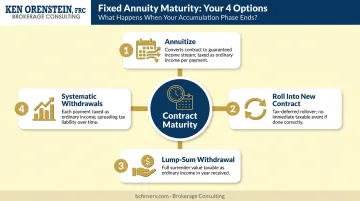
Each path carries distinct tax consequences. A lump-sum withdrawal, for example, can push you into a higher bracket in a single year — whereas annuitizing or systematic withdrawals spread that tax exposure over time. Matching the right exit strategy to your income timeline is worth reviewing with an advisor before your contract term ends.
Key Benefits of Fixed Accumulation Annuities
Guaranteed Principal Protection
Unlike stocks, bonds, or mutual funds, the premium you pay into a fixed annuity cannot be reduced by market performance. The insurer absorbs the investment risk. For conservative savers who have already taken decades to accumulate their nest egg, that matters: the floor of your retirement savings is fixed, not subject to the next market correction.
Tax-Deferred Compounding
Consider two savers, both earning the same nominal interest rate — one in a taxable account, one in a fixed annuity. The taxable saver pays income tax on interest each year, reducing the balance available to compound. The annuity owner pays nothing until withdrawal, letting the full balance compound annually.
Over 10 to 15 years, that gap becomes meaningful. FINRA's guidance on tax-deferred illustrations confirms this: the material difference between taxable and tax-deferred growth grows larger the longer the time horizon.
Rate Benchmarks Worth Knowing
Current rate context (as of May 2026, subject to change):
| Product | Term | Rate |
|---|---|---|
| Top MYGA (fixed annuity) | 3-year | 5.85% |
| Top MYGA (fixed annuity) | 5-year | 6.30% |
| National average CD | 36-month | 1.32% |
| National average CD | 60-month | 1.34% |
Sources: Blueprint Income and FDIC national deposit rates, May 2026. Rates change frequently.
Guaranteed Minimum Rate Floor
Once the initial guaranteed rate period ends, the rate may reset — but the contract specifies a minimum guaranteed rate that acts as a permanent floor. The insurer cannot go below it. This gives conservative savers meaningful predictability across a long accumulation horizon.
Flexible Payout Options
The accumulation phase is building toward choices, not a single locked-in outcome. At maturity, annuity holders can typically select from:
- Single life: Income payments that continue for as long as you live
- Joint and survivor: Payments that continue to a spouse after the owner's death
- Period certain: Guaranteed payments for a set number of years, regardless of survival
Death Benefit During Accumulation
Most fixed deferred annuities include a basic death benefit. Per the NAIC buyer guide, if the annuity owner dies during the accumulation phase, the named beneficiary receives the greater of the account value or the minimum guaranteed surrender value. This adds an estate planning layer to what is otherwise a savings vehicle.
Fixed Accumulation Annuities vs. Other Savings Options
Fixed Annuity vs. CD
Both offer a guaranteed rate for a set term. But the differences matter:
| Factor | Fixed Annuity (MYGA) | CD |
|---|---|---|
| Tax treatment | Tax-deferred growth | Interest taxable annually |
| Federal insurance | Not FDIC insured | FDIC insured up to $250,000 |
| Typical rates (2026) | Up to 6.30% (5-year) | 1.34% national avg. (60-month) |
| Liquidity | Limited; surrender charges apply | More flexible, varies by bank |
| Contribution limits | None (non-qualified) | None |
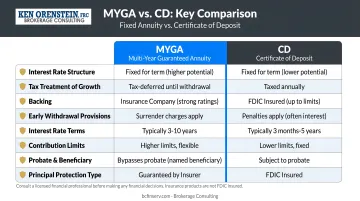
CDs make sense for money you may need within a year or two. For savings you can commit for 3 to 10 years and want to grow without annual tax drag, a fixed annuity often delivers a better outcome. Brokerage Consulting positions MYGAs as CD alternatives for clients seeking tax-efficient, principal-protected growth.
Fixed Annuity vs. Variable Annuity
Variable annuities offer market-linked growth potential, but carry investment risk and no guaranteed interest rate. If the sub-accounts lose value, so does your account. Fixed accumulation annuities sacrifice upside potential in exchange for certainty. For retirees and pre-retirees who prioritize protecting what they've saved, that certainty is the entire advantage.
Brokerage Consulting's framework treats variable annuities as appropriate only for clients who have already secured a base of guaranteed income and have a higher risk tolerance — not as a starting point for conservative accumulation.
Fixed Annuity vs. Fixed Indexed Annuity
Fixed indexed annuities (FIAs) sit between the two extremes. Growth is linked to a market index, with floors preventing losses and caps limiting gains. They offer more upside than a fixed annuity, but come with additional complexity:
- Participation rates — determine what percentage of index gains you receive
- Crediting methods — affect how and when gains are calculated
- Annual caps — set a ceiling on your credited return regardless of index performance
A fixed accumulation annuity sidesteps all of that. The rate is set at the start, and it doesn't change.
Potential Drawbacks to Consider
Fixed accumulation annuities work well for many retirement savers — but they're not the right fit for every situation. Here's what to weigh before committing:
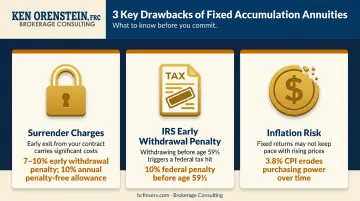
Surrender charges: Most contracts start at 7–10% for early withdrawals and decline to zero over the contract term. Many allow a penalty-free annual withdrawal of up to 10% of contract value, but accessing more than that costs money. Brokerage Consulting reviews full surrender charge schedules — including specific declining-percentage examples — with clients before placement.
IRS early withdrawal penalty: Per IRS Publication 575, withdrawals before age 59½ are generally subject to an additional 10% federal tax on the taxable portion — on top of any surrender charges. Only commit funds you won't need before retirement.
Inflation risk: A fixed rate is guaranteed, but it may not outpace inflation over a long accumulation period. The Consumer Price Index rose 3.8% for the 12 months ending April 2026 (BLS). If inflation consistently exceeds your contract rate, the real purchasing power of your payout erodes — a more meaningful concern for 10+ year contracts than shorter terms.
Who Should Consider a Fixed Accumulation Annuity?
The clearest candidates are conservative pre-retirees — typically ages 55 to 70 — who:
- Have already maximized contributions to IRAs, 401(k)s, or TSP
- Want additional tax-deferred growth without market exposure
- Don't need immediate access to the funds being invested
- Have a lump sum available, whether from savings, a pension buyout, or an inheritance
Federal employees with FERS or CSRS pensions are a natural fit. Their defined benefit pension covers a baseline income layer, Social Security adds another, and a fixed accumulation annuity can add a third layer of guaranteed, tax-deferred growth that complements — rather than duplicates — those existing benefits.
Fixed annuities also work well as bridge vehicles for employees who retire before they're ready to claim Social Security. A 5- or 7-year MYGA, for instance, can grow savings tax-deferred during the years between separation from federal service and the Social Security full retirement age of 67 (for those born in 1960 or later).
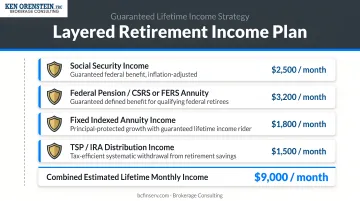
Getting the contract term, funding amount, and payout structure right depends on your tax situation and timeline — which is where a licensed retirement advisor adds real value.
Ken Orenstein at Brokerage Consulting offers no-cost consultations by phone, virtually, or in person, and is licensed across NJ, NY, NC, MD, VA, DC, and additional states. As a Federal Retirement Consultant (FRC) and author of The Informed Fed: A Survival Guide to Federal Employee Benefits, Ken focuses specifically on layered retirement income planning for federal employees and pre-retirees. Reach the practice at (888) 315-3608 or bcfinserv.com.
Frequently Asked Questions
How much does a $100,000 fixed accumulation annuity pay per month?
The monthly payout depends on your age when income begins, the payout option selected, and the insurer's rates. According to Blueprint Income's quote data, a $100,000 annuity purchased at age 65 may pay approximately $550–$651/month for life on a single-life basis, varying by insurer, sex, and contract terms.
Does income from a fixed accumulation annuity affect SSDI?
SSDI (Social Security Disability Insurance) is not means-tested, so annuity income generally does not reduce or disqualify SSDI benefits. SSI (Supplemental Security Income) is different. It is means-tested, and both annuity income and the annuity's cash value could affect SSI eligibility. Consult a financial advisor or benefits specialist for your specific situation.
What is the difference between a fixed annuity and a fixed accumulation annuity?
"Fixed accumulation annuity" refers to the growth phase of a fixed deferred annuity — all fixed deferred annuities have one. The term emphasizes the product's role as a savings vehicle during the period before income distributions begin, as opposed to an immediate annuity, which starts paying right away.
Can you lose money in a fixed accumulation annuity?
The principal is protected from market losses. However, withdrawing funds during the surrender period can reduce your account value through surrender charges, and early withdrawal before age 59½ triggers an IRS penalty. Poor timing — not market performance — is the primary risk.
How long is the accumulation phase?
The accumulation phase lasts until you begin taking distributions — a timeline you control. The guaranteed interest rate period typically runs 1–10 years depending on the contract; MYGAs lock in the rate for the full term, after which the rate may reset annually but cannot fall below the contract's minimum guaranteed rate.
Are fixed accumulation annuities FDIC insured?
No. Fixed annuities are not FDIC insured. They are backed by the claims-paying ability and financial strength of the issuing insurance company. Before purchasing, review independent ratings from AM Best or S&P Global. Brokerage Consulting reviews carrier financial strength ratings as part of every annuity suitability consultation.