Two contracts tracking the same index with similar caps can produce meaningfully different results depending on how they measure index performance. This matters especially for individuals approaching or already in retirement, including federal employees balancing FERS pensions, Social Security, and TSP distributions alongside an annuity strategy.
This article explains what crediting methods are, how each works in practice, which market environments tend to favor each approach, and how to evaluate which structure fits your retirement timeline.
Key Takeaways
- A crediting method is the formula an insurance company uses to measure index changes and calculate interest credited to your FIA account
- Three rate limiters — caps, participation rates, and spreads — control what share of any index gain you actually receive
- The four primary crediting methods are annual point-to-point, monthly point-to-point (monthly sum), monthly averaging, and performance trigger
- No single method outperforms in every market — your best fit depends on income timeline, risk tolerance, and how the FIA fits your retirement plan
- The same index can produce very different credited interest depending solely on which method is used, so understanding these mechanics before purchasing matters
What Are Index Annuity Crediting Methods?
A crediting method is the mathematical formula an insurance company uses to calculate how much interest to credit to your FIA at the end of each crediting period. As the NAIC's Buyer's Guide to Fixed Deferred Annuities explains, fixed indexed annuities earn interest based on changes in a market index — but you are not investing directly in that index or the market.
The index is a benchmark only. Your principal doesn't rise and fall with the S&P 500 — instead, the insurer applies a contract formula at the end of each term to determine credited interest.
Two components work together to determine your final credited interest:
- Rate limiters (caps, participation rates, spreads) — determine what share of the index gain is credited
- The crediting method itself — determines how the index gain is measured in the first place
A high cap rate can still produce modest credited interest if the crediting method measures a smaller index gain — which is why both components deserve equal attention.
The Rate Limiters: Caps, Participation Rates, and Spreads
Three mechanisms control how much index gain actually lands in your account: caps, participation rates, and spreads. Each one limits upside differently — and most FIA contracts apply at least one.
Cap Rates
Say the index gains 10%, but your contract carries a 6% annual cap — you receive 6%, not 10%. The cap is the ceiling, and anything above it is not credited.
Caps reset at each contract anniversary and are not locked in permanently. Future caps depend on the insurer's option budget, which shifts with investment yields, option costs, and market volatility.
Participation Rates
At 65% participation, a 10% index gain credits 6.5% to your account. Instead of cutting off gains above a ceiling, a participation rate applies a fraction to the entire gain.
Some contracts use a participation rate, some use a cap, and some use both together — compounding the limitation on upside.
Spreads (Index Margins)
A spread works by subtraction. With a 3% spread against a 9% index gain, you receive 6%. If the index only gains 2%, nothing is credited — the spread exceeds the gain entirely.
Here's a quick comparison of how each limiter works against the same 10% index gain:
| Limiter | Example Setting | Index Gain | Credited Interest |
|---|---|---|---|
| Cap | 6% annual cap | 10% | 6.0% |
| Participation Rate | 65% | 10% | 6.5% |
| Spread | 3% margin | 10% | 7.0% |

The Zero-Floor Protection
Regardless of which rate limiter applies, one rule holds across all FIAs: if the index declines, zero interest is credited — but your account value does not decrease due to market performance. This principal protection is a defining feature, and it applies regardless of how deep the index decline goes.
The Main Crediting Methods Explained
The crediting method defines how the index change is measured — not just whether the index went up, but which points in time are used to calculate the gain. Here's how each primary method works.
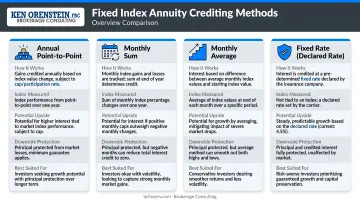
Annual Point-to-Point
The index value at the start of the crediting period is compared to the index value exactly one year later. Only those two data points matter. The percentage change is then subject to the applicable cap, participation rate, or spread before interest is credited.
For context, the American Academy of Actuaries illustrates this clearly: a contract with a 7% cap would credit 7% even if the index's uncapped return was 25% for that year. The cap does the limiting work here, but the measurement is straightforward.
The tradeoff: Annual point-to-point is the simplest and most transparent method. If the index rises strongly mid-year but retreats before the anniversary date, your credited interest reflects only that end-of-year value — not the peak.
Monthly Point-to-Point (Monthly Sum)
The index change is calculated month over month for all 12 months. Each monthly gain is typically subject to a monthly cap, while negative months are not capped. The 12 monthly values — positive and negative — are summed. A positive total is credited as interest; a negative total results in zero.
This is path-dependent in ways annual point-to-point is not. A few large negative months can significantly reduce or eliminate the annual sum, even if the index finishes the year higher than it started.
Contract-specific formulas vary here more than in other methods. The Academy illustrates one design where negative months floor at 0% (not negative), while NAIC describes the standard version where negative months are included in the annual sum without a floor. Always review the specific contract terms.
Monthly Averaging
The index value is recorded at the end of each of the 12 months during the crediting year. Those 12 values are averaged together, and that average is compared to the starting index value. If the average exceeds the starting value, indexed interest is calculated and credited.
The smoothing effect: By averaging monthly observations rather than relying on a single end-of-year value, this method reduces the impact of sharp spikes or drops at any one point in time. It's useful in turbulent markets where the index fluctuates widely but trends generally upward over the year.
Performance Trigger
A predefined interest rate is credited if the index meets or exceeds a threshold — flat or positive — at the end of the crediting period. If the return falls below that threshold, zero interest is credited.
This method is binary rather than proportional. Per the Academy's illustration, a 7% trigger rate is credited when the annual S&P 500 return is positive or zero. When returns are negative — as they were in 2018 and 2022 — zero is credited.
Performance trigger is often used as one allocation within a split strategy, pairing it with a growth-oriented method to balance different market scenarios within the same contract. No single method performs best in every environment — the right fit depends on your contract terms, time horizon, and how much volatility you expect the market to absorb.
- Annual Point-to-Point — simplest structure; one comparison, full-year result
- Monthly Sum — path-sensitive; large down months can offset strong gains
- Monthly Averaging — smooths volatility; reduces single-point-in-time risk
- Performance Trigger — binary outcome; useful when paired with a growth-oriented allocation
How Market Conditions Influence Which Method Performs Best
Each crediting method tends to favor a different market environment:
| Market Environment | Method That Tends to Benefit |
|---|---|
| Steady, consistent bull market | Monthly point-to-point (monthly sum) — each positive month compounds |
| Volatile but net-positive year | Annual point-to-point — ignores mid-year swings |
| Choppy, turbulent with upward trend | Monthly averaging — smooths extreme values |
| Flat or modestly positive market | Performance trigger — credits a defined rate on threshold-meeting years |
No method is optimal in all conditions. Chasing last year's best-performing method is a common mistake. The market environment that made it shine may not repeat — and a different method may be better suited to what's ahead.
Crediting Diversification
Many FIAs allow you to split your premium allocation across two or more crediting methods. This reduces dependence on any single method performing well in a given year. When allocating within a contract, consider discussing these split approaches with your advisor:
- Pair a growth-oriented method (such as annual point-to-point) with a performance trigger for downside buffer years
- Divide between monthly sum and monthly averaging to balance upside capture with volatility smoothing
- Revisit the allocation at each contract anniversary as market conditions shift
The Interest Rate Environment
When interest rates rise, insurers can generally offer more competitive caps and participation rates. That's because the insurer's option budget — used to purchase the index-linked options that fund your potential credited interest — expands when investment yields are higher. The connection isn't mechanical, but it holds in practice: higher rates have generally supported more favorable crediting terms. The low-rate period before 2022 is a clear example of the reverse.
Common Misconceptions About Index Annuity Crediting Methods
Three misconceptions trip up buyers more than any others — and each one can lead to choosing the wrong crediting method for your situation.
"The method with the highest cap always wins"
A high monthly cap on a monthly sum method can still underperform a lower-cap annual method in a volatile year. Negative months reduce the annual sum without a floor in standard designs — which can erode what looks like an attractive monthly cap on paper.
"The annuity just credits the index return up to the cap"
Many buyers assume the crediting method simply applies a ceiling to the full annual index return. In practice, the measurement approach — whether the index is compared point-to-point, averaged, or summed monthly — determines the raw gain before any cap or participation rate applies. That raw gain often differs significantly from the index's actual annual return.
"A zero-interest year means the annuity isn't working"
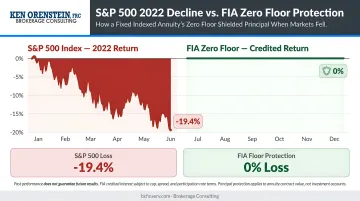
The S&P 500 declined 19.44% in 2022, according to S&P Global data. An FIA crediting 0% that year was not underperforming — it was doing exactly what it was designed to do: preserving principal while the market fell. Zero interest with full principal protection outperforms a 19% loss every time.
Understanding these distinctions upfront helps you evaluate crediting methods on their actual mechanics — not just their headline numbers.
How to Choose the Right Crediting Method for Your Retirement Goals
Match the Method to Your Timeline
Those earlier in an accumulation phase may tolerate more complexity or volatility-sensitive methods. Those near or in retirement often benefit from the transparency of annual point-to-point with a defined cap or participation rate. If you don't need near-term liquidity, multi-year point-to-point strategies may also be worth considering.
For federal employees specifically, this evaluation starts with the existing income picture. If your FERS pension and Social Security already cover essential expenses, an FIA may serve a different role (growth protection or supplemental income) than it would for someone with minimal guaranteed income. Ken Orenstein's practice uses a layered income architecture: Social Security and pensions form the foundation, with annuities addressing gaps and providing longevity protection where needed.
Evaluate the Complete Picture
When comparing crediting options, don't stop at the headline cap rate. Request illustrated scenarios showing how each method performs across both strong and weak market years. The combination of measurement method and rate limiter together determines your realistic range of outcomes — no single factor tells the full story.
A useful comparison should cover:
- Cap rates and participation rates across multiple carriers, not just one
- How each method performs in flat or negative market years, not just bull runs
- Spread fees and their impact on net credited interest
- Surrender schedule length relative to your income timeline
Working with an Independent Advisor
Selecting a crediting method means matching your income timeline, risk tolerance, and overall retirement strategy — cap rates are just one piece of that picture.
Ken Orenstein at Brokerage Consulting works as an independent advisor representing multiple top-rated insurance carriers. That independence allows for side-by-side comparison of crediting strategies across the FIA market: participation rates, cap structures, spreads, and measurement periods evaluated together rather than through a single insurer's lens.
All FIA placements are conducted under NAIC suitability and best-interest standards, with full disclosure of surrender schedules and contract terms before any decision is made.
A no-cost initial consultation is available by phone, virtually, or in person. You can reach Ken at (888) 315-3608 or request a consultation at bcfinserv.com.
Frequently Asked Questions
How do indexed annuities pay out?
Indexed annuities pay out either as a lump sum (the contract's surrender value) or as structured income through annuitization or an optional income rider. Either way, credited interest accumulates tax-deferred, based on the crediting method applied at each period anniversary.
What are the interest crediting methods in indexed annuities?
The four primary methods are annual point-to-point, monthly point-to-point (monthly sum), monthly averaging, and performance trigger. Each measures index changes differently, which means the same index can produce different credited interest amounts depending solely on which method is used.
What method is based on the index value over a specified period?
The point-to-point method — available in annual, biennial, or multi-year forms — compares the index value at the start and end of a defined crediting period. It compares only those two values — start and end — and ignores all movement in between.
What happens to my account if the index goes down?
If the tracked index declines during a crediting period, zero interest is credited — but your account value does not decrease due to market losses. This zero-percent floor is one of the core features distinguishing an FIA from direct market investment.
Can I change my crediting method after purchasing an FIA?
Most FIAs allow reallocation between available crediting methods at each contract anniversary, typically within a set window after that date. Available methods and reallocation rules vary by contract — review your policy terms or consult your advisor before making any changes.