That confusion is understandable. Both products offer principal protection and tax-deferred growth. Both are insurance contracts, not investments. But they work very differently and serve meaningfully different purposes in a retirement income plan.
Choosing the wrong one can mean locking up savings in a vehicle that doesn't match your timeline, overpaying for features you don't need, or missing out on guaranteed growth that fits your situation. This article breaks down how each product actually works — without the sales hype — so you can ask better questions and make a more informed decision.
Key Takeaways
- MYGAs lock in a guaranteed interest rate for a set term (typically 3–10 years) — simple, predictable, no market exposure
- FIAs link returns to a market index with principal protection, but returns are capped and not guaranteed
- MYGAs suit short- to medium-term safe growth; FIAs suit longer horizons with a lifetime income goal
- FIAs work best when paired with income riders for guaranteed lifetime income, not as a substitute for stock market growth
- Neither product delivers actual stock market returns
MYGA vs. FIA: Quick Comparison
| Attribute | MYGA | Fixed Indexed Annuity |
|---|---|---|
| Rate Type | Fixed, guaranteed for full term | Variable, linked to index performance |
| Return Predictability | Fully predictable | Range of outcomes; not guaranteed |
| Term Length | 3–10 years, typically | 7–10 years, typically |
| Fees | Generally none | Income riders typically cost ~1% per year |
| Income Options | Annuitize at maturity or 1035 exchange | Income rider (GLWB/GMIB) available |
| Best Use Case | Safe, tax-deferred accumulation | Long-term income planning |
| Risk Level | Very low | Low (principal protected, returns variable) |
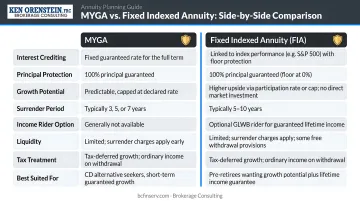
Both products share two core features: principal protection from market loss and tax-deferred growth. That's where the similarity ends.
One transparency point: FIAs typically carry higher agent commissions than MYGAs, which can influence what gets recommended. Ask your advisor to explain specifically why one product fits your situation better than the other before you sign anything.
What Is a MYGA?
A Multi-Year Guaranteed Annuity is a fixed annuity contract where you deposit a lump sum with an insurance company and receive a guaranteed interest rate locked in for the entire term. It works similarly to a bank CD, but with a notable tax advantage and — in the current rate environment — a meaningful yield gap over comparable bank products.
How MYGAs Grow
Interest compounds tax-deferred throughout the accumulation period. In a non-IRA account, that matters. IRS Topic 403 confirms that CD interest is taxable income in the year it becomes available — so a taxable CD at 4% is worth less after taxes than a MYGA at the same rate growing tax-deferred. At maturity, you pay taxes on gains when you withdraw, not annually.
Blueprint Income's rate data as of May 2026 showed top MYGA rates at 5.85% for 3 years, 6.30% for 5 years, and 6.50% for 7 years. The FDIC's national average for a 36-month CD as of May 2026 was 1.32%.
What Happens at Maturity
At the end of a MYGA term, you have four options:
- Cash out — triggers a taxable event on accumulated gains
- Renew — roll into a new MYGA at the current rate for another term
- 1035 exchange — transfer to another annuity tax-free (confirmed under IRS Publication 575)
- Annuitize — convert to a guaranteed income stream
No surrender charges apply if you wait until the term ends. That's an important detail — MYGA flexibility is highest at the maturity window.
Liquidity and Limits
Most MYGAs allow penalty-free withdrawals of up to 10% of account value annually, per the NAIC Buyer's Guide to Fixed Deferred Annuities. Beyond that, surrender charges apply and can be meaningful. Don't put money into a MYGA that you may need before the term ends.
MYGA Use Cases
MYGAs work best as the "safe money" bucket — the portion of a retirement portfolio you don't want at market risk but still want growing above savings account rates.
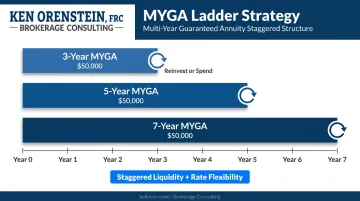
One approach worth considering: laddering across multiple terms instead of placing a full lump sum into a single contract. For example, $150,000 might be split across a 3-year, 5-year, and 7-year MYGA. Funds come due at staggered intervals, letting you reinvest at prevailing rates rather than locking everything into a single rate environment. As Kiplinger notes in its annuity ladder coverage, laddering can hedge reinvestment timing risk — though it doesn't guarantee higher returns than a single contract.
At Brokerage Consulting, Ken Orenstein compares MYGA terms across 3-, 5-, 7-, and 10-year contracts from multiple carriers, evaluating current rates alongside surrender schedules and client liquidity needs. The independent broker model means that comparison spans the broader market rather than a single carrier's product menu.
What Is a Fixed Indexed Annuity (FIA)?
A Fixed Indexed Annuity is a type of fixed annuity — not a security, not a stock market investment — where credited interest is linked to the performance of a market index, typically the S&P 500. Principal is protected from market loss. The distinction matters: "linked to" means your returns are calculated based on index movement, not that your money is actually invested in the market.
How FIA Returns Are Calculated
FIA growth is subject to three limiters that significantly affect what you actually earn:
- Cap rate — the maximum interest you can earn in a given period. Per Annuity.org's current cap rate data, example caps run roughly 9–10.5% for multi-year terms, though these vary by product and change over time
- Participation rate — the percentage of index gains credited to your contract (e.g., 65% participation means you receive 65 cents for every $1 of index gain)
- Spread — a percentage the insurer subtracts from index gains before crediting. FINRA illustrates this clearly: a 3.5% spread on a 10% index gain leaves you with 6.5%
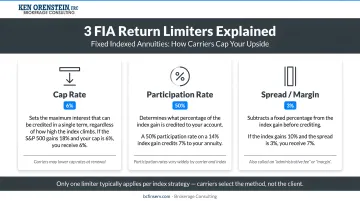
These limiters exist because the insurer is providing principal protection — buying options on your behalf rather than putting your premium directly into the market. In exchange, negative index performance does not reduce your contract value through index-linked interest, as confirmed by the NAIC. The mechanism limits upside; it also eliminates index-driven loss.
The "Market Upside With No Downside" Myth
FINRA states directly that FIAs expose buyers to more potential return than fixed annuities but less than variable annuities — and that caps, fees, changing terms, and participation rates meaningfully limit upside. The "no downside" part is accurate for principal. The "full market upside" part is not.
FIAs will not keep pace with the S&P 500 in strong bull markets. This is structural, not a flaw — but it should be understood clearly before purchase.
Income Riders: The Legitimate Case for FIAs
FIAs are best suited to retirement plans when paired with an income rider. A Guaranteed Lifetime Withdrawal Benefit (GLWB) or Guaranteed Minimum Income Benefit (GMIB) provides a contractually guaranteed income stream, typically for life, regardless of how the index performs.
Kiplinger describes most income riders as costing around 1% per year, deducted from the contract's accumulation value. That fee is the trade — you pay for certainty of future income, not just index exposure.
This is the correct use case for an FIA: not stock-market growth, but guaranteed income planning. Clients who want a vehicle that accumulates for 7–10 years and then converts to a predictable paycheck will find FIAs structured specifically for that purpose.
When working with an independent advisor like Brokerage Consulting, the consultation compares both GLWB and GMIB riders across multiple carriers — reviewing growth rates, fee structures, and income payout factors to match the right product to each client's income timeline.
FIA Use Cases
FIAs make the most sense when:
- Your time horizon is 7+ years before you need income
- You want principal protection with some upside potential
- You plan to attach an income rider and convert accumulation to guaranteed lifetime income
- You understand that the index-linked return is a range of outcomes, not a guarantee
FINRA confirms that FIA surrender periods typically run 6 to 10 years. That makes them poorly suited for anyone who may need liquidity within the contract period.
MYGA vs. FIA: Which One Fits Your Retirement?
The decision comes down to four factors: your time horizon, income needs, liquidity requirements, and how much certainty you need from your return.
Situational Guidance
Choose a MYGA if:
- You want a contractually guaranteed rate with no uncertainty
- You need funds within 3–7 years
- You're in or near retirement and prioritizing safe, predictable growth
- You want to ladder multiple short-term contracts
Choose an FIA if:
- Your accumulation window is 7+ years
- You plan to attach an income rider for guaranteed lifetime income
- You fully understand that the market-linked return is not guaranteed and accept a range of outcomes
- You don't need access to the full contract value during the surrender period
Can You Use Both?
Yes — and in many cases, combining them is the most practical approach.
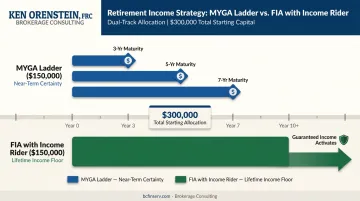
A hypothetical illustration (no specific returns implied): a retiree with $300,000 in safe money might allocate $150,000 across a 3-year, 5-year, and 7-year MYGA ladder for near-term guaranteed growth and predictable maturity windows.
The remaining $150,000 goes into a 10-year FIA with an income rider, accumulating during the same period and activating a guaranteed income stream when the MYGAs have been spent down or reinvested. Each product handles a distinct job — the MYGAs provide near-term certainty and staggered liquidity, while the FIA builds toward a guaranteed income floor later.
That same layered logic applies directly to federal employees and retirees, where MYGA and FIA allocations need to fit alongside FERS pension income, Social Security timing, and TSP distribution decisions — all of which mature on different schedules. Ken Orenstein at Brokerage Consulting works through this multi-income-layer analysis — integrating Social Security, pension, and annuity income into a single retirement income architecture — as part of his broader specialty in federal retirement planning. You can schedule a no-cost consultation by phone, virtually, or in person; reach the office at (888) 315-3608.
Conclusion
MYGAs are the right tool when certainty, simplicity, and short- to medium-term guaranteed growth are the priority. FIAs earn their place when a client wants principal protection paired with a longer accumulation window and a clear pathway to guaranteed lifetime income, provided the product's mechanics are fully understood before signing.
Neither product fits every situation. The right allocation between them depends on your retirement timeline, income needs, and liquidity requirements — and it's rarely a question of one replacing the other.
These decisions land better when made in context of your full financial picture. If you're weighing MYGAs, FIAs, or both, Ken Orenstein at Brokerage Consulting offers personalized, unbiased guidance across the full annuity market, including:
- Carrier financial-strength analysis
- Income rider comparison
- 1035 exchange evaluation
Reach out at (888) 315-3608 or visit bcfinserv.com to schedule a no-cost consultation.
Frequently Asked Questions
Is a MYGA the same as a fixed index annuity?
No. A MYGA guarantees a specific interest rate for the entire contract term — what you earn is locked in from day one. An FIA credits interest based on index performance, subject to caps and participation rates. Both protect principal and offer tax deferral, but they work very differently.
Which annuity is better for short-term savings goals — a MYGA or an FIA?
MYGAs are better suited for 3–7 year goals because the rate is fully guaranteed for the term. FIAs typically require surrender periods of 6–10 years and are structured for longer-horizon income planning, making them a poor fit for near-term needs.
Can you lose money in a Fixed Indexed Annuity?
Your principal is protected — negative index performance won't reduce your contract value. That said, early withdrawals beyond free withdrawal provisions trigger surrender charges, and you may receive zero credited interest in periods where the index underperforms.
What happens at the end of a MYGA term?
At maturity, you can cash out (triggering taxes on gains), renew at the current rate, transfer to another annuity via a 1035 exchange, or convert to an income stream through annuitization — all without surrender charges.
Which is better for guaranteed lifetime income — a MYGA or an FIA?
FIAs paired with income riders (GLWB or GMIB) are specifically built for guaranteed lifetime income. MYGAs are stronger as accumulation vehicles, though a MYGA can also serve as a tax-deferred growth vehicle that later gets 1035-exchanged into an income-producing annuity at maturity.
Can I hold both a MYGA and a Fixed Indexed Annuity in my retirement portfolio?
Yes. Many retirement income plans combine MYGAs for near-term guaranteed growth with FIAs for longer-term income planning. A MYGA ladder alongside a longer-duration FIA with an income rider is a practical structure for clients who need both near-term access and a future guaranteed income stream.