Introduction
The day your paycheck stops is unlike any financial transition you've experienced before. For decades, income arrived every two weeks — taxes withheld, direct deposit clearing, bills paid on schedule. Then, often with little more than a retirement party and a final stub, that rhythm ends.
Yet your mortgage doesn't pause. Property taxes, insurance premiums, and utilities keep coming due. Many retirees describe the first month after their final paycheck as psychologically jarring — not because they lack assets, but because the system that delivered money into their hands has suddenly, completely stopped.
Most financial advice for decades has focused on accumulating a nest egg — hitting that magic number in your 401(k) or IRA. But retirement doesn't run on account balances. It runs on monthly income. The shift from saving money to generating income from it requires a different strategy entirely, yet many retirees don't build that strategy until after their last paycheck clears.
This article answers the core questions: Where does retirement income come from? How do you build a reliable monthly "paycheck" from multiple sources? What hidden threats widen the gap over time, and what mistakes derail even well-prepared retirees?
TLDR:
- 67% of Americans fear running out of money in retirement more than death itself
- Social Security replaces only 43% of pre-retirement income for median earners — multiple sources are essential
- Claiming at 62 vs. 70 creates a 77% difference in monthly Social Security benefits
- Healthcare costs average $172,500 per person over a typical retirement
- The updated safe withdrawal rate is 3.9%, down from the traditional 4% rule
The Income Gap: Why Your Paycheck Stops But Your Bills Don't
Before retirement, income arrives on schedule. Your employer withholds taxes automatically, health insurance is deducted from your paycheck, and your spending adapts to a predictable rhythm of biweekly or monthly deposits.
After retirement, everything changes at once: income must be generated from savings, taxes are triggered by every withdrawal decision, and healthcare costs shift entirely to you — all while your essential expenses continue unchanged.
According to the Allianz Life 2026 Annual Retirement Study, 67% of Americans now worry more about running out of money in retirement than death — a record high that's climbed 10 percentage points since 2022. Gen X leads this anxiety at 73%, followed by Millennials at 69%. This fear isn't irrational — it reflects the very real challenge of converting decades of savings into reliable income.
The Asset-Rich, Income-Poor Trap
A substantial portfolio doesn't automatically prevent financial anxiety in retirement. What matters isn't how large your brokerage account is — it's whether cash arrives in time to cover this month's bills.
This is the "asset-rich, income-poor" trap. You might have $800,000 in retirement accounts, but without a structured income plan, every purchase decision turns into an ad-hoc calculation about whether withdrawing funds now will shortchange you five years later. Most people don't retire to spend their days managing withdrawal timing.
The default strategy — "I'll just pull from my accounts when I need money" — introduces three specific problems:
- Withdrawal uncertainty: You never know how much you can safely take each year without depleting the portfolio prematurely
- Sequence-of-returns risk: Selling investments during a market downturn locks in losses permanently, accelerating depletion
- Ongoing emotional stress: Every purchase decision requires recalculating your financial position
The Real Measure of Retirement Success
Retirement readiness isn't measured by account size — it's measured by income reliability. A retiree with predictable income streams covering essential expenses feels more financially secure than one with a larger but unstructured portfolio, even during market downturns.
The same Allianz study found that 48% of Americans don't have a written financial plan, and the top concerns driving retirement anxiety are inflation (57%) and healthcare costs (53%). These aren't investment return concerns — they're income concerns. People worry about whether their money will generate enough monthly cash flow to cover rising costs over 20-30 years.
Success in retirement means waking up each month knowing your essential expenses are covered, regardless of what the stock market did yesterday. Building that certainty means identifying which income sources — Social Security, annuities, pension distributions — will carry the load so your portfolio doesn't have to do all the work alone.
Where Your Retirement Income Will Come From
Retirement income rarely comes from a single source. Most retirees draw from several streams with different timing, tax treatment, and reliability — so the first step is taking inventory of what you have and how much each piece will contribute.
Social Security
Social Security forms the foundation of most retirement income plans, yet it's widely misunderstood. Workers can claim benefits as early as age 62, but monthly payments increase for every year they delay, up to age 70.
The dollar difference is substantial. According to the Social Security Administration, claiming at 62 instead of waiting until full retirement age (67 for those born in 1960 or later) reduces your benefit by 30%. A $1,000 monthly benefit at age 67 becomes only $700 at age 62. Conversely, delaying until age 70 increases benefits by 24% above the full retirement age amount — so that same $1,000 grows to $1,240.
The total swing between claiming at 62 versus 70 works out to roughly 77% higher monthly income at age 70.
However, Social Security was never designed to replace your entire paycheck. According to the SSA's 2026 guidance, Social Security replaces approximately:
- 43% of pre-retirement income for medium earners
- 28% of pre-retirement income for maximum earners
- 79% of pre-retirement income for very low earners
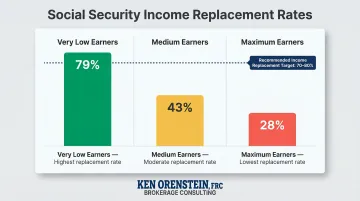
Most financial advisers recommend targeting 70–80% of pre-retirement income to maintain your standard of living. Social Security alone won't get you there — supplemental sources are essential to close that gap.
Employer Pensions and Federal Retirement Benefits
Traditional employer pensions (defined benefit plans) provide a guaranteed monthly payment for life, often with survivor benefit options. These plans are increasingly rare in the private sector but remain a cornerstone for public sector and federal workers.
According to the Bureau of Labor Statistics, only 14% of private industry workers have access to a defined benefit plan, compared to 86% of state and local government workers. If you're among the shrinking group with pension access, this guaranteed income takes real pressure off your personal savings.
Federal employees have a distinctly structured retirement package. Under FERS (Federal Employees Retirement System), retirement income comes from three coordinated sources:
- FERS Basic Annuity (pension based on years of service and high-3 average salary)
- Thrift Savings Plan (TSP contributions and growth)
- Social Security benefits
Federal retirees also retain access to FEHB (Federal Employees Health Benefits) coverage in retirement — a meaningful edge over private-sector retirees who must cover healthcare costs on their own until Medicare kicks in at 65.
Coordinating all three FERS components (and FEHB) for maximum tax efficiency takes careful planning. Ken Orenstein at Brokerage Consulting works specifically with federal employees to sequence each income source and avoid common timing mistakes that cost retirees thousands over their lifetimes.
401(k)s, IRAs, and Personal Investment Accounts
For most private-sector workers, tax-advantaged retirement accounts form the largest income source. These include:
- Traditional 401(k) and IRA: Contributions are tax-deductible; withdrawals are taxed as ordinary income
- Roth 401(k) and Roth IRA: Funded with after-tax dollars, so qualified withdrawals come out completely tax-free
- Taxable brokerage accounts: No contribution limits or withdrawal restrictions, but investment gains are subject to capital gains tax
Other income sources worth factoring in:
- Rental property: Provides ongoing income but requires active management or property management costs
- Annuities: Convert a lump sum into guaranteed monthly payments, which can help cover fixed expenses
- Part-time work: Many retirees use bridge income in early retirement years to delay Social Security and reduce portfolio withdrawals
How to Build Your Retirement "Paycheck"
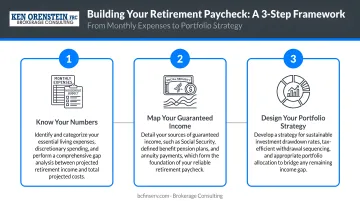
Building a retirement paycheck requires a three-step framework:
- Calculate your actual monthly expenses — Separate essential costs (housing, utilities, food, healthcare, insurance) from discretionary spending (travel, entertainment, hobbies)
- Map guaranteed income sources — Apply Social Security, pensions, and annuities to cover as much of your essential baseline as possible
- Build a portfolio strategy — Design a withdrawal plan to fill the remaining gap while preserving capital for longevity and inflation
Most financial advisors recommend targeting 70-90% of pre-retirement income as a starting benchmark. Your actual number depends on factors like whether your mortgage is paid off, your expected healthcare costs, and the lifestyle you plan to maintain.
The Bucket Strategy
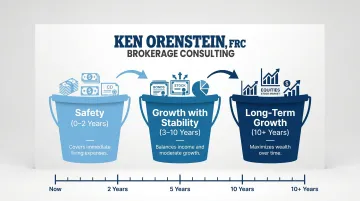
The bucket strategy organizes retirement assets into three categories based on time horizon — solving one of retirement's most common traps: being forced to sell investments at a loss during a market downturn just to cover monthly bills.
Bucket 1 — Safety (0-2 years of expenses): Cash, money market accounts, or short-term CDs. You draw from here first, so market swings never force you to liquidate investments at the wrong time.
Bucket 2 — Growth with Stability (3-10 years of expenses): Bonds, dividend-paying stocks, and balanced funds. This middle bucket replenishes Bucket 1 as it depletes, giving your longer-term investments time to recover from downturns before you need them.
Bucket 3 — Long-Term Growth (10+ years): Equities and growth-oriented assets. You won't touch this for a decade or more, which means it can ride out market volatility and keep pace with inflation over time.