
This guide covers what fixed term annuities are, how they work, their core advantages and limitations, how they compare to CDs and other annuity types, and who actually benefits from using one.
TL;DR: Fixed Term Annuities at a Glance
- A fixed term annuity pays guaranteed income or a lump sum for a set period — typically 2 to 10 years — not for life
- Your principal and interest rate are locked in at purchase; market swings don't affect your return during the term
- Growth is tax-deferred — no annual tax bill on interest until you withdraw
- At maturity, you receive a lump sum and can roll into a lifetime annuity, start a new term, or take the cash
- Early withdrawal triggers surrender charges and a potential 10% IRS penalty if you're under age 59½
What Is a Fixed Term Annuity and How Does It Work?
A fixed term annuity — often called a Multi-Year Guaranteed Annuity (MYGA) in the US — is a contract between you and an insurance company. You contribute a lump sum, and the insurer guarantees a fixed interest rate for a defined term, typically 2 to 10 years. Unlike a lifetime annuity, which pays income until death, a fixed term contract has a clear end date and returns a maturity value when it expires.
Accumulation vs. Distribution
During the accumulation phase, your premium sits with the insurer and grows at the contractually guaranteed rate. That growth is tax-deferred — meaning you owe no taxes on earned interest until funds are actually withdrawn. That tax deferral is what makes a MYGA more efficient than a CD over multi-year horizons.
At the distribution phase, depending on how the contract is structured, you either receive:
- Regular income payments during the term
- A lump sum (the maturity value) at the end
- A combination of both
How Term Length Works
Common term options in the US run from 2 to 10 years. Longer terms have historically offered higher guaranteed rates in normal yield-curve environments, though that relationship can invert. Shorter terms give you more flexibility to respond to changing rate environments.
What happens at the end? The contract matures and you make a new decision:
- Take the maturity value as a lump sum
- Convert to a lifetime annuity for guaranteed income for life
- Lock in again at current rates with a new fixed term
- Shift funds to another retirement vehicle via drawdown
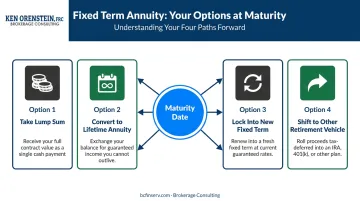
That reset point gives fixed term contracts a flexibility lifetime annuities simply don't offer — and it's worth understanding before you choose between them.
Key Benefits of Fixed Term Annuities
Guaranteed, Predictable Income
Regardless of stock market conditions or interest rate shifts, your income during the term is contractually fixed. For retirees managing a fixed monthly budget, that certainty has real value — there's no scenario where a bad quarter in equities cuts your income.
Tax-Deferred Growth
CD interest is taxable as it's credited or becomes available, per IRS Topic 403. Annuity growth, by contrast, compounds tax-deferred until withdrawal, per IRS Publication 575. The practical effect: your interest earns interest without being reduced annually by your marginal tax rate. Over a 5- or 7-year term, that compounding difference adds up — especially for investors in higher tax brackets.
Principal Protection
Your original deposit is not exposed to market risk. As TIAA explains in its MYGA overview, the guaranteed rate holds regardless of what happens in financial markets. One important caveat: that guarantee is backed by the issuing insurer's financial strength, not by FDIC insurance. This is why evaluating carrier ratings matters — a practice Brokerage Consulting performs using A.M. Best, S&P, Moody's, and Fitch ratings before recommending any annuity product.
Flexibility at Maturity
Unlike a lifetime annuity where your lump sum is permanently converted to income, a fixed term annuity returns your maturity value at the end. You can reassess your needs, shop current rates, or change strategies entirely. For someone whose retirement picture may shift — a pension coming online, Social Security eligibility approaching — that optionality lets you redirect capital when the time is right.
Bridge Strategy for Income Gaps
A person retiring at 60 who plans to claim Social Security at 65 needs five years of reliable income. A 5-year MYGA can generate steady, predictable returns during exactly that window.
For federal employees navigating the gap between early FERS retirement and full Social Security or Medicare eligibility, this bridge function is directly relevant — and an area where a Federal Retirement Consultant can structure the right term length to match the gap precisely.
Potential Drawbacks to Know Before You Buy
Limited Liquidity and Surrender Charges
Fixed term annuities are not liquid investments. Most contracts allow penalty-free withdrawal of up to 10% of the contract value annually, but anything beyond that triggers surrender charges.
A typical 10-year declining surrender charge schedule looks like this:
| Contract Year | Surrender Charge |
|---|---|
| Year 1 | 9% |
| Year 2 | 8% |
| Year 3 | 7% |
| Year 4 | 6% |
| Year 5 | 5% |
| Year 6 | 4% |
| Year 7 | 3% |
| Year 8 | 2% |
| Year 9 | 1% |
| Year 10 | 0% |
IRS Publication 575 confirms that taxable distributions before age 59½ may be subject to an additional 10% federal tax penalty, on top of ordinary income tax on the gain. For anyone who might need these funds before retirement age, the combined cost of surrender charges plus tax penalties can significantly reduce what you actually receive.
Inflation Risk Over Longer Terms
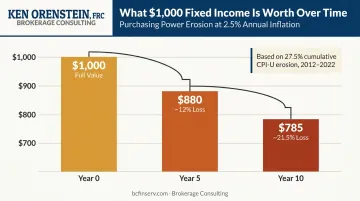
A fixed payment that feels comfortable today may lose purchasing power over time. According to BLS CPI-U data, cumulative inflation from 2012 to 2022 ran 27.5% — meaning a fixed $1,000 monthly payment had roughly $785 of 2012 purchasing power by 2022. Over a 10- or 15-year term, that erosion compounds. Shorter terms reduce this exposure; longer terms amplify it.
Rate Lock-In Risk
If interest rates rise significantly after you commit to your term, you're stuck at your original rate until the contract matures. Term length selection and timing are real strategic decisions — choosing wrong can cost you years of higher yields.
Fixed Term Annuity vs. Other Retirement Income Options
Fixed Term vs. Lifetime Annuity
| Factor | Fixed Term Annuity | Lifetime Annuity |
|---|---|---|
| Duration | Set period (2–10 years) | Until death |
| Maturity value | Yes — returned at end of term | No — principal surrendered |
| Flexibility | High — fresh decision at maturity | Low — permanent commitment |
| Best for | Income gaps, short-term certainty | Longevity protection, permanent income |
The core trade-off: a lifetime annuity eliminates the risk of outliving your income; a fixed term annuity preserves future optionality. If longevity risk is your primary concern, a lifetime annuity wins. If flexibility matters more — or you expect your income needs to shift — a fixed term gives you room to adapt.
Fixed Term vs. CDs
Both offer principal protection and fixed returns. The meaningful differences:
- Rates: As of May 2026, the best 5-year MYGA rate reached 6.30% versus the top 5-year CD rate of 4.15% APY, per Blueprint Income and Bankrate respectively
- Taxes: CD interest is taxable annually; MYGA interest is tax-deferred until withdrawal
- Insurance: CDs are FDIC-insured up to $250,000; MYGAs are backed by the issuing insurer and state guaranty associations — not federal deposit insurance
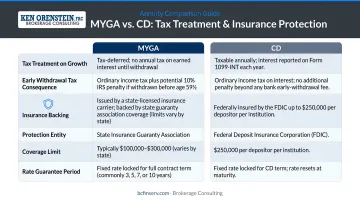
For conservative investors, the higher rate and tax deferral give MYGAs a real edge over CDs. The trade-off is coverage: no FDIC backstop means insurer financial strength analysis matters before any placement.
Fixed Term vs. Variable or Fixed Indexed Annuities
That CD comparison focuses on safety and yield — but what about products that offer market upside? Variable and fixed indexed annuities tie returns to market or index performance, which introduces more complexity, caps, and in some cases, more risk. Fixed term annuities trade that upside potential for pure rate certainty. For conservative investors or those nearing retirement who don't need market exposure in this portion of their savings, that simplicity is often the right call.
Who Should Consider a Fixed Term Annuity?
The Ideal Candidate
A fixed term annuity tends to work best for someone who:
- Is within 5–15 years of retirement (or already retired)
- Wants guaranteed income without permanently surrendering a lump sum
- Is risk-averse or already has equity exposure in other accounts
- Has a defined income gap to bridge — before Social Security, before pension eligibility, or during phased retirement
- Has investable assets available as a lump sum and doesn't need immediate liquidity
Federal Employees: A Natural Fit
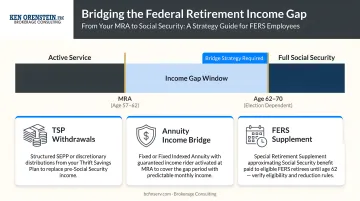
Under FERS, the Minimum Retirement Age (MRA) ranges from 55 to 57 depending on birth year — while Social Security full retirement age reaches 67 for those born in 1960 or later. For many federal employees, that's a decade-long gap with no automatic bridge.
That gap — between early retirement and full Social Security eligibility — can span a decade. During that window, income from a FERS supplement (which ends at 62), TSP distributions, and any bridge annuity need to work together. A fixed term annuity fills a defined slice of that gap with contractually guaranteed returns — letting TSP balances or other investments stay deferred and compound undisturbed.
Ken Orenstein, a Federal Retirement Consultant (FRC) and author of The Informed Fed: A Survival Guide to Federal Employee Benefits, works specifically with federal employees on this kind of multi-source income architecture. That means coordinating FERS pension, Social Security timing, TSP strategy, and annuity placement into a single cohesive plan. No-cost consultations are available by phone, virtual, or in-person at (888) 315-3608 or via bcfinserv.com.
Who Should Look Elsewhere
- Those who need ready access to the funds during the term
- Investors with very long time horizons who can afford market risk for higher growth potential
- Those whose income needs are already fully covered by pensions and Social Security — adding guaranteed income adds little marginal value
Frequently Asked Questions
Are fixed term annuities worth it?
They're worth considering for individuals who prioritize predictability, need to bridge a retirement income gap, or want tax-deferred growth without market exposure. They're less suitable for those who need liquidity during the term or are pursuing higher growth potential.
How much does a $100,000 fixed term annuity pay per month?
MYGAs are accumulation products, not monthly income generators. At a 6% rate on $100,000, you'd accumulate roughly $133,800 over five years. Monthly income figures depend on whether you convert to an income annuity at maturity.
What happens at the end of a fixed term annuity?
The contract matures and pays out a lump sum, called the maturity value. You can then take it as cash, roll it into a lifetime annuity, start a new fixed term at current rates, or move it into a different retirement vehicle. It's also worth comparing current carrier rates before committing to a renewal — rates shift, and your best option may differ from when you first opened the contract.
Does fixed term annuity income affect SSDI?
SSDI is not means-tested; it's based on work history and disability status, so annuity payments don't affect your benefit. SSI is different — it's means-tested, and annuity income can reduce your SSI payments. Confirm your specific situation with a qualified advisor.
What are current fixed term annuity rates?
As of May 2026, competitive MYGA rates ranged from approximately 5% to over 6% depending on term, carrier, and state availability. A-rated carriers generally fell in the 5.00%–5.60% range. Always compare carriers rated A- or better by AM Best for the most reliable guarantees.
Can I withdraw money early from a fixed term annuity?
Most contracts allow penalty-free withdrawal of up to 10% of the contract value annually. Beyond that, surrender charges apply. Withdrawals of taxable gains before age 59½ may also trigger a 10% IRS penalty on top of ordinary income taxes.