
A $400,000 annuity is one answer many retirees are exploring. But "how much will I get each month?" doesn't have a single answer. Based on current April 2026 market rates, a $400,000 single-premium immediate annuity (SPIA) pays between $2,012 and $3,680 per month for buyers aged 60 to 75 — a range wide enough that the details genuinely matter.
Your age, gender, annuity type, and whether you're covering one life or two all push that number up or down significantly. This guide breaks down payout estimates by age and product type, explains what drives the range, and shows how to position a $400,000 annuity within a broader retirement income plan.
Key Takeaways
- A $400,000 SPIA pays roughly $2,012–$3,680/month for ages 60–75 (single life, current rates)
- Age is the biggest lever — a 70-year-old receives $880/month more than a 60-year-old on the same $400,000
- SPIAs deliver the highest income immediately; FIAs with income riders can pay more after 5–10 years of deferral
- Deferring even 5 years on a FIA can meaningfully increase your monthly payout compared to buying a SPIA today
- Payout rates differ significantly by carrier — comparing quotes on the same $400,000 directly impacts what you receive
How Much Does a $400,000 Annuity Pay Per Month?
There's no single figure. Monthly income depends on your age, gender, payout structure, and product type — and the spread between the lowest and highest options is substantial.
Here's what the current market shows for a $400,000 single-life SPIA:
Single-Life SPIA Payouts by Age (April 2026 Rates)
| Buyer Age | Male Monthly | Female Monthly | Gender Difference |
|---|---|---|---|
| 60 | $2,120 | $2,012 | Male +$108 |
| 65 | $2,500 | $2,360 | Male +$140 |
| 70 | $3,000 | $2,812 | Male +$188 |
| 75 | $3,680 | $3,436 | Male +$244 |
Source: Annuity.org, April 2026 rate data
Each five-year delay in purchase produces a meaningful jump in monthly income. A male buyer waiting from 60 to 70 picks up an additional $880/month — that compounds into significant income across a retirement lasting 20+ years.
Men receive slightly higher payments than women because insurers price annuities on life expectancy. According to CDC mortality data, U.S. women live to 81.1 years on average versus 75.8 for men — so the insurer spreads the same $400,000 across more expected payments for a female buyer, reducing each check.
Joint Life and Period Certain Options
Not every buyer wants a single-life payout. Here's how the alternatives compare at $400,000:
| Payout Option | Age 65 Estimate | Age 70 Estimate | vs. Male Single-Life |
|---|---|---|---|
| Male single-life | $2,500/mo | $3,000/mo | Baseline |
| Female single-life | $2,360/mo | $2,812/mo | -$140 / -$188 |
| Joint life | $2,144/mo | $2,480/mo | -$356 / -$520 |
| Life + 20-year certain (male) | $2,292/mo | $2,676/mo | -$208 / -$324 |
| 20-year period certain only | $1,784/mo | $1,784/mo | -$716 / -$1,216 |
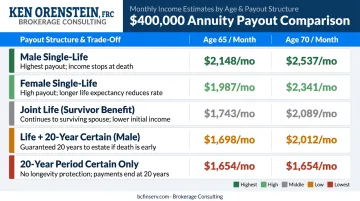
Each option carries a different risk-coverage balance. The right choice depends on your situation:
- Joint life covers two lifetimes, so the insurer plans for a longer payout window — each check is smaller, but your spouse is protected
- Life + period certain (e.g., 20-year certain) guarantees payments for a fixed term even if you die early — useful if you want some estate protection without fully sacrificing income
- Period certain only delivers the lowest monthly amount but locks in payments for a set term regardless of longevity — a fit for income-bridging strategies, not lifetime coverage
Key Factors That Determine Your Monthly Payout
Several variables determine where your $400,000 lands — and how to push that number higher. Understanding each one gives you real leverage before you sign anything.
Age at Purchase
Age is the single most impactful variable. The older you are at purchase, the fewer payments the insurer expects to make, and the larger each check.
The data is direct: a male buying at 60 receives $2,120/month; the same male buying at 70 receives $3,000/month. That's a 41.5% increase from a 10-year delay. For women, the gain is similar: $2,012 at 60 versus $2,812 at 70, a 39.8% jump.
Waiting does come at a cost — going without annuity income for 10 years requires other assets to bridge the gap.
Annuity Type and Interest Rate Environment
The annuity product you choose affects both timing and payout size:
- SPIAs begin paying immediately, offering the highest guaranteed income per dollar at purchase
- Deferred Income Annuities (DIAs) push the start date out, which increases the size of future payments
- FIAs with income riders grow a benefit base at a guaranteed roll-up rate during deferral before converting to lifetime income
SPIA and MYGA payouts are also directly tied to interest rates at the time of purchase. LIMRA reported $113.5 billion in total U.S. annuity sales in Q1 2024 — up 21% year-over-year — largely because higher rates made fixed annuity products significantly more attractive. When rates are higher, insurers can credit more and offer larger monthly checks.
On a SPIA, the rate locked in at purchase stays fixed for the life of the contract — which makes timing a meaningful decision.
Single vs. Joint Life and Rider Choices
Adding a spouse to the contract or selecting a period certain guarantee reduces monthly income — the insurer is committing to a longer or protected payout window.
At age 70, the difference between single-life ($3,000/month) and joint-life ($2,480/month) is $520/month. Over 15 years, that's roughly $93,600. Before defaulting to joint-life, evaluate whether existing life insurance already covers the surviving spouse — single-life paired with a term policy is sometimes the more efficient combination.
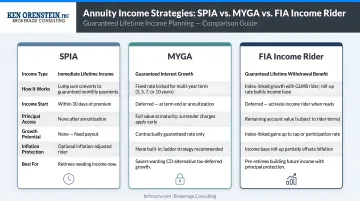
Comparing Annuity Types: SPIA vs. MYGA vs. FIA with Income Rider
Each product type serves a different timeline and income goal.
Immediate Annuity (SPIA)
A SPIA converts $400,000 into income within 30 days. Payments begin the following month, with no waiting period required. For a 65-year-old buying today:
- Male: ~$2,500/month
- Female: ~$2,360/month
SPIAs are best for retirees who need income now. Each payment combines interest and a return of your own principal, which is why payout rates exceed what a CD or savings account generates on interest alone.
Multi-Year Guaranteed Annuity (MYGA)
A MYGA works like a tax-deferred CD. Your $400,000 earns a fixed rate for a set term, and you can withdraw the interest monthly without annuitizing — preserving the principal for a future rollover or income conversion.
Current top rates (May 2026):
| Term | Top Rate | Monthly Interest on $400,000 |
|---|---|---|
| 3-year | 6.00% | ~$2,000/mo |
| 5-year | 6.15% | ~$2,050/mo |
| 7-year | 5.80% | ~$1,933/mo |
The principal stays intact at maturity — you can roll it into a new MYGA, convert to a SPIA, or redirect it entirely. MYGAs suit buyers who want guaranteed fixed-term interest without committing to lifetime annuitization .
Fixed Index Annuity (FIA) with Income Rider
Unlike MYGAs, FIAs with income riders are built for growth first, income later. A benefit base accumulates at a guaranteed roll-up rate during the deferral period, then converts to a lifetime income stream at a set payout percentage.
Consider a 60-year-old who deposits $400,000 into an FIA with a 7.0% simple annual roll-up rate. After 10 years at age 70:
- Benefit base: $680,000
- Payout rate at 70: 5.3%
- Annual income: ~$36,040
- Monthly income: ~$3,003/month
That outcome matches what a 70-year-old male buying a SPIA today would receive ($3,000/month) — achieved by deferring for a decade instead of starting immediately. Important note: the benefit base is not a cash value or death benefit. It's a calculation base used to determine income withdrawals.
Which Type Fits Your Situation?
| Scenario | Best Option |
|---|---|
| Need income within 30 days | SPIA |
| Want to preserve principal over 3–7 years | MYGA |
| 5–10 years from needing income, want larger future checks | FIA with income rider |
Is a $400,000 Annuity Enough to Retire On?
It depends on what else is in the picture. BLS data shows Americans aged 65+ spend an average of $61,432 per year ($5,119/month) in 2024. A $400,000 annuity paying $2,360–$3,000/month covers a large portion but doesn't close the gap alone for most households.
The more useful calculation combines annuity income with Social Security. The average retired-worker Social Security benefit was $1,975/month in December 2024. Add a $400,000 SPIA at age 65 ($2,360–$2,500/month) and the combined income reaches $4,335–$4,475/month, putting most retirees within reach of average spending levels before taxes.
Two caveats to understand:
The interest-only comparison. Leaving $400,000 in a high-yield savings account at 4–5% generates roughly $1,333–$1,667/month without touching principal. An annuity pays more precisely because it also returns principal gradually. SPIAs maximize current income; they don't preserve principal the way MYGAs do.
Inflation risk. Fixed annuity payments don't grow with inflation, and purchasing power erodes over a 20–30 year retirement. Cost-of-living adjustment (COLA) riders can add 1%–5% annual increases, but they reduce starting income by 20–30% and typically take 10–15 years to break even. Whether that trade-off makes sense depends on your health, other income sources, and timeline.
How to Maximize Your $400,000 Annuity Payout
A few decisions at purchase time can meaningfully increase what you receive each month.
Time Your Purchase Strategically
Waiting from 65 to 70 increases a male buyer's monthly check from $2,500 to $3,000 — an extra $500/month, or $6,000/year for life. Buying when interest rates are higher also locks in a better payout rate permanently.
Split Across Two Carriers
Most state guaranty associations protect up to $250,000 per carrier per contract type. Keeping all $400,000 with one insurer leaves $150,000 potentially above the coverage threshold. Splitting across two carriers reduces that concentration. Verify your state's specific limits before assuming full coverage.
Avoid these common mistakes:
- Choosing a carrier based on name recognition rather than current payout comparison — rates vary more than most buyers expect on the same day across carriers
- Defaulting to joint-life coverage without checking whether existing life insurance already protects the surviving spouse
- Ignoring tax treatment — qualified (IRA-funded) annuity payments are fully taxable as ordinary income, while non-qualified annuities use an exclusion ratio, changing the effective after-tax monthly amount considerably
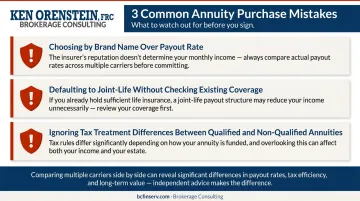
Avoiding these mistakes is easier when you're comparing rates across the full market, not just one carrier's offering.
Ken Orenstein at Brokerage Consulting works as an independent annuity specialist representing carriers including Aetna, Humana, TransAmerica, and others. That independence means direct rate comparisons across the market without single-carrier limitations. A no-cost consultation is available by calling (888) 315-3608 or visiting bcfinserv.com/request-a-quote.
Frequently Asked Questions
How much does a $400,000 annuity pay per month?
For most buyers aged 60–75, a $400,000 single-life SPIA pays between $2,012 and $3,680 per month based on current rates. A 65-year-old receives noticeably more than a 60-year-old on the same principal, and payout amounts differ between carriers on the same day.
How much would a $400,000 annuity pay monthly if purchased at age 70?
A 70-year-old buying a $400,000 single-life SPIA today would receive approximately $3,000/month if male or $2,812/month if female. These figures reflect current April 2026 rates and will vary with interest rate conditions at the time of purchase.
How do payouts scale for different principal amounts?
Annuity payouts scale proportionally with premium. At age 65, a $200,000 SPIA pays roughly $1,250/month (male) or $1,180/month (female); a $800,000 SPIA pays approximately $5,000/month (male) or $4,720/month (female) — double the $400,000 figures at the same age.
Can you live off the interest of $400,000?
At 4–5% APY, $400,000 generates roughly $1,333–$1,667/month in interest without drawing down principal. For many retirees, that's not enough on its own. An annuity produces higher monthly income by returning principal alongside interest, and most retirees pair it with Social Security rather than relying on either source alone.
Can I retire at 65 with $400,000?
$400,000 alone is tight for a full retirement. Combined with Social Security and an annuity generating $2,300–$2,500/month, many people can build a sustainable retirement income — especially when healthcare costs are covered through Medicare or employer coverage.
How much do I need to generate $60,000 per year in retirement?
To generate $60,000/year entirely from a SPIA, most mid-60s buyers would need approximately $800,000–$1,000,000 in annuity principal. But if Social Security covers $20,000–$25,000/year, a $400,000 annuity generating $28,000–$30,000/year closes much of the remaining gap.