That uncertainty is largely resolved now. A 2019 bargaining breakthrough restructured how future retirement benefits are earned, the Sound Variable Annuity Pension (VAP) launched in 2021 as the new forward-looking retirement vehicle, and in August 2024 — in a genuinely historic move — Prudential assumed $221 million in SRT pension liabilities covering roughly 8,700 retirees.
This article explains what these plans are, how the VAP's variable benefit structure actually works, and what the Prudential deal means for current and former workers. Whether you're still building your pension credit or already collecting, here's what you need to know.
Key Takeaways
- The Sound Retirement Trust (SRT) is a multiemployer pension plan for UFCW grocery workers in WA, OR, and ID, with 70,708 total participants and beneficiaries
- As of July 1, 2021, future retirement benefits for covered workers moved to the Sound Variable Annuity Pension (VAP) — a new structure designed to stay financially sound across market cycles
- The VAP uses four return zones and a stabilization reserve to protect against dramatic benefit swings
- Workers retiring after July 1, 2021 receive two separate monthly checks: one from SRT (or the UFCW Consolidated Fund for Kroger workers) and one from the VAP
- In August 2024, the SRT completed the first-ever multiemployer pension risk transfer in U.S. history, with Prudential assuming $221 million in obligations for ~8,700 retirees
What Is the Sound Variable Annuity Pension Trust?
The SRT: A Taft-Hartley Multiemployer Plan
The Sound Retirement Trust is a multiemployer pension plan established under the Labor Management Relations Act of 1947 — commonly known as the Taft-Hartley Act. Under this structure, contributing employers and labor unions (primarily UFCW) jointly manage a single retirement fund covering workers across multiple companies.
The practical benefit for workers: you can move between participating employers without losing your place in the plan. Your pension credit travels with you.
UFCW 3000, which represents more than 50,000 members across Washington state, northeast Oregon, and northern Idaho, covers workers in grocery, retail, health care, meat packing, and related industries. The SRT itself reported 70,708 total participants and beneficiaries in its 2022-2023 Annual Funding Notice, including 21,164 current employees and 18,618 retirees already receiving benefits. Zenith American Solutions administers the plan on behalf of the SRT.
The Sound VAP: The Forward-Looking Component
Established through 2019 collective bargaining, the Sound Variable Annuity Pension (VAP) is a separately structured fund. It covers all retirement benefits earned on and after July 1, 2021 for covered employees.
The Sound VAP differs from a traditional defined benefit pension in three key ways:
- Benefit structure: Traditional DB benefits are fixed regardless of market conditions; VAP benefits can adjust slightly up or down based on investment performance.
- Risk allocation: Under a traditional DB plan, the fund absorbs all investment risk and carries any shortfall indefinitely. The VAP shifts a portion of that risk to benefit adjustments.
- Downside protection: A built-in stabilization reserve limits dramatic swings in either direction, keeping benefit changes within defined boundaries.
Vesting: Participants earn their right to a pension benefit after completing 5 years of covered service. Service credit under both the SRT and VAP counts together, so workers don't lose vesting eligibility because of the transition between the two plans.
How the Sound VAP Works: Return Zones and the Stabilization Reserve
The Four Investment Return Zones
The VAP's benefit mechanism is built around four zones tied to annual investment returns:
| Return Zone | What Happens |
|---|---|
| Above 8.5% (Ceiling Rate) | Excess returns go into the stabilization reserve — not distributed |
| 5.5% – 8.5% (Hurdle to Ceiling) | Benefits may adjust upward |
| 2% – 5.5% (Floor to Hurdle) | Benefits may adjust downward |
| Below 2% | Stabilization reserve kicks in to support benefit payments |
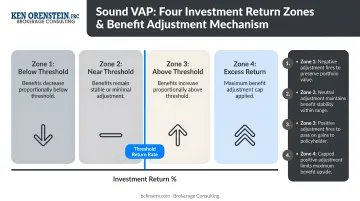
In a strong market year where the fund earns 10%, retirees don't receive a windfall. The extra return above 8.5% goes into a reserve account instead. In a bad year where returns fall below 2%, that same reserve steps in to subsidize benefits — so retirees don't face steep cuts.
The stabilization reserve received an additional $15 million in 2022 to further strengthen its buffer capacity. That reserve funding connects directly to how the plan is built on the employer side.
Employer Contributions and the Dual-Check System
Workers don't contribute to the VAP themselves. Employers contribute a set dollar amount for every hour a covered employee works — the rate is set through collective bargaining, not by individual workers.
At retirement, workers who earned credit both before and after July 1, 2021 receive two separate monthly checks:
- Check 1: From the SRT (or the UFCW Consolidated Pension Fund for Kroger employees) — covers service before July 1, 2021
- Check 2: From the VAP — covers service on or after July 1, 2021
Why Variable? The Lessons of 2000 and 2008
The SRT experienced nearly 20 years of funding problems caused primarily by the 2000 and 2008 market crashes, compounded by long-term shifts in the grocery retail industry. Traditional defined benefit plans absorb all investment risk — when markets fall sharply, the trust builds up unfunded liabilities that can take a decade or more to resolve.
The VAP's variable structure tracks funding in real time. Rather than accumulating hidden deficits, the benefit adjustment mechanism surfaces market impact immediately — in smaller, manageable increments — instead of creating large future shortfalls.
The 2021 Restructuring and the 2024 Prudential Deal
How the SRT Became Financially Stable
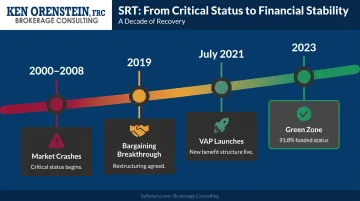
The Department of Labor certified the SRT as being in critical status for the plan year beginning October 1, 2020. The 2019 bargaining breakthrough (ratified by members after the union team secured a tentative agreement) set the restructuring in motion, with the final implementation step completed on July 1, 2021.
By the 2022-2023 Annual Funding Notice, the SRT reported Green Zone status with an estimated funded percentage of 91.8% as of October 1, 2023.
For Kroger employees specifically, all pre-July 1, 2021 SRT benefit liabilities transferred to the UFCW Consolidated Pension Fund, with Kroger committing to fund those liabilities within 7 years. Other employers' pre-2021 liabilities remain within the SRT.
The practical impact of stabilization: bargaining energy that previously had to focus on pension funding shortfalls (tens of millions of dollars per negotiating cycle) can now shift to member priorities like wages, staffing, and training.
The 2024 Prudential Deal: A Historic First
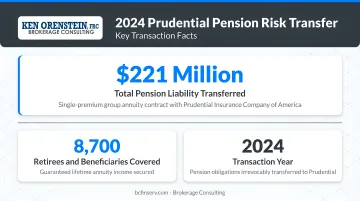
In August 2024, the Sound Retirement Trust completed the first-ever multiemployer plan pension risk transfer in U.S. history. Prudential Insurance Company of America assumed responsibility for approximately $221 million in SRT pension liabilities covering roughly 8,700 retirees and beneficiaries. Monthly payments from Prudential began September 1, 2024.
In a pension risk transfer, the plan sponsor hands off the obligation to pay retirees' monthly benefits to an insurer. For affected retirees, payment amounts don't change — only the payer does. Prudential's financial strength ratings reflect the security behind that shift:
- A+ from A.M. Best
- AA- from S&P
- Aa3 from Moody's
Pension risk transfers are routine in corporate single-employer plans. GM transferred approximately $25.1 billion in liabilities to Prudential in 2012; Verizon completed a $5.9 billion deal in 2024. Multiemployer plans are a different story.
These plans are governed by joint labor-management trustees, maintained under collective bargaining agreements, and subject to different ERISA frameworks than corporate plans. Applying the PRT structure to a jointly managed Taft-Hartley plan required navigating all of those complexities for the first time.
What These Changes Mean for Workers and Retirees
For Active Workers
- Employer contributions continue for every covered hour worked
- Vesting credit counts across both the SRT and VAP — the transition doesn't reset your clock
- Your eventual retirement income will include the dual-check system described above
- Review your benefit statements annually and track your hours toward vesting milestones
For Retirees
- If you're among the ~8,700 retirees included in the Prudential PRT, your payments now come from Prudential — same amount, different payer, added security of an insurance company guarantee
- For retirees remaining in the multiemployer plan, the PRT improved the plan's cash flow and reduced funded-status risk, which benefits long-term plan health for everyone
Thinking About the Bigger Picture
The VAP's long-term expectation is for investment returns to average at or above 5.5%, which would translate to stable or gradually increasing benefits over time. There's no guarantee of that outcome, but the stabilization reserve and return-zone structure are designed to keep any benefit changes measured rather than abrupt.
Even with those protections in place, your pension is one piece of a larger retirement income picture. Coordinating your VAP benefit and any SRT benefit with Social Security timing and personal savings drawdown requires careful planning around sequencing, tax efficiency, and longevity risk.
For personalized guidance on how these pension changes fit your overall retirement strategy, a qualified retirement advisor can help you make well-informed decisions about when to retire and how to structure your income.
Ken Orenstein at Brokerage Consulting specializes in multi-layered guaranteed income planning, integrating Social Security, pension income, and annuity-based income into a coordinated retirement strategy. A no-cost initial consultation is available at bcfinserv.com or by calling (888) 315-3608.
Frequently Asked Questions
What is a Sound Variable Annuity Pension Trust?
The Sound Variable Annuity Pension (VAP) is a collectively bargained multiemployer retirement fund covering UFCW grocery workers in the Pacific Northwest for service earned on or after July 1, 2021. Unlike a fixed pension, benefits can adjust slightly up or down based on investment performance within defined return zones, with a stabilization reserve providing a buffer against sharp market swings.
How does a pension trust work?
A pension trust pools employer contributions into a managed investment fund. When workers retire, the trust pays a monthly benefit based on years of covered service and contribution history. Workers don't manage the investments themselves — the trust, or an assigned insurer in the case of a pension risk transfer, is responsible for all payments.
How much monthly income would a $100,000 annuity provide?
It varies by age, gender, interest rates, and payout structure. As a general benchmark, 2025 CANNEX data analyzed by CBS News shows a $100,000 SPIA paying roughly $652/month for a 65-year-old male and $627/month for a 65-year-old female; a 70-year-old male receives approximately $729/month. These are external market figures — not Sound VAP estimates — so consult an advisor for a personalized quote.
Is my pension benefit safe after the Prudential transfer?
For the approximately 8,700 retirees included in the 2024 PRT, benefits are now backed by Prudential Insurance Company of America — rated A+ by A.M. Best, AA- by S&P, and Aa3 by Moody's. Payment amounts remain unchanged, and retirees gain the added security of an insurance company guarantee behind their monthly income.
What is a stabilization reserve in a variable annuity pension plan?
It's a buffer fund built up during high-return years — when investment gains exceed 8.5% in the Sound VAP — that is drawn upon when returns fall below 2% to protect retirees from sharp benefit cuts. It functions as a shock absorber, smoothing out market volatility so benefit adjustments stay incremental rather than severe.
How do I know if I am vested in the Sound Retirement Trust?
Most SRT participants vest after 5 years of covered employment, and service credit counts across both the SRT and VAP combined. For your specific vesting status and a benefit estimate, contact the plan administrator — Zenith American Solutions — directly through the Sound Retirement Trust website.