
Traditional deferred annuities are frequently positioned as the answer. But they're not a universal solution — they solve specific problems well and others not at all. Understanding exactly which financial needs they address is the difference between a well-fitted tool and an expensive mismatch.
This article covers what traditional deferred annuities are designed to do, which needs they address best, who the ideal candidate looks like, and where they fall short.
Key Takeaways
- Traditional fixed deferred annuities are built for conservative savers who want guaranteed, tax-deferred growth without market exposure
- Non-qualified annuities carry no IRS contribution limits, making them a practical overflow vehicle after maxing out a 401(k) or IRA
- They work best for people 5–20 years from retirement who can leave funds untouched during the accumulation phase
- 64% of Americans worry more about outliving their money than death. Lifetime payout options are built specifically to address that concern
- Paired with FERS pensions and TSP, deferred annuities fill income gaps that structured federal benefits alone may not cover
What Makes a Traditional Deferred Annuity Distinct
A traditional fixed deferred annuity is a contract issued by a life insurance company that credits a declared, guaranteed interest rate to your principal, grows tax-deferred, and distributes funds at a future date you choose.
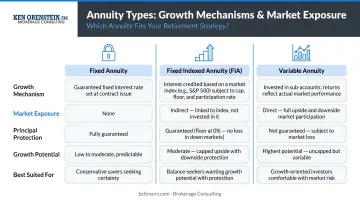
It differs from related annuity types in one critical way: how growth is generated.
| Product | Growth Mechanism | Market Exposure |
|---|---|---|
| Traditional fixed deferred annuity | Declared guaranteed interest rate | None |
| Fixed indexed annuity (FIA) | Linked to a market index (with caps/floors) | Indirect |
| Variable annuity | Sub-account investments | Direct |
The Two Phases
Every deferred annuity operates in two distinct periods:
- Accumulation phase — Your money grows at the guaranteed declared rate, tax-deferred, until you're ready to draw income
- Payout phase — Funds are distributed as a lump sum, withdrawals, or a stream of guaranteed income payments (including lifetime income)
The Safety Structure
Insurance companies issuing these contracts are required by law to maintain statutory reserves — calculated annually under rules established by the NAIC Standard Valuation Law. Beyond that, state life and health guaranty associations provide an additional protection layer, with most offering $250,000 or more in annuity benefits for resident policyholders, according to NOLHGA's 2024–2025 Safety Net report.
That two-layer structure — statutory reserves plus state guaranty association coverage — is why conservative savers gravitate toward these products. The guarantees rest on insurance company obligations and state-level safety nets, with no reliance on market performance.
The Financial Needs Traditional Deferred Annuities Are Best Suited For
Need 1: Tax-Deferred Accumulation Beyond Contribution Limits
The IRS caps how much you can contribute to qualified retirement plans each year:
- 401(k), 403(b), TSP elective deferrals: $23,500 in 2025
- IRA contributions: $7,000 in 2025 ($8,000 if age 50+)
Non-qualified traditional deferred annuities carry no IRS-imposed annual contribution limits, per FINRA's annuity guidance. For high-income earners who have already maxed out their qualified plans, this makes them a natural overflow vehicle for additional tax-deferred accumulation.
The numbers support this use case being concentrated among higher earners. According to Vanguard's How America Saves 2025 report, 49% of participants earning $150,000 or more reached the 2024 elective deferral limit — compared to just 14% of all participants. For federal employees, TSP limits mirror the same caps, meaning high-earning federal workers face the same ceiling.
Need 2: Principal Protection with Guaranteed Growth
Market-linked accounts can lose value. A traditional fixed deferred annuity cannot: the declared rate applies regardless of what equity or bond markets do. For someone in their late 50s who cannot recover from a 30% portfolio drop two years before retiring, that distinction is anything but minor.
The guarantee isn't marketing language. It's a contractual obligation backed by statutory reserves and state guaranty coverage.
Need 3: Supplemental Guaranteed Retirement Income
The accumulated value can be annuitized at retirement, converting into a predictable income stream paid for a set period or for life. In practice, this creates a personal pension that layers on top of Social Security or any employer-provided retirement benefit.
For federal employees with a FERS basic annuity already in place, a traditional deferred annuity can fill the gaps that the pension formula doesn't cover:
- Healthcare premiums in retirement
- Long-term care costs
- A spending buffer above the calculated FERS benefit
Need 4: Longevity Protection
According to Allianz Life's 2025 Annual Retirement Study, 64% of Americans worry more about running out of money than death. The concern is well-founded. The CDC reports that a 65-year-old today can expect to live another 19.7 years on average — longer for women (20.8 years).
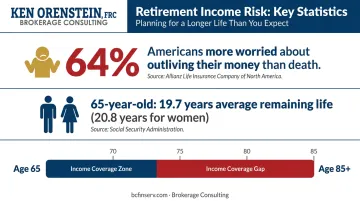
Electing a lifetime payout option from a traditional deferred annuity transfers this longevity risk entirely to the insurance company. The insurer, not the retiree, absorbs the financial consequence of a longer-than-expected life.
Need 5: Safe Parking for a Lump-Sum Windfall
A business sale, inheritance, or pension buyout creates an immediate question: where does this money go while you decide what to do with it?
A single-premium traditional deferred annuity answers that question. The lump sum goes to work immediately in a tax-deferred, principal-protected environment. Income decisions (when to start, in what form) are deferred to a future date, with no forced market exposure in the meantime.
Who Is Best Suited for a Traditional Deferred Annuity
Conservative Savers in Their Late 40s Through 60s
The classic fit: someone within 5–20 years of retirement who wants steady, predictable accumulation without exposure to market downturns. They have enough runway to benefit from compound, tax-deferred growth before needing income — but not so much time that locking funds up for a decade creates a hardship.
High-Income Earners Who Have Reached Contribution Limits
Once the TSP, 401(k), and IRA are maxed, there aren't many tax-deferred options left. A non-qualified traditional deferred annuity fills this gap with no contribution ceiling. For peak earners in their 50s and 60s who are adding significant income annually, this matters.
Federal Employees with Existing Pension Income
Federal employees under FERS already receive a foundational three-part retirement income structure: the Basic Benefit Plan, Social Security, and the Thrift Savings Plan. A traditional deferred annuity adds a fourth layer: guaranteed income that can address spending gaps, healthcare premiums, or long-term care costs the FERS formula doesn't cover.
For federal employees who have maxed their TSP at $23,500 and still have investable income, a non-qualified traditional deferred annuity becomes the logical next vehicle. Ken Orenstein at Brokerage Consulting works specifically with federal employees to assess how a traditional deferred annuity fits within the full FERS + Social Security + TSP picture — at no cost.
Risk-Averse Individuals Approaching or Entering Retirement
Someone who spent 30 years building a nest egg and cannot afford to see it decline 25% in year one of retirement is a natural fit for principal guarantees. When the margin for error disappears, a guaranteed floor means one less variable to worry about — and that certainty has concrete financial value.
The Tax Advantage — How It Works in Practice
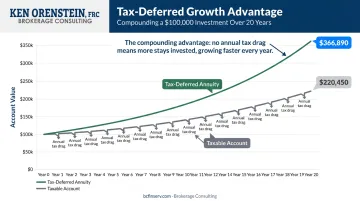
Tax deferral works as a compounding mechanism. Inside a traditional deferred annuity, interest compounds on the full balance each year because it isn't reduced by annual income tax. In a taxable account at the same rate, a portion of each year's earnings exits the account to pay taxes, leaving a smaller base to compound from.
The gap between these two accounts widens noticeably over 20–25 years. A $100,000 initial investment at a hypothetical fixed return, compared across taxable and tax-deferred accounts, can produce tens of thousands of dollars more in the tax-deferred account by year 20 — a difference driven entirely by keeping earnings intact to compound year after year.
Qualified vs. Non-Qualified: The Tax Distinction
How you're taxed at withdrawal depends on how you funded the contract:
- Qualified annuities (funded with pre-tax dollars): All withdrawals are taxable as ordinary income
- Non-qualified annuities (funded with after-tax dollars): Only the earnings portion is taxable at withdrawal — per IRS Publication 575, withdrawals before annuitization use an earnings-first rule; periodic annuity payments apply an exclusion ratio that returns a portion of principal tax-free
Strategic Withdrawal Timing
Taking annuity income during retirement — when overall income may be lower than peak earning years — can mean paying taxes at a lower bracket than you would have during accumulation. No changes to the annuity itself are needed to capture this benefit — the timing does the work.
The IRA Caveat
Placing a traditional deferred annuity inside an IRA or other already-tax-deferred account adds no additional tax benefit. The account is already tax-deferred, making the annuity's tax deferral redundant. FINRA and the NAIC both note this explicitly. In that context, choose the annuity for its other features: the guaranteed interest rate, principal protection, or specific income options — not tax deferral alone.
Limitations That Affect Suitability
These products have real constraints. Ignoring them leads to poor placement decisions.
Surrender charges and illiquidity: Traditional deferred annuities impose surrender charges on withdrawals exceeding the contract's penalty-free provisions. Many contracts allow a 10% annual free withdrawal after year one; amounts above that trigger declining-schedule charges during the surrender period. The IRS also applies a 10% early withdrawal penalty on earnings taken before age 59½. Anyone who may need near-term access to their funds should not purchase this product.
Inflation risk: A fixed declared rate is predictable, but it isn't inflation-linked. When PCE inflation peaked at 7.1% in June 2022, fixed-rate products lost purchasing power in real terms. For savers with very long time horizons, this tradeoff versus variable or indexed alternatives deserves explicit consideration.
Contract complexity: The structure of a traditional fixed deferred annuity involves maturity dates, settlement option elections, and renewal rates that carry real financial consequences. Working through these terms with a qualified advisor before committing is the minimum responsible step.
Brokerage Consulting's no-cost initial consultation covers exactly this ground — reviewing contract terms, comparing carriers, and clarifying the financial consequences before any commitment is made.
Frequently Asked Questions
What needs are traditional deferred annuities best suited for?
They work best for conservative savers who need tax-deferred accumulation beyond 401(k) and IRA limits, principal protection with guaranteed growth, supplemental guaranteed retirement income, and longevity protection. They are most appropriate for those who won't need access to funds during the accumulation phase.
What is an example of a deferred annuity?
A 55-year-old makes a single-premium deposit into a traditional fixed deferred annuity, earns a guaranteed declared interest rate tax-deferred for 10 years, then converts the accumulated value into monthly income payments at age 65. The income amount is known at contract issuance, not determined by market conditions at retirement.
What is the difference between a traditional fixed deferred annuity and a fixed indexed annuity?
A traditional fixed deferred annuity credits a declared guaranteed interest rate regardless of market performance. A fixed indexed annuity links potential interest credits to a market index with caps and floors. The traditional version is more predictable; the indexed version may earn more in strong markets but introduces more complexity and variability.
Can I lose my principal in a traditional deferred annuity?
No. The insurance company contractually guarantees the declared rate of return, and your full principal is preserved. This is the fundamental difference from variable annuities, where market losses can reduce account value.
Are traditional deferred annuities a good fit for federal employees?
They can be. Federal employees with FERS pensions and TSP accounts already have a strong income foundation. A traditional deferred annuity can provide additional tax-deferred accumulation and supplemental guaranteed income to cover spending gaps or healthcare costs. This is especially useful for those who have maxed out their TSP contributions and want continued tax-deferred growth.