
The stakes are significant. According to the Society of Actuaries' 2024 Retirement Risk Survey, 46% of retirees are now concerned about running out of money — up sharply from 36% in 2021.
This article covers exactly what distinguishes these two tools: clear definitions, a side-by-side comparison, key structural differences, and practical guidance on when to use one, the other, or both.
Key Takeaways
- An IRA is a tax-advantaged account that holds investments you select — stocks, bonds, ETFs, mutual funds
- An annuity is an insurance contract that converts savings into guaranteed income, either now or later
- Both offer tax-deferred growth, but annuities carry no IRS contribution limits; IRAs cap at $7,000/year in 2025 ($8,000 for those 50+)
- IRAs offer more flexibility and lower fees — annuities provide income guarantees, but come with added cost and complexity
- Many retirees benefit from using both: IRAs for growth, annuities for a predictable income floor
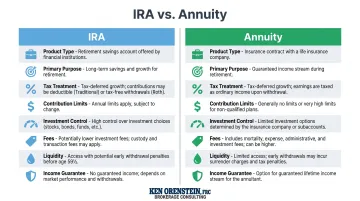
Annuities vs IRAs: Quick Comparison
| Feature | IRA | Annuity |
|---|---|---|
| Product Type | Retirement account | Insurance contract |
| Primary Purpose | Wealth accumulation | Guaranteed income |
| Tax Treatment | Traditional: tax-deferred; Roth: tax-free | Tax-deferred growth; withdrawals taxed as ordinary income |
| Contribution Limits | $7,000–$8,000/year (2025) | No IRS limit |
| Investment Control | Investor chooses assets | Managed by insurer per contract |
| Fees | Generally low | Can be substantial (M&E, surrender charges, riders) |
| Liquidity | Flexible (penalty before 59½) | Restricted during surrender period |
| RMDs | Required at age 73 (traditional) | Non-qualified annuities exempt; qualified annuities subject to RMDs |
| Income Guarantee | No | Yes (fixed and immediate types) |
The right choice depends on your age, income, tax situation, and how far you are from retirement.
What Is an IRA?
An IRA — Individual Retirement Account — is not an investment itself. It's a tax-advantaged account that holds investments like stocks, bonds, ETFs, and mutual funds — shielding their growth from immediate taxation. IRAs are available through most banks and brokerages, often with no minimum balance to open.
Money inside an IRA grows based on the performance of whatever assets the account holder selects. The tax advantage depends on the IRA type — which is where traditional and Roth accounts diverge significantly.
Types of IRAs
Traditional IRA: Contributions may be tax-deductible depending on income and workplace plan access. Growth is tax-deferred, meaning you pay taxes when you withdraw in retirement — as ordinary income. Required Minimum Distributions (RMDs) begin at age 73 under the SECURE 2.0 Act.
Roth IRA: Contributions are made with after-tax dollars, so withdrawals in retirement are completely tax-free. There are no RMDs during the owner's lifetime, making Roth IRAs a strong legacy planning tool. The tradeoff: income limits apply. For 2025, single filers phase out between $150,000–$165,000 MAGI; married filing jointly between $236,000–$246,000.
The 2025 contribution limits, per the IRS:
- Standard limit: $7,000/year
- Age 50+ catch-up: $8,000/year
- These limits apply across all traditional and Roth IRAs combined
Which Type Fits Your Situation?
If you expect a lower tax bracket in retirement, a traditional IRA's upfront deduction often wins. If you expect your bracket to stay the same or rise, the Roth's tax-free withdrawals typically deliver more value. Running both scenarios with your actual income projections usually makes the right answer clear.
What Is an Annuity?
An annuity is a contract between you and an insurance company. You pay premiums — either as a lump sum or over time — and the insurer promises to pay you income according to the contract terms. The core appeal is protection against outliving your savings: the insurance company assumes the longevity risk, not you.
Annuities can be held inside an IRA, but they are not retirement accounts themselves. That distinction matters for tax treatment, as explained in the Key Differences section below.
Fee Structures to Know
Annuity costs vary significantly by type, but variable annuities carry the most layered fees:
- Mortality & Expense (M&E) charges: Typically around 1.0–1.5% of account value annually
- Administrative fees: Roughly $25–$30/year or ~0.15% of account value
- Living benefit riders (GLWB, GMIB): An additional 1.0–1.5% annually on the income base
- Surrender charges: Often start near 7% in year one, declining over a 6–10 year schedule
- All-in variable annuity costs can exceed 3% per year when all components are combined
Fixed and fixed indexed annuities embed costs in the spread between what the insurer earns and what it credits to your contract — no M&E charges — though surrender charges still apply on early withdrawals.
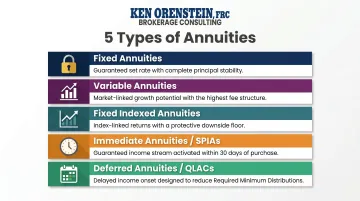
Types of Annuities
Understanding fee structures helps frame the type selection decision — because what you pay is directly tied to what type of annuity you choose.
- Fixed Annuities — Guarantee a set interest rate and predictable income. The tradeoff: limited upside in exchange for full stability.
- Variable Annuities — Invest premiums in market-linked sub-accounts, offering higher growth potential but also the highest fee loads of any annuity type. Returns fluctuate with performance.
- Fixed Indexed Annuities (FIAs) — Link returns to an index like the S&P 500 with a floor protecting against losses. A 6% annual cap, for example, means a 15% index gain still credits only 6%. Crediting methods (point-to-point, monthly average, participation rate) vary by contract.
- Immediate Annuities (SPIAs) — Begin paying income within 30 days of a lump-sum purchase. A common tool at or near retirement for converting a nest egg into an instant income stream.
- Deferred Annuities — Delay income to a future date, allowing tax-deferred accumulation in the meantime. This category includes Qualified Longevity Annuity Contracts (QLACs), which defer income to ages 80–85 and exclude up to $200,000 in premium from RMD calculations — a specialized option for IRA holders.
Key Differences Between Annuities and IRAs
Tax Treatment
Both offer tax-deferred growth, but the mechanics differ in important ways.
- Traditional IRA: Contributions may be pre-tax; full withdrawals taxed as ordinary income
- Roth IRA: After-tax contributions; qualified withdrawals are completely tax-free
- Non-qualified annuity (purchased outside an IRA with after-tax dollars): Only the earnings portion is taxed on withdrawal — your original principal comes back tax-free
- Qualified annuity (held inside a traditional IRA): The full withdrawal is taxed as ordinary income — no cost basis advantage
One critical point flagged by the SEC: placing an annuity inside a tax-deferred account like a traditional IRA provides no additional tax advantage beyond what the IRA already delivers, while still adding annuity fees. This doesn't make it always wrong — income riders and longevity protection can still justify it — but the tax deferral argument alone doesn't hold up.
Contribution Limits and Funding
IRAs are capped at $7,000 ($8,000 for 50+) per year by IRS rules. Non-qualified annuities have no IRS contribution cap — as FINRA confirms, you can deposit any amount of after-tax dollars. This makes non-qualified annuities attractive for high earners who have already maxed out their IRA and 401(k) contributions.
Investment Control and Liquidity
- IRAs: Full investor control — choose and rebalance any time
- Annuities: Control sits with the insurer; variable and indexed types offer a limited menu of choices
On liquidity, both impose a 10% IRS penalty on withdrawals before age 59½. IRAs allow withdrawals at any time otherwise. Annuities layer on surrender charges during the contract's early years — often 6–10 years — restricting access to your funds without penalty.
Income Guarantees and Longevity Risk
IRAs have no income guarantee — their value tracks market performance. Fixed and immediate annuities can guarantee income for life, regardless of how long you live.
The longevity math makes this distinction concrete:
- A 65-year-old woman has approximately 20.8 additional years of life expectancy (CDC data)
- A 65-year-old man has a 50% chance of reaching age 84, per Social Security actuarial tables
- Roughly 1 in 4 people who reach 65 will live past 90
A 20–25 year retirement is not a planning edge case — it's the norm. An annuity transfers that longevity risk to the insurance carrier.

Annuity vs IRA: Which Is Better for Your Retirement?
Neither is universally better. The right tool depends on where you are in your retirement journey.
Lean toward an IRA when:
- You're in the accumulation phase and focused on long-term growth
- You want full control over investment choices and allocations
- Low fees and flexibility are priorities
- You're comfortable managing market risk
Lean toward an annuity when:
- You're at or near retirement and want guaranteed income you cannot outlive
- You lack a pension and need a reliable income floor
- You've maxed out IRA and 401(k) contributions and want additional tax-deferred savings
- Longevity risk concerns you more than investment upside
The "Use Both" Strategy
For many retirees, the most effective approach combines both tools — IRAs for building wealth during working years, and annuities for converting a portion of that wealth into guaranteed income at retirement.
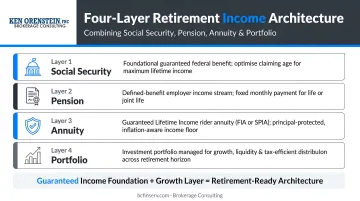
At Brokerage Consulting, Ken Orenstein applies a flooring strategy: Social Security, pensions, and guaranteed lifetime income annuities cover essential expenses, while a discretionary investment portfolio — managed through Brookstone Capital Management — handles growth, legacy, and emergencies.
The annuity layer fills the income gap between what Social Security and any pension provide and what you actually need to live on.
Federal employees face this coordination challenge directly. For clients managing FERS pension income, Social Security, and TSP savings, Ken Orenstein designs a four-layer income architecture — Social Security, FERS pension, guaranteed income annuities, and a discretionary portfolio — that puts this strategy into practice.
When an Annuity Inside an IRA Makes Sense
Buying an annuity inside a traditional IRA adds annuity fees without adding tax deferral — the IRA already provides that. The SEC is explicit on this point.
That said, it can still make sense in specific situations:
- You want a guaranteed lifetime withdrawal benefit (GLWB) rider for longevity protection
- You're using a QLAC inside an IRA to defer income and reduce RMD exposure
- The income guarantee itself — not the tax treatment — is the primary objective
It typically doesn't make sense when the only goal is tax deferral, or when a lower-cost product can deliver the same income guarantee without the added annuity fees.
Frequently Asked Questions
What is better, an IRA or an annuity?
Neither is universally better. IRAs are generally superior for wealth accumulation and flexibility during your working years, while annuities are better for guaranteeing income in retirement. The right answer depends on your age, income needs, and how much longevity risk you want to carry.
Why would someone choose an annuity over an IRA?
The primary reason is lifetime income. Annuities guarantee payments regardless of how long you live, which matters when you don't have a pension. They also have no IRS contribution limits, making them useful for high earners who have already maxed out their IRA and employer plan contributions.
What is the difference between an IRA and an annuity?
An IRA is a tax-advantaged account structure that holds investments you select; the account value depends on market performance. An annuity is an insurance contract designed to convert savings into a guaranteed income stream, with the insurer assuming both the investment and longevity risk.
Is a tax-deferred annuity the same as an IRA?
No. Both defer taxes on growth, but an IRA is an account structure while an annuity is an insurance product. Placing an annuity inside a traditional IRA (called a "qualified annuity") doesn't add tax deferral beyond what the IRA already provides, and still subjects you to annuity fees.
What type of account is a variable annuity?
A variable annuity is an insurance contract, not a savings account. Premiums go into market-linked sub-accounts similar to mutual funds, so returns vary with performance. This means higher growth potential than fixed annuities, but also higher risk and substantially higher fees.
This content is for educational purposes only and does not constitute investment or tax advice. Investment advisory services are offered through Brookstone Capital Management, LLC, a registered investment advisor. Insurance products, including annuities, are offered separately through individually licensed and appointed agents. Guarantees are subject to the claims-paying ability of the issuing insurance company. For personalized guidance, contact Ken Orenstein at Brokerage Consulting: (888) 315-3608.