The FlexChoice Access rider, offered on Brighthouse Financial variable annuities, is one such tool. Variable annuities are frequently misunderstood — dismissed as too expensive by some, oversimplified as retirement cure-alls by others. Neither characterization is accurate. This article cuts through both and explains what FlexChoice Access actually delivers: guaranteed lifetime income, flexible withdrawal control, and built-in spouse protection — and where those features genuinely matter in retirement planning.
Key Takeaways
- FlexChoice Access is an optional living benefit rider on a Brighthouse variable annuity that guarantees lifetime income
- The benefit base grows at a 5% compounded deferral bonus each year for the first 10 contract years (no withdrawals required)
- Withdrawal timing and payout structure are flexible — you don't have to lock in those choices at purchase
- Spouse coverage is included at no extra charge, at the same initial withdrawal rate as single holders
- Total fees stack across multiple layers; review each one carefully before committing
What Is the FlexChoice Variable Annuity?
FlexChoice Access is a Guaranteed Lifetime Withdrawal Benefit (GLWB) rider attached to a Brighthouse Financial Series VA — a flexible premium deferred variable annuity. It gives you contractually guaranteed income for life while keeping your money invested in the market. It is not a standalone investment account, and it is not designed primarily as a growth vehicle.
Here is how the structure works:
- Your account value tracks actual market performance across 50+ sub-account investment options
- Your benefit base is a separate contractual figure used only to calculate guaranteed income (not a cash value or lump sum you can withdraw)
- Your lifetime income is calculated by multiplying the benefit base by your applicable withdrawal rate, regardless of market performance
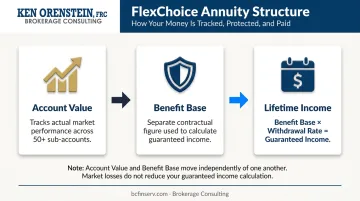
This distinction matters. If markets decline and your account value drops, your income calculation is still anchored to the benefit base. The two figures move independently.
FlexChoice Access is most relevant for people approaching or already in retirement who want a predictable income floor alongside continued market exposure. It is a long-term commitment. The fee structure and surrender period reflect that, and the rider delivers its full value when you avoid excess withdrawals and hold it through the income phase.
Key Advantages of the FlexChoice Access Rider
The three advantages below correspond directly to the most common retirement planning concerns: outliving your income, losing flexibility, and leaving a spouse unprotected. Each one addresses a specific structural problem.
Advantage 1: Guaranteed Lifetime Income with Market Upside Potential
According to Allianz Life's 2025 Annual Retirement Study, 64% of Americans worry more about running out of money than dying — a fear shared across generations. FlexChoice Access is built to solve that problem at the contract level, through two mechanisms that work in opposite market directions.
The mechanism works in two directions:
Downside protection: Even if your account value falls to zero due to market conditions, income continues for life. The benefit base — not the account value — drives the calculation.
Upside capture: On each contract anniversary before age 91, if your account value exceeds the current benefit base, the benefit base steps up to lock in those gains permanently. A higher benefit base means a higher guaranteed income stream going forward.
This combination matters most in three scenarios:
- During prolonged market volatility or bear markets early in retirement
- In extended low-interest-rate environments where bond-heavy portfolios underperform
- For retirees without a traditional pension — including private-sector workers and federal employees transitioning from defined benefit-style coverage
The step-up is contingent on market performance, not guaranteed annually. When it does trigger, though, the gain to your income base carries forward for the life of the contract — it cannot be reversed by a subsequent market decline.
Key metrics this advantage affects: monthly income floor, benefit base growth rate, income replacement ratio in retirement
Advantage 2: Flexible Withdrawal Timing and Payout Structure
Many annuity products lock in your income start date and payout structure at purchase — decisions you may not be ready to make on day one. FlexChoice Access takes a different approach — the timing and structure of withdrawals can be deferred until you actually need income.
The 5% deferral bonus is central to this flexibility. For each of the first 10 contract years in which no withdrawals are taken, the benefit base compounds at 5% annually. The compounding effect over time:
| Year | Benefit Base Growth (Starting $200,000) |
|---|---|
| Year 5 | $255,256 |
| Year 7 | $281,420 |
| Year 10 | $325,779 |
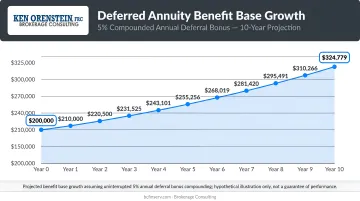
This is a benefit base illustration only — not account value, cash value, or investment return.
Deferring withdrawals for five years grows the guaranteed income base by roughly 28% in this illustration. Waiting the full 10 years produces a benefit base that is roughly 63% larger than the original premium before a single dollar of income is taken.
Two payout structures are available once withdrawals begin (initiated by the first withdrawal taken after age 59½):
- Level payments for life — consistent monthly income across all retirement years
- Higher early withdrawals — accelerated income during the more active, higher-spending years of early retirement, with adjustments later
The initial withdrawal rate is locked in by the first withdrawal taken. That means the decision about when to start income matters — but it does not have to be made on day one of the contract.
This flexibility is most valuable for:
- Early retirees with phased retirement plans who may not need annuity income immediately
- Those with other income sources (Social Security, part-time work) who can allow the benefit base to compound
- Retirees who want higher spending flexibility in their 60s before income needs shift
Key metrics this advantage affects: income start date, withdrawal rate at first withdrawal, benefit base at income start, total lifetime income received
Advantage 3: Spouse and Family Protection Built Into the Rider
FlexChoice Access includes joint lifetime income coverage at no additional charge. A surviving spouse continues receiving income for their lifetime after the primary contract holder passes — without restructuring the financial plan or purchasing a separate rider.
Several design features distinguish this from typical joint coverage:
- No forced decision at purchase — the election between single and joint lifetime income can be deferred until withdrawals begin
- Age-based rate advantage — income is calculated based on the older owner's age, which may produce a higher initial withdrawal rate sooner
- Rate parity at initial withdrawal — married couples receive the same initial withdrawal rate as single holders, per Brighthouse's married-client brochure
The rate parity point deserves context. Morningstar's 2025 GLWB analysis shows that joint-life payout rates in the industry are typically 0.5 percentage points lower than single-life rates. The GAO has reported the same differential. FlexChoice's initial rate parity for married clients is a meaningful differentiator against this industry norm.
One important nuance: per Brighthouse materials, the Joint Lifetime Guarantee Rate — which applies after the account value reaches zero — is lower than the Single Lifetime Guarantee Rate. Initial withdrawal rate parity does not extend to every phase of the contract. Review the current prospectus carefully.
This benefit matters most for:
- Dual-income households transitioning to retirement
- Couples with a significant age gap (older owner's age determines the withdrawal rate)
- Households where one spouse has limited independent retirement savings
Key metrics this advantage affects: spousal income continuity, joint vs. single withdrawal rate parity, survivor benefit reliability
What Happens Without Lifetime Income Protection
Retirees who rely solely on market-dependent portfolios face a risk that most underestimate until they experience it: sequence-of-returns risk.
Research published in the Journal of Financial Planning found that a 25% portfolio drop turns a 4% withdrawal rate into an effective 5.33% withdrawal rate — because the same dollar withdrawal represents a larger percentage of a smaller portfolio. Early losses compound. The portfolio never fully recovers from the same starting position.
Without a guaranteed income floor, the consequences tend to follow a predictable pattern:
- Income becomes irregular — tied to portfolio performance rather than a contractual floor
- Downturns force spending reductions precisely when retirees are least prepared to adapt
- Portfolios may deplete before death, with no backstop
- Managing withdrawals through volatility takes a real psychological toll — one most retirement plans never account for
These consequences don't end with the first spouse. Without a built-in survivor benefit, a surviving spouse faces an abrupt income reduction at the worst possible time. SSA research indicates the median widow can expect income of roughly 71-73% of what the couple received before the spouse's death — a shortfall that a guaranteed joint income rider is specifically designed to close.
How to Get the Most Value from FlexChoice Access
How you use FlexChoice Access determines whether the cost is justified. The strategy choices — when to start income, which riders to elect, which sub-accounts to hold — have a compounding effect on lifetime value.
Maximize the deferral period. The 5% compounded bonus runs for the first 10 contract years without withdrawals. Every year deferred within that window compounds into a larger benefit base — and therefore the guaranteed income amount for life. Starting withdrawals in year three versus year nine produces a substantially different lifetime income stream.
Understand total fees before committing. The FlexChoice Access rider adds approximately 1.35% annually (on the benefit base), alongside:
- Base contract M&E and administrative charges: 1.30%
- Optional GLWB Death Benefit rider: 0.65% (if elected)
- Annual account fee: $30 if account value is under $50,000
- Underlying portfolio expenses: 0.52% to 4.15% depending on sub-accounts selected
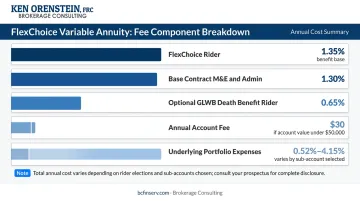
Total costs depend on which options are elected and which sub-accounts are chosen — an actual illustration from your advisor is the only reliable way to model the full cost picture.
Match income timing to your other sources. For clients who have Social Security, a FERS pension, or part-time income covering essential expenses, deferring annuity withdrawals allows the benefit base to compound longer. For those with income gaps to fill immediately, earlier withdrawals may make more sense — even if it means a lower benefit base at income start.
Federal employees balancing FERS supplements, TSP distributions, and Social Security timing face a more complex decision matrix than most. Ken Orenstein at Brokerage Consulting works specifically with federal workforce clients to model how a product like FlexChoice fits — or doesn't — before any commitment is made.
Conclusion
The FlexChoice Access rider's practical value comes down to three outcomes:
- A guaranteed income floor that survives market downturns
- Withdrawal flexibility that adapts to real retirement timelines
- Built-in spouse protection that removes a common planning trade-off
Those advantages compound when the product is used intentionally, particularly when the deferral bonus period is maximized and income timing is coordinated with other retirement income sources. Without that intentionality, fees can erode the value proposition.
FlexChoice is not the right fit for everyone. Its value depends on fee tolerance, income longevity concerns, and how it integrates with your overall retirement income plan. A conversation with an advisor who can model your specific income timeline — including Social Security, pensions, and other sources — will clarify whether FlexChoice belongs in your strategy.
Frequently Asked Questions
How much would a $100,000 FlexChoice variable annuity pay out per month?
Monthly income depends on the benefit base at first withdrawal — not just the original premium — and the applicable withdrawal rate for your age. Industry GLWB rates at age 65 are typically around 5%, which would produce roughly $416/month on a $100,000 benefit base. Actual FlexChoice amounts require a personalized illustration from Brighthouse.
What is the FlexChoice Access rider and how does it work?
The FlexChoice Access rider is an optional living benefit add-on for a Brighthouse Financial variable annuity. It builds a contractual benefit base — separate from your account value — that determines guaranteed lifetime withdrawal amounts. A 5% compounded deferral bonus grows that benefit base each year for the first 10 contract years, provided no withdrawals are taken.
What fees are associated with the Brighthouse FlexChoice variable annuity?
Fees are layered across several components:
- FlexChoice rider: ~1.35% annually on the benefit base
- Base contract M&E/admin: 1.30%
- Optional death benefit rider: 0.65%
- Underlying portfolio expenses: 0.52%–4.15%
A $30 annual account fee applies if your account value falls below $50,000. Total costs vary based on your elections and sub-accounts chosen.
Can I cancel the FlexChoice income rider if I no longer need lifetime income?
Yes — the rider includes cancellation provisions. However, cancellation may affect other contract features, so you should review the current contract terms with your advisor before making that decision.
Is the FlexChoice variable annuity a good fit for federal employees?
Federal employees with FERS pension income may find FlexChoice most useful as a supplemental income layer — covering gaps between FERS, Social Security, and TSP withdrawals, or providing a guaranteed income floor for a surviving spouse. Suitability depends on your full retirement income picture.
What happens to my FlexChoice benefits if the market drops significantly?
The guaranteed benefit base is not reduced by market losses — income calculations always use the benefit base, not the account value. Even if your account value reaches zero, income continues from Brighthouse's general account (subject to the Lifetime Guarantee Rate, which may differ from the standard rate). Review the current prospectus for full details.