
For pre-retirees and retirees evaluating variable annuities, that distinction matters. A fee that seems minor at contract inception can represent tens of thousands of dollars in cumulative cost over a 20-to-30-year retirement. Understanding what the M&E charge actually funds, how it's calculated, and where to find it in the contract is essential groundwork before committing to any variable annuity.
Key Takeaways
- The M&E charge is an annual fee on variable annuities, typically averaging around 1.25% per year, deducted automatically from subaccount value
- It covers two insurer risks: mortality risk (death benefit guarantees) and expense risk (guaranteed contract costs won't rise)
- The charge applies only to variable subaccount funds, not fixed account allocations — easy to overlook
- Fixed annuities generally do not carry an explicit M&E charge; the fee is primarily a variable annuity cost
- Review the fee table in the prospectus and compare total annual costs before purchasing any contract
What the M&E Charge Is
The M&E charge is a fee the insurance company imposes on variable annuity holders to compensate for two categories of financial risk it takes on under the contract:
- Mortality risk: If you die when your account value has dropped below total premiums paid, the insurer must cover the difference through the guaranteed death benefit. That obligation represents real financial exposure.
- Expense risk: When you sign a variable annuity contract, the insurer guarantees it will not raise the stated contract charges over the life of the policy — even if its own administrative costs increase. The M&E charge funds that promise.
How It's Applied
The charge is not an optional rider, a separately billed invoice, or a one-time cost. It's a percentage deducted directly and automatically from the value held in your variable subaccounts on an ongoing basis. Most insurers calculate it against the average daily net asset value of the subaccounts and deduct it annually.
One important boundary: the NAIC identifies the M&E charge as a fee on variable annuity subaccount assets, and actual contract filings confirm no M&E is deducted from any fixed account allocation. If you hold funds in a fixed account option within a variable annuity, that portion is not subject to the M&E charge.
Which Annuity Types Carry It
- Variable annuities: M&E charges apply to subaccount assets
- Fixed annuities: No explicit M&E charge; the insurer earns its margin on the spread between investment returns and credited interest rates
- Fixed indexed annuities: Varies by contract structure; check the specific disclosure document
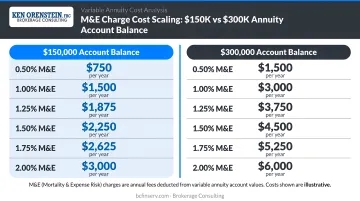
Because the fee is expressed as a percentage rather than a flat dollar amount, its absolute cost scales with your account. A 1.25% M&E charge on a $300,000 account costs $3,750 per year. On a $150,000 account, that same 1.25% costs $1,875. The fee rises every year your balance grows.
What the M&E Charge Actually Covers
The M&E charge funds three distinct guarantees the insurer extends to you under the variable annuity contract.
The Guaranteed Death Benefit
If you die when your account value is less than total premiums paid, the insurer pays your beneficiary the difference. Variable annuity subaccounts fluctuate with market performance, so this shortfall is a real possibility — not a theoretical one. Lincoln's SEC filing confirms the M&E charge covers the risk that death benefits paid will exceed the actual contract value at the time of death.
Lifetime Income After Annuitization
Once you annuitize the contract, the insurer guarantees income payments for your lifetime — regardless of how long you live. An annuitant who lives 35 years past annuitization costs the insurer far more than the insurer's longevity estimates projected. The M&E charge helps offset that open-ended longevity liability.
The Expense Guarantee
The insurer commits, for the life of the contract, not to increase the stated charges — even if its internal costs rise above what the contract currently generates in revenue. That's a concrete promise with measurable financial consequences. Prudential's glossary language describes the M&E charge as funding precisely this guarantee: that contract expenses will not increase.
Beyond these three guarantees, the SEC's variable annuity guide flags one more disclosure worth noting: profit from M&E charges is sometimes used to cover selling costs, including commissions paid to financial professionals. That doesn't diminish the value of the three guarantees above — but the charge does serve more than one purpose, and understanding that distinction helps you evaluate whether the cost is justified for your situation.
How M&E Charges Are Determined and Disclosed
Typical Range and Benchmark
The SEC's Investor.gov bulletin describes the base M&E charge as averaging approximately 1.25% per year. Actual contract-level charges vary widely:
| Carrier / Product | M&E Charge |
|---|---|
| Lincoln Group Variable Annuity | 1.00% (standard); 0.75% (breakpoint) |
| Ameritas Direction Variable Annuity | 1.00% (current); 1.35% (guaranteed max) |
| Fidelity Personal Retirement Annuity | 0.20%; 0.05% for $1M+ contracts |
| TIAA CREF Accounts | 0.005% |
These figures come from current SEC EDGAR filings. The spread from 0.005% (TIAA) to 1.35% (Ameritas guaranteed max) shows why comparing prospectuses before committing to a variable annuity matters — the difference compounds significantly over a 10- or 20-year contract.
Key Factors That Drive the Charge
Underwriters calculate M&E charges based on three primary variables:
- Net amount at risk — the gap between the guaranteed death benefit and current account value
- Risk classification — the insurer's actuarial assessment of the annuitant
- Age of the annuitant — younger annuitants typically receive lower charges
A 35-year-old annuitant gives the insurer decades to collect premiums before any death benefit is likely triggered. A 65-year-old presents a shorter time horizon and a higher near-term probability of a claim. The M&E charge at contract issue is therefore lower for younger buyers, even within the same product.
Finding the Charge in the Prospectus
SEC Form N-4 requires variable annuities to disclose mortality and expense risk fees in the fee table, which appears in the first few pages of the prospectus. When reviewing any variable annuity prospectus:
- Locate the fee table section (usually labeled "Annual Contract Expenses" or "Base Contract Expenses")
- Identify the annualized M&E percentage
- Check for any optional rider charges listed separately — GLWB, GMIB, and GMAB riders carry their own fees on top of the base M&E
How M&E Charges Impact Long-Term Returns
The Compounding Cost Effect
Because the M&E charge is assessed annually as a percentage of the total account balance, its dollar impact grows alongside the account itself. A 1.25% charge on a $100,000 account costs $1,250 in year one. If that account grows to $200,000, the same 1.25% now costs $2,500 annually — with no change in the charge rate.
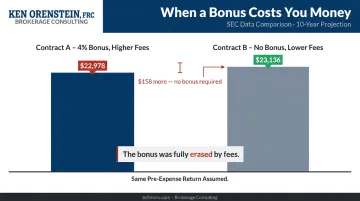
The SEC illustrates this clearly with a 10-year example: a variable annuity contract with a 4% bonus credit but higher annual charges ended at $22,978 after 10 years, while a lower-cost contract without the bonus ended at $23,136 — assuming the same pre-expense return. The bonus looked attractive on paper; the fees erased it and then some.
How M&E Stacks with Other Fees
That compounding effect matters even more because the M&E charge is rarely the only fee in a variable annuity. A complete cost picture typically includes:
- Base M&E charge — approximately 1.0%–1.5% annually
- Administrative fees — separate charge for contract maintenance
- Subaccount expense ratios — underlying fund operating costs
- Living benefit rider charges — GLWB, GMIB, or GMAB riders typically run an additional 1.0%–1.5% annually
When these costs are combined, all-in variable annuity costs can exceed 3% per year. The Ameritas prospectus illustrates the spread: on the same $100,000 investment with 5% assumed annual appreciation, annual costs ranged from $1,609 to $6,974 depending on policy class, portfolio selection, and optional benefits.
Getting a Full Fee Review
A spread of $1,609 to $6,974 in annual costs on the same investment underscores why reviewing the full fee structure matters — before purchasing or before deciding to hold an existing contract.
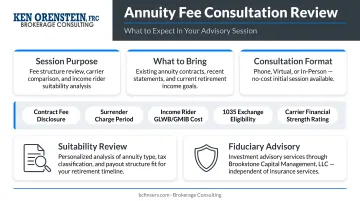
At Brokerage Consulting, Ken Orenstein's annuity consultations cover M&E charges, rider fees, and subaccount expenses weighed against what the guarantees actually deliver. For many clients, that breakdown reveals that a fixed indexed annuity or fixed annuity — where M&E charges don't apply — provides comparable income guarantees at meaningfully lower total cost.
Common Misconceptions About M&E Charges
"It's just a small administrative fee"
At 1.0%–1.75% annually, the M&E charge is among the largest ongoing costs in a variable annuity contract. Unlike a flat administrative fee, its dollar cost scales upward every year the account grows. The SEC explicitly warns that seemingly small annual charge differences compound significantly over time.
"All annuities have an M&E charge"
Fixed annuities do not impose an explicit M&E charge. Instead, the insurer earns its margin on the spread between investment returns and the interest rate credited to your account. For cost-conscious buyers, fixed annuities and fixed indexed annuities are worth a direct comparison to any variable annuity.
"A higher M&E charge means better guarantees"
The fee percentage tells you what you're paying — not what you're getting. Each contract's death benefit terms, income guarantee structure, and expense cap must be read independently, regardless of where the M&E charge falls.
In practice, the variation between contracts matters more than the rate:
- Two contracts at the same M&E charge can offer meaningfully different death benefit terms and income floor guarantees
- Two contracts at different M&E charges can deliver nearly identical protection levels
- A lower-cost contract sometimes outperforms on guarantees once rider terms are compared side by side
Compare guarantees on their own merits before letting the fee level drive the decision.
Frequently Asked Questions
What is the M&E charge on an annuity?
The M&E (Mortality and Expense) charge is an annual fee on variable annuities, expressed as a percentage of account value, that compensates the insurer for guaranteeing a death benefit, lifetime income after annuitization, and stable contract expenses. The SEC describes it as averaging approximately 1.25% per year, though actual charges vary by contract.
Do all annuities have M&E charges?
No. M&E charges are primarily associated with variable annuities and apply specifically to funds held in variable subaccounts. Fixed annuities do not carry an explicit M&E charge, and fixed indexed annuities vary by contract — check the specific disclosure document before assuming either way.
How does the M&E charge affect my annuity's long-term growth?
Because the charge is a percentage of account value, it scales with account growth and compounds against returns over time. A 1.25% annual M&E fee on a growing account can represent tens of thousands of dollars in total cost over a 20–30 year retirement — particularly when stacked with other variable annuity fees.
Can I avoid or reduce M&E charges in a variable annuity?
The M&E charge is fixed by contract terms and cannot be renegotiated after purchase. Shopping across insurers before buying — or choosing a fixed or low-cost variable annuity — can meaningfully reduce this cost. A 1035 tax-free exchange from a high-cost variable annuity into a fixed indexed annuity is worth a closer look before signing anything new.
Is the M&E charge tax-deductible?
No. Per IRS Publication 550, investment expenses are not deductible for individual investors under current rules. The M&E charge is deducted from account value before growth is measured, reducing tax-deferred accumulation with no direct tax offset.
Where can I find the M&E charge in my annuity contract?
Look for the fee table near the front of the variable annuity prospectus, typically labeled "Annual Contract Expenses" or "Base Contract Expenses." Check separately for optional rider charges — those fees are additive to the base M&E and can significantly increase your total annual cost.