The challenge is that annuities and index funds aren't designed to do the same job. One eliminates income uncertainty; the other maximizes long-term wealth. Understanding where they differ — across structure, risk, fees, liquidity, tax treatment, and income options — is what makes it possible to build a retirement strategy that actually fits your situation.
This article breaks down each dimension clearly so you can make an informed decision rather than defaulting to whichever product someone's trying to sell you.
Key Takeaways
- Annuities guarantee income or protect principal; index funds track a market index with uncapped growth and no income floor
- Index funds offer low fees and daily liquidity; annuities carry higher costs and surrender periods
- Long-term index fund gains are taxed at capital gains rates — annuity withdrawals are taxed as ordinary income
- Index funds suit long-term accumulation; annuities suit guaranteed retirement income and downside protection
- Most retirees benefit from holding both — not choosing between them
Annuities vs. Index Funds: Quick Comparison
Here's how annuities and index funds compare across the dimensions that matter most in retirement planning.
| Dimension | Annuities | Index Funds |
|---|---|---|
| Product structure | Insurance contract with insurer | Pooled investment vehicle (ETF or mutual fund) |
| Risk level | Low to moderate (type-dependent) | Market risk — no downside protection |
| Return potential | Capped or guaranteed (type-dependent) | Uncapped — full index participation |
| Liquidity | Restricted; surrender charges 4–10 years | High — tradeable any market day |
| Fees | Higher (M&E charges, rider fees, admin) | Very low (0.03%–0.09% for major ETFs) |
| Tax treatment | Tax-deferred; withdrawals taxed as ordinary income | Long-term gains taxed at 0%, 15%, or 20% |
| Retirement income | Guaranteed lifetime income options available | No guarantee; requires withdrawal strategy |
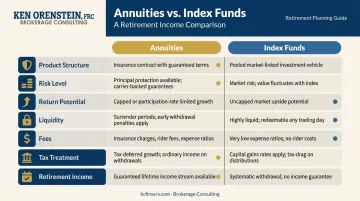
Note: "Annuities" covers the broad category. Fixed, variable, and fixed-indexed annuities differ meaningfully within these dimensions — the table reflects general tendencies.
What Are Annuities?
An annuity is a contract between an individual and an insurance company. You contribute a lump sum or a series of premiums; the insurer provides either future income payments or tax-deferred growth. That core appeal matters in retirement planning: an annuity can convert savings into a guaranteed income stream for life, which no index fund can replicate on its own.
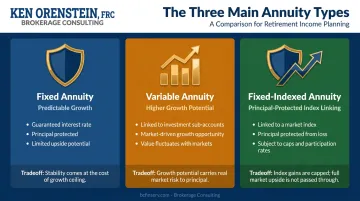
The Three Main Types
Fixed annuities credit a guaranteed interest rate regardless of market conditions. They're predictable and principal-protected, but upside is limited.
Variable annuities tie performance to underlying investment sub-accounts — similar to mutual funds. Growth potential is higher, but so is market risk. The account value fluctuates, and there's no guaranteed return on the investment component.
Fixed-indexed annuities (FIAs) link interest credits to a market index like the S&P 500 while protecting the principal from market losses. Gains are subject to participation rates, caps, and spreads — meaning you don't receive the full index return.
Understanding the type you're looking at is step one. The contractual terms attached to any annuity are equally important — and often where the fine print matters most.
Contractual Features You Need to Understand
- Surrender periods: Typically 4–10 years; the SEC notes surrender charges often run 6–8 years for variable annuities, sometimes up to 10
- Surrender charges: An example schedule might start at 7% and decline by 1 percentage point annually
- Optional riders: Guaranteed Lifetime Withdrawal Benefits (GLWBs) and Guaranteed Minimum Income Benefits (GMIBs) add features at additional cost
- Early withdrawal penalty: The IRS imposes a 10% additional tax on taxable distributions before age 59½, per IRS Publication 575
The Core Benefit — and the Real Limitations
The defining advantage of annuities is guaranteed lifetime income. A single-life or joint-life annuity can pay you (and a spouse) for as long as either of you lives, eliminating longevity risk outright. According to the SSA's actuarial tables, remaining life expectancy at 65 is approximately 17.5 years for males and 20.0 years for females — a long runway where guaranteed income delivers real value.
The limitations are just as concrete. Variable annuities carry mortality and expense (M&E) charges, administrative fees, and underlying fund expenses that erode returns over time. Fixed-indexed annuities limit actual gains through participation rates, caps, and spreads — so an FIA linked to the S&P 500 is a fundamentally different product from owning an S&P 500 index fund.
What Are Index Funds?
An index fund is a pooled investment vehicle — available as a mutual fund or ETF — that tracks the performance of a market index such as the S&P 500, Nasdaq 100, or Russell 2000. As Investor.gov defines it, index funds follow a passive strategy to achieve the same return as the index before fees. Investors receive full index participation, including dividends, with no caps or participation rate limitations.
Why They Work for Retirement Savers
- Low cost: VOO and IVV (two major S&P 500 ETFs) carry expense ratios of just 0.03%; SPY runs 0.0945%
- High liquidity: ETF shares trade throughout the trading day at market prices — no surrender charges, no waiting periods
- Uncapped upside: No participation rates or cap rates limiting what you receive
- Favorable tax treatment: Long-term capital gains rates apply to assets held over one year
Where They Fall Short
Two structural gaps matter most for retirement savers:
- No downside protection: When markets drop, your portfolio drops with them. A significant decline early in retirement — while you're actively drawing income — can cause severe sequence-of-returns damage that's hard to recover from.
- No guaranteed income stream: Retirees must manage systematic withdrawals carefully, balancing spending needs against portfolio longevity. That task becomes harder if markets underperform or a long life stretches the timeline.
Key Differences Between Annuities and Index Funds
Fees and Costs
This is where the gap between these products is most dramatic.
The SEC reports that variable annuities typically carry an M&E risk charge of about 1.25% annually, plus administrative fees of roughly $25–$30 per year or ~0.15% annually. Add optional rider fees and underlying fund expenses, and all-in costs on a variable annuity can exceed 3% per year.
Compare that to index fund expense ratios of 0.03% for VOO or IVV.
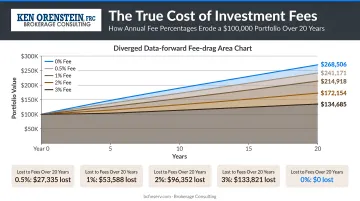
The compounding impact of that fee gap is significant. A fee illustration from Investor.gov shows that on a $100,000 investment growing at 4% annually over 20 years:
- No fees: ~$219,000
- 1% annual fees: ~$180,500
- 2% annual fees: ~$147,900
- 3% annual fees: ~$120,700
That's nearly $100,000 in fee drag at 3% versus no fees. For annuity costs to make sense, the guarantee being purchased must deliver equivalent value.
Liquidity
Index fund ETFs can be sold during any market trading session with no penalty beyond standard transaction costs and applicable taxes. Annuities are categorically different.
Surrender charges during the contract term can be substantial, and early withdrawals before age 59½ trigger the IRS's additional 10% tax. Most annuity contracts allow free withdrawals of up to 10% of the contract value annually — but beyond that, the illiquidity is real and can last a decade.
Any money you may need during the surrender period should stay out of an annuity entirely.
Tax Treatment
| Annuities | Index Funds (ETFs/Mutual Funds) | |
|---|---|---|
| Growth phase | Tax-deferred | Taxable each year (or deferred in tax-advantaged accounts) |
| Withdrawals | Taxed as ordinary income (10%–37%) | Long-term gains taxed at 0%, 15%, or 20% |
| Inherited assets | Gains taxed as ordinary income to beneficiaries | Heirs typically receive a stepped-up cost basis |
For 2025, long-term capital gains rates are 0% for single filers up to $48,350, 15% up to $533,400, and 20% above that. Ordinary income rates run 10% to 37%. For high earners, the difference between paying 20% versus 37% on the same dollar of retirement income is meaningful over a multi-decade withdrawal period.
The inherited assets distinction matters for estate planning. Annuity gains passed to heirs are taxed as ordinary income; inherited index fund shares typically benefit from a stepped-up cost basis, potentially eliminating capital gains tax entirely on accumulated appreciation.
Growth Potential
Here's what many investors don't fully appreciate about fixed-indexed annuities: they're often compared against S&P 500 price returns, but index funds deliver total returns — including dividends.
According to S&P Dow Jones Indices research, dividends have contributed approximately 31% of S&P 500 total return since 1926, with capital appreciation accounting for the remaining 69%. Most FIA crediting formulas are based on price return only — meaning investors miss a substantial portion of the index's historical return before participation rates and caps further reduce what they actually receive.
In practical terms, the difference looks like this:
- Index funds deliver full total return — dividends included — with no participation cap
- FIAs apply crediting formulas to price return only, then cap or limit that further via participation rates
FIAs trade potential upside for principal protection. That exchange makes sense for investors who can't tolerate a down year in early retirement — and far less sense for those with a long time horizon and a stomach for volatility.
Retirement Income Options
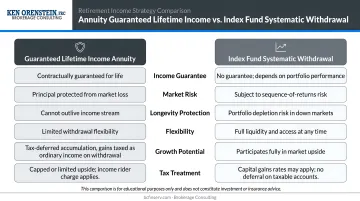
Principal protection is one thing — but annuities hold a second advantage that index funds simply cannot match: guaranteed lifetime income. A single-life or joint-life immediate annuity pays for as long as the annuitant (and potentially a spouse) lives, regardless of market performance and without any risk of depleting the account.
Index funds require a systematic withdrawal strategy — drawing down the portfolio at a sustainable rate. If markets underperform in early retirement, or if the investor lives significantly longer than projected, the portfolio can be depleted. Annuities transfer that longevity risk to the insurance carrier — which is exactly why they belong in the conversation for anyone who lacks a pension and needs income they can't outlive.
Annuities vs. Index Funds: Which Should You Choose?
Match the Tool to the Job
Choose annuities if you:
- Are in or near retirement and cannot absorb significant portfolio losses
- Need guaranteed income to cover essential expenses (housing, healthcare, food)
- Have already maximized tax-advantaged accounts and need additional tax-deferred growth
- Want to eliminate longevity risk for at least a portion of your income
Choose index funds if you:
- Have a longer time horizon and can ride out market downturns
- Need flexibility and may require access to your capital
- Have an existing guaranteed income floor (pension, Social Security, or annuity)
- Are in an accumulation phase where uncapped growth matters most
The Account Priority Question
The SEC notes that buying a variable annuity inside an IRA or 401(k) provides no additional tax advantage — the tax deferral is already built into the qualified account. For 2025, the IRS sets the 401(k)/TSP deferral limit at $23,500 (with a $7,500 catch-up for age 50+, and $11,250 for ages 60–63 under SECURE 2.0), and the IRA contribution limit at $7,000. Max these out before evaluating nonqualified annuity purchases.
The Case for Holding Both
Once you've addressed account priority, the next question isn't always either/or. Many retirees don't need to choose.
A "floor and upside" approach uses guaranteed income — Social Security, pensions, and annuities — to cover essential expenses, while index funds grow the remaining portfolio for discretionary spending and legacy goals.
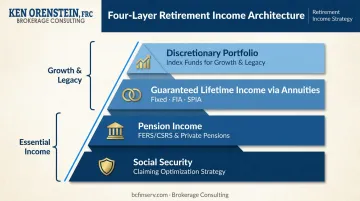
At Brokerage Consulting, Ken Orenstein structures this as a four-layer income architecture:
- Social Security (with claiming-strategy optimization)
- Pension income (FERS/CSRS for federal employees, private-sector pensions)
- Guaranteed lifetime income via annuities (Fixed, FIA with income riders, or SPIAs)
- Discretionary portfolio (growth-oriented, invested through the advisory channel)
The guaranteed layers eliminate sequence-of-returns risk for essential expenses. The growth layer captures market returns without the pressure of depending on it for rent and groceries.
Get the Right Allocation for Your Situation
The right split between annuities and index funds is personal — shaped by your Social Security timing, existing pension income, federal benefits (for FERS/CSRS employees), tax bracket, health, and income certainty needs.
Ken Orenstein at Brokerage Consulting works through this analysis with federal employees and individuals — low-cost, tax-efficient retirement planning with no-cost initial consultations available by phone, virtually, or in person. Reach the practice at (888) 315-3608 or request a consultation at bcfinserv.com/request-a-quote.
Conclusion
Annuities and index funds solve different problems. Annuities provide income certainty and protect against outliving your assets; index funds deliver growth, flexibility, and low costs. The strongest retirement portfolios use both deliberately — because retirement carries risks that no single tool can cover on its own.
If you're unsure how to balance guaranteed income with growth, that's a signal your current plan needs a closer look. Mapping your income needs, tax situation, and retirement timeline to a tailored strategy is exactly where a no-cost consultation with Ken Orenstein can help.
Frequently Asked Questions
Is an annuity better than an index fund?
Neither is universally better. Annuities excel at guaranteed income and downside protection; index funds offer superior growth potential and liquidity. The right choice depends on your retirement timeline, how much income certainty you need, and your risk tolerance. For many retirees, the answer is using both.
Can you hold both an annuity and index funds in your retirement portfolio?
Yes — combining both is a common and often effective approach. An annuity can cover essential income needs while index funds grow the remaining portfolio for long-term goals and legacy planning.
Are index fund gains taxed differently than annuity withdrawals?
Index funds held over one year are taxed at preferential long-term capital gains rates (0%, 15%, or 20% depending on income). Annuity withdrawals are taxed as ordinary income at rates up to 37%. That gap directly affects after-tax retirement income, especially for higher earners.
What is the typical surrender period for an annuity, and why does it matter?
Surrender periods typically range from 4 to 10 years, during which early withdrawals trigger surrender charges. This limits liquidity significantly and makes annuities unsuitable for funds you may need in the near term. Always understand the surrender schedule before purchasing.
Do index funds offer any guaranteed income in retirement?
No. Index funds require a systematic withdrawal strategy, which carries the risk of depleting the portfolio if markets underperform or if you live longer than projected. That's the fundamental gap annuities are designed to fill.
At what age or life stage does an annuity make the most sense?
Annuities tend to make the most sense for individuals in their 50s or 60s who are approaching or already in retirement and have maximized their tax-advantaged accounts. They're particularly valuable for those who want guaranteed income they cannot outlive and a hedge against longevity risk.