
Introduction
Choosing the wrong annuity rate can cost a retiree tens of thousands of dollars in foregone interest over a five-year term. Yet many people sign contracts without fully understanding what the quoted rate actually guarantees, what drives it, or whether the product fits their broader retirement picture.
A 5-year fixed annuity rate is not an estimate: it is a contractual commitment. The difference between a 5.5% and a 6.3% rate on a $200,000 premium totals roughly $3,200 in additional interest by year five — a gap that matters at retirement.
Top 5-year MYGA rates reached approximately 6.30% in May 2026 (per Blueprint Income's rate aggregator), making this one of the stronger rate environments for these products since the post-2022 Fed tightening cycle began.
This article breaks down what a 5-year fixed annuity rate actually means, what drives it, what range is realistic today, and how to decide whether this product belongs in your retirement income strategy.
Key Takeaways
- A 5-year fixed annuity locks in a guaranteed interest rate for the full term — not an estimate, not a variable return
- Rates are shaped by Federal Reserve policy, insurer investment strategy, and competition among carriers
- Top 5-year MYGA rates reached ~6.30% in May 2026; the national 60-month CD average was just 1.34%
- Principal is fully protected, growth compounds tax-deferred, and there are no IRS contribution limits
- Surrender charges apply during the term, inflation can erode purchasing power, and early withdrawals before age 59½ trigger a 10% IRS penalty
- Best suited for pre-retirees, federal employees, and seniors within 5–10 years of retirement who don't need immediate access to these funds
What a 5-Year Fixed Annuity Rate Actually Represents
The rate quoted on a 5-year fixed annuity is a contractually guaranteed annual interest rate applied to your principal for the full five-year term. The insurer cannot reduce it during that period. This is a binding commitment — not a projection, not a market-linked return.
MYGA vs. Annually Resetting Fixed Annuities
When most people search for "5-year fixed annuity rates," they are looking at Multi-Year Guaranteed Annuities (MYGAs). The distinction matters: a standard fixed deferred annuity typically resets its credited rate after a shorter period — often just one year. A MYGA holds the same rate for the entire selected term, whether that is three, five, seven, or ten years.
As Annuity.org explains, a MYGA guarantees a stated interest rate for the full multi-year guarantee period. That predictability is the product's core value.
Guaranteed Rate vs. Minimum Renewal Rate
These two numbers are not the same, and confusing them leads to poor decisions at renewal:
- Guaranteed rate: Locked in for the initial 5-year term
- Minimum renewal rate: The contractual floor the insurer cannot go below after the term ends
After the five-year period, the insurer sets a new rate. It may be higher, lower, or at the floor. Understanding the renewal minimum before purchasing tells you exactly how low your credited rate could fall in year six.
5-Year Fixed Annuity vs. 5-Year CD
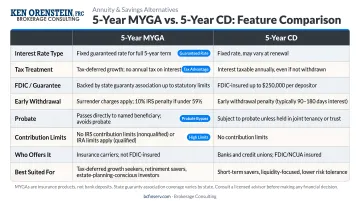
| Feature | 5-Year MYGA | 5-Year CD |
|---|---|---|
| Rate guarantee | Fixed for full term | Fixed for term if held to maturity |
| Tax treatment | Tax-deferred until withdrawal | Interest taxed annually |
| Federal insurance | Not FDIC-insured | FDIC-insured (within limits) |
| Additional features | Riders, income conversion options | Simpler structure, fewer features |
The tax-deferral difference compounds significantly. A taxable CD holder in a 24% bracket pays tax on credited interest each year, reducing the effective compounding base. Inside an annuity, that same interest compounds untouched until withdrawal. If withdrawals begin in retirement at a lower tax bracket, the overall tax burden drops further still.
Accumulation vs. Distribution
During the 5-year period, the contract is in accumulation phase — your principal and credited interest compound inside the contract. You do not receive income payments during this time unless you choose to annuitize or make scheduled withdrawals.
At the end of the term, you have four options:
- Renew at the new declared rate
- Transfer to another product via a 1035 tax-free exchange
- Begin income payments (annuitize)
- Take a lump sum distribution
Each path carries different tax consequences and liquidity implications — knowing which direction fits your retirement timeline should factor into the purchase decision itself, not just the renewal conversation.
What Drives 5-Year Fixed Annuity Rates — And What Range to Expect
The rate an insurer offers on a 5-year MYGA is set at contract issue. It reflects the prevailing interest rate environment, the insurer's investment strategy, and competitive dynamics in the market.
Federal Reserve and Treasury Influence
Insurers back fixed annuity guarantees primarily by investing in investment-grade bonds and similar fixed-income instruments. When the Fed raises benchmark rates, bond yields rise and insurers can offer higher annuity rates. When rates fall, annuity rates compress accordingly.
Rate levels today reflect this dynamic directly. The Federal Reserve maintained the federal funds target range at 3.5% to 3.75% as of April 29, 2026. The 10-year Treasury yield stood at approximately 4.41% as of May 22, 2026.
This elevated rate environment — a direct result of the post-2022 tightening cycle — is the primary reason 5-year MYGA rates are substantially higher today than they were before 2022.
Insurer-Specific Factors
Macro rates set the ceiling, but individual insurer decisions determine where a given carrier lands within that range. Differences arise from:
- Portfolio allocation decisions — how the insurer structures its asset-liability matching
- Profit margin targets — lower-margin carriers often pass more yield directly to policyholders
- Growth objectives — a carrier expanding its book may temporarily price above market to attract volume
- Financial strength ratings — highly rated carriers sometimes offer modestly lower rates because their stability carries its own value
An insurer's AM Best, Moody's, or S&P financial strength rating reflects its ability to meet ongoing contract obligations. It doesn't directly set the rate, but it does influence how aggressively a carrier prices its products.
Current Rate Range
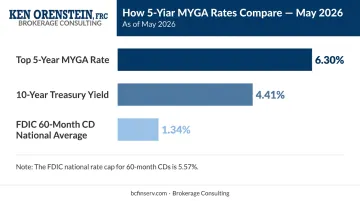
As of late May 2026, published aggregator data showed top 5-year MYGA rates at approximately 6.30% (Blueprint Income, Annuity.org). These are best-rate listings from aggregator pages — not a market average — so actual available rates across a broader cross-section of carriers will vary.
For context:
| Benchmark | Rate (May 2026) |
|---|---|
| Top published 5-year MYGA rate | ~6.30% |
| 10-year Treasury yield | ~4.41% |
| FDIC 60-month CD national average | 1.34% |
The gap between the national CD average and top MYGA rates is substantial. However, the CD national average reflects all banks including community institutions with less competitive rates — the FDIC's reported national rate cap for 60-month CDs was 5.57%, which is a more appropriate upper-bound comparison point.
Key Benefits of a 5-Year Fixed Annuity
Principal Protection and Rate Certainty
Unlike equities or variable annuities, a 5-year fixed annuity guarantees both the principal and the stated rate. The account cannot decline due to market conditions. For conservative savers approaching retirement, this capital-preservation function is the product's most direct appeal.
Tax-Deferred Compounding
Interest credited inside the annuity is not taxed until withdrawal. Over five years, the difference between tax-deferred and annually taxed growth compounds in your favor — particularly for those in higher working-years tax brackets who expect to withdraw in retirement at lower rates.
That said, this is not tax-free growth. FINRA confirms that distributions are taxed as ordinary income when received — the tax is deferred, not eliminated.
No IRS Contribution Limits
IRAs cap annual contributions at $7,000 (or $8,000 for those 50+). 401(k)s have their own ceilings. Fixed annuities have no IRS contribution limit for non-qualified (after-tax) purchases. For savers who have already maxed out qualified accounts, this means additional tax-deferred accumulation with no ceiling.
Optional Riders for Added Protection
Many 5-year fixed annuity contracts allow optional add-ons:
- Death benefit riders — pass accumulated value to beneficiaries
- Nursing home waiver riders — allow penalty-free access if the annuitant requires long-term care
- Income riders — convert the accumulated balance into a lifetime income stream at a future date
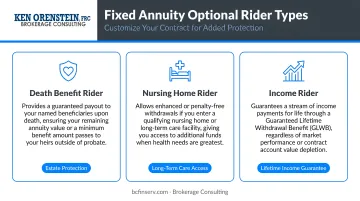
Each rider adds to the contract's cost. Evaluate whether the protection matches your actual situation before adding one.
Risks, Limitations, and Common Misconceptions
Surrender Charges and Limited Liquidity
Most 5-year fixed annuities impose surrender charges if you withdraw more than the allowable amount before the term ends. These charges typically follow a declining schedule — highest in year one, stepping down each year until they reach zero at contract maturity.
Most contracts permit penalty-free annual withdrawals of a defined percentage, commonly 10% of the contract value per year. Withdrawing beyond that triggers surrender charges. Confirm the exact schedule before signing.
Some contracts also include a Market Value Adjustment (MVA) — a mechanism that can increase or decrease your surrender value depending on interest-rate direction at the time of early surrender. If rates rise after you purchase, an early full surrender may result in a lower payout than your stated account value. If rates fall, an MVA can work in your favor.
Inflation Risk
A fixed rate that looks attractive today may erode in real terms if inflation runs high over the five-year term. The annuity rate does not adjust upward with inflation. If you lock in 5.5% and inflation averages 4%, your real return is roughly 1.5% — a meaningful gap for retirees counting on this product as a long-term income source.
Early Withdrawal Tax Penalty
Withdrawals before age 59½ trigger a 10% IRS additional tax on the taxable portion, on top of ordinary income taxes. A 5-year fixed annuity is best suited for those confident they won't need these funds before the term ends.
Common Misconceptions
"The five years means five years of income payments"
Not quite. The five-year period refers to the rate guarantee period — the accumulation phase. Income payout structure is a separate election made at or after contract maturity.
"All 5-year fixed annuities are essentially the same"
They're not. Rates, surrender terms, renewal minimums, MVA provisions, and rider availability vary substantially by insurer — differences that can cost thousands in foregone interest over the term if you don't compare.
How to Evaluate and Compare 5-Year Fixed Annuity Rates
Key Variables Beyond the Headline Rate
The stated rate is the starting point, not the full picture. Before committing to any contract, compare:
- Guaranteed minimum renewal rate — the floor after the initial term expires
- Surrender charge schedule — the penalty structure for early exit
- Free withdrawal provision — the annual penalty-free withdrawal percentage
- MVA terms — whether and how a market value adjustment applies to early surrenders
- State guaranty association coverage — annuities are not FDIC-insured; most states cover up to $250,000 in present value of annuity benefits through state guaranty associations
Insurer Financial Strength Matters
A guaranteed rate is only as reliable as the insurer behind it. AM Best Financial Strength Ratings provide an independent opinion of an insurer's ability to meet ongoing obligations. Use them as a baseline filter, not a secondary consideration.
| AM Best Rating | Meaning |
|---|---|
| A++, A+ | Superior ability to meet obligations |
| A, A- | Excellent ability |
| B++, B+ | Good ability |
| B, B- | Fair; more vulnerable to adverse conditions |
| C++ and below | Increasing vulnerability |
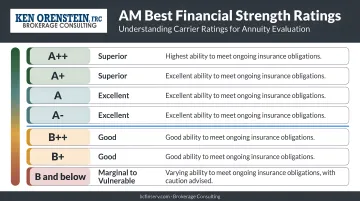
For a five-year commitment, an insurer in the A- or above tier is a reasonable baseline. A slightly lower rate from a financially strong carrier is often more defensible than a top-rate offer from an insurer with weaker ratings.
Working With an Independent Advisor
Because rates and terms vary significantly across insurers, working with an independent advisor who represents multiple carriers is a practical way to access a real-time cross-section of the market. Ken Orenstein at Brokerage Consulting evaluates MYGAs across multiple dimensions: guaranteed rate, surrender schedule, free withdrawal provisions, and carrier financial strength ratings from AM Best, S&P, Moody's, and Fitch.
This is particularly relevant for federal employees coordinating a fixed annuity with FERS pension income and TSP distributions. Brokerage Consulting's Federal Retirement Consultant credential means those integration questions are addressed directly as part of every engagement. A no-cost initial consultation is available by calling (888) 315-3608 or visiting bcfinserv.com.
Is a 5-Year Fixed Annuity Right for You?
Ideal Candidate Profile
A 5-year fixed annuity tends to be a strong fit for someone who:
- Is within 5–10 years of retirement and wants stable, low-risk accumulation
- Has a conservative risk tolerance and does not want stock market exposure on this portion of assets
- Has already maximized IRA and 401(k) contributions and wants additional tax-deferred growth
- Does not need immediate access to these funds during the 5-year term
- Wants a defined income supplement — not market-linked growth — as part of a retirement income plan
For federal employees specifically, a 5-year MYGA can serve as a complementary income layer alongside a FERS pension, Social Security, and TSP distributions. The predictability of a fixed annuity pairs well with the defined-benefit structure of FERS, building a predictable income base that doesn't rise or fall with market conditions.
When to Consider Alternatives
A 5-year fixed annuity may not be the right fit when:
- Liquidity is a priority — the surrender charge structure makes this a poor choice for funds that may be required on short notice
- Time horizon is long and risk tolerance is higher — a fixed indexed annuity or equity exposure may generate better long-term outcomes for younger accumulators
- Inflation protection is a primary concern — fixed rates do not adjust upward, so a fixed indexed annuity with participation in index gains may offer better inflation-hedging characteristics
- Income is needed sooner — a shorter MYGA term (3-year) or an immediate annuity may better match the timeline
If any of these scenarios apply, reviewing your full retirement income picture with an advisor — before locking in a 5-year term — can prevent a mismatch between your timeline and your product choice.
Frequently Asked Questions
How much would a $100,000 annuity pay per month?
Payouts vary by annuity type, age at annuitization, and rates at the time income begins. For immediate annuities, Annuity.org data (April 2026) showed illustrative payouts of roughly $503/month at age 60 (female), $590–$652/month at age 65, and $750/month at age 70 (male). With a 5-year MYGA, income only begins after the accumulation phase ends and you elect to receive payments.
What is the difference between a 5-year fixed annuity and a 5-year CD?
The main differences are tax treatment and backing. CD interest is taxed annually; annuity interest is tax-deferred until withdrawal. CDs are FDIC-insured, while annuities are backed by the insurer's claims-paying ability and state guaranty associations — and unlike CDs, annuities can include income conversion features and optional riders.
Are 5-year fixed annuity rates guaranteed for the entire term?
Yes. The defining feature of a MYGA is that the stated rate is contractually locked for the full 5-year guarantee period — the insurer cannot reduce it during that window. This distinguishes a MYGA from a traditional fixed annuity that may reset its credited rate annually after the first year.
Can I withdraw money early from a 5-year fixed annuity?
Most contracts allow penalty-free annual withdrawals up to a set percentage — commonly 10% of the contract value per year. Withdrawals beyond that trigger surrender charges. If you are under age 59½, a 10% IRS additional tax applies to the taxable portion of any withdrawal, on top of ordinary income tax.
How do Federal Reserve rate changes affect 5-year fixed annuity rates?
The link is indirect but consistent. Insurers invest premiums in bonds and fixed-income instruments to back guarantees. When the Fed raises rates and bond yields rise, insurers can offer higher annuity rates. When rates fall, annuity rates typically follow. The timing of your purchase relative to the rate environment directly affects the rate you lock in for the full term.
Is a 5-year fixed annuity a good investment for someone nearing retirement?
It can be a strong fit for conservative savers within a decade of retirement who want guaranteed, tax-deferred growth without market risk. Whether it fits depends on your full retirement income picture: Social Security, pension income, other savings, and liquidity needs. Brokerage Consulting offers no-cost consultations to help determine whether a 5-year MYGA or another vehicle best fits your situation.