
Introduction
Many retirees want to support causes they care about — but not at the cost of income they depend on. A Charitable Gift Annuity (CGA) resolves that tension by combining philanthropy with guaranteed lifetime income in a single contract.
CGAs aren't new, but they've gained renewed attention among retirees managing Required Minimum Distributions (RMDs) and donors sitting on appreciated assets with large embedded capital gains.
The American Council on Gift Annuities reports that its suggested payout rates are followed by 97% of charitable organizations nationwide, giving donors a consistent benchmark when comparing offers.
This article covers what a CGA actually is, how payout rates work, the tax treatment of payments, key drawbacks, and who tends to benefit most. If you're weighing how a CGA fits alongside other retirement income strategies — such as annuities or RMD planning — the details below will give you a clear foundation before any planning conversation.
Key Takeaways
- A CGA is a contract — not a trust — where you transfer assets to a charity in exchange for fixed lifetime payments
- Age determines your payout rate — 5.7% at 65, 8.1% at 80 (ACGA 2024 suggested rates)
- You may claim a partial charitable deduction in the year you fund the CGA
- Payments can have three tax components: tax-free, capital gain, and ordinary income
- Donors age 70½+ can fund a CGA with up to $54,000 from an IRA via QCD (2025 limit)
What Is a Charitable Gift Annuity?
A CGA is a legally binding contract between a donor and a qualified 501(c)(3) public charity, where the donor makes an irrevocable transfer of assets in exchange for the charity paying a fixed dollar amount — typically quarterly — for the donor's lifetime, and for a co-annuitant's lifetime if the contract is structured that way.
A CGA is not a trust. It's a direct contractual obligation of the charity itself, backed by the charity's overall assets — not a separate fund holding just your donated gift. That structure means your payment security depends directly on the issuing charity's financial health.
How Payout Rates Are Set
Most nonprofits follow payout rate recommendations published by the American Council on Gift Annuities (ACGA), an independent organization whose suggested maximum rates have been followed by 97% of charities nationwide. The current rate schedule became effective January 1, 2024, and has been reconfirmed through November 2025.
Minimum gift amounts and age requirements vary by charity. Many organizations require a minimum contribution of $5,000–$50,000 and that the annuitant be at least age 60.
How a Charitable Gift Annuity Works
Funding Your CGA
Three primary funding methods are available, each with different tax consequences:
- Cash — The simplest option, with the cleanest tax treatment.
- Long-term appreciated assets — Publicly traded stocks or bonds held more than one year. Funding with appreciated securities can spread capital gains recognition over your life expectancy rather than triggering a lump-sum gain.
- IRA Qualified Charitable Distribution (QCD) — Available once in a lifetime for donors age 70½ or older. Per IRS Publication 590-B (2025), the current annual limit for this one-time QCD-to-CGA election is $54,000. Payments must begin within one year of funding and must equal at least 5% annually.
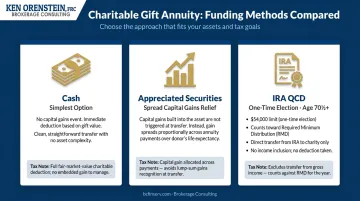
The funding choice significantly affects how your payments are taxed — covered in the next section.
CGA Payout Rates
Rates are fixed at the time of the contract and are age-based. Older donors receive higher rates because their expected payment period is shorter.
| Donor Age | ACGA Suggested Single-Life Rate |
|---|---|
| 65 | 5.7% |
| 80 | 8.1% |
These rates are designed so that roughly 50% of the contributed funds remain for the charity after all payments are made. That design reflects the dual purpose of a CGA:
- Income for you: Fixed, guaranteed payments for life regardless of investment performance
- Gift for the charity: The remaining balance transfers to the organization at the end of the payment period
Because part of every contribution is charitable in nature, CGA payout rates are lower than what comparable commercial annuities offer. That difference is the cost of the charitable component built into the contract.
What Happens After the Annuitant Dies
CGAs can be structured two ways:
- Single-life: Payments stop at the donor's death. Remaining assets go to the charity.
- Two-life (joint): Payments continue to a surviving co-annuitant (often a spouse) until their death. After the last annuitant passes, the remaining assets — called the "remainder" — belong to the charity.
Tax Benefits of a Charitable Gift Annuity
The Charitable Income Tax Deduction
Donors who itemize can claim a partial charitable deduction in the year they establish the CGA. The deductible amount equals the total gift minus the present value of all expected lifetime payments, calculated using IRS actuarial tables and the Section 7520 interest rate in effect that month.
Deduction limits apply based on funding method:
- Cash gifts: Deductible up to 60% of AGI
- Appreciated securities: Deductible up to 30% of AGI
Excess deductions can be carried forward for up to five additional tax years. High-income earners should also be aware that specific IRS rules may reduce the effective benefit of their deduction — a tax advisor can run the numbers for your specific situation.
How Payments Are Taxed
The tax treatment of CGA payments depends on what you used to fund the contract.
Cash-funded CGA:
- A portion of each payment is tax-free (return of your cost basis, spread over your IRS-projected life expectancy)
- The remainder is taxable as ordinary income
- Once you outlive your projected life expectancy, all payments become fully ordinary income
Appreciated securities-funded CGA:
Because this is treated as a "bargain sale" under IRS rules, the tax split on each payment has three components:
| Payment Component | Tax Treatment |
|---|---|
| Return of basis | Tax-free |
| Capital gain portion | Recognized gradually over life expectancy |
| Charitable annuity income | Ordinary income |
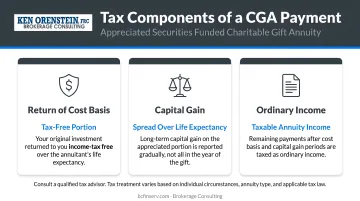
Rather than triggering the full embedded capital gain at once, this structure lets you spread the gain recognition across your lifetime. For donors holding highly appreciated stock, that deferred recognition can translate into real tax savings each year.
IRA/QCD-funded CGA:
This one works differently. The QCD amount is excluded from your gross income and counts toward satisfying your RMD requirement, which makes it particularly useful for retirees managing taxable income. That said, two trade-offs apply:
- All CGA payments from an IRA-funded contract are fully taxable as ordinary income
- No charitable deduction is available for the QCD amount
For retirees with substantial IRA balances facing large RMDs, this can still be a worthwhile trade-off. Choosing the right funding method requires weighing your tax bracket, asset composition, and giving goals — ideally with a qualified tax or financial advisor.
Key Benefits and Drawbacks
Core Benefits
- Guaranteed lifetime income regardless of market performance
- Partial charitable tax deduction in year one (if itemizing)
- Tax-free income for a period when funded with cash (return of basis)
- Capital gains spreading when funded with appreciated assets
- RMD offset when funded via IRA QCD
- Charitable legacy without requiring a separate trust or complex structure
Important Drawbacks
No Withdrawal or Cancellation
Once assets are transferred to the charity, you cannot withdraw them, cancel the contract, or redirect the remainder to a different organization. This distinguishes CGAs from some commercial annuities that allow surrender options.
Payments Never Increase
Payments are fixed for life. Over a 20- or 30-year retirement, inflation erodes purchasing power steadily. There is no cost-of-living adjustment built into CGA contracts.
Counterparty (Charity Solvency) Risk
Your payments are only as secure as the issuing charity. If the organization becomes financially distressed or insolvent, payments may stop with little recourse for donors. Before committing, evaluate the charity's:
- Financial reserves and liquidity
- Ratio of total liabilities to total assets
- State registration compliance (charities issuing CGAs must comply with regulations in the donor's state of residence)
Tools like Charity Navigator's accountability and finance ratings can serve as a starting screen.
Who Should Consider a Charitable Gift Annuity?
The strongest CGA candidates typically share several characteristics:
- Age 60 or older (most charities won't issue CGAs to younger donors)
- Charitably motivated — the giving intent matters, since CGA rates trail commercial alternatives
- Holding appreciated assets with large embedded capital gains and no immediate need to sell
- Managing taxable RMD income from an IRA (for the QCD route)
- In a tax bracket where itemizing deductions provides real benefit
Federal employees and retirees with FERS pension income and TSP balances are a natural fit — the QCD-to-CGA route lets them redirect IRA distributions toward a cause they care about, cutting taxable income in the process.
How to request a CGA illustration:
- Identify a qualified 501(c)(3) charity whose mission aligns with your values
- Contact the nonprofit's planned giving department and request a complimentary CGA illustration
- Review the illustration with a financial or tax advisor before signing anything
Ken Orenstein at Brokerage Consulting works with retirees and pre-retirees across New Jersey and the Northeast on tax-efficient retirement income planning, including RMD management and IRA distribution sequencing. If you're weighing whether a CGA fits your broader plan, a no-cost consultation is available by phone, virtual, or in-person at (888) 315-3608.
CGA vs. Other Charitable Giving Vehicles
| Feature | Charitable Gift Annuity | Charitable Remainder Trust | Donor-Advised Fund |
|---|---|---|---|
| Income stream | Yes — fixed, lifetime | Yes — fixed or variable | No |
| Minimum contribution | Often $5,000–$50,000 | Typically $250,000+ | Varies (often $5,000) |
| Structure | Contract with one charity | Formal irrevocable trust | Separate fund at a sponsoring org |
| Multiple charity beneficiaries | No | Possible (via DAF remainder) | Yes |
| Immediate tax deduction | Partial | Partial | Full |
| Complexity | Low | High | Low |
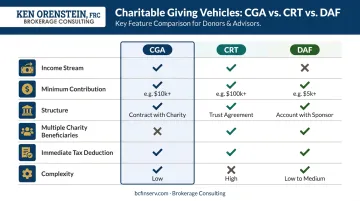
Each vehicle serves a different purpose — here's how the two most common alternatives stack up in practice.
CGA vs. CRT
A Charitable Remainder Trust operates as a formal irrevocable trust, often requiring $250,000 or more to establish. It can name multiple charities and may offer variable payout options. For donors with substantial assets who want more flexibility over time, a CRT warrants consideration. For most donors, a CGA is simpler and accessible at lower contribution levels.
CGA vs. DAF
A Donor-Advised Fund doesn't provide income, but it does offer a full deduction in the year of contribution, flexibility to support multiple charities, and broad asset acceptance (including restricted stock and private business interests). The two vehicles can also work together — a DAF named as the charitable remainder beneficiary of a CRT lets donors consolidate future giving decisions into a single, flexible account.
Frequently Asked Questions
Who is the owner of a charitable gift annuity?
The charity holds legal ownership of the contributed assets from the moment of transfer. The donor receives income payments as the annuitant but has no ownership rights over the gifted property. There is no personal account — the assets become part of the charity's general fund.
Is a charitable gift annuity irrevocable?
Yes, always. Once the transfer is made, the donor cannot withdraw funds, cancel the contract, or reclaim the assets. This is a defining feature of CGAs under IRS classification and distinguishes them from commercial annuities that may allow surrender.
How are charitable gift annuity payments taxed?
Payments typically include up to three components: a tax-free return of principal (spread over your IRS life expectancy), ordinary income, and capital gains if funded with appreciated assets. IRA-funded CGA payments are fully taxable as ordinary income, with no charitable deduction available.
What is a good age to set up a charitable gift annuity?
Most charities require donors to be at least 60. Older donors receive higher payout rates due to shorter life expectancy. Donors age 70½ and older also gain access to the IRA/QCD funding option. Waiting until your late 70s or 80s meaningfully improves the rate.
Can I fund a charitable gift annuity with an IRA?
Yes — once in a lifetime for donors age 70½ or older, up to $54,000 (2025 IRS limit). The distribution is excluded from taxable income and counts toward your RMD. No charitable deduction is allowed; payments must begin within one year of funding.
What happens to a charitable gift annuity when you die?
For a single-life CGA, remaining assets pass to the charity at death. For a two-life CGA, payments continue to the surviving co-annuitant until their death, after which the remaining assets transfer to the charity.