
The Assumed Interest Rate (AIR) is the benchmark your annuity uses to determine whether your monthly payments rise, fall, or stay flat. It is not a guaranteed return. It is not a crediting rate. And choosing the wrong one at annuitization can have lasting consequences for your retirement income.
This article explains exactly what the AIR is, how it drives your payment amounts period by period, what AIR options typically look like across the market, and what happens when your subaccount performance clears — or misses — that benchmark.
Key Takeaways
- Your insurance company sets the AIR to calculate your first variable annuity payment and benchmark every payment change after that
- If your subaccounts earn more than the AIR, your next payment increases; less than the AIR, it decreases; exactly equal, it holds steady
- Choosing a higher AIR boosts your initial payment but raises the return threshold your investments must clear to maintain or grow that income
- The AIR only matters during the payout phase; it plays no role while your money is accumulating
- Once you annuitize, your AIR is permanent — compare options carefully before locking in, since no adjustments are possible afterward
What the Assumed Interest Rate Actually Is
The AIR is the annual benchmark return built into your variable annuity's payout calculation. Transamerica's 2023 prospectus defines it as "the annual effective rate shown in your policy that is used in the calculation of each variable annuity payment." Lincoln's filing describes it as "the measuring point for subsequent annuity payouts."
Simply put, it's the net-of-fees return your subaccounts must earn to keep your payments flat.
How It Connects to Your Payment Mechanics
After annuitization, your income is calculated using annuity units (not the accumulation units used while your money was growing). The number of annuity units you hold is fixed at annuitization. Each period, your payment equals:
Number of annuity units × current annuity unit value
The AIR determines how that annuity unit value moves. If your subaccounts clear the AIR, the unit value rises and your payment increases. If they fall short, the unit value drops and so does your check.
What the AIR Is Not
That mechanic makes it easy to confuse the AIR with other annuity terms. Here's where those distinctions matter:
- Unlike a fixed annuity's crediting rate, the AIR doesn't add interest to your account balance
- Missing the AIR means your payments fall, with no floor protecting you (unless you've added a living benefit rider)
- Mortality and expense charges, administrative fees, and fund expenses are separate costs that reduce the net return measured against the AIR — they are not the AIR itself
The AIR is a design parameter disclosed in the annuity contract's payout section, and once locked in at annuitization, it cannot be changed.
How the AIR Drives Your Income Payments
Every payment period, one comparison determines your next check: actual net subaccount return versus the AIR. Your portfolio's history doesn't factor in, nor does last year's gain. Only this period's net performance relative to the benchmark counts.
The Three Outcomes, With Real Numbers
Transamerica's prospectus illustrates this with a $500/month starting payment and a 3% AIR:
| Subaccount Performance | vs. AIR | Payment Result |
|---|---|---|
| 8% annualized | Exceeds AIR | Payment rises to ~$501.37 |
| 3% annualized | Matches AIR | Payment stays at $500.00 |
| –2% annualized | Below AIR | Payment falls to ~$498.88 |
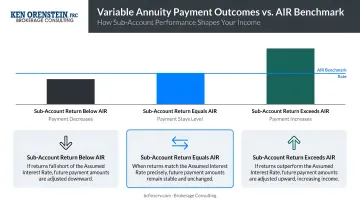
The direction of change is entirely a function of the gap between actual performance and the AIR — not the absolute level of returns.
Why Positive Returns Can Still Mean a Pay Cut
Suppose your AIR is 5% and your subaccounts earn 4% in a given year. Your portfolio had a positive return, but your next payment will still be lower — 4% did not clear the 5% hurdle.
The rule is straightforward: exceed the AIR and payments rise; fall short and payments drop — regardless of whether returns were positive in absolute terms.
What Sets Your First Payment
The initial payment calculation uses several inputs together:
- Your age and sex at annuitization
- Total account value less applicable premium taxes
- The annuity payout option selected (life only, joint and survivor, period certain, etc.)
- The AIR you choose
Change the AIR and the first payment changes with it, which is why AIR selection and payout structure decisions are inseparable.
AIR Options and the Selection Trade-Off
AIR options vary by carrier and product — there is no universal standard. Recent SEC filings show the range is wider than many advisors assume:
| Carrier / Product | AIR Options Available |
|---|---|
| Lincoln Group Variable Annuity | 1%, 2%, 3%, 4%, 5%, or 6% |
| Lincoln Multi-Fund Select | 3%, 4%, 5%, or 6% |
| Transamerica Principium IV | Fixed at 3% |
| American Fidelity Separate Account A | Fixed at 4.5% |
Some products give you a choice; others fix it for you. Either way, the AIR is disclosed in the annuity payout section of the contract and prospectus — that's where you'll find it.
Higher vs. Lower AIR: The Core Trade-Off
A higher AIR (e.g., 5% or 6%) raises your starting payment but sets a steep performance hurdle. Your subaccounts must consistently beat 5%+ net of all fees just to hold payments steady, and in down markets, that volatility becomes very visible.
A lower AIR (e.g., 3%) starts smaller but is easier to beat. When subaccounts outperform the benchmark, payments rise. Over a 20- or 30-year retirement, that upside creates meaningful inflation-hedging potential.

The right choice depends on your income needs today versus your long-term priorities. Before the decision is locked in, work through AIR scenarios with a retirement income advisor who can model different subaccount return assumptions against each option.
At Brokerage Consulting, Ken Orenstein works with clients approaching annuitization to evaluate these trade-offs as part of a broader retirement income review, including whether annuitization makes sense versus other guaranteed income structures.
When Returns Beat or Miss the AIR
The Upside
When subaccounts consistently outperform the AIR over multiple periods, annuity unit values rise and payments increase. For a retiree holding a variable annuity through a sustained bull market, this can translate to meaningful income growth, which is one of the core reasons investors choose variable annuity income over fixed.
According to the SEC's Variable Annuities guide, variable annuity payment options can increase or decrease based on mutual fund performance — the upside potential being the fundamental tradeoff for accepting investment risk during the payout phase.
The Downside
Sustained underperformance relative to the AIR causes payments to decline period after period. Because the annuity unit count is fixed, there's no mechanism for recovery other than future outperformance. A prolonged bear market can steadily erode retirement income with no easy reversal.
Living Benefit Riders as a Backstop
Some variable annuity contracts offer optional riders — primarily Guaranteed Minimum Income Benefits (GMIBs) and Guaranteed Lifetime Withdrawal Benefits (GLWBs) — that establish a payment floor regardless of subaccount performance.
These riders carry real costs. Based on SEC filings and Ken Orenstein's advisory experience, typical all-in annual expenses include:
- Rider fees (GMIB/GLWB): 1.0–1.5% on the benefit base, with maximums reaching 2.0–2.5%
- M&E charges: ~1.25% annually (per SEC investor materials)
- Fund expenses: variable, but combined with the above, total costs can exceed 3% per year
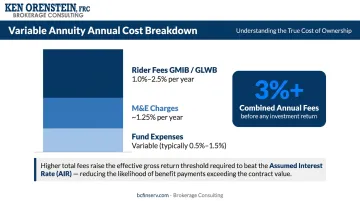
That cost burden matters directly for AIR performance. Higher fees reduce net subaccount returns, raising the effective return threshold your investments must clear just to keep payments flat. The protection a rider provides comes at a price that makes the AIR harder to beat — not easier.
Common Misunderstandings About the AIR
Three misconceptions come up repeatedly:
The AIR Is Not a Guaranteed Minimum Return
The AIR is a calculation benchmark, not a promise. If your subaccounts fall short of it, your payments fall — no floor, no guarantee unless you've purchased a separate rider.
Positive Returns Don't Automatically Increase Your Payment
Only returns that exceed the AIR produce a payment increase. A 4% gain measured against a 5% AIR still results in a lower next payment. What matters isn't the absolute return — it's the spread versus the AIR.
Fees and the AIR Are Two Separate Things
M&E charges, administrative fees, and underlying fund expenses are deducted from gross investment returns before the net result is compared to the AIR. Fees effectively raise the gross return your subaccounts must earn to clear the AIR hurdle. A 5% AIR with 1.5% in annual fees requires a gross subaccount return of roughly 6.5% just to hold payments flat.
Frequently Asked Questions
What is the AIR on a variable annuity?
The AIR (Assumed Interest Rate) is a benchmark rate set by the insurance company and disclosed in your annuity contract. It is used to calculate your initial variable income payment and to determine whether each subsequent payment rises, falls, or holds steady during the payout phase.
How does the AIR affect my monthly annuity payments?
Each payment period, your subaccounts' actual net return is compared to the AIR. If performance exceeds the AIR, your next payment increases; if it falls short, your payment decreases; if it matches exactly, your payment stays the same.
Is the assumed interest rate the same as a guaranteed return?
No. The AIR is a performance benchmark, not a promise. Payments can and do decrease when subaccount returns fail to meet the AIR. No guaranteed floor is attached to the AIR itself unless a separate living benefit rider has been added.
What happens if my variable annuity's actual returns exceed the AIR?
When actual net returns exceed the AIR, the annuity unit value increases, producing a higher payment in the following period. Consistently exceeding the AIR over time is how variable annuity income can keep pace with — or outrun — inflation.
Can I choose my own AIR, and how do I decide which rate to select?
Some carriers offer a selection of AIR options (Lincoln, for example, offers 1% through 6% depending on the product); others fix it in the contract. A higher AIR delivers a larger initial payment but requires stronger ongoing performance to sustain it. Starting with a lower AIR means a smaller first check, but leaves more room for payments to grow as returns accumulate.
Does the AIR apply during the accumulation phase of a variable annuity?
No. During the accumulation phase, your account value simply grows or contracts based on subaccount investment performance. The AIR becomes operative only at annuitization — when your account balance is converted into periodic income payments.
For personalized guidance on AIR selection, variable annuity annuitization planning, or evaluating whether your existing variable annuity still fits your retirement income strategy, contact Ken Orenstein at Brokerage Consulting at (888) 315-3608 or schedule a no-cost initial consultation at bcfinserv.com.