
For many high-income professionals and federal employees, this is a real and frustrating position. According to Vanguard's How America Saves 2025 report, 49% of participants earning over $150,000 maxed out their 401(k) deferrals in 2024 — meaning nearly half of high earners are actively searching for somewhere else to put their money.
Non-qualified annuities are one of the most underused answers to that problem. They're funded with after-tax dollars, grow tax-deferred with no IRS contribution limits, and can generate guaranteed income in retirement — making them a powerful complement to your existing qualified accounts.
Here's what you need to know.
Key Takeaways
- Non-qualified annuities are funded with after-tax dollars and grow tax-deferred with no IRS contribution limits
- Only the earnings are taxed at withdrawal — your principal comes back tax-free
- No required minimum distributions (RMDs) mean you control when you take income
- Fixed, variable, and fixed-indexed structures each carry different risk profiles
- Ideal for investors who've maxed out qualified accounts and need more tax-deferred growth room
What Is a Non-Qualified Annuity?
Defining the Basics
A non-qualified annuity is a financial contract between you and an insurance company, purchased with money you've already paid tax on. The word "non-qualified" is purely a tax designation — it tells you how the contract was funded, not whether it's legitimate or high-quality. Per IRS Publication 575, a commercial annuity contract purchased directly from an issuer is treated as a nonqualified plan for tax purposes — meaning it's a standalone contract funded with after-tax, discretionary dollars, not held inside an IRA or 401(k).
Here's how it works mechanically:
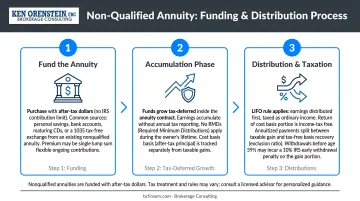
- You make a lump-sum payment or a series of contributions
- The money grows tax-deferred inside the contract
- At a future date, you take distributions as a lump sum, systematic withdrawals, or a guaranteed income stream through annuitization
What "Non-Qualified" Does and Does Not Mean
A non-qualified annuity can still be fixed, variable, or indexed in structure. The label only answers the funding question — not what the contract does or how it grows.
Two features set non-qualified annuities apart from nearly every other retirement vehicle:
- No contribution caps — traditional IRAs top out at $7,000 ($8,000 if you're 50+) in 2024, and 401(k)s at $23,000; non-qualified annuities have no IRS ceiling
- No required minimum distributions (RMDs) — IRS RMD rules kick in at age 73 for traditional IRAs and qualified plan accounts, but standalone non-qualified annuity contracts held outside retirement plans are not subject to those rules
These two distinctions make non-qualified annuities especially useful for savers who've maxed out their qualified accounts and still want tax-deferred growth.
Types of Non-Qualified Annuities
All three major annuity structures can be purchased as non-qualified contracts. The type you choose depends on your risk tolerance and income goals.
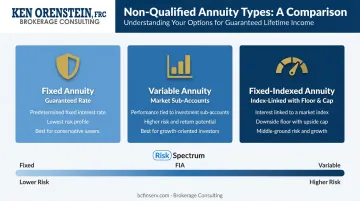
| Type | How It Works | Best For |
|---|---|---|
| Fixed | Guaranteed interest rate for a set period | Conservative savers who prioritize certainty |
| Variable | Funds allocated across market-based sub-accounts | Those comfortable with investment risk and higher growth potential |
| Fixed-Indexed (FIA) | Growth linked to a market index (e.g., S&P 500) with a floor protecting against losses and a cap limiting upside | Those wanting growth potential with downside protection |
As FINRA describes, fixed-indexed annuities link credited interest to an external index and sit between fixed and variable options in terms of risk and return potential. Pre-retirees are drawn to them specifically because the floor mechanic means a down year in the index doesn't translate to a loss in their account value.
Choosing between these structures comes down to more than just risk tolerance. At Brokerage Consulting, Ken Orenstein works with all three non-qualified structures, representing top carriers including Aetna, Humana, and TransAmerica. He compares products across caps, participation rates, income rider features, and surrender schedules to find the right fit for each client.
How Non-Qualified Annuities Are Taxed
The tax treatment of non-qualified annuities follows three distinct rules depending on how you access the money: annuitized payments, systematic withdrawals, and early distributions. Each works differently, and understanding the distinction can meaningfully affect your retirement income strategy.
What Gets Taxed — and What Doesn't
Because you funded the annuity with after-tax dollars, your original principal is not taxed again when you withdraw it. Only the earnings accumulated inside the contract are subject to ordinary income tax when withdrawn.
For example, if you invested $100,000 and the contract grew to $150,000, the $50,000 in gains is the taxable portion. Your $100,000 of principal comes back to you tax-free.
The Exclusion Ratio
When you annuitize — converting the contract into a stream of income payments — the IRS uses a formula called the General Rule (outlined in IRS Publication 575) to determine what portion of each payment is taxable earnings versus tax-free return of principal. This exclusion ratio is applied proportionally to each payment, so you're not hit with a large tax bill up front.
Systematic Withdrawals: Earnings Come Out First
If you take withdrawals before annuitizing, the IRS treats them differently. Under the LIFO (last in, first out) rule, earnings are withdrawn first, before you touch your principal. This means the full taxable gain is drawn down before you receive any tax-free return of cost.
Early Withdrawal Rules
Withdrawals before age 59½ trigger a 10% IRS penalty — but only on the earnings portion, not on your original principal. This is different from qualified annuities, where the penalty can apply to the entire distribution.
Additionally, insurance companies typically impose surrender charges during the early years of the contract. According to the SEC, surrender-charge periods often last 6 to 8 years (sometimes up to 10), with charges as high as 9% of purchase payments. Most contracts include a 10% annual free-withdrawal provision that allows some access without penalty.
Non-Qualified vs. Qualified Annuities: Key Differences
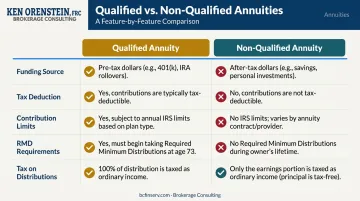
| Feature | Qualified Annuity | Non-Qualified Annuity |
|---|---|---|
| Funding source | Pre-tax dollars (401(k), IRA, TSP) | After-tax dollars |
| Tax deduction on contributions | Yes — reduces current taxable income | No upfront deduction |
| Contribution limits | Yes — $7,000 IRA / $23,000 401(k) in 2024 | No IRS-mandated limits |
| RMD requirements | Yes — must begin by age 73 | No RMDs required |
| Tax on distributions | 100% taxable as ordinary income | Only earnings taxable; principal returned tax-free |
Tax treatment on distributions is where the real difference lands. With a qualified annuity, every dollar you withdraw is taxable — none of it was taxed going in. With a non-qualified annuity, you've already paid tax on your principal, so only the growth is taxed at withdrawal.
Key Benefits of Non-Qualified Annuities
No Contribution Limits Enable Additional Savings
For anyone who has already maxed out their TSP, 401(k), or IRA, a non-qualified annuity offers an additional accumulation vehicle without restriction. There's no IRS ceiling on how much you can contribute — only the insurance company's own premium limits apply.
This is particularly relevant for federal employees. As of December 31, 2024, there were over 4 million FERS participants with TSP balances, with an average balance of $194,131. For those who are maximizing their TSP contributions and still want additional tax-deferred growth, a non-qualified annuity fills that gap without the complexity of another qualified account.
Tax-Deferred Compounding Accelerates Growth
When earnings aren't taxed annually, the entire balance compounds — including the amount you would have otherwise paid in taxes each year. The longer the money stays invested, the more significant this advantage becomes.
Both the SEC and FINRA confirm that annuity earnings grow tax-deferred until withdrawn. The structural benefit is straightforward: money that stays invested rather than being paid out in taxes each year has more time to compound. Actual results will vary based on rates, fees, and withdrawal timing, but that core mechanic holds.
No RMDs Provide Retirement Flexibility
Without forced withdrawals at age 73, you control when you access the funds. That flexibility has direct tax planning value: if you have other income sources in early retirement — a pension, Social Security, part-time work — you can let the annuity keep compounding while managing your taxable income from other sources.
Retirees who have FERS pension income, TSP distributions, and Social Security may find themselves in a high tax bracket already. Not being forced to take distributions from an additional account gives real flexibility. For many federal retirees, that alone justifies the strategy.
Key scenarios where no-RMD flexibility pays off:
- FERS retirees drawing pension and Social Security simultaneously who want to delay further taxable income
- Part-time workers in early retirement who can defer annuity distributions until income drops
- TSP account holders managing bracket exposure across multiple distribution sources
Death Benefit and Estate Planning
Most non-qualified annuities include a death benefit provision. Per the SEC, variable annuities commonly include a designated beneficiary provision under which the beneficiary receives a specified amount if the owner dies before payout begins — typically at least the original investment value or the current account value, whichever is greater.
Beneficiaries will owe ordinary income tax on the earnings portion they inherit, consistent with how IRS Publication 575 treats survivor and beneficiary income from annuity contracts.
Guaranteed Income Stream for Longevity Protection
Through annuitization, a non-qualified annuity can be converted into a guaranteed lifetime income stream that pays regardless of market conditions or how long you live. This directly addresses longevity risk — and the numbers make a compelling case.
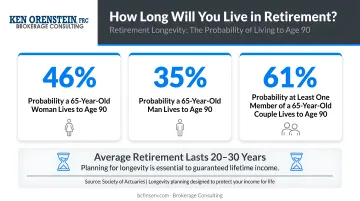
According to the Social Security Administration's actuarial life table:
- A 65-year-old woman has a 32.3% chance of living to age 90
- A 65-year-old man has a 21.3% chance of reaching 90
For married couples, the probability that at least one spouse lives to 90 is considerably higher. Those odds mean a significant share of today's retirees will spend 25+ years in retirement — longer than many expect to fund.
Who Should Consider a Non-Qualified Annuity?
Non-qualified annuities are not the right tool for everyone. Here's how to think about fit:
Strong candidates include:
- High-income earners who have maxed out all qualified retirement accounts and want additional tax-deferred savings
- Individuals who don't need immediate access to funds and can commit to a long-term contract
- Those with estate planning goals who want to pass assets efficiently to named beneficiaries
- Retirees with other income sources who want to defer distributions for tax bracket management
- Federal employees with FERS pension, TSP, and Social Security who want a supplemental guaranteed income layer beyond their government benefits
Less likely to benefit:
- Those who may need liquidity in the near term — surrender charges can restrict access for 6 to 10 years
- Individuals in low tax brackets who won't benefit meaningfully from tax deferral
- Anyone uncomfortable with the complexity of annuity contracts or long-term commitments
If you're unsure which category applies to you, a brief consultation can help clarify the fit before you commit to anything.
Ken Orenstein at Brokerage Consulting offers no-cost initial consultations — by phone, virtually, or in person — to walk through your specific retirement picture and determine whether a non-qualified annuity belongs in your plan. The practice represents multiple carriers, so you get a comparison across products rather than a push toward any single option. Reach Ken at (888) 315-3608 or schedule at bcfinserv.com.
Frequently Asked Questions
What is considered a non-qualified annuity?
Any annuity purchased with after-tax dollars outside of a qualified retirement plan — such as a 401(k) or IRA — is considered non-qualified. The term refers solely to the tax treatment of the funding source, not the annuity type — whether fixed, variable, or indexed.
What is the difference between a qualified and non-qualified annuity?
Four key distinctions separate them:
- Funding source: Pre-tax dollars (qualified) vs. after-tax dollars (non-qualified)
- Tax on withdrawals: 100% taxable (qualified) vs. earnings only (non-qualified)
- Contribution limits: IRS-capped (qualified) vs. no IRS limit (non-qualified)
- RMDs: Required at age 73 (qualified) vs. none required (non-qualified)
How are non-qualified annuities taxed?
Your original contributions are not taxed again at withdrawal — they were already taxed. Earnings grow tax-deferred and are taxed as ordinary income when withdrawn. The exclusion ratio (per IRS Publication 575) determines the taxable vs. tax-free portion of each annuity payment.
Can I withdraw money from a non-qualified annuity?
Yes, withdrawals are permitted. However, withdrawals before age 59½ trigger a 10% IRS penalty on the earnings portion, and most contracts impose surrender charges during the early years, typically 6 to 8 years and sometimes up to 10.
Is a non-qualified annuity a good investment?
It can be a strong tool for those who have maxed out qualified accounts and want additional tax-deferred growth, no RMD obligations, and guaranteed income options. Suitability depends on your tax situation, liquidity needs, and retirement timeline — consulting a licensed advisor before purchasing helps ensure the product fits your specific plan.
Is a fixed annuity a non-qualified annuity?
A fixed annuity can be either qualified or non-qualified. "Fixed" describes the interest structure (guaranteed rate), while "non-qualified" describes the funding source (after-tax dollars). Many fixed annuities purchased outside of retirement plans are indeed non-qualified.