
According to Vanguard's How America Saves 2025 report, 49% of participants earning over $150,000 reached their plan's statutory maximum in 2024. That's nearly half of high earners running out of qualified account space. IOVAs are one answer to that problem — but they come with real trade-offs worth understanding before you commit.
This article covers what an IOVA is, how its fee structure works, the key benefits and drawbacks, and who this product actually fits.
Key Takeaways
- An IOVA is a variable annuity built for tax-deferred accumulation — not guaranteed lifetime income
- Fees run lower than traditional variable annuities; some products charge a flat monthly fee with zero M&E charges
- Withdrawals are taxed as ordinary income, with a 10% early-withdrawal penalty before age 59½
- Ideal for high-income investors who've maxed out their 401(k), IRA, and TSP contribution limits
- A free-look period (10–30 days) lets you cancel without penalty if the product isn't the right fit
What Is an IOVA and How Does It Work?
An investment-only variable annuity is a nonqualified annuity contract issued by an insurance company and governed by IRC Section 72. Unlike traditional variable annuities, it carries no guaranteed income rider, no built-in lifetime benefit, and no death benefit enhancements beyond the standard contract value. The point is purely tax-deferred investment growth.
The Two Structural Phases
Accumulation phase: Your premiums are allocated across investment subaccounts — equity funds, bond funds, managed volatility strategies, and in some contracts, alternative investment options. You can rebalance and transfer between subaccounts without triggering a taxable event. That tax-free flexibility is a meaningful advantage over a taxable brokerage account.
Payout phase: At some point, you can convert the contract value into periodic income through annuitization. But this step is optional — many IOVA holders simply take systematic withdrawals instead.
Tax Treatment: Deferral Benefits and the Ordinary Income Rate Trap
Gains compound inside the contract without annual capital gains taxes or dividend distributions creating a drag. When you withdraw, though, gains are taxed at ordinary income rates — not the preferential long-term capital gains rates you'd get in a taxable brokerage account.
Key rules:
- Before age 59½: IRC Section 72(q) imposes a 10% additional tax on early withdrawals (premature distributions) from nonqualified annuities (separate from the Section 72(t) rules that govern retirement plans)
- Exceptions: Distributions made after the holder's death, attributable to disability, or structured as substantially equal periodic payments avoid the penalty
- No IRS contribution limits: Unlike IRAs (capped at $7,000 for 2024, or $8,000 for age 50+), IOVA contribution limits are set by the carrier — making them useful for investors who've already hit qualified plan ceilings
To see how these rules play out in practice: a federal employee who retires from a 28% marginal bracket and drops to 22% in retirement may find the deferral genuinely valuable — withdrawals land in a lower bracket than contributions would have been taxed in.
Important clarification: IOVAs don't require medical underwriting (no health exam to purchase), but they are not a tax avoidance strategy. They defer taxes; they don't eliminate them.
IOVA Fee Structure: What You'll Actually Pay
Fees are the defining difference between IOVAs and traditional variable annuities. Tax deferral only works in your favor if total annual costs don't erode it.
Mortality and Expense (M&E) Fees
Traditional variable annuities commonly include M&E charges — insurance-layer costs that Morningstar's fee benchmarking data puts at 1.22%–1.30% annually across industry samples. IOVAs are specifically designed to reduce or eliminate this charge.
Two documented examples:
- Nationwide Monument Advisor Select: $0 M&E charge; charges instead a flat $20/month fee with no surrender period and no commissions
- Fidelity Personal Retirement Annuity (FPRA): 0.25% annual annuity charge, dropping to 0.10% for contracts at or above $1 million
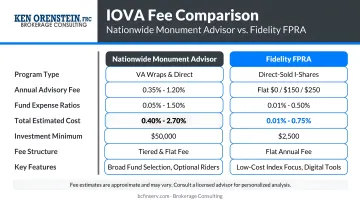
These are product-specific figures — always verify the actual fee schedule in the contract prospectus before committing to any contract.
Administrative and Subaccount Fees
Administrative fees cover account management and vary by carrier. Subaccount fees function like mutual fund expense ratios — they vary based on which investment options you select. These apply on top of the contract-level charge — unavoidable with either product type.
The all-in cost calculation: contract fee + administrative fees + subaccount/fund expenses + any advisory fees if you work with a fee-based advisor.
Surrender Charges and No-Load Structures
Many IOVAs are structured with:
- No contingent deferred sales charges (CDSC) — you can exit without penalty
- No commissions built into the product cost
- No multi-year surrender lock-in periods
Traditional variable annuities, by contrast, commonly carry surrender periods of 6–10 years that penalize early exits. For investors who value flexibility, the no-load IOVA structure is a genuine structural advantage.
Key Benefits of IOVAs for Retirement Planning
Tax-Deferred Compounding
Inside an IOVA, you don't pay annual taxes on dividends, capital gains distributions, or rebalancing activity. For high-turnover or actively managed fund strategies, this is where the advantage concentrates — those strategies generate the most tax drag in a taxable account.
The SEC confirms that transfers between subaccounts during accumulation typically don't trigger a taxable event, which means you can shift your allocation as market conditions or your risk tolerance change without tax consequences.
Open Architecture and Investment Flexibility
IOVAs typically offer a broader subaccount menu than standard retirement accounts, including:
- Domestic and international equity funds
- Fixed income and bond funds
- Managed volatility strategies
- In some contracts, alternative investment options
For investors whose 401(k) menu feels limiting, this broader lineup is a meaningful structural advantage.
Creditor Protection and Estate Planning
In many states, annuity assets receive some degree of creditor protection — though the scope varies significantly by state. Texas, for example, provides broad exemptions under Insurance Code Chapter 1108, while California's protections under CCP Section 704.100 are more limited and tied to amounts reasonably necessary for support. Don't assume blanket protection without reviewing your state's specific rules.
On the estate planning side, IOVAs offer two useful features:
- Probate bypass: Named beneficiaries receive the contract value directly, without going through probate
- Death benefit: Standard contracts pass the account value to beneficiaries; enhanced death benefits are available from some carriers for an additional fee
High-net-worth clients sometimes name a charity as a primary or contingent beneficiary, avoiding income tax on the gains for the charitable recipient.
Overflow Savings After Maxing Qualified Accounts
Once qualified account limits are reached, an IOVA provides additional tax-deferred space with no IRS-mandated contribution ceiling. For 2025, the contribution ceilings are:
- TSP elective deferrals: $23,500 standard; $31,000 catch-up (ages 50–59 and 64+); $34,750 catch-up (ages 60–63)
- IRA contributions: $7,000 standard; $8,000 age 50+
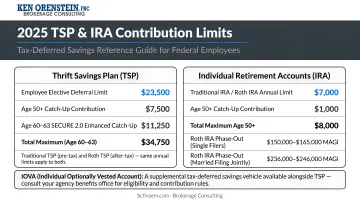
Once those buckets are full, an IOVA provides additional tax-deferred space with no IRS-mandated contribution ceiling.
For federal employees who've maximized TSP contributions, this overflow capacity is the single strongest argument for adding an IOVA to the retirement picture.
Drawbacks and Risks of IOVAs
Fee Complexity and Cost Drag
Even stripped-down IOVAs carry costs: the contract fee (flat or percentage-based), subaccount expense ratios, and potentially an advisory fee. If these total 0.75% to 1.25% annually, you need the tax deferral to generate at least that much additional after-tax return compared to a low-cost taxable account to break even.
For investors holding highly tax-efficient index funds in a taxable account — where dividend yields are low and capital gains distributions are minimal — the math may not favor the IOVA. The benefit concentrates in higher-turnover, less tax-efficient strategies.
Liquidity Constraints and Market Risk
Two risks worth taking seriously:
- Liquidity: Even without surrender charges, the IRS 10% early distribution tax under Section 72(q) effectively locks your money until age 59½. IOVAs are not appropriate for capital you may need in the short term.
- Market risk: IOVA returns depend entirely on subaccount performance. There is no principal guarantee. A poor stretch of returns doesn't just reduce gains — it can erode principal.
Ordinary Income Tax Treatment on Withdrawals
For high earners, this is the sharpest drawback. The gap between capital gains rates in a taxable account and ordinary income rates on IOVA withdrawals is substantial:
| Account Type | Tax Rate on Gains/Withdrawals |
|---|---|
| Taxable brokerage (long-term gains) | 0%, 15%, or 20% |
| IOVA withdrawals (ordinary income) | 32%, 35%, or 37% |
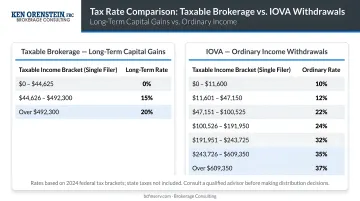
If you expect to stay in a high bracket throughout retirement, that rate gap can neutralize — or exceed — the deferral benefit. The IOVA tax advantage is most pronounced when you expect a noticeably lower rate at withdrawal than during accumulation.
Who Should Consider an IOVA?
The Ideal Candidate
An IOVA fits best when all of these conditions apply:
- Qualified accounts are maxed: TSP, 401(k), and IRA contributions fully funded
- Long investment horizon: 10+ years before anticipated distributions
- Higher tax bracket now, lower in retirement: The deferral benefit grows with the bracket differential
- Comfort with market risk: No need for a guaranteed income floor from this asset
- High-net-worth or high-income: The complexity and cost structure justify larger contract values
Federal Employees: A Natural Fit
Federal employees who've maximized TSP contributions face a specific gap — they have a disciplined savings habit and a long-term mindset, but limited additional tax-advantaged options outside the federal retirement system.
For this group, a nonqualified IOVA can complement the TSP, FERS pension, and Social Security income that form the base of their retirement plan. Ken Orenstein at Brokerage Consulting holds the Federal Retirement Consultant (FRC) designation and works with federal employees on how supplemental savings vehicles fit alongside TSP distribution strategy, FERS pension income, and phased retirement timelines. He offers no-cost consultations by phone, virtually, or in person for federal employees evaluating these options.
That said, an IOVA isn't the right tool for every situation.
When an IOVA Is NOT the Right Fit
Skip the IOVA if:
- You need access to the funds within 5–10 years
- You're already in a low tax bracket where deferral adds little value
- You can't tolerate investment losses without a guaranteed floor
- Low-cost index investing in a taxable account is already highly tax-efficient for your strategy
Frequently Asked Questions
What is an investment-only variable annuity?
An IOVA is a nonqualified variable annuity structured as a tax-deferred investment account (authorized under IRC Section 72). It lets policyholders invest across a menu of subaccounts and defer taxes on gains until withdrawal — without bundling guaranteed income riders or enhanced insurance features.
How much income can I expect from an investment-only variable annuity?
There is no guaranteed income — returns depend on subaccount performance. You can take systematic withdrawals or elect to annuitize the contract, but without adding an income rider (for an additional fee), no lifetime income guarantee is built in.
How does an IOVA differ from a traditional variable annuity?
Traditional variable annuities bundle income riders, death benefit enhancements, and higher M&E charges into one package. IOVAs strip those features to focus on pure investment growth at lower cost, making them better suited for accumulation-focused investors than for those seeking guaranteed retirement income.
What are the main fees associated with an IOVA?
IOVAs typically carry three cost layers:
- Contract fee: flat monthly charge or a low annual percentage
- Administrative fees: charged at the contract level
- Subaccount expense ratios: comparable to mutual fund fees
Many IOVAs carry zero surrender charges and no commissions, though subaccount and advisory fees still apply.
Is an IOVA a good option if I've already maxed out my 401(k) and IRA?
For most investors, yes. IOVAs carry no IRS contribution limits, making them an effective overflow vehicle for additional tax-deferred savings once qualified retirement accounts are fully funded.
What is the free look period for an IOVA?
The free look period typically runs 10 to 30 days from the date you receive the contract, depending on your state and the carrier. During this window, you can cancel for a full refund of your initial premium, though some states return the current account value rather than the full amount paid.