
Introduction
Most Americans approaching retirement face a stark reality: the guaranteed income floor their parents relied on has largely disappeared. According to the Bureau of Labor Statistics, only 15% of private-sector workers had access to a defined-benefit pension plan as of March 2023. The rest are left managing longevity, market swings, and inflation largely on their own.
Concepts like annuities and protected income get discussed often , but the conversation usually stops at definitions. What gets underexplained is the practical impact: how a guaranteed income floor changes spending behavior, reduces portfolio risk, and frees up the rest of your assets to work harder.
This article covers what that actually looks like in practice: how a guaranteed income floor affects withdrawal sequencing, what research shows about retiree spending confidence, and why building one often changes how the rest of your portfolio gets used.
Key Takeaways
- Only 15% of private-sector workers have pension access, leaving most retirees without a guaranteed income floor
- Protected income directly addresses retirement's core risks: outliving savings, market downturns, and rising costs
- Retirees with guaranteed income spend more freely, take smarter investment risks, and tend to leave larger estates
- Without it, retirees often over-withdraw during downturns or under-spend out of fear, each quietly draining long-term wealth
- Protected income works best alongside Social Security, savings, and growth investments — not as a standalone solution
What Is Protected Income?
Protected income is a guaranteed stream of retirement income you cannot outlive. It's typically generated through a lifetime income annuity — a contract with an insurance company where you convert a portion of savings into predictable monthly payments for life. In practical terms, it works like a private pension you build on your own terms.
Where it fits in your plan matters. Financial professionals commonly describe a layered income architecture:
- Layer 1 — Social Security (with claiming strategy optimization)
- Layer 2 — Pension (FERS for federal employees, or private-sector DB plans)
- Layer 3 — Guaranteed lifetime income via annuity (Fixed, Fixed Indexed, or Immediate/SPIA)
- Layer 4 — Discretionary portfolio (growth, legacy, emergencies)
Layers 1 through 3 form your guaranteed income floor — the portion that covers essential expenses regardless of what markets do. Layer 4 handles everything else.

The key question isn't whether to include protected income — it's how much of your essential expenses your guaranteed floor actually covers. Getting that sizing right is where the planning work begins.
Key Advantages of Protected Income in Your Retirement Plan
The advantages below are about real-world outcomes — what protected income lets you actually do, spend, and afford — not abstract theory.
Advantage 1: A Guaranteed Income Floor That Protects Against Outliving Your Savings
Longevity risk is one of the most underestimated threats in retirement. CDC data shows a 65-year-old man can expect to live an additional 18.4 years, and a woman 20.8 years. Per Social Security actuarial data, roughly 1 in 4 people who reach 65 will live past age 90. That's a 25-30+ year income horizon most people are not planning for.
A lifetime income annuity addresses this directly. The insurance company is contractually obligated to keep paying — regardless of how long you live. You're no longer guessing how much to withdraw each year without depleting principal. The longevity risk transfers off your balance sheet entirely.
The research backs this up. A study by Finke and Pfau commissioned by Principal Financial Group, as reported by 401(k) Specialist Magazine, used 10,000 Monte Carlo simulations and found that adding a lifetime income annuity allows retirees to achieve higher income at a lower risk of running out of money than an investments-only portfolio.
A related finding from Blanchett and Finke (2024) adds another layer: retirees consume approximately 80% of lifetime income (Social Security, pensions, annuities) but only about 50% of available savings. The implication is clear — converting savings into guaranteed income can actually increase retirement consumption, not reduce it.
This advantage matters most for:
- Retirees without a pension
- Those with strong family longevity history
- Anyone concerned about cognitive decline affecting their ability to manage withdrawals in later years
Advantage 2: A Buffer Against Market Volatility — And Freedom to Invest More Aggressively
Market volatility in retirement creates a problem called sequence-of-returns risk: poor returns early in retirement, combined with ongoing withdrawals, can permanently deplete a portfolio even if markets fully recover later. The losses compound because you're selling shares at depressed prices to fund expenses — shares that never get a chance to bounce back.
Protected income solves this in two distinct ways:
- Essential expenses stay covered during downturns — you're never forced to sell investments at a loss to pay bills
- The remaining portfolio can be allocated more aggressively — because the income floor is secured, you don't need to defensively weight bonds to protect against spending needs
Research published in the Journal of Financial Planning by David Blanchett found that retirees with higher guaranteed income had a higher optimal equity allocation in their remaining investment portfolio. The income floor enables the portfolio to take on more growth potential.
The legacy impact is significant. A TIAA Institute study examining 49 years of historical data found that portfolios including a guaranteed annuity component outperformed in over 90% of retirement scenarios and averaged nearly $89,000 larger estate balances than bond-only alternatives.
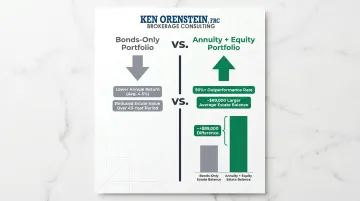
The common objection — that annuities reduce legacy potential by pulling assets out of market growth — is directly contradicted by this finding. The mechanism is the income floor itself: it keeps the remaining portfolio in equities longer, which compounds favorably over multi-decade retirements.
This advantage matters most for:
- Retirees who watched their portfolio drop during 2022 and felt pressure to change course
- Those with significant assets in equities unsure how to generate income without selling
- Anyone who has heard of sequence-of-returns risk but hasn't built a structural defense against it
Advantage 3: Reduced Spending Anxiety and Built-In Flexibility for Inflation
One of the least discussed costs of retirement without guaranteed income is behavioral. Retirees who rely entirely on investment portfolios often under-spend — forgoing experiences and quality of life even when their assets are sufficient — out of fear of running out of money.
This pattern is well-documented. The Employee Benefit Research Institute finds that many retirees are not spending down assets at rates consistent with life-cycle economic models. The Blanchett and Finke research confirms it: withdrawal rates from savings are consistently well below typical guidance.
When essential expenses are covered by a guaranteed income floor, this changes. Retirees have psychological permission to spend what they've saved for, because they know the bills are covered regardless.
That confidence, though, has a limit: inflation erodes spending power quietly over time. Prices roughly doubled over the 30 years ending in 2024, according to BLS CPI data. Annual CPI hit 8.0% in 2022 before moderating. Even at the Federal Reserve's 2% long-term target, purchasing power erodes meaningfully over a 25-year retirement.
Some lifetime income annuities include optional cost-of-living adjustment (COLA) features — typically 1%, 2%, 3%, or CPI-linked increases annually. Through top carriers, Brokerage Consulting can help clients access COLA riders across its immediate annuity options. The tradeoff: a lower starting payment in exchange for rising income over time. For retirees with a 20-30 year horizon, that tradeoff is often worth modeling carefully.
Healthcare costs make inflation protection especially urgent. Fidelity's 2024 estimate puts average healthcare spending at $165,000 per person in retirement — up nearly 5% from the prior year and more than double the 2002 estimate.
A guaranteed income floor that rises with inflation is one of the few reliable ways to absorb costs like these without drawing down discretionary savings.
This advantage matters most for:
- Retirees who have sufficient assets but hesitate to spend them
- Anyone with significant healthcare cost concerns in later retirement years
- Those planning for a retirement horizon of 20+ years
What Happens When You Retire Without Protected Income
Without a guaranteed income floor, retirees must constantly manage withdrawal rates, monitor market performance, and make emotionally charged decisions during downturns. The data shows what that pressure costs.
Three compounding risks go unmanaged:
- Longevity risk: assets that look sufficient at 65 can run dry by 85, with no backstop once they're gone
- Sequence-of-returns risk: early losses combined with ongoing withdrawals create permanent portfolio damage — market recoveries can't undo it
- Behavioral risk: in 2024 alone, the average equity investor underperformed the S&P 500 by 848 basis points, driven by panic-selling and mistimed re-entries
Over a 30-year period ending in 2025, DALBAR data shows the average equity investor earned 7.94% annualized versus the market's 10.98% — a 304-basis-point annualized gap driven almost entirely by behavioral decisions made under stress.
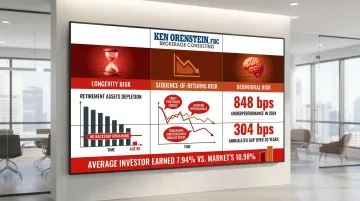
When essential expenses draw from the same asset pool exposed to these pressures, there's no separation between "money I can afford to lose" and "money I need to live on." The result is self-insurance against an open-ended timeline — using assets that behavioral stress can permanently impair.
How to Build Protected Income Into Your Retirement Plan
Sizing It Correctly
Most financial professionals recommend that guaranteed income sources — Social Security, any pension, and annuity income combined — cover your essential monthly expenses. Discretionary spending and growth come from the investment portfolio.
Industry guidance generally suggests limiting annuity purchases to no more than 50% of investable assets to maintain adequate liquidity. Wade Pfau's research suggests an allocation of approximately 30% of assets worked best for retirees beginning income immediately, based on income optimization modeling. The right number depends on your income gap, timeline, and liquidity needs — not a fixed rule.
Interest Rates and Timing
Annuity payout rates are closely tied to prevailing interest rates at the time of purchase. Research from CANNEX confirms that changes in interest rates lead to meaningful changes in income annuity payout rates. Higher rates generally translate to more income per dollar committed. Current rate conditions are worth factoring into timing discussions — though specific rate predictions aren't the right basis for a long-term income decision.
For Federal Employees
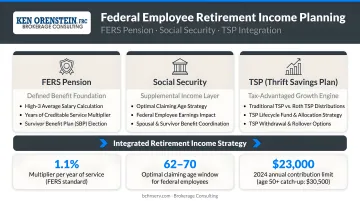
Federal employees working with FERS pensions and Social Security already have a partial guaranteed income floor. The key planning question is: how large is the gap between those guaranteed sources and your actual essential expenses?
Ken Orenstein at Brokerage Consulting focuses on that gap-closing work for federal employees. The analysis covers:
- Integrating FERS pension, Social Security, and TSP into a coordinated income plan
- Calculating how much additional annuity income is needed to close any remaining gap
- Evaluating TSP distribution options, including whether rolling TSP assets to an IRA opens access to better annuity products than the TSP's built-in MetLife option
To explore what that looks like for your situation, no-cost consultations are available by phone, virtually, or in person by calling (888) 315-3608.
Conclusion
Protected income works by trading a portion of savings for something most retirees value above almost everything else: the certainty that essential expenses are covered for life. That certainty, in turn, creates more freedom with the rest of the portfolio.
These advantages compound when layered into a well-structured plan:
- Protects against outliving savings with a guaranteed income floor
- Insulates the remaining portfolio from sequence-of-returns risk
- Gives retirees the psychological confidence to spend what they've saved
The earlier protected income is integrated, the more work it can do — freeing up the rest of your assets to grow, flex, or be passed on. If you're ready to explore what a guaranteed income floor could look like in your own plan, a no-cost consultation with Ken Orenstein is a practical first step.
Frequently Asked Questions
What is a protected retirement income annuity?
A protected retirement income annuity is a contract with an insurance company where you convert a portion of savings into guaranteed monthly payments for life. Payments continue regardless of market performance or how long you live, transferring longevity risk to the insurer.
How does protected income reduce the risk of outliving my savings?
Because a lifetime annuity pays for as long as you live, the insurance company absorbs your longevity risk. You no longer need to estimate how many years your savings must last — the payments simply continue.
How much of my retirement savings should I convert to protected income?
A common guideline: size guaranteed income so Social Security, pension, and annuity payments together cover your essential monthly expenses. A common rule of thumb is to limit annuity purchases to no more than 50% of investable assets to preserve adequate liquidity.
What is the difference between a fixed and variable lifetime income annuity?
A fixed annuity provides a set, predictable monthly payment that never changes. A variable annuity's payments fluctuate based on the performance of underlying investments — prioritizing growth potential over stability. Most retirees prioritizing income security choose fixed or fixed indexed annuities.
Can I still leave money to my heirs if I purchase a lifetime income annuity?
Many annuities include beneficiary protections such as cash refund features, installment refund options, or period-certain guarantees that pass remaining value to heirs if you die earlier than expected. Joint-life options also allow payments to continue to a surviving spouse.
How does protected income work alongside Social Security and a federal pension?
Social Security and a FERS pension provide a partial guaranteed income floor for federal employees. A lifetime income annuity fills any remaining gap between those guaranteed sources and actual essential expenses — reducing reliance on TSP or personal savings for day-to-day retirement costs.