
Introduction
Most people entering retirement assume annuities pay for life. That's true for some — but not all. Period certain annuities work differently, and that difference matters enormously when you're building a retirement income plan.
A period certain annuity pays guaranteed income for a fixed number of years. When that window closes, payments stop — whether you're living or not. The structure delivers income certainty over a defined span, not longevity protection over an open-ended one.
That distinction trips people up. Clients sometimes select a period certain payout expecting lifetime coverage, or choose a 10-year period without thinking through what income replaces it in year 11.
According to the SSA's 2022 actuarial life table, a 65-year-old woman has a 54.1% probability of surviving to age 85. For anyone retiring at 65, a 20-year period certain annuity runs out at the exact point survival odds start working against you.
This guide breaks down how period certain annuities work, where they fit against other payout options, and the specific scenarios where choosing one is the right call.
Key Takeaways
- A period certain annuity pays guaranteed income for a fixed term — commonly 10 or 20 years — regardless of whether you're alive at the end
- If you die before the period ends, your named beneficiary receives the remaining payments
- Payments stop completely when the term expires, even if you're still living
- Payouts run higher than life annuities — the insurer's liability ends with the term
- Best use case: bridging the gap between early retirement and Social Security or pension income
What Is a Period Certain Annuity?
A period certain annuity — also called a fixed-period annuity or annuity certain — is a contract with an insurance company that delivers guaranteed income payments for a pre-selected, finite time span. As the NC Department of Insurance defines it, payments continue for the specified number of years regardless of whether the annuitant (the person receiving payments) dies before the period ends.
The product solves a specific problem: income uncertainty during a defined financial window. Early retirement, a pension gap before Social Security kicks in, a mortgage payoff period — each creates a need for reliable income over a known timeframe, not necessarily for life.
Understanding where period certain fits among its close relatives helps avoid a costly selection mistake.
Period Certain vs. Life Annuities: Key Differences
Three terms cause consistent confusion:
- Period certain annuity: Pays for a fixed number of years, then stops. No life-contingent feature.
- Life annuity (straight life): Pays until death, with no guaranteed minimum term and nothing passing to beneficiaries.
- Life with period certain: A hybrid that pays for life, but guarantees a minimum term. If you die within that term, beneficiaries receive the remainder.
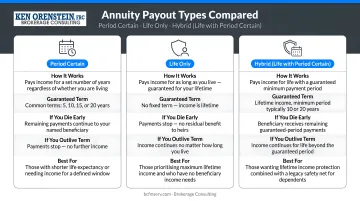
These are meaningfully different products. Selecting the wrong one can leave a spouse unprotected or result in an insurer keeping assets that could have passed to heirs.
Available Period Lengths
Most insurers offer period certain options of 5, 10, 15, or 20 years. The period is chosen at annuitization and generally cannot be changed once payments begin — as Wisconsin's Office of the Commissioner of Insurance notes in its consumer guidance.
Period certain can be structured as:
- A standalone immediate annuity (lump sum converted directly to income)
- A payout election when annuitizing an existing deferred annuity
How Does a Period Certain Annuity Work?
Setting Up the Contract
Setting up a period certain annuity is straightforward — but the decisions made at contract time are permanent. The annuitant either purchases an immediate period certain annuity with a lump sum, or elects the period certain payout option when annuitizing an existing deferred annuity. Three things get locked in at that point:
- The period length (e.g., 10 or 20 years)
- Payment frequency (monthly, quarterly, or annual)
- Named beneficiary (who receives remaining payments if the annuitant dies early)
The payment amount is calculated by dividing the contract value (adjusted for interest and pricing) across the total number of scheduled payments. Because the end date is fixed, the math is more straightforward than a life annuity, where the insurer must price for an unknown lifespan. That's why period certain payments tend to be higher on a per-payment basis.
The Payout Phase
Once payments begin, they continue on the agreed schedule for the full term. For fixed period certain annuities, payments don't fluctuate with market conditions — they're contractually guaranteed.
The beneficiary provision is one of the most important features to understand:
If the annuitant dies before the guaranteed period expires, payments don't stop. They continue to the named beneficiary for the remainder of the term.
Example: Someone purchases a 10-year period certain annuity and dies in year 6. Their beneficiary receives payments for the remaining 4 years on the same schedule — confirmed by the NY Department of Financial Services in its annuity product guidance.
End of the Period
When the term concludes, payments stop permanently and the contract is complete. No residual value is returned. That's the core limitation to weigh: a period certain annuity delivers predictable income for exactly the term you choose — nothing more, and no safety net if you outlive it.
Period Certain vs. Other Annuity Payout Options
| Payout Type | Duration | Beneficiary Outcome | Monthly Payment |
|---|---|---|---|
| Period certain | Fixed term (e.g., 10 years) | Receives remaining payments if death occurs during term | Higher |
| Straight life | Until death | Nothing passes to beneficiaries | Highest |
| Life with period certain | Life, with guaranteed minimum term | Receives remainder of certain period if death occurs during it | Lower than period certain |
| Joint and survivor | Until both spouses die | Survivor continues at 50–100% of original payment | Lowest |
As the table shows, payment size and beneficiary protection move in opposite directions. The NY Department of Financial Services confirms that straight life annuities pay the most precisely because the insurer owes nothing after death — no beneficiary protection, no residual payments. A standalone period certain annuity trades some of that income for a fixed end date, giving the insurer a defined liability window instead of an open-ended one.
Other payout options worth knowing:
- Installment refund: Pays for life; if the annuitant dies before recovering the full premium, remaining value passes to beneficiaries
- Cash refund: Similar to installment refund, but delivers the balance as a lump sum
Benefits and Drawbacks of Period Certain Annuities
Benefits
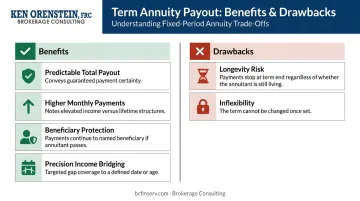
- Predictable total payout: The number of payments and the amount per payment are both fixed at the start. You know the exact income you'll receive over the term — something no life annuity can offer.
- Higher monthly payments: The insurer's liability ends at a defined date, not at an unknown death. That actuarial certainty translates to larger payments than comparable life-contingent products.
- Beneficiary protection: Unlike a pure life annuity, unused contract value doesn't revert to the insurer. Remaining payments pass to heirs — relevant for clients with estate planning goals.
- Precision income bridging: Useful for covering a specific financial window — early retirement years, a mortgage payoff period, or the gap before Social Security or a pension begins.
Drawbacks
- Longevity risk: If you outlive the period, income stops. SSA life tables show a 54.1% probability that a 65-year-old woman reaches age 85 — meaning a 20-year period certain may end with years of life remaining.
- Inflexibility: Once the period is set and payments begin, the structure cannot be modified. Choosing a period that's too short relative to your income needs can create a gap with no straightforward remedy once the contract is in force.
When a Period Certain Annuity Makes Sense
Bridging to Social Security
SSA data shows that delayed retirement credits increase benefits by 8% per year after full retirement age, up to age 70. For someone born in 1960, claiming at 70 instead of full retirement age produces 124% of the full benefit. Early claiming at 62, by contrast, can reduce benefits by as much as 30%.
That math creates a strong incentive to delay. But the gap between early retirement and age 70 needs to be funded. A 10-year period certain annuity purchased at age 60 delivers guaranteed income through that entire bridge window — ending just as maximized Social Security begins.
Preserving Investment Accounts in Early Retirement
That same bridge window also creates a hazard for investment accounts. Sequence-of-returns risk is sharpest in the first years of retirement — drawing heavily from a 401(k), IRA, or TSP during a downturn can permanently impair long-term balances. A period certain annuity provides a guaranteed income floor during early retirement, allowing investment accounts to recover without forced liquidation.
Federal Employee Timing Gaps
For federal employees, the income timing picture is more layered. FERS retirees face a distinct set of gaps that a period certain annuity can address directly:
- The FERS annuity supplement — which approximates Social Security for those who retire before 62 — stops at the end of the month before the retiree turns 62, per OPM, even if Social Security isn't claimed until later
- FERS minimum retirement age (MRA) ranges from 55 to 57 depending on birth year — meaning some federal employees retire years before the supplement ends, and years before Social Security eligibility
- MRA+10 benefits are reduced 5% per year for each year under age 62
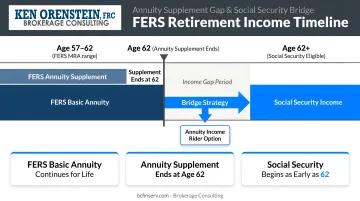
These gaps can be structured precisely with a period certain annuity. Ken Orenstein at Brokerage Consulting works with federal employees to evaluate how a period certain annuity fits alongside FERS pension income, TSP distributions, and Social Security timing. No-cost consultations are available by phone, virtually, or in person at (888) 315-3608.
For FERS retirees specifically, an annuity laddering approach (stacking multiple period certain annuities with staggered start or end dates) can create sequential income windows that move cleanly from one guaranteed source to the next.
Frequently Asked Questions
What does period certain mean on an annuity?
"Period certain" refers to a guaranteed payment window of a fixed number of years. Payments are made for the full term regardless of whether the annuitant is alive, with any remaining payments going to a named beneficiary if death occurs before the term ends.
What does life annuity with period certain mean?
This is a hybrid payout: the annuitant receives income for life, but if they die within the certain period (e.g., 10 or 20 years), the beneficiary receives the remaining guaranteed payments for the rest of that period. In short, it pairs lifetime income with a floor-level inheritance guarantee.
What happens at the end of a period certain annuity?
Once the specified period ends, all payments stop permanently — even if the annuitant is still living. The contract has been fully paid out and no remaining value is returned.
What is the difference between annuity certain and life annuity?
An annuity certain pays for a fixed time period regardless of whether the annuitant dies before or after it ends. A life annuity pays until the annuitant dies, regardless of how long that takes. Choose annuity certain if you need income for a defined window; choose life annuity if outliving your savings is the primary concern.
Are period certain annuities good?
They work well for bridging a defined income gap — covering early retirement years before Social Security kicks in, for instance, or addressing a specific estate planning goal. The key limitation is longevity risk: if you outlive the period, income stops. Whether they're right for you depends on your other income sources, health status, and how long you realistically need coverage.
What is the 10-year rule for annuities?
The "10-year rule" typically refers to IRS rules requiring non-spouse beneficiaries who inherit an IRA or qualified retirement account to fully distribute the funds within 10 years of the owner's death. This is a tax distribution rule — separate from a 10-year period certain payout structure, though both can interact in estate planning for qualified annuities.