The problem is that annuity costs have two distinct components: the premium you hand over upfront, and the ongoing fees that quietly reduce your returns year after year. Most buyers focus on the first number and underestimate the second — which is where the real cost lives.
This article breaks down both: what you actually pay to buy and hold an annuity, how fees vary by product type, and how to evaluate whether the cost is justified by the benefits you're getting.
Key Takeaways
- Minimum premiums range from $2,500–$5,000 for fixed annuities to $25,000–$200,000+ for variable and immediate annuities
- Ongoing fees — administrative, mortality, and rider charges — can total 1% to 3%+ annually for complex products
- Variable annuities carry the highest ongoing fees due to investment sub-account management costs
- Higher fees aren't automatically a red flag — they fund real benefits like guaranteed lifetime income
- Comparing products across multiple carriers is the most effective way to control total annuity cost
How Much Does an Annuity Cost? Pricing Overview
Annuity cost has two components that buyers often conflate: the upfront premium (what you pay to buy the contract) and ongoing fees (what you pay each year to hold it). Confusing the two leads to real problems: locking into high-fee products, underestimating surrender penalties, or selecting a cheaper contract that doesn't match your actual income needs.
Minimum Investment by Annuity Type
Premium minimums vary widely by product:
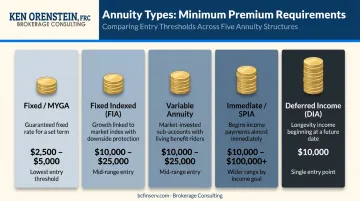
| Annuity Type | Typical Minimum Premium |
|---|---|
| Fixed / MYGA | $2,500–$5,000 |
| Fixed Indexed (FIA) | $10,000–$25,000 |
| Variable | $10,000–$25,000 |
| Immediate / SPIA | $10,000 minimum; $100,000+ for meaningful income |
| Deferred Income | $10,000 |
These are starting points, not recommendations. Some providers accept lower minimums for qualified retirement accounts. There's also a meaningful difference between the minimum needed to open a contract and the amount needed to generate substantial retirement income — especially for immediate annuities, where a $10,000 premium produces a very small monthly check.
The premium itself is not a fee. It's the capital base handed to the insurer in exchange for future income or tax-deferred growth. Every ongoing fee is then calculated as a percentage of that base, which is why the premium amount directly affects your total annual cost in dollars.
Is There a "Right" Amount to Invest?
The right premium size depends on your income gap: the difference between your guaranteed retirement income (Social Security, pension, TSP distributions) and your expected monthly expenses.
Federal employees with a FERS pension already have a base income layer. They typically need a smaller annuity premium than someone with no pension equivalent. That's why sizing a premium without reviewing your full income picture first is a common and costly mistake. Ken Orenstein's approach maps Social Security, pension, guaranteed annuity income, and discretionary portfolio assets together to determine how much, if any, should be converted to guaranteed income.
Common Annuity Fees Explained
Beyond the premium, annuities carry layered charges. Some are annual percentages; others are one-time or triggered by specific events. Here's how each one works.
Administrative Fees
These cover record-keeping, transaction processing, and customer service. They appear in two formats:
- Percentage-based: Roughly 0.15%–0.3% of account value annually
- Flat fee: Commonly $25–$35 per year, sometimes waived once the contract exceeds a threshold (e.g., $50,000)
Administrative fees are present across most annuity types and are generally the smallest component of total annual cost.
Surrender Charges
Surrender charges apply when you withdraw more than the allowed amount during the surrender period — typically 6–10 years after purchase. According to the SEC, a common schedule looks like this:
Year 1: 7% → Year 2: 6% → Year 3: 5% → ... → Year 8: 0%
Most contracts allow a 10% free withdrawal annually without penalty. Withdrawing beyond that triggers the charge. On a $10,000 contract in year one, withdrawing $5,000 creates a $280 surrender charge — because $4,000 exceeds the free-withdrawal allowance and is charged at 7%.
IRS early withdrawal penalty: The IRS also imposes a separate 10% additional tax on distributions taken before age 59½ on most qualified annuity contracts — independent of any insurer surrender charge.
Mortality and Expense (M&E) Risk Charges
M&E fees compensate the insurer for providing guaranteed death benefits and income protections. They're most common in variable and fixed indexed annuities.
| Typical range | 0.5%–1.5% of account value annually |
| Most commonly cited | 1.25% |
| Dollar example | $1,250/year on a $100,000 contract |
That figure compounds over time. On a $100,000 contract, a 1.25% M&E versus a 0.75% M&E means $500 more in annual fees — a difference that can exceed $10,000 over a 20-year hold. Comparing M&E rates across carriers is one of the most direct ways to reduce your total annuity cost.
Investment Expense Ratios
Variable annuities charge expense ratios on the underlying subaccounts — similar to mutual fund fees. These vary by the funds selected:
- Broad range: 0.06%–3% annually
- Morningstar industry-average subaccount expenses: approximately 0.91%–0.95%
- Morningstar sample total expense ratios for two specific contracts: 2.18% and 4.21%
These ratios compound over time. A subaccount earning 7% gross but charging 1.5% in expenses delivers only 5.5% net — a gap that grows larger with every passing year of a 20-year hold.
Rider Fees
Optional add-on riders — guaranteed lifetime withdrawal benefits (GLWBs), death benefit enhancements, long-term care waivers — carry additional annual charges:
- General rider range: 0.25%–1% of contract value
- FIA rider fees: often 1%–1.5% of the benefit base
- Morningstar sample: one proposed contract showed 1.3% for the living benefit rider plus 0.7% for the death benefit rider — 2% in rider fees alone
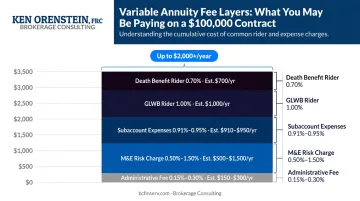
Stacking multiple riders is common, but it's also where costs accelerate quickly. A GLWB rider at 1% plus a death benefit rider at 0.7% adds $1,700 per year on a $100,000 contract — before M&E or subaccount expenses.
How Annuity Type Affects Your Fee Structure
The more guarantees an annuity provides, the more complex, and typically more expensive, its fee structure. Choosing the right type matters as much as comparing rates.
Fixed Annuities — Lowest Ongoing Costs
Fixed annuities (including MYGAs) offer a guaranteed interest rate for a set term with minimal ongoing charges:
- No investment expense ratios (no subaccounts)
- Minimal or no M&E charges
- Commissions are built into contract design, not charged annually
This makes fixed annuities the simplest option for capital preservation. The main consideration is the surrender schedule and whether the guaranteed rate is competitive.
Fixed Indexed Annuities — Embedded Costs, Less Transparent
FIAs often advertise no explicit annual fee, but costs are embedded in the crediting mechanics:
- Participation rates: an 85% participation rate means a 10% index gain credits only 8.5% to your account
- Cap rates: an 8% annual cap limits a 15% index gain to 8%
- Spreads: a percentage deducted from index gains before crediting — Bankrate puts the average spread at 2%, so a 6% gain minus a 4% spread credits just 2%
These aren't labeled fees, but they function as one, limiting the upside you actually receive. Add an income rider at 1%–1.5% annually, and the total annual drag adds up quickly.
Variable Annuities — Highest Fee Potential
Variable annuities layer multiple charges simultaneously:
- M&E: ~1.25% annually
- Administrative: ~$25–$35/year or ~0.15%
- Subaccount expenses: ~0.91%–0.95% on average
- Riders: 0.25%–1.5% or more
Morningstar's fee disclosure samples show total expense ratios of 2.18% and 4.21% for two specific variable annuity contracts. At those levels, the investment hurdle— what the underlying portfolio must earn just to break even — is substantial.
Because fee structures vary so widely across annuity types, comparing them side by side before committing is critical. An independent advisor like Ken Orenstein at Brokerage Consulting works across multiple carriers rather than a single product shelf, which makes that comparison practical rather than theoretical.
Low-Fee vs. High-Fee Annuities: Understanding the Trade-offs
A lower-fee annuity is not automatically the better choice. The question is whether the features funded by those fees are ones you actually need.
Two broad categories define the trade-off:
- Low-fee annuities (fixed MYGAs, straightforward SPIAs) prioritize capital efficiency and simplicity. They suit buyers focused on preservation and predictability, but typically lack guaranteed lifetime income riders, death benefit enhancements, or market participation.
- High-fee annuities (variable with GLWB rider, FIA with income rider) cost more but provide protections that matter for longevity-sensitive buyers, particularly those without pensions who need income they can't outlive.
What the Fee Drag Actually Costs Over Time
The dollar impact of fee drag is easy to underestimate. Assume a $200,000 annuity with a 6% gross return:
| Scenario | Net Return (After Fees) | Value After 20 Years |
|---|---|---|
| 1% annual fees | 5.0% net | $530,660 |
| 2.5% annual fees | 3.5% net | $397,958 |
| Difference | $132,702 |
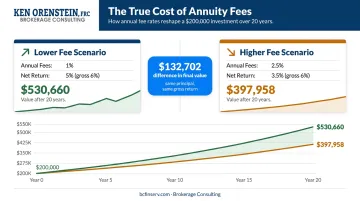
That gap — over $132,000 — is the cost of carrying 1.5% more in annual fees over two decades. Whether that's worth it depends entirely on what those fees fund.
What Most Buyers Miss
- Fixating on the upfront premium while ignoring annual fee drag over the contract's life
- Adding riders that don't match actual income needs, inflating costs without adding value
- Choosing the cheapest product without verifying the insurer's financial strength (AM Best, Moody's, S&P, and Fitch are the four rating agencies Ken Orenstein's practice evaluates)
- Not requesting a full surrender schedule before signing — state insurance regulators require this disclosure, but agents don't always volunteer it
To spot hidden costs: ask for a complete fee disclosure in writing, review the policy illustration, and request the surrender schedule before any contract is finalized.
Conclusion
Annuity costs vary widely based on product type, features selected, and the specific insurer. Understanding each fee layer — premium, administrative charges, M&E, subaccount expenses, and riders — is essential to evaluating whether an annuity delivers genuine value for your retirement plan.
The right annuity cost is one proportional to the benefits it funds, matched to your income needs, and viewed in the context of your full retirement picture. Some riders add real value; others add cost without meaningful benefit. A low-fee product isn't automatically the right choice, and a higher-fee product isn't automatically overpriced — what matters is whether the structure fits your goals.
Ken Orenstein at Brokerage Consulting works with federal employees, individuals, and seniors to compare annuity options across multiple top carriers and structure retirement income around each client's specific needs. No-cost consultations are available by phone, virtually, or in person. Call (888) 315-3608 or visit bcfinserv.com to get started.
Frequently Asked Questions
How much money do I need to start an annuity?
Minimums vary by type. Fixed annuities often start at $2,500–$5,000, while variable and immediate annuities typically require $10,000–$25,000 at minimum. Generating meaningful lifetime income from a SPIA usually requires $100,000 or more. Some providers accept lower minimums for qualified retirement accounts.
Is it a good idea to buy an annuity?
Annuities work well for retirees who need predictable income, lack a pension, or want protection against outliving their savings. They're less suitable for those who need liquidity or already have sufficient guaranteed income from Social Security and pensions.
Can you live off $1 million in retirement savings?
At 4%–5% annual returns, $1 million could generate $40,000–$50,000 per year. Recent Morningstar research pegs a safe starting withdrawal rate at around 3.9%. Inflation and longevity risk make annuities a useful complement to ensure a portion of that income is guaranteed regardless of market conditions.
What type of annuity has the lowest fees?
Fixed annuities — especially MYGAs — and straightforward immediate annuities (SPIAs) carry the lowest ongoing fees. Variable annuities with multiple living benefit and death benefit riders tend to carry the highest total annual costs, sometimes exceeding 3% per year.
Can I avoid surrender charges on an annuity?
Most contracts allow penalty-free withdrawals of up to 10% annually. Some include hardship waivers for terminal illness or nursing home care. Waiting until after the surrender period ends — typically 6–10 years — eliminates surrender charges entirely.
Are annuity fees negotiable?
Built-in fees are set by the insurer and generally not directly negotiable. However, comparing products across multiple providers often reveals meaningfully lower-fee alternatives with similar features — which is the most practical way to reduce total annuity cost.