
The Variable Annuity Paradox
The annuity market has never been larger. LIMRA's final 2025 data confirm $464.1 billion in U.S. retail annuity sales — the fourth consecutive record year. Yet traditional variable annuity sales came in at just $63.1 billion, down roughly 38% from the $101.9 billion broad variable category recorded in 2019.
That gap tells a story. FIAs generated $127.9 billion. Fixed-rate deferred products generated $165.3 billion. Variable annuities, once the industry's flagship product, now hold a shrinking share of a booming market.
For advisors, the pressure is coming from inside the category. FIAs, RILAs, and MYGAs are capturing clients who might once have landed in a VA. Closing that gap means understanding exactly why those alternatives are winning — and where VAs still have the stronger case.
Key Takeaways
- The ideal VA client has maxed-out qualified accounts, a long time horizon, guaranteed income already in place, or legacy planning goals.
- Outcome framing outperforms feature listing: lead with "guaranteed income for life," not M&E ratios.
- Every major objection — cost, portfolio comparisons, market risk — has a specific, evidence-based reframe.
- Reviewing legacy VA contracts is an underutilized opportunity: older designs often carry inflated fees and outdated living benefits.
- FINRA Rule 2330 compliance, handled transparently with clients, functions as a trust-building tool rather than a friction point.
Know Your Ideal Variable Annuity Client
Variable annuities are not a mass-market product. Advisors who try to sell them broadly struggle. Those who target precisely — and position VAs as the only solution that fits — close far more consistently.
The Maxed-Out Investor
The clearest VA candidate is the high earner who has already hit their qualified plan contribution limits. In 2025, that means $23,500 in 401(k) elective deferrals and $7,000 in IRA contributions. After those buckets are full, a nonqualified VA provides the only additional tax-deferred growth vehicle available — with no IRS contribution cap and full investment flexibility through subaccounts.
For this client, a VA is the next logical step in a tax-efficient accumulation strategy — not a fallback, but a deliberate progression.
The Long-Horizon Pre-Retiree
VAs are long-term products. The SEC makes this explicit — they're generally not suitable for short-term investing due to surrender charges, tax penalties, and the layered cost structure. The sweet spot is pre-retirees with enough runway for market growth to compound, and enough time to weather volatility without needing to liquidate.
The Layered-Income Client
Clients who already have substantial guaranteed income from a pension, Social Security, or federal benefits are a consistently underserved VA prospect. When baseline living expenses are covered by guaranteed sources, VA market exposure becomes pure upside — a bad market year affects a supplemental growth account, not rent or groceries.
Federal retirees are a strong example. CBO data show average monthly pension benefits of roughly $5,700 for CSRS annuitants and $2,300 for FERS annuitants — income floors that make a VA's market exposure appropriate rather than risky. The advisor's job is surfacing that alignment during a retirement review, not assuming it exists. Key indicators to look for:
- Guaranteed income already covers essential expenses
- No near-term liquidity needs that would trigger surrender charges
- Interest in supplemental growth without taking on full portfolio risk
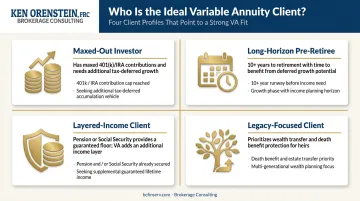
The Legacy-Focused Client
Some clients want both growth and a death benefit in a single contract. A managed portfolio paired with term insurance can approximate this, but a VA does both inside one tax-deferred wrapper — a structural advantage no combination of non-insurance products can fully replicate.
Reframe the Value Proposition — From Features to Outcomes
Most VA sales conversations fail before they start. Advisors lead with subaccount options, M&E ratios, and accumulation units. Clients tune out. The fix is simple: lead with outcomes, not mechanics.
The Unique Role Argument
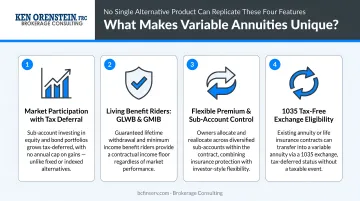
Variable annuities occupy a genuinely unique space. No other financial product combines:
- Market-linked growth through diversified subaccounts
- Tax-deferred compounding with no contribution cap
- A contractually guaranteed lifetime income stream
- A death benefit for heirs
A managed portfolio can't guarantee lifetime income. A CD can't provide market participation. A term policy provides no accumulation. The VA is the only contract that does all four simultaneously. That's the foundation of the pitch — not the fund lineup.
Outcome Language That Actually Works
AARP and TIAA Institute research shows that consumption framing — describing annuities in terms of income they'll produce — increases product appeal significantly compared to investment framing. The same research found that 61% of Americans aged 44–75 were more afraid of running out of money than dying.
That fear is the most direct entry point you have. Instead of explaining how GLWBs work, say: "This contract can guarantee you will never run out of income in retirement, regardless of how long you live or how markets perform."
The mechanics can follow. The outcome has to lead.
The Fee Reframe
Cost objections are inevitable. Preempt them. The SEC notes M&E risk charges are typically around 1.25% annually — and that's before administrative fees, subaccount expenses, and optional rider costs. All-in costs on a traditional VA can exceed 3% per year.
Stop comparing VA fees to a zero-cost alternative. Instead, ask what it costs to replicate the same guarantees separately:
- A lifetime income annuity for longevity protection
- A death benefit policy for heir coverage
- A tax-deferred investment account for accumulation
Purchased independently, those three components typically cost more than a VA's all-in fee. The bundle is usually the better deal.
For advisors working under fiduciary or Regulation Best Interest standards, fee-based I-share and advisory-class VA contracts carry substantially lower M&E charges than traditional commission-based versions. These structures deserve a prominent place in any fiduciary-aligned VA conversation.
Handle the Three Biggest Variable Annuity Objections
Objection 1: "Variable Annuities Are Too Expensive"
The reframe: The question isn't whether a VA costs money — everything does. The question is what the client gets for that cost.
Use this framework in client meetings:
| What the VA Provides | Cost to Replicate Separately |
|---|---|
| Guaranteed lifetime income (GLWB rider) | Income annuity premium |
| Death benefit for heirs | Term or permanent life insurance |
| Tax-deferred growth | Taxable account (plus annual tax drag) |
| Market participation | Managed portfolio or ETFs |
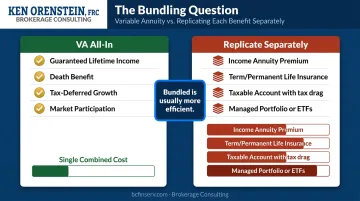
Present it as a bundling question: "Would you pay less buying each of these separately?" In most cases, the answer is no. That changes the conversation from "this is expensive" to "this is efficient."
Objection 2: "I Can Get the Same Result With a Managed Portfolio"
They cannot — and the distinction is structural, not a matter of investment quality.
A managed portfolio, regardless of how skilled the manager or how disciplined the strategy, cannot contractually guarantee income for life if the account value reaches zero. A GLWB rider can. That gap isn't closeable through better stock picks or lower expense ratios. It's a feature only an annuity contract can provide.
Frame it directly: "Your managed portfolio can grow. Your managed portfolio cannot guarantee you income if the market drops 40% right before you retire and you live to 95. This contract can."
Objection 3: "What Happens If the Market Crashes?"
Modern VAs are built for exactly this concern. Walk through how GLWB riders function during a downturn:
- Market drops 40% — account value falls significantly
- GLWB income base remains intact — the income base typically grows at a contractual roll-up rate (often 5–7%) regardless of market performance
- Guaranteed withdrawals continue — the client receives their guaranteed income regardless of account value
- Death benefit is preserved — heirs are protected even if account value has declined
Understanding exactly what each rider costs — and what it delivers — is where client confidence gets built. Brokerage Consulting's VA consultations evaluate GLWB, GMIB, and GMAB riders against the specific value of the guarantee they provide, including the typical rider cost of 1.0–1.5% annually on the income base. Walking a client through that analysis openly turns cost transparency into a closing advantage.
For complexity objections ("I don't understand it"), use a three-sentence story: "You're worried about outliving your money. This contract guarantees you income for life no matter how long you live. The rider that provides that guarantee costs roughly what you'd pay for term insurance." Clarity closes.
Mine the Legacy Contract Review Opportunity
A significant portion of existing VA contracts are seven to fifteen years old — many issued under fee structures, M&E rates, and living benefit designs that no longer reflect what the current market offers. This installed base represents one of the most productive prospecting opportunities available to proactive advisors.
The Review Process
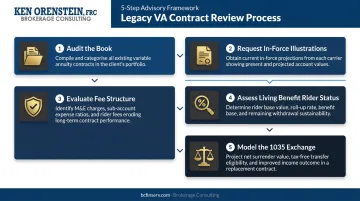
Brokerage Consulting treats VA replacement analysis as a core service — specifically evaluating whether existing contracts should be 1035-exchanged into a newer structure for better economics or stronger income riders. The typical review follows this sequence:
- Audit the book — identify clients holding older VA contracts
- Request in-force illustrations — get current account value, income base, and benefit status from the carrier
- Evaluate the fee structure — compare existing M&E charges (often 1.0–1.5%) against current fee-based options
- Assess living benefit rider status — determine whether the existing GLWB, GMIB, or GMAB rider is still optimal or has been superseded by better designs
- Model the 1035 exchange — if a newer contract offers materially better terms, analyze whether an exchange is in the client's best interest
Compliance Is Not Optional
FINRA Rule 2330 governs this entire process. Any recommendation to exchange one VA for another requires documented analysis of whether the client would:
- Incur a new surrender charge period
- Lose existing benefits that cannot be replicated
- Face increased fees in the replacement contract
- Have executed another VA exchange within the prior 36 months
Walking a client through this analysis transparently serves a dual purpose: it satisfies regulatory requirements and demonstrates that the recommendation is driven by their benefit, not by a transaction. Advisors who conduct thorough, documented reviews consistently report stronger client retention and more referrals — outcomes that compound over time.
Build an Education-First, Compliant Sales Process
The advisors generating the most consistent VA business aren't selling harder — they're educating first. When clients understand the problem (longevity risk, retirement income gaps), they ask about solutions rather than having to be persuaded toward them.
The Client Education Framework
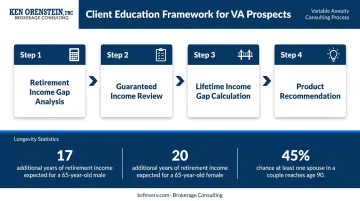
A simple four-step education sequence surfaces VA-qualified prospects consistently:
- Retirement income gap analysis — Calculate what monthly income the client needs versus what Social Security and any pension will actually deliver
- Guaranteed income review — identify all existing guaranteed income sources
- Lifetime income gap calculation — quantify the shortfall the client needs to cover for potentially 20–30 years
- Product recommendation — once the gap is visible and the client understands longevity risk, the VA's role is self-evident
SSA actuarial data show that a 65-year-old male has a life expectancy of roughly 17 additional years; females, nearly 20. SOA research puts the probability that at least one member of a 65-year-old couple lives to age 90 at 45%. Show clients these numbers. Longevity risk becomes concrete, not abstract.
FINRA Rule 2330 as a Sales Tool
Most advisors treat Rule 2330 as a paperwork requirement. The better approach: present the suitability discovery process transparently as evidence of professionalism.
Rule 2330 requires a full suitability assessment before recommending a VA, covering:
- Age, income, and overall financial situation
- Investment experience, objectives, and time horizon
- Existing assets, liquidity needs, risk tolerance, and tax status
Walking a client through those questions — and explaining why each one matters — signals that you understand their full picture before making any recommendation. That perceived thoroughness builds trust. Clients who feel genuinely understood rarely need convincing.
Lead Generation Tactics That Surface VA Candidates
- Retirement income webinars — Ken Orenstein runs educational webinars through the Seminars on Call platform (bcfinserv.seminarsoncall.com) covering annuity fundamentals, pre-retirement income planning, and tax-efficient retirement strategies. These attract pre-retirees 55–68 who are exactly the right profile for a VA conversation.
- CPA and estate attorney referrals — professionals working with high earners who have maxed qualified accounts and need tax-deferred vehicles are natural referral partners.
- Targeted content — workshop titles like "Will Your Money Last As Long As You Do?" attract longevity-anxious prospects who are already pre-sold on the problem a VA solves.
Frequently Asked Questions
What can I do with a variable annuity?
A VA can grow savings tax-deferred through market-linked subaccounts, convert to guaranteed lifetime income through annuitization or a GLWB rider, provide a death benefit for heirs, or allow partial withdrawals as needed. No non-insurance product bundles all three of those functions — growth, income, and protection — into a single contract.
Why are variable annuity sales declining, and does that make them harder to sell?
VA sales declined as rising interest rates made fixed products more competitive, and lower-cost alternatives like RILAs captured market share. But the right client — long time horizon, maxed qualified accounts, wants guaranteed lifetime income — still benefits significantly from a VA. Targeted positioning matters more than volume.
How do I handle the objection that variable annuities are too expensive?
Reframe fees as the cost of specific guarantees — lifetime income, a death benefit, and tax-deferred growth — then compare the all-in VA cost against what replicating those protections separately would cost. Also point to lower-cost fee-based I-share VA options for fiduciary-aligned clients.
Who is the ideal client for a variable annuity?
Clients who have maxed 401(k) and IRA contributions, have a long accumulation horizon, can tolerate market risk, and want both growth potential and guaranteed lifetime income. Federal retirees with existing pension income are strong candidates — their guaranteed income floor makes VA market exposure appropriate rather than threatening.
What FINRA rules apply when recommending variable annuities?
FINRA Rule 2330 requires a suitability analysis (age, income, risk tolerance, time horizon, existing assets) and registered principal approval before submitting a VA application. VA-to-VA exchanges carry added requirements, including a 36-month lookback on prior exchanges.
How do variable annuities differ from fixed indexed annuities?
VAs offer direct market exposure through subaccounts — no cap on upside, but also no floor on downside beyond optional riders. FIAs link interest credits to an index with principal protection but typically cap upside participation. The right choice depends on the client's growth expectations, risk tolerance, and whether they prioritize certainty or higher long-term return potential.