
Introduction
Picture this: you're five years from retirement, sitting on a substantial chunk of savings, and your financial advisor suggests an annuity. Your first instinct is to hesitate — aren't annuities those products that tie up your money for a decade or more?
It's a common misconception. Short-term annuities (typically one to five years) exist specifically for people who want guaranteed returns without a long-term lock-in. And they're gaining traction: LIMRA reported $243.2 billion in fixed-rate deferred annuity sales in 2024, up 26% year over year, driven largely by savers seeking predictable, guaranteed returns.
This guide breaks down short-term annuities in full: what they are, how they work, the types available, how they compare to CDs and bonds, and who they make the most sense for.
Key Takeaways
- Short-term annuities (1–5 years) offer guaranteed fixed interest rates without long-term lock-in
- Tax-deferred growth gives them a yield advantage over CDs for investors in higher tax brackets
- MYGAs are the most common short-term annuity type, with current rates that often outpace equivalent CD rates
- Maturity options include withdrawal, rollover, or a tax-free 1035 exchange into another annuity
- Best suited for conservative savers, near-retirees, and those wanting to lock in today's rates
What Is a Short-Term Annuity?
A short-term annuity is a contract between a buyer and an insurance company that locks in a guaranteed interest rate for a set period — typically one to five years. When the term ends, the accumulated value is available to withdraw, roll over, or convert to income.
Unlike a lifetime annuity, which pays out for as long as the annuitant lives, short-term annuities are built around a defined end date.
The Terminology Confusion
"Short-term annuity" is an umbrella term that covers two distinct products:
- Multi-Year Guaranteed Annuities (MYGAs) are fixed deferred annuities with terms of 1, 2, 3, or 5 years. Money grows at a guaranteed rate and is accessed at maturity — making these accumulation vehicles, not income tools.
- Period-certain immediate annuities convert a lump-sum payment into income paid out over a fixed number of years (commonly 5 or 10). These are income-focused products, not growth vehicles.
Most people searching for "short-term annuity" are thinking of the MYGA — the CD-like savings vehicle. The period-certain immediate annuity is a less common choice and suits a narrower set of planning needs.
Key Structural Facts
- Only insurance companies can issue annuities. Even when purchased through a bank or brokerage, the underlying product is an insurance contract regulated at the state level.
- Guarantees depend entirely on the insurer's financial strength and claims-paying ability — not the federal government.
- One-year MYGAs offer maximum liquidity, with full access to funds at the end of a short commitment window.
- Three- to five-year terms typically carry higher guaranteed rates in exchange for a longer lock-in period.
How Short-Term Annuities Work
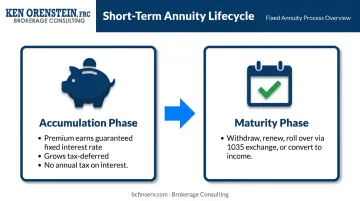
Short-term annuities follow a straightforward structure, which is part of what makes them appealing for conservative savers and near-retirees. Understanding the mechanics — from how interest accumulates to what happens when the contract ends — helps you evaluate whether they fit your income strategy. The process breaks into two phases:
- Accumulation phase: Your premium earns a guaranteed fixed interest rate and grows tax-deferred. Unlike CDs, you don't pay annual taxes on the interest earned.
- Maturity phase: At the end of the term, you decide what to do with the accumulated funds.
What Happens at Maturity
This flexibility is one of the most underappreciated features of short-term annuities. When your contract matures, you typically have four options:
- Withdraw the full amount (taxes due on gains)
- Renew with the same insurer at current rates
- Roll funds into a new annuity via a 1035 exchange — tax-free, with no gain recognized under IRS rules
- Convert to an income stream
Surrender Periods and Early Exit Costs
Knowing your maturity options is useful — but so is understanding what happens if you need to exit before the term ends. In most short-term annuities, the surrender period aligns with the contract term. Exit at maturity and there's no penalty. Exit early, and two costs apply:
- Surrender charges from the insurer (typically a percentage of withdrawn amount)
- IRS early withdrawal penalty of 10% on taxable gains if you're under age 59½, per IRS Topic 558
The Tax Advantage
Beyond exit flexibility, the tax treatment of short-term annuities is where they pull meaningfully ahead of CDs. Interest earned inside a short-term annuity is not taxed annually. With a CD, interest is taxable each year whether you withdraw it or not.
That annual tax drag reduces your effective yield on CDs — a meaningful difference for investors in the 22%, 24%, or higher tax brackets. When you do withdraw from an annuity, gains are taxed as ordinary income rather than capital gains. For retirees managing income across multiple sources, that distinction matters when projecting how much you actually keep after taxes.
Types of Short-Term Annuities
Fixed Multi-Year Guaranteed Annuities (MYGAs)
MYGAs are the most common short-term annuity. The insurer locks in a single guaranteed interest rate for the entire contract term — no rate adjustments, no market surprises. Often called "CD-type annuities" because of their structural similarity to bank certificates of deposit, MYGAs are straightforward to compare across carriers.
Available terms typically include 1, 2, 3, and 5 years. An independent broker can compare options across the broader market to match the right term length to your specific income timeline.
Short-Term Fixed-Indexed Annuities (FIAs)
Where MYGAs prioritize simplicity, fixed-indexed annuities trade some predictability for growth potential. Some carriers offer FIAs with shorter terms of 3–5 years, linking growth to a market index (commonly the S&P 500) with a cap rate. Nationwide's Peak 5 is one example of this structure.
FIAs are more complex than MYGAs. Key characteristics include:
- Growth potential: Tied to index performance, subject to a cap rate
- Principal protection: A 0% floor means you don't lose value in down markets
- Uncertainty: Annual credited interest varies — higher upside, less predictability
This makes FIAs better suited for investors comfortable with variability in exchange for the chance at higher returns.
Period-Certain Immediate Annuities
A period-certain immediate annuity converts a lump sum into income payments for a fixed number of years — for example, 5 or 10 years. Payments begin within 30 days of purchase. Unlike MYGAs, there's no accumulation phase; this product is designed for retirees who need immediate, predictable cash flow for a defined window.
Short-Term Annuities vs. CDs, Bonds, and Longer-Term MYGAs
Rate Comparison: MYGAs vs. CDs vs. Treasuries
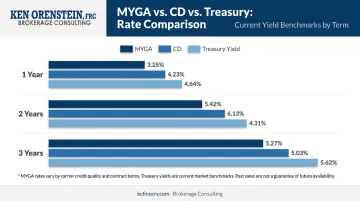
Current rates across alternatives break down as follows (as of May 2026, sourced from Annuity.org/Cannex and Bankrate):
| Term | Top MYGA Rate | Top CD Rate | Treasury Yield (12/31/2024) |
|---|---|---|---|
| 1 year | 7.50%* | 4.10% APY | 4.16% |
| 2 years | 5.25% | 4.16% APY | 4.25% |
| 3 years | 6.00% | 4.13% APY | 4.27% |
Important note: *The 7.50% 1-year rate is from a B++ rated carrier — not investment-grade. MYGA rates vary significantly by carrier credit quality. Always verify AM Best ratings before comparing rates.
Key Differences to Understand
MYGAs vs. CDs:
- MYGAs typically offer higher rates and tax-deferred growth
- CDs are FDIC-insured up to $250,000; annuities are backed by the insurer only
- CDs may allow more flexible partial withdrawals
MYGAs vs. Treasuries:
- Treasuries carry the lowest credit risk (federal government backing)
- MYGAs frequently offer higher yields plus the tax-deferral advantage
- For investors in higher tax brackets, the tax-equivalent yield of an annuity often makes it the stronger choice over Treasuries
Short-term vs. long-term MYGAs:
- Longer terms (5–10 years) sometimes offer higher rates in normal rate environments
- In inverted yield curve conditions, short-term rates can match or exceed long-term rates — making the shorter lock-in worth considering
- The right term depends less on chasing the highest rate and more on when you'll actually need the money
The Laddering Strategy
One approach that combines flexibility with competitive returns: annuity laddering. Rather than putting all funds into a single contract, you stagger multiple contracts with different maturity dates.
A simple example:
- Contract A: 1-year MYGA
- Contract B: 2-year MYGA
- Contract C: 3-year MYGA
Each year, one contract matures, giving you a liquidity window — money to use, reinvest, or redirect based on whatever rates look like at that point. Ken Orenstein at Brokerage Consulting uses laddering as a core planning tool — matching surrender periods to each client's income timeline so liquidity and growth work together rather than against each other.
Who Should Consider a Short-Term Annuity?
Short-term annuities aren't right for everyone. But for the right person, they're a strong fit.
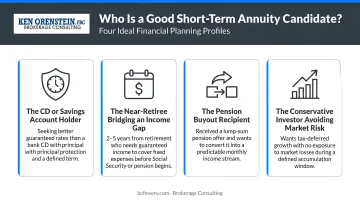
You're likely a good candidate if you fall into one of these situations:
- 1–5 years from retirement: A short-term annuity lets you accumulate safely during that transition window — no market risk, no guessing when your income start date is in sight. Federal employees weighing TSP distribution timing often find this structure especially useful.
- Uncomfortable with volatility: Want to park a portion of savings at a guaranteed rate that beats most bank accounts or money market funds? A short-term MYGA delivers that without requiring you to watch the market daily.
- Watching interest rates: If you think rates will fall, locking in today's elevated rates makes sense. If you expect them to rise, a 1-year term keeps you flexible to reinvest when the contract matures.
- In the 24%+ tax bracket: Tax-deferred growth compounds faster when your bracket is high. The annual tax drag from CDs hits hardest here, making the MYGA structure noticeably more efficient.
Federal employees evaluating TSP distribution strategies, in particular, often find short-term MYGAs align well with their retirement timeline. Ken Orenstein's federal employee consulting practice covers this intersection directly.
Pros and Cons of Short-Term Annuities
Pros
- Guaranteed fixed rate for the full term — principal faces no market risk
- Tax-deferred growth eliminates the annual drag that cuts into CD effective yields
- Rates are competitive with CDs and other safe alternatives in the current environment
- At maturity: withdraw, renew, roll over, or convert to income
- Rate lock-in protects against falling interest rates during the contract term
Cons
- Surrender charges apply if funds are accessed before maturity
- Withdrawals before age 59½ trigger a 10% IRS penalty on gains
- No inflation protection — a fixed rate loses purchasing power if inflation outpaces the contract rate
- Not FDIC-insured — carrier financial strength is the primary safety net
Checking Carrier Safety
That last point makes carrier vetting critical. Before purchasing, verify the insurer's AM Best rating — A and A- both classify as "Excellent," indicating a strong ability to meet ongoing obligations. Ken Orenstein reviews AM Best, Moody's, S&P, and Fitch ratings for every annuity recommendation.
State insurance guaranty associations add a second safety net — each pays out claims up to a state-set cap if an insurer fails, though those caps vary widely:
| State | Annuity Coverage Limit |
|---|---|
| New Jersey | $250,000 deferred / $500,000 payout |
| New York | $500,000 |
| Maryland | $250,000 |
| Virginia | $250,000 |
| North Carolina | $300,000 |
| District of Columbia | $300,000 |
These are not FDIC equivalents. Verify your state's specific limits before making a large annuity purchase.
Frequently Asked Questions
Is a short-term annuity a good idea?
It depends on your goals. Short-term annuities work well for conservative savers and near-retirees who want guaranteed returns, tax-deferred growth, and rate lock-in without a long commitment. They're less suitable for anyone who may need full liquidity or who needs growth that outpaces inflation.
Is there such a thing as a short-term annuity?
Yes. Short-term annuities exist under several names, including MYGAs, fixed-term annuities, and period-certain annuities, and are offered by many major insurance carriers. Terms typically range from one to five years.
What annuity has a guaranteed rate of return?
Fixed annuities, particularly MYGAs, guarantee a specific interest rate for the entire contract term. This makes them the go-to choice for investors who prioritize predictable, principal-protected growth over market-linked performance.
What is the shortest annuity term available?
One-year fixed annuities are the shortest generally available term — unlike bank CDs, which may offer 3- or 6-month options. Carrier competition also thins out considerably at the one-year duration.
How does a short-term annuity compare to a CD?
Both offer fixed returns for a set period, but short-term annuities typically offer higher rates and tax-deferred growth. CDs offer FDIC insurance and may allow more flexible partial withdrawals. The better choice depends on your tax situation, liquidity needs, and comfort with insurer credit risk.
Can I roll over a short-term annuity into another annuity when it matures?
Yes. At maturity, you can use a 1035 exchange to transfer proceeds into a new annuity contract without triggering a taxable event, per IRS rules. This lets you lock into current market rates and keep your savings compounding tax-deferred.
For personalized guidance on whether a short-term annuity fits your retirement plan, contact Ken Orenstein at Brokerage Consulting — no-cost consultations are available by phone, virtually, or in person at (888) 315-3608.