
Monthly payouts from a $1 million annuity can range from roughly $4,460 to over $11,500, according to April 2026 quote data from Annuity.org. That's not a typo — the spread is that wide. A 65-year-old buying an immediate income annuity today will see very different numbers than a 50-year-old locking in a deferred contract, or a married couple adding joint-life protection.
This article breaks down realistic payout ranges by annuity type, the key variables that move those numbers up or down, and what to think through before committing $1 million to any annuity contract.
Key Takeaways
- A $1 million immediate annuity pays roughly $5,900–$6,250/month for a 65-year-old (female/male, life-only, April 2026 rates)
- Annuity type and age at purchase are the two biggest drivers of monthly income
- Women receive slightly lower payments than men because insurers price for longer life expectancy
- Deferring payouts by 5–10 years can boost monthly income by 20–40%, though funds remain inaccessible during that period
- A $1 million annuity works best as one layer of a broader retirement income plan, not a standalone solution
How Much Does a $1 Million Annuity Pay? Payout Overview
There is no single number. What you receive monthly depends on the annuity type, your age and gender, when payments start, and the interest rate environment at the time you buy.
People who assume a flat payout without understanding these variables often make costly mistakes — underestimating income needs, choosing the wrong structure, or missing meaningfully higher payouts by not comparing quotes across carriers.
Immediate Income Annuity Payouts
Immediate annuities (SPIAs) begin paying within 12 months of purchase. Based on April 2026 quote data, a 65-year-old purchasing a $1 million single-life SPIA can expect:
| Structure | Male | Female |
|---|---|---|
| Life-only | $6,250/month | $5,900/month |
| Life + 10-year certain | $6,080/month | $5,760/month |
| Joint-life (both age 65) | $5,360/month | $5,360/month |
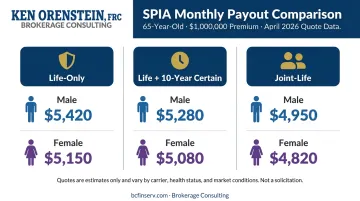
Adding a 10-year period-certain rider reduces the male payout by about $170/month, a relatively small cost for ensuring beneficiaries receive payments if you die early. The joint-life option costs $890/month less than the male single-life figure, reflecting the insurer's exposure to two lifespans.
Deferred Income Annuity Payouts
Deferred income annuities (DIAs) delay payments to a future date, letting the principal compound during that time. A 50-year-old who locks in a DIA today and defers income to age 65 or 70 will receive significantly higher monthly payments than someone purchasing a SPIA at 65, because the insurer has invested the premium for years and projects fewer remaining payout years.
The cost of that higher income is real access. You give up the ability to withdraw that $1 million during the accumulation period — no partial pulls, no flexibility. For pre-retirees focused on locking in today's rates and maximizing future income, that's often an acceptable trade.
Variable Annuity Payouts
Unlike SPIAs and DIAs, variable annuities tie payouts to underlying investment performance rather than a guaranteed rate. A Vanguard Variable Insurance Fund Balanced Portfolio posted a 10-year annualized return of 10.03% through December 2025, though equity-focused subaccounts have varied widely.
Key characteristics to understand before comparing variable annuities to income annuities:
- Income floor: Most contracts include a minimum guaranteed rate (often around 3%), but monthly income is not fixed
- Investment risk: Subaccount performance directly affects payout levels — returns can go down
- Regulatory classification: FINRA classifies variable annuities as hybrid securities-and-insurance products, which means they require separate suitability analysis from guaranteed-income structures
Key Factors That Affect Your Monthly Payout
Several personal, contractual, and market-based variables determine how much a $1 million annuity pays. Understanding each one helps you optimize the structure before signing.
Age at Purchase and Payment Start Date
Older buyers receive higher monthly payouts because the insurer projects fewer payments over a shorter remaining lifespan. The difference is substantial:
| Age / Gender | Monthly Payout (Life-Only SPIA) |
|---|---|
| Age 60, male | ~$6,200/month |
| Age 60, female | ~$5,990/month |
| Age 70, male | ~$7,780/month |
| Age 70, female | ~$7,110/month |
Source: ImmediateAnnuities.com age tables (May 2026), scaled arithmetically from $100K figures.
Waiting 10 years to start payments — from age 60 to 70 — can increase monthly income by over $1,500/month for a male buyer. Whether that trade-off makes sense depends on your other income sources and how long you can afford to wait.
Gender and Life Expectancy
Insurers price payouts using actuarial data. The SSA's life tables show that at age 65, women have a remaining life expectancy of 20.12 years versus 17.48 years for men. That 2.6-year gap translates directly into lower monthly payments for female buyers — about $350/month less on a $1 million single-life SPIA at age 65.
Payout Structure and Riders
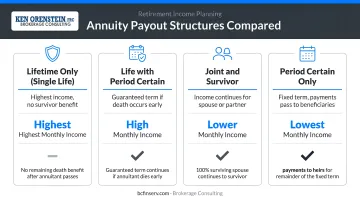
The structure you choose determines both your monthly income and your beneficiaries' protection:
- Life-only — Highest monthly payout; payments stop at death, nothing to heirs
- Joint-life — Continues for a surviving spouse at 50–100% of original payment; lower monthly income
- Period-certain — Guarantees a minimum duration (e.g., 10 or 20 years); payments continue to beneficiaries if you die during that period
- Cash/installment refund — Returns unpaid premium balance to beneficiaries; reduces monthly payout
Each protective feature redistributes risk to the insurer, which reduces your base monthly payment. The right choice depends on whether you're optimizing for maximum income or for spousal and legacy protection.
Prevailing Interest Rates
Annuity income is directly correlated with interest rates at the time of purchase. CANNEX research found a 0.96 correlation between income annuity payout levels and interest rates across a dataset of 55,000 bi-weekly quotes from 2013 to 2022. When rates rise, payouts rise. When rates fall, payouts fall — and the rate locks in permanently at purchase.
The 10-year Treasury yield stood at approximately 4.57% in May 2026, which represents a historically favorable rate environment compared to the near-zero rates of 2020–2021. Buyers who purchase during high-rate environments lock in stronger lifetime income.
Inflation and COLA Riders
Fixed annuity payments don't adjust for inflation. Using BLS CPI-U historical data, a fixed nominal payment retains roughly 60% of its purchasing power after 20 years and about 47% after 30 years — a meaningful erosion for retirees expecting a 25- to 30-year horizon.
Some contracts offer cost-of-living adjustment (COLA) riders that increase payments by 1–5% annually. Adding a COLA rider reduces the initial monthly payout, and cumulative income may take roughly 20 years to surpass the non-COLA version. For retirees with long life expectancies, COLA riders can make sense; for those prioritizing near-term income, they're often not worth the initial reduction.
Annuity Payout Breakdown by Type
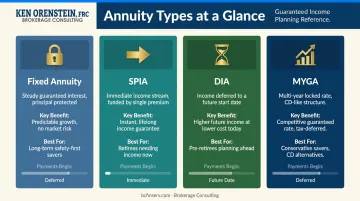
Each annuity type solves a different retirement income problem. Here's how they compare:
Fixed Annuity
Provides a guaranteed, unchanging monthly payment. Includes a minimum guaranteed rate and stable disbursements — but no market upside and limited liquidity once payments begin.
Best for: Retirees who prioritize income predictability and want zero market exposure.
Immediate Income Annuity (SPIA)
Funded with a lump sum and starts paying within 12 months. No accumulation phase, no ongoing management. SPIAs are among the simplest, lowest-fee annuity structures available — what you see in the quote is what you get.
Best for: Retirees who need income now and have a lump sum ready to convert.
Deferred Income Annuity (DIA)
Funded with a lump sum, with payouts beginning years later. The deferral period enables compounding growth, producing higher monthly income — often 30–50% more than an equivalent SPIA — when payments eventually start.
Best for: Pre-retirees who want to lock in today's rates and maximize future guaranteed income. Note that principal is inaccessible during the deferral period.
Multi-Year Guaranteed Annuity (MYGA)
Functions like a CD — locks in a fixed interest rate for a set term (typically 3, 5, or 7 years). Useful as an accumulation vehicle before converting to an income annuity. Current 5-year MYGA rates reach as high as 6.30% (Knighthead Life, May 2026). At that rate, a $1 million premium grows to approximately $1,357,270 over five years — providing a larger principal base when you eventually convert to income.
Best for: Pre-retirees who want tax-deferred growth now and plan to convert to income later.
What Most People Miss About $1 Million Annuity Payouts
Even buyers who understand the basics often overlook these four issues:
1. Inflation erodes fixed payments. A fixed $6,000/month payment today will have the spending power of roughly $3,600/month in 20 years at a 2.5% average inflation rate. For a 30-year retirement, that erosion is severe.
2. Annuitizing your entire nest egg is a portfolio mistake. Most financial guidance suggests allocating only a portion of total savings to annuities — enough to cover predictable income gaps, not the entire nest egg. Reserving assets outside the annuity keeps your overall plan flexible.
3. Once income starts, you can't access the principal. Most income annuity contracts do not allow principal withdrawals after payments begin. Before committing $1 million, confirm you have sufficient liquid reserves — separate from the annuity — to cover unexpected expenses.
4. Payout quotes vary significantly across insurers. For identical contracts, different carriers can offer noticeably different monthly figures. Shopping quotes from multiple financially strong carriers — evaluated using A.M. Best, Moody's, S&P, and Fitch ratings — is essential before any purchase. At Brokerage Consulting, Ken Orenstein compares quotes across multiple carriers and reviews carrier financial strength alongside the rate, so clients aren't trading a higher payout for insurer risk.
Is a $1 Million Annuity Enough to Retire On?
The short answer: for most households, probably not on its own.
According to FRED/BLS Consumer Expenditure data, households age 65 or older had average annual expenditures of $61,432 in 2024. The average Social Security retirement benefit was $2,081/month as of April 2026.
Combined, Social Security plus a $1 million SPIA payout of roughly $6,000/month gives a 65-year-old male approximately $8,081/month ($96,972/year) in guaranteed income. That total covers average household expenses with room to spare, assuming costs stay typical.

The math gets tighter for:
- Households with higher-than-average spending
- Retirees without substantial Social Security benefits
- Anyone facing significant healthcare or long-term care costs
- Buyers who need liquidity for emergencies or estate goals
For federal employees specifically, a $1 million annuity alongside FERS pension income and Social Security can create a robust guaranteed income floor. Ken Orenstein's practice is built around this kind of multi-layered income architecture — mapping Social Security claiming strategy, FERS pension timing, TSP distribution planning, and annuity structure into a coordinated retirement income plan. If you're a federal employee evaluating how an annuity fits your existing benefit package, a no-cost consultation is available at (888) 315-3608 or through bcfinserv.com.
Annuities work best as one component of a broader plan. Guaranteed income anchors the foundation, but liquid reserves, growth assets, and estate goals each need their own place in the structure.
Frequently Asked Questions
How much will a $1 million annuity pay per month?
Monthly payouts range from roughly $4,460 to over $11,500 depending on annuity type, age, gender, and interest rates. For a 65-year-old purchasing an immediate life-only annuity in April 2026, expect approximately $5,900/month (female) to $6,250/month (male) based on current quotes.
Can you live off the interest of $1 million?
At current rates, $1 million invested in fixed income or high-yield instruments generates roughly $40,000–$50,000/year in interest before taxes — tight for most households and not guaranteed to last. An annuity converts principal into a guaranteed income stream that typically delivers more predictable monthly income, often higher at older ages, without the risk of outliving the balance.
Does annuity income affect Social Security Disability Insurance (SSDI) benefits?
Annuity income generally does not reduce SSDI benefits, which are based on work history rather than unearned income. SSI (Supplemental Security Income) is a separate program and can be affected by annuity income. Consult a financial advisor for your specific situation.
What type of annuity pays the most per month?
Life-only immediate annuities typically pay the highest monthly amount since there is no survivor benefit and payments stop at death. Deferred income annuities can also produce very high monthly payouts when purchased years before the payment start date.
Are annuity payments taxable?
It depends on the funding source. Qualified annuities (funded with pre-tax dollars such as an IRA or TSP rollover) are fully taxable upon withdrawal. Non-qualified annuities (funded with after-tax money) are taxed only on the earnings portion of each payment, per IRS Publication 575.
Is a $1 million annuity a good investment for retirement?
It can be a strong tool for guaranteed lifetime income, particularly for those concerned about outliving their savings. It does require a large capital commitment and sacrifices liquidity, so it works best alongside other income sources — Social Security, a pension, or investment accounts. A no-cost consultation with a retirement income specialist can help determine the right allocation for your situation.