
Both questions have answers — but the answers depend heavily on decisions you make early, some of which have strict deadlines. Unlike inheriting a brokerage account or real estate, non-qualified annuities come with their own IRS rulebook. Because they were funded with after-tax dollars, only the earnings are taxable — not the original premium. But there's no step-up in basis, distributions are taxed as ordinary income, and certain elections must happen within one year of the owner's death or you lose them permanently.
This article covers the four main payout options, how the exclusion ratio determines your tax bill, the 5-year rule and non-qualified stretch provision, the critical differences between spouse and non-spouse beneficiaries, and practical strategies for minimizing your tax exposure.
Key Takeaways
- Only the earnings (growth above the original premium) are taxable — the after-tax principal comes back to you tax-free
- Payout options include a lump sum, periodic withdrawals, annuitization, or the non-qualified stretch
- Non-spouse beneficiaries must fully withdraw within 5 years unless the stretch option is elected within one year of the owner's death
- Surviving spouses can assume full contract ownership — the most flexible option available
- No step-up in basis, no 10% early withdrawal penalty, and no RMDs during the accumulation phase
What Makes a Non-Qualified Annuity Different From Other Inherited Assets
Most inherited assets come with a tax break called the step-up in basis. Inherited stocks, mutual funds, or real estate are revalued to fair market value at the date of death — meaning any appreciation during the original owner's lifetime escapes income tax entirely.
Non-qualified annuities work differently. Under Rev. Rul. 2005-30, the earnings above the original owner's investment in the contract are classified as income in respect of a decedent (IRD) under IRC Section 691. Because IRC Section 1014(c) explicitly excludes IRD from the step-up rule, you inherit the original cost basis — not the current value.
That distinction has real tax consequences. Every dollar of accumulated gain is taxable as ordinary income when distributed, not at the more favorable capital gains rate.
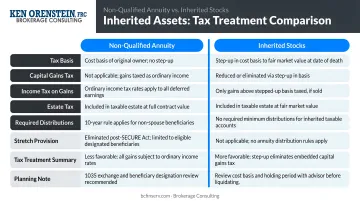
How the tax treatment compares:
| Asset Type | Basis at Death | Tax Treatment of Gains |
|---|---|---|
| Inherited stocks/mutual funds | Stepped up to FMV | Gains during owner's lifetime escape tax |
| Inherited non-qualified annuity | Original purchase price | All accumulated gains taxed as ordinary income |
The upside: because the premium was funded with after-tax dollars, you do not owe income tax on that portion. Only the earnings are taxable — a meaningful distinction if the original premium was substantial relative to the current contract value.
Non-qualified annuities are also governed by a separate set of rules: IRC Section 72, not the qualified-plan framework under IRC Section 401(a)(9). That means no required minimum distributions during the accumulation phase — but specific IRS distribution deadlines do apply once the contract passes to a beneficiary.
Your Payout Options When You Inherit a Non-Qualified Annuity
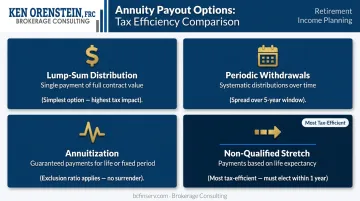
Most beneficiaries have four main distribution choices, and the best fit depends on your tax situation, how soon you need income, and your time horizon. Whether the original owner was in the accumulation or distribution phase at death may also affect which options remain open to you.
Lump-Sum Distribution
Taking the full balance at once is the simplest path — but rarely the most tax-efficient. The entire earnings portion becomes taxable income in a single year.
A quick example: if the original premium was $60,000 and the annuity is now worth $100,000, the $40,000 gain is fully taxable in one tax year. Depending on your other income, that could push you into a significantly higher bracket.
Systematic or Periodic Withdrawals
Rather than taking everything at once, you can spread withdrawals across multiple years — subject to the 5-year deadline for non-spouse beneficiaries. This distributes the taxable gain across tax years and prevents a large one-year income spike. You control the timing and amounts, as long as the account is fully depleted by year five.
Annuitization
You can convert the inherited contract into a guaranteed income stream paid over a fixed period or your lifetime. Each payment includes a proportional mix of taxable earnings and tax-free return of principal, calculated using the exclusion ratio (explained in the next section).
The trade-off: once annuitized, the contract cannot be surrendered for a lump sum. This option works best for beneficiaries who want predictable income and don't need access to the full principal.
Non-Qualified Stretch
For beneficiaries who want income stretched even further than the 5-year rule allows, the non-qualified stretch spreads distributions over your life expectancy using IRS life expectancy tables — potentially the lowest annual tax exposure of any option. A few conditions apply:
- An election must be made proactively — it's not automatic
- The first distribution must begin within one year of the owner's death
- Missing that window defaults you to the 5-year rule, with no way to recover the stretch election
Important: if the beneficiary is a trust, estate, or charity rather than a living individual, the stretch is not available. Under IRC Section 72(s)(4), only individual designated beneficiaries qualify. Non-individual beneficiaries are limited to the 5-year rule.
How a Non-Qualified Annuity Is Taxed When You Inherit It
The core tax rule is straightforward: only the earnings are taxable. The original after-tax premium — what the IRS calls the "investment in the contract" — comes back to you free of income tax. IRS Publication 575 confirms that taxable annuity amounts are treated as ordinary income, not capital gains.
The Exclusion Ratio
For annuitized payments, the IRS uses the exclusion ratio to determine what portion of each payment is taxable versus tax-free. The formula:
Investment in the contract ÷ Expected total return = Excluded percentage
Using the earlier example: if the original premium was $60,000 and the expected total payout is $100,000, then 60% of each payment is a tax-free return of principal and 40% is taxable income.
For a lump-sum withdrawal, there's no ratio to apply — the gain is taxed all at once in the year received. For periodic distributions, tax is spread proportionally across payments, which is easier to manage.
Two Key Advantages for Beneficiaries
- No 10% early withdrawal penalty. Under IRC Section 72(q)(2)(B), the penalty that normally applies to pre-age-59½ withdrawals does not apply to distributions made after the holder's death. Younger beneficiaries inherit without the penalty that would apply in most other retirement account contexts.
- Waived surrender charges. Many annuity contracts waive surrender charges upon the owner's death, even when the contract is still within its original surrender period. This is contract-specific (not a universal rule), so verify with the insurance company before making distribution decisions.
The 5-Year Rule and the Non-Qualified Stretch Provision
How the 5-Year Rule Works
Under IRC Section 72(s)(1)(B), most non-spouse beneficiaries must withdraw the entire annuity balance within five years of the original owner's death. There are no required annual minimums during this window — you can take money at any time, in any amount, as long as the account is fully depleted by year five.
The Stretch Election and Its Deadline
IRC Section 72(s)(2) provides an alternative: distributions spread over the beneficiary's life expectancy, known as the non-qualified stretch. To qualify:
- You must be an individual designated beneficiary
- Distributions must begin no later than one year after the owner's death
- You must take at least annual distributions based on your life expectancy
Missing the one-year window eliminates the stretch option. The 5-year rule then applies automatically, with no recourse.
Why the Stretch Often Makes More Sense
If you meet the one-year deadline, electing the stretch can meaningfully reduce your tax burden. Key advantages:
- Keeps each year's taxable income lower, reducing the risk of a higher bracket
- Lets you take more than the life-expectancy minimum whenever needed
- Preserves tax deferral on the remaining balance longer
One constraint: you cannot take less than the annual minimum. Distributions are required each year once the stretch begins.
Not the SECURE Act 10-Year Rule
The 10-year rule from the SECURE Act applies to qualified annuities held inside IRAs or 401(k)s — it governs distributions under IRC Section 401(a)(9). Non-qualified annuities operate under IRC Section 72's own framework: the 5-year rule or the non-qualified stretch. If you're unsure which rule applies to an inherited annuity, the first question to ask is whether the contract was funded with pre-tax (qualified) or after-tax (non-qualified) dollars — that distinction determines everything.
Spouse vs. Non-Spouse Beneficiary: Key Differences
Your relationship to the deceased owner determines which distribution options are available to you — and how much tax flexibility you'll have.
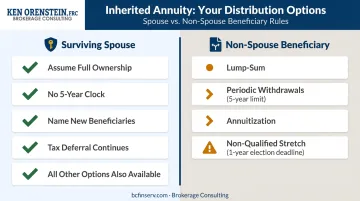
Surviving Spouse Options
Under IRC Section 72(s)(3), a surviving spouse can assume full ownership of the non-qualified annuity contract — continuing it as their own. This means:
- No forced distribution timeline
- No 5-year clock
- Ability to name new beneficiaries
- Tax deferral continues on remaining earnings
Spousal continuation is typically the most tax-efficient choice for spouses who don't immediately need the funds. The other options — lump sum, periodic withdrawals, or annuitization — remain available if immediate income is needed.
Non-Spouse Beneficiary Limitations
Non-spouse beneficiaries — children, siblings, domestic partners, friends — cannot assume contract ownership. That option is available only to surviving spouses under the statute. Non-spouse beneficiaries must choose among:
- Lump-sum distribution
- Periodic withdrawals within the 5-year window
- Annuitization
- Non-qualified stretch (if elected within one year of death)
The one-year stretch election deadline is especially critical for non-spouse beneficiaries. Missing it removes the option to spread distributions — and the tax liability — over decades, leaving only the 5-year window to deplete the account.
How to Minimize Your Tax Burden on an Inherited Non-Qualified Annuity
You cannot avoid taxes entirely on an inherited non-qualified annuity. But you can control the timing, which significantly affects how much of the gain you keep.
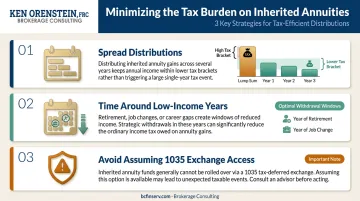
Key strategies:
- Spread distributions over as many years as possible. Whether using the 5-year rule or the non-qualified stretch, avoiding a lump sum in a high-income year prevents unnecessary bracket creep. A $40,000 gain spread over 10 years costs far less in total taxes than the same amount landing in a year when you're already earning a solid salary.
- Time larger withdrawals around lower-income years. If you're expecting reduced income — retiring, changing jobs, taking a sabbatical — that's often the right year to take a larger distribution. The same dollars taxed at a lower rate means more of the inheritance stays with you.
- Don't assume reinvested proceeds can be deferred. Once distributed, inherited annuity funds generally cannot be rolled into another annuity on a tax-deferred basis through a standard 1035 exchange.
The IRS did issue a private letter ruling (PLR 201330016) approving a limited beneficiary exchange under specific facts — but PLRs apply only to the taxpayer who requested them and carry no broader precedent. Treat "no 1035 exchange" as the practical default, and confirm with a qualified advisor if you believe your situation may qualify for an exception.
Modeling these distribution decisions across multiple years — and fitting them into an overall retirement income plan — is where working with a specialist makes a real difference. Brokerage Consulting offers no-cost consultations (phone, virtual, or in-person) to work through the numbers for your specific situation. Reach us at (888) 315-3608 or bcfinserv.com.
Frequently Asked Questions
What are my options if I inherit a non-qualified annuity?
Beneficiaries generally choose among four methods: lump-sum payout, systematic withdrawals within the 5-year window, annuitization into guaranteed income, or the non-qualified stretch over life expectancy. Surviving spouses have the additional option of assuming full contract ownership.
How is a non-qualified annuity taxed at death?
The earnings above the original after-tax premium are taxable as ordinary income to the beneficiary. The original principal is returned tax-free. There is no step-up in basis, unlike inherited stocks or other investment assets.
What is the 5-year rule for inherited non-qualified annuities?
Non-spouse beneficiaries must fully withdraw the annuity balance within five years of the owner's death. No annual minimums apply during this period. Failing to elect the non-qualified stretch within one year of death automatically triggers this rule.
What is the only part of a non-qualified annuity's death benefit that is taxable?
Only the accumulated earnings — the growth above the original premium or cost basis — are taxable as ordinary income. The after-tax principal the original owner contributed is returned to the beneficiary free of income tax.
How can I minimize taxes on an inherited non-qualified annuity?
Taxes can't be avoided, but they can be reduced by spreading withdrawals across multiple years, electing the non-qualified stretch if available, and timing larger distributions to coincide with lower-income years.
What is the tax advantage of a non-qualified annuity?
Unlike qualified annuities, non-qualified annuities are funded with after-tax money — so only the earnings are taxed upon withdrawal, not the principal. There are also no required minimum distributions during the accumulation phase, giving the original owner more time before any forced distributions apply.