
This guide covers which annuities can be converted, exactly how to do it, what it will cost you, and the mistakes most people make along the way.
Key Takeaways
- Most deferred annuities (fixed, variable, indexed) can be cashed out; annuitized contracts and income annuities generally cannot
- The cash-out process involves reviewing your contract, calculating costs, and submitting a surrender form to your provider
- Surrender charges, income taxes, and a Surrender charges, income taxes, and a potential 10% IRS early withdrawal penalty can stack up quickly — sometimes consuming 30–40% of your payout
- Timing matters: your age, contract holding period, and tax bracket all affect how much you'll actually keep
- Alternatives like partial withdrawals or a 1035 exchange may preserve more of your money than a full cash-out
Types of Annuities You Can (and Can't) Convert to Cash
The single most important question before initiating any cash-out: is your annuity still in the accumulation (deferred) phase, or has it already entered the payout (annuitization) phase? accumulation (deferred) phase, or has it already entered the payout (annuitization) phase? Once annuitization begins, surrender rights typically disappear — and so does your ability to take a lump-sum withdrawal.
Annuities That Can Generally Be Cashed Out
According to the NAIC Buyer's Guide for Fixed Deferred Annuities, a deferred annuity owner can take a full withdrawal of the cash surrender value and end the contract. This applies to:
- Fixed deferred annuities: cash surrender value is clearly defined in the contract terms
- Variable deferred annuities: value fluctuates based on subaccount performance
- Fixed indexed annuities: value tracks an index, subject to participation rates and contract terms
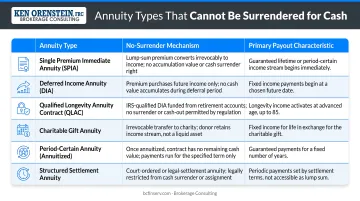
Annuities That Generally Cannot Be Cashed Out
| Annuity Type | Why It Can't Be Surrendered |
|---|---|
| Annuitized deferred contracts | NAIC states once payments begin, "you can't take any other money out" |
| Single premium immediate annuities (SPIAs) | Payments begin within one year of purchase; no accumulation phase to surrender |
| Deferred income annuities (DIAs) | Structured for future income; no cash surrender right built in |
| QLACs | Federal regulations prohibit commutation benefits or cash surrender rights |
| CSRS/FERS federal pensions | Governed by OPM refund rules, not commercial surrender — a refund voids all annuity rights under FERS |
A note for federal employees: Government pension annuities operate under completely separate rules from commercial contracts. If you're considering a CSRS or FERS refund, verify the specific OPM rules with a federal retirement specialist before assuming a cash-out is equivalent to a commercial surrender.
Step-by-Step: How to Change Your Annuity to a Cash Option
Step 1: Review Your Annuity Contract
Pull out your original contract and confirm:
- Annuity type — fixed, variable, or indexed?
- Current phase — are you still in the accumulation period?
- Surrender period length — commonly six to eight years from the purchase date, though some contracts run longer
- Free withdrawal provision — many contracts allow you to withdraw up to 10% of account value per year without surrender charges
Check for any riders — a crisis waiver, nursing home waiver, or terminal illness provision may allow penalty-free access under specific circumstances.
Step 2: Calculate the Real Cost of Cashing Out
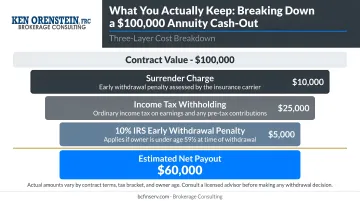
Three cost layers apply simultaneously. Here's how they compound on a $100,000 deferred annuity surrendered in year two of a standard schedule:
- Surrender charge (~6% in year two based on the Investor.gov example schedule): −$6,000
- Ordinary income tax on gains (varies by your bracket and whether the annuity is qualified or non-qualified): could be −$10,000 to $22,000+ on taxable earnings
- 10% IRS early withdrawal penalty if you're under 59½ (on the taxable portion): potentially −$9,400 after charges
What starts as a $100,000 contract could net you $65,000–$75,000, or less — before factoring in your specific tax bracket.
Step 3: Consult a Financial Advisor and Tax Professional
Skipping this step is where most people lose money they didn't have to lose. Before submitting any paperwork, get two opinions:
- A financial advisor can weigh the surrender against your broader retirement picture and identify alternatives you may not have considered
- A tax professional can time withdrawals strategically — for example, spreading them across two tax years to avoid bracket creep
Federal employees face an added layer of complexity: the interaction between a FERS pension, TSP distributions, and a commercial annuity surrender requires specialized analysis. Ken Orenstein of Brokerage Consulting is a Federal Retirement Consultant (FRC) who works specifically with federal employees on these scenarios. Initial consultations are available by phone, virtually, or in person — call (888) 315-3608 or visit bcfinserv.com/request-a-quote.
Step 4: Contact Your Provider and Request the Surrender Form
Call your annuity provider's customer service line and:
- Confirm the current cash surrender value (not the account value — these differ when surrender charges apply)
- Ask what documentation is required — some providers require notarized signatures or additional identity verification
- Request the surrender or full withdrawal form
Step 5: Submit Documentation and Receive Your Funds
After submitting a completed surrender form, your provider will process the request. Processing timelines vary by carrier and contract, so confirm the expected window with your provider directly.
Funds are typically delivered via electronic transfer to the account specified on the form. Your provider will also issue a Form 1099-R reporting the distribution to the IRS. For tax-free 1035 exchanges between carriers, the 1099-R carries code 6.
Key Factors That Affect How Much Cash You'll Actually Receive
The annuity's account value is never what lands in your bank account. Four variables determine the final number.
Surrender Charge Timing
Surrender charges are percentage-based fees that decrease each year. The Investor.gov variable annuity example shows a representative schedule:
| Contract Year | Surrender Charge |
|---|---|
| Year 1 | 7% |
| Year 2 | 6% |
| Year 3 | 5% |
| Year 4 | 4% |
| Year 5 | 3% |
| Year 6 | 2% |
| Year 7 | 1% |
| Year 8+ | 0% |
Waiting one additional year can save thousands on a large contract. Always confirm your specific schedule — FINRA notes that variable annuity surrender periods can run eight years or more, and some contracts extend further.
Qualified vs. Non-Qualified Tax Treatment
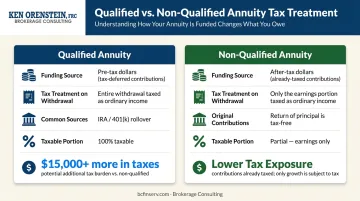
How your annuity was funded determines how much of your withdrawal gets taxed:
- Qualified annuities (funded with pre-tax dollars — IRA rollover, 401(k) rollover): the entire withdrawal is taxed as ordinary income, because you've never paid tax on any of it
- Non-qualified annuities (funded with after-tax dollars): only the earnings portion is taxable; your original contributions come back tax-free
Per IRS Publication 575, annuity payments from a contract in which you have no cost basis (qualified) are fully taxable. On a $100,000 withdrawal, this distinction alone could mean $15,000+ in additional taxes.
Age at the Time of Withdrawal
Under IRS rules, withdrawing before age 59½ triggers an additional 10% federal tax on the taxable portion. A withdrawal at 57 vs. 60 can produce meaningfully different net proceeds — even when surrender charges are identical.
Limited exceptions waive the penalty, including:
- Total and permanent disability
- Terminal illness
- Substantially equal periodic payments under Rule 72(t)
Variable Annuity Market Timing
Age isn't the only timing consideration. For variable annuities, your cash surrender value rises and falls with the underlying subaccounts. Cashing out during a market downturn may lock in losses. Fixed and indexed annuities are more predictable, though some contracts include a market value adjustment (MVA) that can alter surrender value based on current interest rates.
When Converting Makes Sense — and When It Doesn't
When Converting May Make Sense
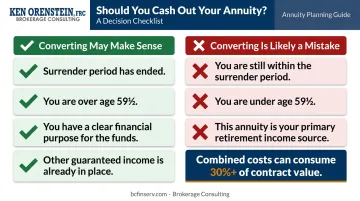
Conversion makes the most financial sense when these conditions align:
- The surrender period has ended (zero or minimal surrender charges)
- You are over age 59½ (no IRS early withdrawal penalty)
- There is a clear financial reason — paying off high-interest debt, covering a major medical expense, or reinvesting in a demonstrably stronger vehicle
- You already have sufficient guaranteed income from another source — for example, a federal employee with a FERS pension covering essential expenses may find a lump sum more useful than additional annuity payments
When Converting Is Likely a Mistake
Cashing out typically costs too much when:
- You're still within the surrender period
- You're under age 59½
- The annuity is your primary source of retirement income
In those scenarios, the combined weight of surrender charges, income tax, and the IRS penalty can consume 30% or more of the contract value. Cashing out during a market decline or to plug a temporary cash gap tends to be among the costliest moves an annuity holder can make.
Common Mistakes When Cashing Out an Annuity
Pull your contract and confirm the surrender schedule before submitting any request — some run 10 years, and assuming otherwise is a costly mistake.
A large distribution adds directly to your gross income and can push you into a higher marginal bracket. Spreading withdrawals across two tax years — or taking partial withdrawals over time — can lower the overall tax hit.
Most deferred annuity contracts allow up to 10% of account value per year without surrender charges — use that provision first before pursuing a full surrender, and you may cover your cash need at no cost.
Alternatives to a Full Cash-Out
Before surrendering an annuity, consider whether one of these options fits better.
Partial or Systematic Withdrawals
If your contract includes a free withdrawal provision (typically 10% of account value annually), you can access funds regularly without triggering surrender charges. A systematic withdrawal schedule provides ongoing cash flow while preserving the remaining contract's tax-deferred growth.
1035 Exchange
A 1035 exchange transfers your annuity's value directly into a new annuity contract (or in some cases a life insurance policy) without triggering income tax on the gains. As Investor.gov explains, no money passes through your hands, so no taxable event occurs.
This is the preferred route when your goal is to move to a better-suited product, not access cash. Two caveats worth knowing before you proceed:
- Surrender charges from your original contract may still apply
- The replacement contract starts its own surrender period
Ken Orenstein's 1035 exchange analysis evaluates whether moving an older fixed annuity, variable annuity, or MYGA to a current-market contract captures stronger income rider terms or guaranteed rates — without a tax hit.
Selling Future Payments (Structured Settlements)
Holders of structured settlement or lottery annuities can sell some or all future payment rights to a factoring company in exchange for a discounted lump sum. This is legally and mechanically distinct from surrendering a commercial annuity to the issuer.
Key procedural points for structured settlement sellers:
- Court approval is required in most states before any transfer is effective, adding time and legal cost
- Partial sales — selling a defined block of payments while retaining the rest — are permitted under many state statutes
Frequently Asked Questions
Can I convert my annuity to cash?
Most deferred annuities — fixed, variable, and indexed — can be surrendered for cash during the accumulation phase. Annuitized contracts, immediate annuities, and certain income annuities generally cannot. Surrendering typically triggers surrender charges, income taxes, and a potential 10% IRS early withdrawal penalty if you're under 59½.
What penalty will I pay for cashing out an annuity early?
Two penalty layers apply on top of income tax: the insurance company's surrender charge (commonly starting around 7% and declining annually) and the IRS's 10% additional tax on the taxable portion if you're under age 59½. Both can apply simultaneously, making early cash-outs significantly more expensive than the account value suggests.
How long does it take to cash out an annuity?
Processing timelines vary by carrier and contract — confirm with your provider after submitting the surrender form. Structured settlement transfers requiring court approval take longer, with timelines dependent on state court schedules.
Can I cash out an annuity after annuitization has started?
Once annuitization begins, the contract generally cannot be surrendered for cash — FINRA classifies this as "generally irrevocable." Some contracts include specific riders or commutation provisions that create limited exceptions; review your contract terms or contact your provider directly.
What is a 1035 exchange, and how is it different from cashing out?
A 1035 exchange transfers funds from one annuity into another without triggering income tax on accumulated gains — no money passes through your hands, so no taxable event occurs. Unlike a full cash-out, you retain tax-deferral on the gains. Surrender charges from the original contract may still apply.
Are there annuities that cannot be converted to cash at all?
Yes. The following generally cannot be surrendered for cash:
- Annuitized contracts
- SPIAs (single premium immediate annuities)
- Deferred income annuities (DIAs) and QLACs
- Medicaid-compliant annuities
Government pension annuities like CSRS and FERS follow OPM rules — a refund voids all annuity rights under FERS and is not equivalent to a commercial surrender.