That's the tension at the heart of this comparison. Choosing between a Fixed Index Annuity and direct S&P 500 investing isn't just about chasing the better return — it's about matching the right vehicle to where you actually are in your financial life.
According to the 2024 EBRI Retirement Confidence Survey, 40% of workers fear outliving their retirement savings — and confidence hasn't recovered from a significant drop seen in 2023. That fear is driving a real question: how much market risk is too much when retirement is close?
Key Takeaways
- FIAs link interest credits to the S&P 500 but never invest directly in the market — your principal is contractually protected from losses
- S&P 500 index investing offers uncapped growth potential alongside full exposure to market swings — gains and losses both
- Caps, participation rates, and spreads limit FIA upside in exchange for downside protection and tax-deferred growth
- Younger accumulators with 20+ years and high risk tolerance fit S&P 500 investing; FIAs suit those within 5–10 years of — or already in — retirement
- Most people benefit from both: a blended approach delivers growth and protection at the same time
FIA vs. S&P 500: Quick Comparison
Here's how the two options stack up across the factors that matter most for retirement planning decisions:
| Factor | Fixed Index Annuity | S&P 500 Index Fund |
|---|---|---|
| Downside Risk | Principal protected; 0% floor in down markets | Full exposure — lost -37% in 2008, -18.1% in 2022 |
| Return Potential | Capped (top cap rates ~10.50% as of mid-2026) | Uncapped; historically ~10% annually over long horizons |
| Liquidity | Surrender charges 5–10 years; limited free withdrawals | Fully liquid; sell any trading day |
| Fees | Embedded in cap/rate structure; income rider fees ~1.0–1.5%/yr | Expense ratios as low as 0.015% (FXAIX) to 0.03% (VOO) |
| Tax Treatment | Tax-deferred; withdrawals taxed as ordinary income | Capital gains rates apply (long-term rates if held 1+ year) |
The right choice rarely comes down to a single row in this table — it depends on how much downside risk you can absorb, how soon you need access to funds, and whether guaranteed income matters more than maximum growth.
What Is a Fixed Index Annuity (FIA)?
A Fixed Index Annuity is an insurance contract that credits interest based on the performance of an external market index — most commonly the S&P 500 — without directly investing your money in the market. The issuing insurance company absorbs the market risk; your principal is shielded from negative index returns.
As the NAIC confirms in its Buyer's Guide: the interest rate on a FIA is "guaranteed to never be less than zero, even if the market goes down."
The Floor and Ceiling Mechanics
Every FIA has two structural boundaries:
- Floor (0%): If the index declines, you receive 0% interest — not a loss. Your principal and previously locked-in gains are preserved.
- Ceiling: Limits how much of the index's upside you capture, expressed through one of three mechanisms:
| Limiting Mechanism | How It Works | Example |
|---|---|---|
| Cap Rate | Maximum interest credited in a period | Index returns 14%, cap is 10.50% → you receive 10.50% |
| Participation Rate | Percentage of index gain credited | Index returns 10%, participation rate is 65% → you receive 6.5% |
| Spread | Amount subtracted from index gain | Index returns 7%, spread is 2% → you receive 5% |
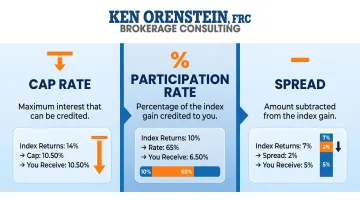
In years like 2023 (S&P 500 up 26.29%) or 2024 (up 25.02%), an FIA with a 10.50% cap would have credited 10.50% — forgoing roughly 15–16 percentage points of upside. In 2008 (down 37%) or 2022 (down 18.11%), that same FIA would have credited 0% while direct S&P 500 investors absorbed the full loss.
Income Riders: Building a Private Pension
Many FIAs allow the addition of a Guaranteed Lifetime Withdrawal Benefit (GLWB) or Guaranteed Minimum Income Benefit (GMIB) rider — converting your annuity into a private pension. These riders typically cost 1.0–1.5% annually on the income base and provide guaranteed income for life regardless of how markets perform or how long you live.
Income rider analysis is central to FIA selection for retirees in the 65–73 age range — particularly those who need immediate income replacement and want a guaranteed paycheck alongside Social Security or a FERS pension.
Interest inside a FIA also grows tax-deferred — no annual taxation on credited gains. This compounding effect is especially meaningful for higher-income earners who would otherwise owe ordinary income tax on investment growth each year.
Who Should Consider a FIA
- Pre-retirees within 5–10 years of retirement who want market-linked growth without the risk of a major drawdown at a critical savings stage
- Retirees seeking a guaranteed income layer to complement Social Security, a pension, or TSP distributions
- Federal employees looking to add a third income layer (after Social Security and FERS pension) that covers essential expenses with no market exposure
- Clients holding older variable annuities that may be candidates for a 1035 tax-free exchange into a FIA with stronger principal protection and better income rider terms
What Is S&P 500 Investing?
Buying an S&P 500 index fund or ETF gives you proportional ownership in 500 large U.S. companies. You get every dollar of upside when markets rise — and every dollar of loss when they fall.
The long-term historical average annual total return for the S&P 500 is 10% per year over multi-decade horizons (dividends reinvested). The 5-year cumulative return through 2024 was 97.02%, though that figure was lifted significantly by exceptional years in 2023 (+26.29%) and 2024 (+25.02%).
The cost advantage is undeniable:
- FXAIX (Fidelity): 0.015%
- VOO (Vanguard): 0.03%
- IVV (iShares): 0.03%
The Tradeoff: Upside With No Floor
The same market that delivered 25%+ returns in 2023 and 2024 dropped -37% in 2008 and -18.11% in 2022. After the 2008 crash, the S&P 500 took approximately five to six years to recover its pre-crisis nominal peak.
For a 35-year-old, that recovery window is manageable. For a 65-year-old already drawing income during those five years, it's a different story — each withdrawal at depressed prices permanently reduces the shares left to recover.
Who Should Prioritize S&P 500 Investing
- Younger investors (30s–40s) with a long runway who can ride out multiple market cycles and benefit from compounding over decades
- High-risk-tolerance accumulators who understand volatility and won't panic-sell during corrections
- Those with no near-term income dependence on a specific portfolio value
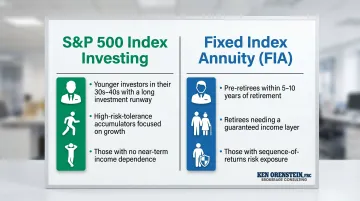
That last point is the critical one. As retirement approaches and your portfolio shifts from accumulation to income, a 30%+ drawdown stops being a patience problem and becomes a math problem — one that may not resolve before you need the money.
Fixed Index Annuity vs. S&P 500: Which Is Right for Your Retirement?
The right answer depends on your timeline, risk tolerance, and income needs — not on which product wins in a vacuum.
Sequence-of-Returns Risk: The Retirement Killer
For investors near or in retirement, the order of returns matters as much as the average return. A major market loss in the first few years of retirement — when withdrawals are already reducing the portfolio — can permanently damage your income potential even if markets recover later.
Here's how that plays out in practice:
Hypothetical: Two retirees both retire on January 1, 2008
Retiree A has 100% in an S&P 500 index fund. By year-end, their portfolio has dropped 37% — and they're still withdrawing income, selling shares at depressed prices. The shares sold during the downturn are gone for good. That capital never participates in the recovery.
Retiree B has 50% in an S&P 500 index fund and 50% in a FIA. The FIA portion credits 0% for 2008 — no loss, no gain. Retiree B draws income from the FIA's protected value and leaves the index fund untouched to recover. Income stays stable in year one, and more shares remain to benefit from the eventual rebound.

The FIA didn't outperform the S&P 500 over 20 years. But it prevented a catastrophic year-one income disruption that Retiree A couldn't undo.
Investment Timeline as the Deciding Factor
| Situation | Recommended Approach |
|---|---|
| 20+ years to retirement, high risk tolerance | S&P 500 index investing — let compounding work |
| 10–20 years to retirement | Consider beginning a FIA allocation for a portion of assets |
| 5–10 years from retirement | FIA protection becomes increasingly valuable |
| Already in retirement | FIA-based guaranteed income layer is typically appropriate |
The Blended Portfolio Approach
Most advisors — including Ken Orenstein at Brokerage Consulting — don't recommend choosing one or the other. The practice uses a flooring strategy, where guaranteed income vehicles (like FIAs with income riders) cover essential expenses.
Market-exposed assets (S&P 500 index funds, TSP, or IRA investments) continue to grow separately for discretionary spending, legacy goals, and emergencies.
This structure serves both goals at once:
- The FIA protects against sequence-of-returns risk for the essential income layer
- The S&P 500 exposure preserves long-term growth for the discretionary layer
- Together, the layers reduce the risk of a bad early year derailing your retirement income
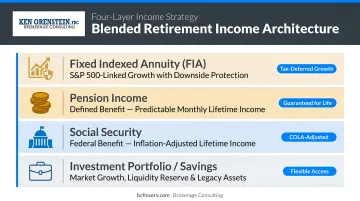
For federal employees, this blended approach fits naturally into a four-layer income architecture: Social Security → FERS pension → FIA guaranteed income → TSP/IRA growth assets.
If you're approaching retirement and want to evaluate the right split for your specific pension, Social Security, and savings picture, Ken Orenstein at Brokerage Consulting offers no-cost consultations by phone, virtual, or in-person. Reach the office at (888) 315-3608 or request a consultation at bcfinserv.com.
Conclusion
The S&P 500 is a powerful wealth-building engine — but its power depends on having time to recover from losses. A Fixed Index Annuity sacrifices some of that upside in exchange for a contractual guarantee: you cannot lose principal in a down market.
Neither is universally superior. The right answer depends on where you are in your financial journey, what income sources you already have, and how much market risk you can actually afford to absorb.
For most people nearing retirement, the answer isn't either/or — it's pairing market-linked growth with a guaranteed income floor.
The clearest path forward: Match each tool to the job it does best — S&P 500 exposure for long-term growth, a Fixed Index Annuity for income you can't outlive.
If you're weighing these options for your retirement plan, a no-cost consultation with a licensed advisor can help you map out which structure fits your timeline, risk tolerance, and income needs. Ken Orenstein offers phone, virtual, and in-person consultations — schedule yours here.
Frequently Asked Questions
Which is better, a fixed annuity or a fixed index annuity?
A traditional fixed annuity credits a guaranteed, predetermined interest rate with no connection to market performance. A fixed index annuity credits interest based on an external index's performance (subject to caps and participation rates) while still protecting principal. FIAs generally offer more growth potential than fixed annuities, but also more structural complexity.
What is the downside of a fixed index annuity?
FIAs come with real trade-offs: caps and participation rates limit upside, surrender charge periods (typically 5–10 years) restrict liquidity, and flat or declining markets yield 0% credits. Withdrawals are also taxed as ordinary income — not at the lower long-term capital gains rate.
What is the average return on a fixed index annuity?
Returns vary widely based on the index chosen, crediting method, and the cap or participation rate in effect. In strong equity years, credits are typically capped well below actual index gains; in down years, FIAs credit 0% rather than absorbing losses.
Can I lose money in a fixed index annuity?
In a standard accumulation FIA, market declines cannot reduce your principal — the floor is 0% credited interest. The exception: income riders carry annual fees (typically 1.0–1.5%), which can erode account value if the fee exceeds the credited interest in a given year.
Is a fixed index annuity a good investment for retirement?
A FIA can be a valuable component of a retirement plan — particularly for those who want market-linked growth without market risk. It works best as part of a broader, layered income strategy rather than as someone's only financial vehicle. Whether it fits depends on your timeline, existing guaranteed income (pension, Social Security), and how much flexibility you need in the early retirement years.
How does the S&P 500 compare to a fixed index annuity over time?
Over long horizons (20+ years), the S&P 500 has historically outperformed FIAs on raw returns due to uncapped growth and dividend reinvestment. In volatile or flat markets — especially during the critical early retirement years — the FIA's floor protection and locked-in gains can compare favorably, particularly when sequence-of-returns risk is a real concern.