This isn't just academic. Get the calculation wrong — or use the wrong formula variant — and you could accept a lump-sum offer that shortchanges you by tens of thousands of dollars. This guide walks through the exact steps, both formula variants, the variables that matter most, and the errors that consistently trip people up.
Key Takeaways
- Present value (PV) of an annuity is what a series of future payments is worth in today's dollars, discounted at a given interest rate
- Two formula variants exist: ordinary annuity (payments at period end) vs. annuity due (payments at period beginning)- Two formula variants: ordinary annuity (end-of-period payments) vs. annuity due (beginning-of-period payments)
- Three required inputs: payment amount, discount rate per period, and number of periods
- Higher discount rate = lower present value; lower discount rate = higher present value
- PV calculations are essential when comparing lump-sum buyout offers, evaluating structured settlements, or planning retirement income
How to Calculate the Present Value of an Annuity
Calculating PV of an annuity follows four steps, and precision matters throughout — errors in the discount rate or period count will distort the result significantly.
Step 1: Gather Your Three Required Inputs
Payment amount (PMT): The fixed amount received or paid each period. This must be consistent — the standard formula breaks down with variable payments.
Discount rate per period (r): Expressed as a decimal, and it must match your payment frequency. If payments are monthly, divide the annual rate by 12. Using an annual rate for monthly payments is one of the most common calculation errors.
Number of periods (n): Not simply the number of years. A 10-year annuity with monthly payments has 120 periods, not 10.
Step 2: Identify Which Annuity Type You Have
This distinction determines which formula you use:
| Annuity Type | Payment Timing | Common Examples |
|---|---|---|
| Ordinary Annuity | End of each period | Pension income, loan repayments, retirement account distributions |
| Annuity Due | Beginning of each period | Rent, certain insurance premiums, some structured settlements |
Using the wrong formula consistently overstates or understates PV: a material error when evaluating a buyout offer.
Step 3: Apply the Correct Formula
Ordinary Annuity:
PV = PMT × [1 – (1 + r)^-n] / r
Annuity Due:
PV = PMT × [1 – (1 + r)^-n] / r × (1 + r)
The annuity due formula is the ordinary annuity formula multiplied by (1 + r). That single multiplier accounts for payments arriving one period earlier, which is why annuity due always produces a higher present value.
Step 4: Solve and Interpret
Worked example — ordinary annuity:
- PMT = $1,000/year
- r = 5% (0.05)
- n = 10 years
Step-by-step:
- Calculate (1 + 0.05)^-10 = 0.6139
- Subtract from 1: 1 – 0.6139 = 0.3861
- Divide by r: 0.3861 / 0.05 = 7.7217
- Multiply by PMT: $1,000 × 7.7217 = $7,721.70
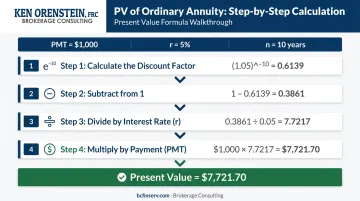
That $7,721.70 figure represents the maximum you should pay today to receive that payment stream — and the fair benchmark when comparing it against a lump-sum buyout offer.
Key Variables That Affect Your Present Value Calculation
PV is sensitive to changes in any input. Small shifts, particularly in the discount rate, can move the result by thousands of dollars.
Payment Amount (PMT)
Higher payments increase PV on a roughly proportional basis. Double the payment, roughly double the present value. The critical constraint: the formula assumes equal, fixed payments. Variable or inflation-adjusted payment streams require a different approach or actuarial modeling.
Discount Rate (r)
This is the most consequential (and most subjective) variable in the calculation.
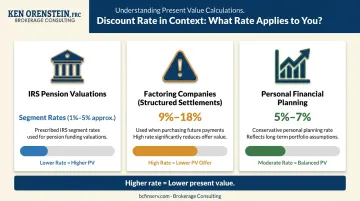
As the discount rate rises, PV falls because future payments are discounted more heavily. Choosing the right rate depends on context:
- Pension valuations: The IRS publishes minimum present value segment rates used for lump-sum pension calculations — these shift monthly and directly affect what a pension sponsor must offer as a buyout
- Factoring companies purchasing structured settlements typically apply discount rates in the 9%–18% range, which dramatically reduces the present value they'll offer
- Personal financial planning: Many advisors use an expected market return (often 5%–7%) or a risk-free rate as the opportunity cost benchmark
Selecting an unrealistic rate, whether too low or too high, produces a number that's technically correct but practically misleading.
Number of Periods (n)
More periods generally increases PV, but the effect tapers. A payment 30 years from now contributes far less to today's value than the same payment arriving in 3 years. Beyond a certain point, adding more distant payments barely moves the needle due to the compounding effect of discounting.
Inflation and Real Purchasing Power
The standard PV formula doesn't account for inflation. If you're evaluating a fixed-payment annuity over 20+ years, the purchasing power erosion documented by the BLS is real and material. Sophisticated analyses use a real discount rate (nominal rate minus expected inflation) to adjust for this, which is particularly relevant when comparing a fixed pension with a Cost-of-Living Adjustment (COLA) option.
Ordinary Annuity vs. Annuity Due: Which Applies to You?
The only difference between these two formula variants is when payments land. But that timing difference affects the present value every time.
Annuity due always produces a higher PV because each payment arrives one period sooner, giving it less time to be discounted. Using the same inputs (PMT = $1,000, r = 5%, n = 10):
- Ordinary annuity PV: $7,721.70
- Annuity due PV: $7,721.70 × 1.05 = $8,107.82
That's a $386 difference on a modest $1,000/year stream — the gap grows larger with bigger payments or longer time horizons.
Quick reference:
- Ordinary annuity: mortgage payments, pension income, fixed annuity distributions, loan repayments
- Annuity due: rent, certain insurance premiums, some structured settlement structures
When evaluating a buyout offer, confirming which type you have is the first step — the wrong assumption here changes every figure that follows.
Common Mistakes When Calculating Present Value
Mismatching rate and payment frequency
Using an annual rate of 6% for monthly payments without dividing by 12 means you're discounting at a rate 12x too high. The result: a dramatically understated present value. Always convert: monthly r = annual rate ÷ 12.
Applying the wrong annuity formula
Ordinary annuity vs. annuity due isn't just a technicality. If your payments arrive at the beginning of each period and you use the ordinary annuity formula, you'll undervalue the stream by a factor of (1 + r). On a large pension buyout comparison, that gap can translate into thousands of dollars of miscalculation.
Choosing an arbitrary discount rate
Selecting a rate because it "feels conservative" ignores the actual context. The discount rate should reflect your real opportunity cost — what you could earn with that money elsewhere at comparable risk. For federal pension decisions, the IRS segment rates provide an objective anchor.
Assuming the formula handles variable payments
The standard PV annuity formula only works for equal, fixed payments. Inflation-adjusted annuities, variable annuities with market-linked payouts, or annuities with market value adjustments require either a cash-flow-by-cash-flow discounting approach or actuarial software. Applying the simple formula to variable payment streams produces an inaccurate number. If any of these mistakes sound familiar, that's a signal to revisit your inputs — or work with an advisor who can apply the right methodology from the start.
When Should You Calculate the Present Value of an Annuity?
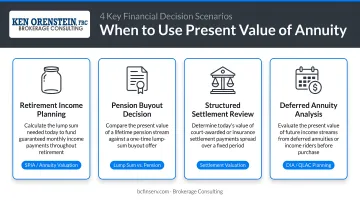
Not every annuity owner needs to run this calculation regularly. But at certain decision points, getting it right is critical:
- Pension buyout decisions: Comparing a lump-sum offer against lifetime monthly income — the PV of the annuity stream should exceed the lump sum (adjusted for your discount rate) to justify keeping the payments
- Structured settlement evaluation: Assessing whether a factoring company's offer reflects a fair discount rate or an exploitative one
- Annuity sizing for retirement: Determining how much to invest today in a Single Premium Immediate Annuity (SPIA) to generate a target monthly income
- Comparing two annuity products: Different payment structures, start dates, or payout periods need a common-denominator comparison — PV provides that
Each of these scenarios gets more complex for federal employees. FERS and CSRS pensions may include COLA adjustments, survivor benefit elections, and specific tax treatment that the standard PV formula doesn't account for on its own — and that most online calculators skip entirely.
Ken Orenstein at Brokerage Consulting holds the Federal Retirement Consultant (FRC) designation and works specifically with federal employees on these calculations. A no-cost initial consultation is available by phone, virtual, or in-person at (888) 315-3608.
Frequently Asked Questions
What is the formula for the present value of an annuity?
The ordinary annuity formula is PV = PMT × [1 – (1 + r)^-n] / r, where PMT is the payment per period, r is the discount rate per period, and n is the total number of periods. For an annuity due, multiply the result by (1 + r) to account for payments arriving at the beginning of each period.
What information do I need to calculate the present value of an annuity?
Three inputs: the fixed payment amount per period (PMT), the discount or interest rate per period (r — expressed as a decimal and matched to payment frequency), and the total number of payment periods (n). Make sure each input reflects the actual terms of the annuity contract.
What is the difference between ordinary annuity and annuity due present value?
An ordinary annuity makes payments at the end of each period; an annuity due makes them at the beginning. Because annuity due payments arrive sooner, they're discounted less — producing a present value higher by a factor of (1 + r) compared to an otherwise identical ordinary annuity.
How does the discount rate affect the present value of an annuity?
The relationship is inverse: a higher discount rate lowers present value because future payments are discounted more aggressively. A lower rate increases present value.
Is the present value the same as the cash surrender value of an annuity?
No. Present value is a theoretical calculation of what future payments are worth today. Cash surrender value is the actual amount an insurer pays if you cancel the contract early — which reflects surrender charges, penalties, and any market value adjustments. The two can differ substantially.
Can I use an online calculator instead of the manual formula?
Online calculators work well for straightforward fixed-payment annuities. They typically don't account for inflation adjustments, variable payments, COLA riders, or contract-specific fees. For high-stakes decisions such as pension buyouts, large annuity purchases, or structured settlement evaluations, verify the result manually or review it with a financial advisor.