
That gap creates real risk. A joint SEC/NASD report found regulators received a "significant number of complaints" about variable insurance products, and FINRA has flagged variable annuity sales practices as a recurring examination priority in 2021, 2023, and 2025. The consequences of getting disclosures wrong range from regulatory fines to full contract rescission.
This guide covers what must be disclosed, why, who is responsible, and what the most common compliance failures look like — whether you're an advisor recommending these products or an investor trying to understand what you're signing.
Key Takeaways
- Variable annuities carry two separate regulatory burdens: federal (SEC/FINRA) and state (NAIC/insurance law)
- Required documents include a prospectus, a Buyer's Guide, and a Contract Summary
- Disclosures must cover fees, surrender charges, investment risks, tax treatment, and agent compensation costs
- FINRA Rule 2330 requires suitability review and principal approval within 7 business days before an application reaches the insurer
- Skipping or mishandling disclosures can result in fines, restitution orders, and contract rescission
What Variable Annuity Disclosure Requirements Actually Are
Variable annuity disclosure requirements are legally mandated communications that must reach a prospective buyer before or at the point of purchase. They explain how the product works, what it costs, and what risks it carries — in plain language, not buried in fine print.
Consumers receive enough information to compare products and decide whether a variable annuity fits their financial goals, risk tolerance, and retirement timeline.
Why Variable Annuities Face Stricter Rules Than Fixed Products
Fixed and indexed annuities are regulated solely as insurance products under state law. Variable annuities are different. Because they involve investing premiums across market-linked sub-accounts, they are classified as securities under federal law — which means they require SEC registration in addition to state insurance oversight.
That dual status creates a dual disclosure burden:
- SEC Form N-4 prospectus, covering the contract as a security under federal law
- Buyer's Guide and Contract Summary, governed by NAIC model regulation and state insurance law
Neither layer satisfies the other. A broker who delivers the prospectus but skips the state-required Buyer's Guide has not met full disclosure obligations — something that catches many advisors off guard.
What Must Be Disclosed Before Selling a Variable Annuity
Product Features and Investment Risk
The prospectus or summary prospectus must explain:
- How the annuity accumulates value (through sub-account choices, a fixed interest account, or both)
- Whether the product accepts a single premium or flexible premium payments
- That growth is tax-deferred
- That the product is not suited for short-term financial goals
All material investment risks must also be disclosed in plain language. This includes the possibility that sub-account investments may lose value, that the issuer may not be able to satisfy guaranteed benefit claims, and which specific risks attach to each investment portfolio under the contract.
Fees, Surrender Charges, and Tax Treatment
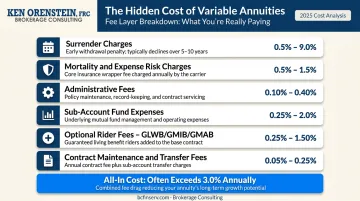
The SEC's variable annuity guide identifies the standard fee components buyers must see in writing:
- Surrender charges: Displayed in a table by contract year; surrender periods typically run 6 to 8 years, sometimes longer
- Mortality and expense (M&E) risk charges
- Administrative fees
- Underlying fund (sub-account) expenses
- Optional rider fees (GLWB, GMIB, GMAB)
- Contract maintenance or transfer fees
All-in costs for a variable annuity with living benefit riders can exceed 3% annually. That total must be clearly presented in one place, not scattered across different sections of the disclosure documents.
Required tax disclosures include:
- Earnings withdrawn are taxed as ordinary income, not at capital gains rates
- Withdrawals before age 59½ are subject to a 10% federal tax penalty under IRC Section 72(q)
- A 1035 exchange allows tax-deferred transfer from one annuity contract to another, but buyers should compare benefits, costs, and surrender charges before exchanging
- Placing a variable annuity inside an IRA or other tax-deferred retirement account provides no additional tax benefit from the annuity structure
That last point is one of the most commonly omitted disclosures, and one of the most important — particularly for clients considering rolling TSP funds into an IRA that then holds a variable annuity.
Compensation and Replacement Disclosures
The disclosure package must also inform the buyer:
- The broker-dealer or agent receives commission for the sale
- Revenue-sharing arrangements may exist between the carrier and the selling firm
- Buyers have the right to ask how their representative is compensated
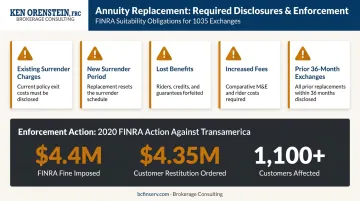
When an existing annuity contract will be replaced or significantly reduced in value, additional disclosures are required. The buyer must be told:
- Any surrender charges that will apply to the existing contract
- Whether they will enter a new surrender period under the replacement contract
- Any benefits they will lose from the original contract
- Whether fees will increase under the new contract
- Whether they have completed another exchange within the preceding 36 months
Replacement disclosures are the highest-risk area in variable annuity compliance. FINRA's 2020 enforcement action against Transamerica resulted in a $4.4 million fine and $4,354,160 in restitution. Nearly $3.6 million of that went to over 1,100 customers harmed by inaccurate variable annuity exchange disclosures.
Key Regulatory Frameworks Governing Variable Annuity Disclosures
Variable annuity disclosures operate under three overlapping frameworks. Understanding which rules apply — and to whom — is essential for both advisors and buyers.
SEC: Form N-4 and the 2024 Rule Updates
Variable annuity separate accounts must register with the SEC under Form N-4, which triggers registration under both the Investment Company Act of 1940 and the Securities Act of 1933.
In July 2024, the SEC issued Release No. 33-11294, updating Form N-4 to require a summary prospectus framework for variable annuities, index-linked annuities (RILAs), and registered market value adjustment annuities. The rule became effective September 23, 2024, with a general compliance date of May 1, 2026 — a date that has now passed, meaning current materials must reflect the updated framework.
The updated form requires the Key Information Table in question-and-answer format and places the Overview of the Contract before that table, leading with plain-English disclosure of costs, surrender charges, and market risk before buyers reach the full prospectus detail.
FINRA Rule 2330: Suitability and Principal Review
FINRA Rule 2330 governs the sales-practice obligations that attach to every deferred variable annuity recommendation. Before making any such recommendation, a registered representative must:
- Gather the customer's age, income, financial situation, investment experience, objectives, time horizon, existing assets, liquidity needs, liquid net worth, risk tolerance, and tax status
- Have a reasonable basis to believe the customer was informed of material features, including surrender periods, the 10% early withdrawal penalty, M&E charges, rider features, and market risk
A registered principal must then review and either approve or reject the application no later than 7 business days after the Office of Supervisory Jurisdiction receives a complete application. Approval can only be granted if the transaction is suitable for the customer.
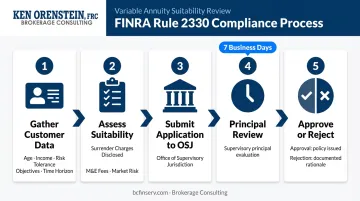
Firms must also maintain written supervisory procedures, automated surveillance for exchange patterns, and training programs for both representatives and reviewing principals.
State Requirements: NAIC Model Regulation and Free Look Periods
Under NAIC Annuity Disclosure Model Regulation #245, every annuity sale must be accompanied by:
- A Buyer's Guide: A standardized consumer brochure explaining how annuities work generally
- A Contract Summary: A product-specific document covering premiums, benefits, fees, surrender charges, and riders
Both must be delivered in addition to the federal prospectus — not instead of it.
State law also mandates a free look period, during which buyers can return the contract for a full refund. The SEC sets a baseline of 10 or more days, but state-specific rules vary materially:
| State | Free Look Period |
|---|---|
| Florida | 21 days |
| California (seniors) | 30 days |
| California (other buyers) | 10 days |
| SEC baseline | 10 or more days |
The specific free look duration must be disclosed in the contract and supporting documents.
Who Bears Responsibility for Variable Annuity Disclosures
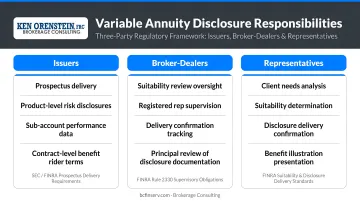
Disclosure responsibility is shared across three distinct parties, and compliance failures most often occur in the gaps between them.
Issuers (insurance companies) are responsible for preparing and filing accurate prospectuses with the SEC and complying with NAIC disclosure templates. Their obligation is product-level accuracy.
Broker-dealers and firms own the supervisory infrastructure: written procedures, principal review systems, exchange surveillance, and representative training. A firm cannot delegate its Rule 2330 obligations to individual representatives.
Registered representatives bear the customer-facing obligation. At the point of sale, that means:
- Confirming the prospectus or summary prospectus is delivered before or at the time of the sale
- Reviewing the Buyer's Guide and Contract Summary with the customer — not just handing them over
- Documenting the suitability basis for the recommendation in writing
- In Florida specifically, asking about the customer's income sources regardless of age, as required under Florida Statute 627.4554
These obligations underscore why working with an independent advisor matters. Representing multiple carriers rather than a single company allows for objective product comparison and an unfiltered suitability review. Brokerage Consulting offers no-cost consultations — by phone, virtually, or in person — for clients evaluating whether a variable annuity fits their retirement strategy.
Common Disclosure Mistakes and Misconceptions
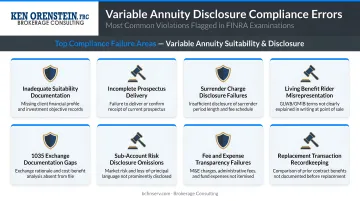
The most frequent compliance failures in variable annuity disclosure are not obscure — they are predictable and well-documented in FINRA examination findings.
Two mistakes appear in virtually every FINRA examination cycle:
- Prospectus delivery treated as a checkbox — Many advisors hand over the document without walking clients through what matters most: surrender charge tables, fee schedules, and sub-account risk disclosures.
- Assuming the prospectus covers all obligations — It does not. State-required Buyer's Guide and Contract Summary delivery, free look disclosures, and compensation transparency operate independently of SEC registration requirements. One document does not satisfy the others.
The most common suitability and documentation errors flagged in examinations:
- Failing to document the suitability basis for the recommendation in writing
- Not disclosing that placing a variable annuity inside an IRA or 401(k) provides no additional tax advantage
- Recommending exchanges without disclosing the new surrender period, lost benefits, or increased fees
- Using professional designations that imply specialized expertise beyond the agent's actual licensure — a practice FINRA specifically addressed in Regulatory Notice 07-43
Of these, exchange activity draws the most regulatory scrutiny. It concentrates every major disclosure risk in a single transaction: surrender charges on both sides, potential loss of accumulated benefits, new lock-up periods, and the compensation conflict inherent in replacing an existing contract.
Frequently Asked Questions
What are the disclosure obligations for annuities?
Annuity disclosure obligations include delivering a Buyer's Guide, a Contract Summary, and — for variable annuities — a prospectus or summary prospectus. These documents must cover the product's features, fees, risks, payout options, tax treatment, and agent compensation, and must be delivered before or at the point of sale.
What must you check before recommending a variable annuity?
Under FINRA Rule 2330, a registered representative must assess the customer's age, income, investment experience, objectives, time horizon, existing assets, net worth, and risk tolerance. The recommendation must be grounded in a reasonable belief that the customer would benefit from features like tax deferral, annuitization, or death and living benefits.
What is required to sell variable annuities?
Selling variable annuities requires a securities license (Series 6 or 7) and a state insurance license. Required documents include a prospectus, Buyer's Guide, and Contract Summary; principal review and approval must occur within 7 business days before the application is submitted to the insurer.
What does a variable annuity provide?
A variable annuity is a tax-deferred insurance contract that lets the owner invest premiums across market-linked sub-accounts, with payout options including lifetime income. Unlike fixed annuities, account value fluctuates with sub-account performance, and most contracts include a death benefit.
What is the free look period for a variable annuity?
Most states require a free look period of at least 10 days after purchase, during which the buyer can return the contract for a full refund. The exact duration varies by state — Florida requires 21 days, California provides 30 days for seniors — and the specific terms must be disclosed in the contract documents.
How does a variable annuity prospectus differ from a Contract Summary?
A prospectus is a federally required, SEC-filed document covering all material facts about the annuity as a security. A Contract Summary is a shorter, state-required document presenting key terms such as benefits, fees, and surrender charges in a more readable format. Both must be delivered at or before the point of sale.
Conclusion
Variable annuity disclosure requirements span two regulatory layers — federal (SEC and FINRA) and state (NAIC and insurance law) — and satisfying both requires more than delivering a prospectus. It means conducting a documented suitability review, delivering the Buyer's Guide and Contract Summary, obtaining principal approval within 7 business days, and ensuring the buyer understands what they are signing.
Disclosures exist because the cost of misunderstanding a variable annuity falls entirely on the investor. The risks are concrete:
- Surrender charges that lock up funds for years
- Unexpected tax penalties on early withdrawals
- Replacements that strip away hard-earned living benefits
For personalized guidance on whether a variable annuity fits your retirement strategy, schedule a no-cost consultation with Ken Orenstein at Brokerage Consulting. Phone, virtual, and in-person appointments are available — call (888) 315-3608 or visit bcfinserv.com.