
Introduction
Many couples spend decades building retirement savings but never fully address a harder question: what happens to the surviving spouse's income when one of them dies first? A pension or Social Security benefit might shrink — or a single-life annuity stops entirely — leaving a household that budgeted for two incomes suddenly running on one.
A joint and survivor annuity is designed specifically for this problem. It guarantees income to two people (typically spouses) for as long as either one is alive. When the first person dies, payments continue to the survivor, either at the same amount or a reduced percentage depending on the option selected.
This guide breaks down how joint and survivor annuities work, what the payout options cost you, and whether this structure makes sense for your retirement — including key considerations for federal employees under FERS and CSRS.
TL;DR: Key Takeaways
- A joint and survivor annuity pays guaranteed income to two people for as long as either one is alive
- Survivor payout options typically include 50%, 66.67%, 75%, or 100% of the original payment
- Higher survivor percentages mean lower initial monthly payments — the core trade-off
- Best suited for married couples who are close in age and prioritize income security over maximizing monthly payments
- Once payments begin, the payout structure is locked in — review your survivor percentage carefully before the election deadline
What Is a Joint and Survivor Annuity?
A joint and survivor annuity is an insurance contract that pays income to two named annuitants — most often spouses, but also domestic partners or other eligible individuals — for as long as either one is alive. When the first annuitant dies, payments don't stop. They continue to the survivor, sometimes at a reduced amount, depending on the payout option selected at purchase.
Joint and Survivor vs. Jointly Owned Annuity
This distinction trips up a lot of people. A jointly owned annuity is a contract-ownership arrangement. When one owner dies, it typically triggers a death benefit and can end scheduled income payments. A joint and survivor annuity is a payout structure — the contract is specifically designed so that income continues to the surviving annuitant without interruption, at no additional administrative burden to the survivor.
The contract does not treat the surviving annuitant as a beneficiary receiving a death benefit. They are a co-annuitant receiving continuing income under the original contract terms. In practice, this means no distribution event is triggered on the first death — payments continue under the same tax exclusion ratio without interruption.
Who Can Be the Second Annuitant?
The second annuitant doesn't have to be a spouse. Eligible parties include:
- Domestic partners
- Former spouses
- Qualifying dependents
However, IRS Publication 575 notes age-gap restrictions when the secondary annuitant is not the spouse. A non-spouse secondary annuitant cannot be more than 10 years younger than the primary annuitant while still receiving 100% continuation of the payment.
How Does a Joint and Survivor Annuity Work?
Funding and Setup
A joint and survivor annuity is purchased through an insurance company, funded with a lump-sum premium. Common funding sources include personal savings, CDs, or a rollover from a 401(k) or IRA.
Two structures exist based on when income starts: an immediate annuity, where payments begin within 12 months of purchase, or a deferred annuity, where funds accumulate first and income begins at a future date.
At purchase, the buyer locks in three key decisions:
- Designates a primary and secondary annuitant
- Selects a survivor benefit percentage (commonly 50%, 75%, or 100%)
- Establishes a payment schedule, typically monthly
What Happens After the First Death
When the primary annuitant dies, payments continue automatically to the surviving annuitant. No probate, no death benefit claim, no administrative restart. The survivor keeps receiving payments — either the same amount or a reduced percentage based on the elected option.
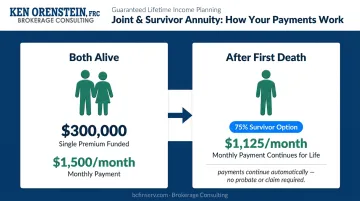
Hypothetical example: A couple funds a joint and survivor annuity with a $300,000 premium and receives $1,500/month. They elect the 75% survivor option. If one partner dies, the other receives $1,125/month for the rest of their life.
The Guarantee Period Option
Concerned about dying before you've recouped much of the premium? A period-certain guarantee addresses this. If both annuitants die within the guarantee window — commonly 10 or 20 years — a named beneficiary continues receiving payments until that period ends. Once it expires, all payments stop.
This feature doesn't affect the joint-life payments during either annuitant's lifetime. It only activates if both covered lives end early.
Joint and Survivor Annuity Payout Options
Buyers must select a survivor benefit percentage at purchase. Per IRS rules under IRC 417, the survivor must receive between 50% and 100% of the amount paid during the primary annuitant's lifetime.
The PBGC's 2025 benefit options illustration provides a clear side-by-side comparison of how survivor percentage affects monthly payments:
| Payout Option | Payment While Both Alive | Survivor Payment After First Death |
|---|---|---|
| Straight-life (no survivor) | $500 | $0 |
| Joint-and-50% | $450 | $225 |
| Joint-and-75% | $429 | $322 |
| Joint-and-100% | $409 | $409 |
These are hypothetical PBGC pension figures for illustration. Commercial annuity pricing varies by carrier, age, and interest rate environment.
The Three Main Options Explained
The right percentage depends on one question: how much income does the surviving spouse need to maintain their standard of living on their own?
- 100% suits couples where the survivor has little or no independent income — full continuity at the cost of a lower starting payment.
- 75% (or 66.67%) works well when some outside income exists; the reduction is real but manageable.
- 50% delivers the highest initial payment but creates a sharp income drop at the first death — appropriate only when the survivor has substantial other resources.
Fixed vs. Inflation-Adjusted Payouts
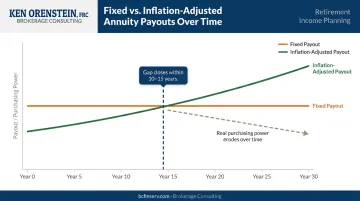
A fixed payout stays constant for life. An inflation-adjusted option increases annually — typically by 1%, 2%, or 3% compounded, according to the American Academy of Actuaries. CPI-linked options also exist, though fewer carriers offer them and they typically carry a higher cost.
The core trade-off breaks down this way:
- Fixed payouts start higher but lose purchasing power over time — a real concern across a 20-30 year retirement.
- Inflation-adjusted payouts start lower for the same premium but protect against rising costs, often closing the gap within 10-15 years depending on the adjustment rate.
Pros and Cons of a Joint and Survivor Annuity
Like any retirement income tool, a joint and survivor annuity involves real trade-offs. The right choice depends on your household's longevity risk, liquidity needs, and overall income picture.
Pros
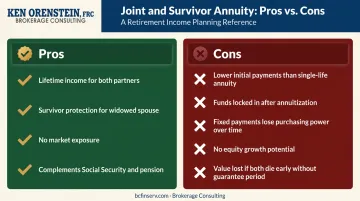
- Payments continue for as long as either partner lives — regardless of market conditions. The Society of Actuaries puts the probability that at least one member of a 65-year-old couple reaches age 85 at 72%, a planning horizon most people underestimate.
- Survivor income directly addresses a documented risk: SSA data shows aged widows faced a 13.4% poverty rate in 2008, compared to 7.8% for all aged beneficiaries.
- No market exposure means payments aren't tied to investment performance — a critical feature for retirees who can't absorb income volatility.
- Works alongside Social Security, FERS or CSRS pension income, and other retirement assets to build a reliable income floor.
Cons
- Initial payments are lower than a single-life annuity. The Urban Institute found single-life benefits can run 8.7% higher in comparable scenarios — a meaningful difference over a 20- or 30-year retirement.
- Once annuitized, the lump sum is generally locked in. As the California Department of Insurance notes, buyers of immediate annuities "usually cannot take extra money out." Large unexpected expenses must come from other sources.
- Fixed payments lose purchasing power over time. A $1,500/month payment in year one is worth considerably less by year 20 without an inflation rider.
- Capital committed to an annuity can't grow in equities or other vehicles. Couples with longer time horizons and higher risk tolerance should weigh what they're giving up in potential growth.
- If both annuitants die shortly after payments begin and no guarantee period was elected, the remaining value stays with the insurer. A guarantee period reduces — but doesn't eliminate — this risk.
Tax Treatment and IRS Rules
How Funding Source Determines Taxes
- Pre-tax funding (401(k), traditional IRA rollover): Payments are fully taxable as ordinary income when received
- After-tax funding (personal savings, nonqualified annuity): The exclusion ratio applies — only the earnings portion of each payment is taxable; the return of principal is not
For joint and survivor annuities specifically, IRS Publication 575 states that expected return is calculated using the combined life expectancies of both annuitants — a longer expected payout period than a single-life calculation.
Taxes for the Surviving Annuitant
The survivor continues to exclude the same percentage of each payment that applied before the first death, until the full investment in the contract is recovered. Once the cost basis is fully recovered, every payment becomes 100% taxable ordinary income — with no adjustment, no new exclusion ratio, and no step-up in basis.
The Qualified Joint and Survivor Annuity (QJSA) Requirement
Under IRC 401(a)(11) and IRC 417, qualified retirement plans — including defined benefit, money purchase, and target benefit plans — must offer a Qualified Joint and Survivor Annuity (QJSA) as the default payout for married participants.
A married participant can waive the QJSA, but the rules are specific:
- Waiver requires written spousal consent, witnessed by a plan representative or notary
- Notice must be provided no more than 180 days and no less than 30 days before the annuity start date
- The election window closes on the annuity start date — no changes are permitted after that point
Who Should (and Shouldn't) Consider a Joint and Survivor Annuity?
Good Candidates
- Married couples close in age with similar life expectancies — the pricing works most efficiently when both lives are valued similarly
- Risk-averse retirees who prioritize predictability over growth potential
- Couples where one spouse has limited independent retirement savings — the survivor benefit becomes a financial lifeline
- Those with a longevity history in their family, where the extended payout period is likely to be fully utilized
Less Suitable Situations
- One or both partners have shortened life expectancy — a single-life annuity or other vehicle may deliver better value
- The surviving spouse already has substantial guaranteed income from Social Security, a pension, or an estate — the survivor protection is redundant
- Significant liquidity needs for ongoing health care expenses — locking funds into an irrevocable income stream can create cash-flow problems
A Note for Federal Employees
For federal employees, joint and survivor annuity suitability involves an additional layer of complexity. FERS or CSRS survivor benefit elections, TSP distribution timing, and private annuity planning don't exist in isolation. A FERS pension survivor election and a private joint and survivor annuity can work together — or overlap in ways that create redundant coverage or leave gaps.
Ken Orenstein at Brokerage Consulting works specifically with federal employees navigating these decisions. As a Federal Retirement Consultant and author of The Informed Fed: A Survival Guide to Federal Employee Benefits, he evaluates how a joint and survivor annuity fits alongside federal pension income, Social Security timing, and survivor benefit elections — including 1035 exchange analysis for clients funding an annuity from an existing nonqualified contract. Phone, virtual, and in-person consultations are available at no charge. Reach the office at (888) 315-3608.
Frequently Asked Questions
What are the payout options for a joint and survivor annuity, and how do they affect monthly payments?
The main options are 50%, 66.67%, 75%, and 100% survivor benefit levels. The higher the percentage guaranteed to the survivor, the lower the initial monthly payment both partners receive while alive — because the insurer prices in the extended coverage obligation over two lifetimes.
What are common misconceptions about joint and survivor annuity payouts?
Three misconceptions come up regularly:
- The survivor always receives the same payment — not true; the amount depends on the elected percentage
- Money is "wasted" if one spouse dies early — a guarantee period option addresses this directly
- The surviving annuitant is treated like a beneficiary — they're not; they're a co-annuitant with distinct, simpler tax treatment
How does a joint and survivor annuity differ from a jointly owned annuity?
In a jointly owned annuity, the death of one owner typically triggers a death benefit and can end scheduled payments. In a joint and survivor annuity, the contract is structured so that income continues to the surviving annuitant on the original schedule: no death benefit payout, no restart of payments.
Is a joint and survivor annuity required for married participants in a qualified retirement plan?
Yes. Under IRS rules, qualified plans — including defined benefit and money purchase plans — must offer a QJSA as the default payout for married participants. A spouse can waive this right in writing, but only with proper plan notice and written spousal consent obtained within the required timeframe.
What happens if both annuitants die during the guarantee period?
The named beneficiary — a child or other designated person — continues receiving annuity payments for the remaining years of the guarantee period. Once that period expires, all payments stop permanently.
Can I change my joint and survivor annuity payout option after payments have started?
In most cases, no. Once annuity income begins, the payout structure is locked in. This is why selecting the right survivor benefit percentage before purchase, preferably after reviewing your income needs with an advisor who specializes in annuity planning, is so important.