
But popularity doesn't mean universally right.
Annuities are insurance contracts, not investments. Whether one belongs in your retirement plan depends entirely on your income situation, timeline, and risk tolerance — not on what's trending. This article walks through how annuities work, what they cost, who benefits, and how to make the determination for your own circumstances.
Key Takeaways
- Annuities are insurance products that convert premiums into guaranteed income — distinct from stocks, bonds, or mutual funds
- Best suited for risk-averse individuals nearing or in retirement who have a gap between guaranteed income and projected expenses
- Advantages include guaranteed lifetime income, tax-deferred growth, and no IRS contribution limits
- Drawbacks include fees, limited liquidity, surrender charges, and lower return potential than equities
- The right decision depends on your financial picture — income sources, risk tolerance, time horizon, and goals
What Is an Annuity and How Does It Work?
An annuity is a contract between you and an insurance company. You pay a lump sum or a series of premiums; the insurer guarantees income payments — either immediately or at a future date — for a set period or for life. Product guarantees depend on the insurer's financial strength, and state guaranty associations provide an additional safety net if the insurer fails (coverage varies by state but provides at least $250,000 in annuity benefits per member association).
The Two Phases
Every annuity moves through two stages:
- Accumulation phase — Your premium grows, typically tax-deferred. How long this phase lasts depends on whether you choose a deferred or immediate product.
- Distribution phase — The insurer begins making income payments. Timing and structure depend on the contract you selected.
Why It's Insurance, Not an Investment
This distinction matters. With an annuity, you transfer the risk of outliving your savings to the insurance company. The insurer uses actuarial modeling to price that guarantee, which is why only licensed insurers issue these contracts and why fixed annuities are regulated by state insurance commissioners rather than the SEC.
Variable annuities and registered index-linked annuities are also regulated as securities by the SEC and FINRA, given their market exposure.
That structural difference shapes how Ken Orenstein at Brokerage Consulting approaches retirement planning:
"Retirement is fundamentally an income problem, not just an investment problem. The question that matters most isn't 'how much have I saved?' — it's 'how much guaranteed monthly income will I receive for the rest of my life?'"
Types of Annuities: Which One Are You Looking At?
Fixed Annuities
Fixed annuities guarantee a minimum interest rate for a set contract period. The insurer may credit more than the minimum, but not less. Think of them as a CD alternative with tax-deferred growth and no market exposure — predictable, conservative, and well-suited for clients who want principal protection and have no interest in market participation.
Best for: Retirees in or near distribution who need a guaranteed rate locked in for a defined term — typically 3, 5, or 7 years — without any exposure to market swings.
Variable, Indexed, and Immediate Annuities
These three types cover a wider range of risk profiles:
| Type | Risk Level | Growth Potential | Best Use Case |
|---|---|---|---|
| Variable | High | Highest — tied to sub-account investments; can lose principal | Higher-risk clients with guaranteed income already in place |
| Fixed Indexed (FIA) | Low-to-moderate | Moderate — linked to a market index with downside protection and upside caps | Clients wanting growth potential without direct market risk |
| Immediate (SPIA) | Low | Minimal — optimized for income, not growth | Retirees needing guaranteed income within 30 days of purchase |
| Deferred Income (DIA/QLAC) | Low | Moderate during accumulation | Pre-retirees locking in income at a future activation date |
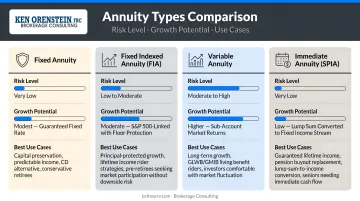
For most income planning consultations — particularly for clients aged 65–73 replacing a paycheck in retirement — Fixed Indexed Annuities tend to be the starting point. Variable annuities require closer scrutiny: a replacement analysis is typically needed to determine whether an existing VA warrants exchange for a lower-cost, principal-protected alternative. At Brokerage Consulting, that analysis is part of every annuity review.
The Real Benefits of Annuities
Guaranteed Lifetime Income
This is the defining advantage, and the primary reason annuity sales keep breaking records. An annuity can provide income you cannot outlive, regardless of how long you live. The American Academy of Actuaries identifies longevity risk as the core gap when Social Security and pension income don't cover essential living expenses — this is precisely what annuities are built to solve.
At 65, a person can expect to live nearly 19 more years on average, according to CDC/NCHS life table data. Two risks compound that reality:
- Longevity risk — outliving your assets if savings aren't structured for a 20+ year retirement
- Sequence-of-returns risk — a market downturn early in retirement that permanently impairs a portfolio
Annuities neutralize both by isolating a portion of your income need from market volatility entirely.
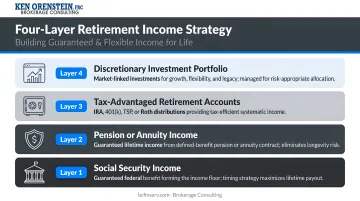
Ken Orenstein structures retirement income across four layers: Social Security → Pension → Guaranteed Annuity Income → Discretionary Portfolio. The annuity layer covers what the first two don't.
Tax-Deferred Growth and No Contribution Limits
Per IRS Publication 575, annuity earnings are not taxed until distributed, and taxable distributions are treated as ordinary income. Two practical advantages follow:
- No annual IRS contribution limits — unlike 401(k)s and IRAs, non-qualified annuities have no cap on how much you can contribute, making them a natural overflow vehicle for those who have already maxed out tax-advantaged accounts
- Compound growth without annual tax drag — particularly valuable over long accumulation periods
One caveat: withdrawals before age 59½ generally trigger a 10% additional tax on the taxable portion, on top of ordinary income tax.
Principal Protection and Customization
Fixed and fixed indexed annuities contractually protect your original premium. The guaranteed rate will never be credited below zero for FIAs, meaning market downturns don't erode principal.
Riders let you tailor the contract further:
- GLWB/GMIB riders — guarantee a minimum income regardless of account performance
- Inflation-adjustment (COLA) riders — raise income payments annually, typically 1–3% or CPI-linked, at the cost of a lower starting amount
- Joint-life riders — continue income to a surviving spouse at 50–100% of the original payment
- Death benefit riders — pass remaining contract value to beneficiaries
Each rider adds cost — weigh the income guarantee or protection benefit against the annual fee drag before adding one.
The Drawbacks You Shouldn't Ignore
Fees
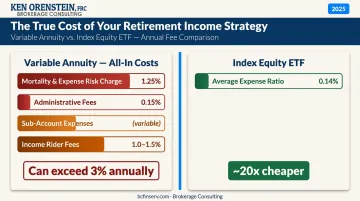
Variable annuities carry the heaviest cost burden. A typical contract layers multiple charges on top of each other:
- Mortality and expense risk charge: ~1.25% annually (SEC estimate)
- Administrative fees: ~0.15%
- Investment sub-account expenses: varies by fund selection
- Income rider fees: often 1.0–1.5% on the income base
Combined, all-in costs can exceed 3% per year. For comparison, ICI data shows 2024 index equity ETFs averaged 0.14% in expense ratios — roughly 20x cheaper. Fixed and FIA products carry lower explicit fees, but they embed their own costs in caps, spreads, and participation rate limitations.
Illiquidity and Surrender Charges
Annuity contracts lock in your money during the surrender period. Key restrictions to know:
- Surrender periods typically run 5–10 years (one common structure: 9-8-7-6-5-4-3-2-1-0%, declining annually)
- IRS 10% additional tax applies to early withdrawals before age 59½
- Penalty-free withdrawals are capped at roughly 10% of contract value per year
Beyond that 10% threshold, accessing funds early is expensive. That combination of surrender charges and tax penalties makes annuities a poor fit for anyone who may need liquid access to this capital.
Lower Return Potential and Complexity
The guarantee comes at a price: the upside ceiling that equity markets can deliver over long time horizons. For someone with 20+ years before retirement, locking principal into an annuity often sacrifices meaningful compounding returns.
Variable and indexed contracts add another layer of difficulty. Riders, fee structures, crediting methods, cap rates, and payout elections all require careful reading. FINRA flags annuities as complex, potentially costly products — and buying a contract without fully understanding its terms can quietly cost you far more than you anticipated.
Who Should (and Shouldn't) Consider an Annuity?
The Income Gap Test
The most practical framework: add up your projected retirement expenses, then subtract all guaranteed income sources — Social Security, pension, any other contractual income. If a gap remains, an annuity is worth serious consideration as a tool to fill it.
This is exactly how Ken Orenstein approaches client consultations at Brokerage Consulting. The flooring strategy — using guaranteed income to cover essential expenses, with discretionary assets handling the rest — ensures retirees aren't forced to sell investments during market downturns to cover living expenses.
Who Benefits Most
- Age 45 or older, particularly 55–73
- Risk-averse, prioritizing income security over growth
- Approaching retirement or already in it
- Existing savings gap between guaranteed income and essential expenses
- Has already maxed out 401(k) and IRA contributions and wants additional tax-deferred growth
A Special Note for Federal Employees
Federal employees with FERS, TSP, and Social Security already have a meaningful income foundation. That doesn't automatically mean a commercial annuity is redundant — but it does mean the income gap analysis is essential before adding one.
FERS pays approximately 1–1.1% of high-3 average salary per year of service, and TSP provides additional distribution flexibility. Whether a commercial annuity fills a real gap or creates unnecessary overlap depends on running the actual numbers.
Ken Orenstein, a Federal Retirement Consultant and author of The Informed Fed: A Survival Guide to Federal Employee Benefits, works specifically with federal employees navigating this question — evaluating FERS, TSP distribution strategies, and Social Security together to determine whether an annuity adds genuine value.
Who Probably Doesn't Need One
- Under 45, still in the aggressive wealth-building phase
- Needs flexible or emergency access to capital
- Already fully covered by pension and Social Security (no income gap)
- Unwilling to absorb fees for guarantees they may not need
Frequently Asked Questions
Are annuities a good investment?
Annuities are technically insurance products, not investments. For the right person — particularly those seeking guaranteed lifetime income, principal protection, and tax-deferred growth — they can be a strong retirement tool. They are not well-suited for high-growth wealth accumulation.
How do you know if an annuity is right for you?
Start with the income gap test: estimate your retirement expenses, subtract Social Security and pension income, and see what remains. If there's a gap, an annuity may help fill it. A fee-based or independent advisor who reviews your complete retirement picture can confirm whether an annuity fits — ideally before you allocate any funds.
What are the biggest downsides of annuities?
Three main concerns: fees (especially on variable products, which can exceed 3% annually), illiquidity from multi-year surrender periods that restrict access to funds, and lower growth potential relative to equities over long time horizons.
At what age should you consider buying an annuity?
Most annuity buyers are 45 or older, with the core buyer profile at 62–73. LIMRA data puts the average fixed-rate deferred annuity buyer at 62. Timing depends on the annuity type, your retirement timeline, and when you need income to begin.
Can you lose money in an annuity?
Fixed and fixed indexed annuities protect principal — the credited rate won't go below zero for FIAs. Variable annuities can lose money because returns depend on market performance. Fees on any type can also reduce net returns over time.
Do federal employees need an annuity if they already have a pension?
Not necessarily — it depends on the income gap after accounting for FERS, TSP distributions, and Social Security. Federal employees with sufficient guaranteed income from FERS and TSP may not need additional annuity coverage. A Federal Retirement Consultant can map that gap across all your existing benefits — Ken Orenstein offers no-cost consultations for exactly this analysis.