
Introduction
Most people encounter fixed annuities through a mailer or a passing conversation, and walk away with a vague impression of "guaranteed income" — but no clear picture of what's actually guaranteed, what the surrender period costs them, or how the payout phase works.
That gap has real consequences. Fixed annuities are long-term legal contracts with specific mechanics and defined terms. An uninformed buyer can face surrender charges of 7–10% for early withdrawals, IRS penalties on top of that, or lock themselves into an income structure that doesn't match how their retirement actually unfolds.
This article breaks down how fixed annuities actually work: the two phases, the contractual terms every buyer must understand, current rate context, and an honest look at the trade-offs. Whether you're evaluating your first annuity or weighing options alongside a FERS pension or Social Security strategy, the goal is clarity before commitment.
Key Takeaways
- A fixed annuity guarantees a minimum interest rate on your premium — your principal has no market exposure
- Two phases govern every contract: accumulation (tax-deferred growth) and payout (income stream)
- The credited rate is locked for the contract term; renewal rates are not guaranteed to match
- Read the contract carefully — surrender charges, free withdrawal provisions, minimum guaranteed rates, and MVA clauses all affect your returns
- Best suited for conservative savers who prioritize predictability, principal protection, and reliable retirement income
What Is a Fixed Annuity and How Does It Work?
A fixed annuity is an insurance contract in which the issuing company credits a guaranteed interest rate to your premium contributions. The insurance company absorbs all market risk — your account cannot lose value due to market downturns. According to the NAIC's Buyer's Guide to Fixed Deferred Annuities, a fixed annuity guarantees the money will earn at least a minimum interest rate, with that floor stated directly in the contract.
"Fixed" refers to the guaranteed interest rate — not to a fixed payment amount. Those are two different things, and confusing them leads to mismatched expectations during the payout phase.
Every fixed annuity moves through two phases — and the transition between them is a one-way door.
The Accumulation Phase
During accumulation, your premium — either a single lump sum or a series of contributions — earns interest at the guaranteed rate. Earnings compound tax-deferred, meaning no income taxes accrue until you withdraw funds. This allows faster compounding than a taxable savings vehicle like a CD, where interest is taxed annually.
Two structures exist within this phase:
- Fixed deferred annuities — accumulation begins now, income starts at a future date you select
- Fixed immediate annuities (SPIAs) — a single premium is paid and income begins within 30 days to one year, per Investor.gov's definition
Deferred annuities suit pre-retirees building toward a future income date. Immediate annuities suit retirees who need income to begin now — often used to replicate a paycheck after leaving employment.
The Payout Phase
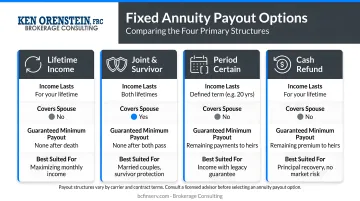
Once annuitization begins, you select a payout option. Common structures include:
- Life only — income for your lifetime, nothing to beneficiaries after death
- Life with period certain (10- or 20-year) — income for life, with remaining payments continuing to beneficiaries if you die before the period ends
- Joint and survivor — income continues for a surviving spouse
- Cash refund — guarantees at least the original premium is paid out
This selection is typically irrevocable. Once income payments begin, access to the account value is generally surrendered, per NAIC guidelines.
That permanence is exactly why some contracts offer a Guaranteed Lifetime Withdrawal Benefit (GLWB) rider as an alternative. Unlike traditional annuitization, a GLWB lets you take lifetime income withdrawals while keeping some access to the remaining account value — so you get guaranteed income without giving up all liquidity.
Key Fixed Annuity Terms Explained
These are operative contract definitions that determine how your money actually behaves — not marketing language.
Guaranteed Rate vs. Current Rate vs. Renewal Rate
Three distinct rates apply to a fixed annuity contract:
| Rate Type | What It Means |
|---|---|
| Minimum guaranteed rate | The contractual floor: the rate can never drop below this level |
| Current (declared) rate | What's actually credited during the initial term, typically higher than the floor |
| Renewal rate | What applies after the guarantee period ends: not contractually fixed |
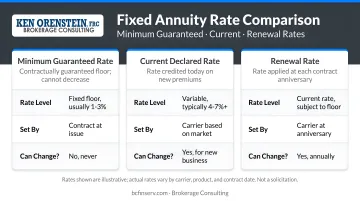
The renewal rate is where many policyholders encounter an unwelcome surprise. It's set by the insurer at the time of renewal and can differ significantly from the initial credited rate.
Surrender Charges and Free Withdrawal Provision
A surrender charge is a fee assessed when withdrawals exceed the permitted amount during the charge period. According to the Texas Department of Insurance, surrender charges often start around 10% in early years and decline annually until the period ends — commonly over 5 to 10 years.
Most contracts include a free withdrawal provision allowing annual withdrawals of up to 10% of accumulated account value without a company penalty. Important caveats:
- The IRS 10% early withdrawal penalty still applies if you're under age 59½
- Income taxes are owed on the taxable portion of any withdrawal, regardless of the free withdrawal provision
Market Value Adjustment (MVA)
Some fixed annuity contracts include an MVA clause, which can increase or decrease your surrender value depending on interest rate movements since the contract was issued. Per Annuity.org's MVA explainer:
- If rates have risen since your contract was issued, your surrender value decreases
- If rates have fallen, your surrender value increases
An MVA reflects the insurer's bond portfolio economics, not a penalty for exiting early. Before signing, ask the carrier for a sample MVA calculation under both rising and falling rate scenarios.
Cash Value vs. Surrender Value
These two figures are not the same:
- Cash value = your accumulated account value (premium plus credited interest)
- Surrender value = what you'd actually receive if you terminated the contract during the surrender period — after surrender charges and any applicable MVA are applied
That gap is why surrender periods matter — and why you should assess your liquidity needs before committing.
Core Benefits of Fixed Annuities
Guaranteed, Risk-Free Growth
Because the insurer absorbs all market risk, your credited rate can never fall below the contractual minimum. You benefit from the returns of the insurer's professionally managed bond portfolio with zero market exposure — no month-end statement anxiety, no sequence-of-returns risk. This contrasts directly with variable annuities, where account value can and does decline.
The appetite for this type of protection is measurable. BlackRock's 2025 Read on Retirement survey found that 86% of savers want guaranteed income options — a number that reflects how much uncertainty currently surrounds retirement planning.
Tax-Deferred Compounding
Growth inside a fixed annuity is not taxed as it accrues. Unlike a CD or savings account — where interest appears on a 1099-INT each year — annuity earnings compound uninterrupted until withdrawal.
Tax treatment differs based on how the contract was funded:
- Qualified annuities (funded with pre-tax dollars, such as an IRA rollover) — 100% of distributions are taxable as ordinary income
- Non-qualified annuities (funded with after-tax dollars) — only the gain portion is taxable; original contributions return tax-free under the exclusion ratio method
Per IRS Topic 558, a 10% additional tax applies to distributions taken before age 59½, on top of ordinary income tax — with limited exceptions.
Guaranteed Lifetime Income Options
The payout phase can be structured so you cannot outlive your income. Social Security and defined-benefit pensions offer this feature, but among private savings vehicles, only insurance contracts can guarantee it. For federal employees already receiving FERS or CSRS pension payments, adding fixed annuity income creates a second layer of guaranteed income that doesn't fluctuate with markets or interest rates.
Common payout structures include:
- Lifetime only — income payments continue for as long as you live
- Period-certain — payments guaranteed for a set term (e.g., 10 or 20 years), with a beneficiary receiving remaining payments if you die early
- Joint-life — payments continue for the lifetimes of you and a spouse
- Life with cash refund — guarantees your heirs receive at least the amount you paid in, if you die before recouping your premium
Principal Protection and State Guaranty Coverage
Your original premium is guaranteed by the issuing insurance company. Annuities are not FDIC-insured, but they are regulated by state insurance commissions and backed by state guaranty associations up to specified limits.
These limits vary by state — Maryland, for example, covers up to $250,000 in present value of annuity benefits, while New York covers up to $500,000. Before purchasing, verify the insurer's financial strength through AM Best, S&P, Moody's, or Fitch ratings.
When working with an advisor like Ken Orenstein at Brokerage Consulting, carrier ratings are reviewed alongside current rates — confirming that the guaranteed rate is backed by a financially sound issuer, not just an attractive number.
Fixed Annuity Rate Ranges and Contract Term Lengths
Rates are set by the insurer based on bond portfolio yields, the current interest rate environment, and competitive positioning. They change regularly, which means comparison shopping at the time of purchase matters considerably.
Current Rate Context by Term
Fixed annuity guarantee periods typically run from 1 to 10 years, with 3-, 5-, and 7-year terms being most common. Multi-Year Guaranteed Annuities (MYGAs) lock in a single rate for the entire contract term with no resets — similar in structure to a CD, but with tax-deferred growth.
Verified rate examples from AM Best A-rated or higher carriers (as of April–May 2026):
| Term | Rate Range | Carrier Rating |
|---|---|---|
| 3-year | 4.20%–4.75% | AM Best A++ |
| 5-year | Up to 5.05% | AM Best A++ |
| 10-year | Up to 5.00% | AM Best A |
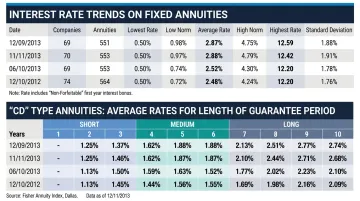
Source: Annuity.org rate pages via Cannex, updated April–May 2026. These are reference examples, not endorsements of specific products.
Traditional fixed annuities (as distinct from MYGAs) may reset the credited rate annually after an initial guarantee period — so confirm whether your contract locks the rate for the full term or resets annually.
What to Compare Across Term Lengths
Rate differentials are typically larger at longer durations in a normal yield curve environment and can invert in a flat or inverted curve. Beyond the headline rate, a thorough comparison covers:
- Free withdrawal provisions vs. client liquidity needs
- Surrender charge schedules across competing carriers
- Carrier financial strength to ensure the guarantee is backed by a solvent issuer
- 1035 exchange analysis for clients holding older annuities at below-market rates
Drawbacks, Limitations, and Who Fixed Annuities Best Serve
Inflation Risk and Liquidity Constraints
Fixed annuity payments don't adjust for inflation. According to J.P. Morgan's 2026 Guide to Retirement, overall inflation averaged 3.0% annually from 1982–2025, with healthcare costs averaging 4.4% — in a retirement that could span 35 years, flat payments lose real purchasing power. Cost-of-living riders exist but typically add expense.
Liquidity is the other constraint. The 10% annual free withdrawal limit and surrender charges make fixed annuities inappropriate for funds that might be needed in an emergency. These contracts are not short-term savings vehicles.
Three Misconceptions to Clear Up
- The credited rate isn't permanent. It applies only during the initial guarantee period. Renewal rates can — and often do — differ.
- "Guaranteed" doesn't mean FDIC-insured. It means the insurer has contractually committed to the minimum rate, backed by its own financial strength and state guaranty association limits.
- Annuity income affects your broader tax picture. Distributions count as ordinary income and can push Social Security benefits into taxable territory, affect Medicare premium calculations (IRMAA), or trigger RMD complications inside a qualified account.
Who Fixed Annuities Are Best For
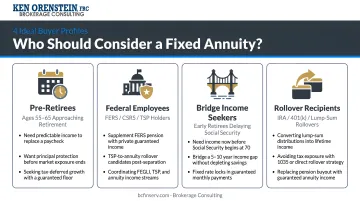
The ideal candidate is a conservative saver who values predictability over growth potential and has a time horizon that aligns with the contract term. Specifically:
- Pre-retirees who want to lock in a guaranteed rate before transitioning to income
- Bridge-income seekers who need to cover the gap between retirement and Social Security or pension commencement
- Federal employees — who often already have FERS or CSRS pension income — and want to layer in additional guaranteed income without market exposure
- Rollover recipients who've received a lump-sum distribution and want principal-protected, tax-deferred growth
Ken Orenstein at Brokerage Consulting works with multiple carriers to compare rates and match the right term and payout structure to each client's income strategy. No-cost consultations are available by phone, virtually, or in person at (888) 315-3608.
Frequently Asked Questions
What does 'fixed' in a fixed annuity refer to?
"Fixed" refers to the guaranteed interest rate credited to your account — not a fixed payment amount. The rate is locked in for the contract's guarantee period, and your principal is protected from market loss by the issuing insurance company.
What is a fixed-term fixed-rate annuity?
A fixed-term fixed-rate annuity — commonly called a Multi-Year Guaranteed Annuity (MYGA) — locks in a single interest rate for the entire contract term, typically 3, 5, or 10 years, with no resets during that period. It functions similarly to a CD but with tax-deferred growth.
How much income will a fixed annuity pay each month?
Monthly income depends on the premium amount, the annuitant's age and gender, the payout option selected, and current annuity payout factors. A $100,000 and a $500,000 premium will produce very different figures. Request a personalized illustration from a licensed advisor for an accurate projection.
Can you lose money in a fixed annuity?
Your principal cannot be lost to market decline — the insurer guarantees the credited rate and protects the premium. Surrendering the contract early may result in surrender charges and a market value adjustment that reduce the net amount you receive.
Does annuity income affect SSDI benefits?
Per SSA guidelines, annuity income is classified as unearned income — not earned income — so it generally does not affect SSDI eligibility or benefit amounts. Individual circumstances vary; consult a benefits specialist for your specific situation.
What happens to a fixed annuity when the owner dies?
Before annuitization, the account value is generally paid to the named beneficiary. If a period-certain payout was selected and the annuitant dies before the period ends, remaining payments continue to the beneficiary.