
A Single Premium Deferred Annuity (SPDA) was designed for exactly this situation. You make one upfront payment to an insurance company, the money grows tax-deferred during an accumulation period, and income begins at a future date you choose. This article covers how SPDAs work, the three main types, key benefits and drawbacks, tax treatment, and who this product is — and isn't — right for.
Key Takeaways
- An SPDA is funded with a single lump-sum payment; no additional contributions are allowed after purchase
- Three main types: fixed deferred, MYGA, and fixed indexed — each with a different growth mechanism and risk profile
- Grows tax-deferred with no annual IRS contribution limits — fixed contracts also protect your principal
- Offers flexible payout options when you're ready to convert savings into income
- Surrender charges apply during a 5–10 year window, so liquidity is limited — fixed contracts also carry inflation risk
- Best suited for pre-retirees in their 50s or early 60s with a deployable lump sum they won't need to access soon
What Is a Single Premium Deferred Annuity?
An SPDA is a contract between you and an insurance company. You make one lump-sum payment — the "single premium" — upfront. No additional deposits are allowed after that initial purchase. In exchange, the insurer grows your money tax-deferred and agrees to pay you income at a future date you select.
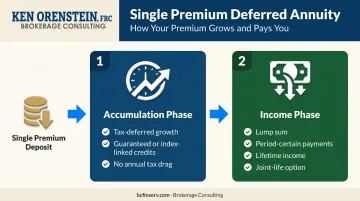
Every SPDA operates in two phases:
- Accumulation phase — Your deposit grows according to the contract's interest structure (guaranteed rate, index-linked credits, etc.), with no annual tax drag on earnings
- Income phase — At the date you choose, the contract converts to payouts: a lump sum, income for a set number of years, or lifetime payments
Understanding those two phases also clarifies how an SPDA compares to its close cousin, the SPIA.
How an SPDA Differs from a SPIA
The "deferred" part matters. A Single Premium Immediate Annuity (SPIA) starts paying income within 30 days of purchase. An SPDA delays those payments — often by years or even decades — giving your deposit more time to compound before income begins. That delay typically produces larger payouts when the income phase begins.
Example: A 52-year-old deposits $100,000 into an SPDA targeting an income start date of age 67. Over 15 years, that balance accumulates tax-deferred before a single payment is made. The contrast with a taxable CD or savings account — where interest is taxed each year — can add up to tens of thousands of dollars over that window.
Common Funding Sources
SPDAs are a natural fit for near-retirees with a meaningful lump sum to deploy. Common sources include:
- 401(k) or TSP rollover distributions
- Traditional IRA rollovers
- Pension buyout proceeds
- Inheritance or estate distributions
- Proceeds from a business or property sale
According to LIMRA, rollovers from defined-contribution plans accounted for 97% of traditional IRA inflows in 2022, with the annual IRA rollover market projected to cross $1 trillion by 2030 — a scale that puts SPDAs squarely in the middle of most retirement income conversations.
Key Contract Terms to Know
| Term | What It Means |
|---|---|
| Accumulation period | The deferral window during which your deposit grows tax-deferred |
| Annuitization | Converting the contract's accumulated value into a stream of income payments |
| Surrender period | The window (typically 5–10 years) during which early withdrawals trigger penalties |
| Death benefit | The value passed to named beneficiaries if the annuitant dies before or during the payout phase |
Types of Single Premium Deferred Annuities
SPDAs aren't a single product. They differ in how the contract value grows during the accumulation phase, and the right type depends on your risk tolerance, time horizon, and income goals. The NAIC's Buyer's Guide to Fixed Deferred Annuities outlines the core mechanics for each type.
Fixed Deferred Annuities
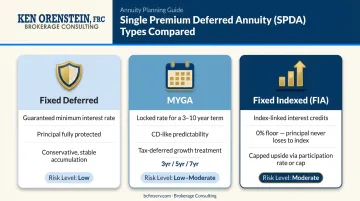
Fixed SPDAs credit a guaranteed minimum interest rate for the life of the contract. The insurer may declare a higher current rate annually, but the floor is written into the contract — your balance cannot decline. This makes fixed deferred annuities the most conservative SPDA type.
The trade-off is inflation risk — if the guaranteed rate runs below prevailing inflation over a long accumulation period, purchasing power erodes even as the nominal balance grows.
Multi-Year Guarantee Annuities (MYGAs)
MYGAs are a sub-type of fixed SPDAs that lock in a specific rate for a defined term — typically 3 to 10 years. At the end of the term, you can renew, roll over to another contract, or annuitize.
MYGAs are popular with near-retirees who want CD-like predictability but with tax-deferred treatment and potentially better rates than comparable bank instruments. As a benchmark, Annuity.org's rate table (updated November 2025) reported example MYGA rates of 6.00% for 3-year terms, 6.45% for 5-year terms, and 6.90% for 7-year terms — rates should always be confirmed at the time of purchase as they fluctuate with market conditions.
Because MYGA rates vary significantly by carrier and term length, comparing contracts before committing matters. Ken Orenstein works with multiple carriers to evaluate options across 3-, 5-, 7-, and 10-year terms, matching clients with the most competitive rate for their specific timeline.
Fixed Indexed Annuities (FIAs)
FIAs tie credited interest to the performance of an external market index — commonly the S&P 500 — with a floor of 0%. You can't lose principal in a down market, but your upside is limited by a cap, participation rate, or spread.
If the index gains 12% and your cap is 6%, your annuity is credited 6%. If the index drops 15%, your credit is 0% — not a loss.
This is not a direct market investment. As FINRA notes, the annuity does not hold index shares; the formula-based crediting method simply uses index performance as a reference point. Because these crediting mechanics — participation rates, caps, spreads, and methods like annual point-to-point or monthly average — vary widely by carrier, the contract structure matters as much as the rate. Ken Orenstein's FIA consultations compare these variables across multiple carriers to identify the structure best suited to each client's income timeline and risk profile.
Key Benefits of a Single Premium Deferred Annuity
Tax-Deferred Compound Growth
Inside an SPDA, earnings are not taxed annually. The full balance compounds throughout the accumulation period — unlike a taxable savings account or CD where interest is taxed each year, reducing the amount available to compound.
Fidelity's published illustration (variable annuity, labeled for tax-deferral mechanics only) shows that $100,000 growing at 6% annually over 20 years in a tax-deferred vehicle produced an after-tax value of $239,436, compared to $222,508 in a taxable account at a 32% marginal tax rate. The advantage narrows at shorter timeframes but becomes meaningful in the 10–15 year accumulation windows common with SPDAs.
Principal Protection (Fixed and FIA Contracts)
Fixed and fixed indexed SPDAs protect your original deposit from market losses. For pre-retirees who have spent decades accumulating wealth, a major drawdown with limited time to recover is a serious risk — one that principal-protected contracts specifically address.
Flexible Payout Options
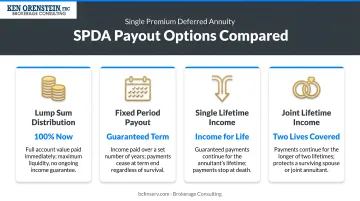
When the income phase begins, you're not locked into one approach. Options typically include:
- Withdraw the full accumulated value as a lump sum
- Receive payments for a defined number of years (period-certain)
- Draw lifetime income that cannot be outlived, regardless of how long you live
- Cover a spouse under joint-life income, with survivor percentage options
No Annual Contribution Limits
Non-qualified SPDAs carry no IRS-imposed annual contribution cap. By comparison, contribution limits for other tax-advantaged accounts in 2024 include:
- IRA: $7,000/year ($8,000 if age 50+)
- 401(k) / TSP: $23,000 in elective deferrals ($30,500 with catch-up)
This makes SPDAs a practical option for placing large lump sums — pension rollovers, asset sale proceeds, inheritances — particularly for individuals who have already maxed out other tax-advantaged accounts.
Death Benefit and Estate Planning
Most SPDA contracts include a death benefit that lets you name a beneficiary to receive the remaining contract value — or a guaranteed minimum — if you die before or during the payout phase.
When a beneficiary is named, proceeds typically bypass probate and transfer directly. Without a named beneficiary, the annuity may pass through your estate and face probate delays.
Potential Drawbacks to Consider
Surrender Charges and Limited Liquidity
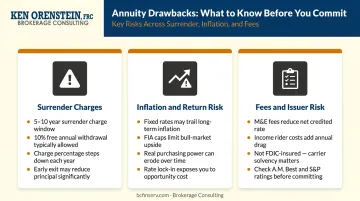
SPDAs impose a surrender charge schedule that typically runs 5–10 years. Withdrawals beyond the free-withdrawal allowance during this period trigger a penalty — a percentage of the amount withdrawn that generally steps down each year. Most contracts allow up to 10% of the contract value annually without surrender charges, per NAIC guidelines.
For qualified contracts, the IRS also imposes a 10% early withdrawal penalty on distributions taken before age 59½ under IRC Section 72(q) for non-qualified contracts and Section 72(t) for qualified plans — on top of ordinary income taxes. If there's any chance you'll need those funds before the surrender period ends, a shorter-term MYGA or a laddered strategy may be a better fit.
Potential for Lower Returns vs. Market Investments
Fixed SPDAs offer stability, but in strong equity markets they may significantly underperform a diversified portfolio. Inflation risk is real: if a fixed rate runs below the prevailing inflation rate, purchasing power declines even as the nominal balance grows. FIAs address this partially through index-linked upside, but capped growth still limits the benefit in strong bull markets.
Fees and Issuer Risk
Fixed and MYGA contracts generally carry minimal fees. FIAs and contracts with optional riders are a different story. Common charges to review include:
- Administrative fees
- Mortality and expense (M&E) fees
- Income or benefit rider costs
These can meaningfully reduce net returns, so compare them against the rider's actual value before signing.
SPDAs are not FDIC-insured. As the NAIC states, the guarantees are only as strong as the issuing insurance company's claims-paying ability. Ratings from A.M. Best, Moody's, S&P, and Fitch give you a concrete read on carrier stability — checking them before committing is essential, not optional. Ken Orenstein reviews carrier financial-strength ratings alongside rate comparisons as a standard part of every annuity recommendation.
How Single Premium Deferred Annuities Are Taxed
Qualified vs. Non-Qualified SPDAs
Tax treatment depends on how the contract was funded:
- Qualified SPDA (pre-tax dollars — 401(k) rollover, traditional IRA): The entire distribution — principal and earnings — is taxed as ordinary income when withdrawn. No basis has been established.
- Non-qualified SPDA (after-tax dollars): Only the earnings portion is taxed upon withdrawal. The original premium was already taxed, so only the growth is treated as income using the exclusion ratio method under IRS Publication 939.
For most SPDA buyers rolling over a TSP or 401(k), the qualified scenario applies — meaning 100% of distributions will be taxable.
Tax-Deferral and Bracket Strategy
The strategic advantage is timing. During peak earning years, deferring tax on growth means those earnings compound fully. At retirement — when most people drop into a lower marginal bracket — distributions are taxed at a more favorable rate.
Keep in mind that annuity earnings are taxed at ordinary income rates, not capital gains rates, upon distribution. For non-qualified contracts, this matters: assets held outside an annuity might otherwise qualify for lower long-term capital gains rates.
Early Withdrawal Penalty and RMDs
Two rules govern the timing of withdrawals:
- Early withdrawal penalty: Withdrawals before age 59½ trigger a 10% IRS penalty on the taxable portion, on top of ordinary income taxes.
- Required Minimum Distributions (RMDs): For qualified SPDAs held inside IRAs, RMDs must begin by April 1 of the year following the year you reach age 73, per SECURE 2.0 Act rules effective January 1, 2023.
Who Should Consider an SPDA?
The Ideal Candidate
The SPDA tends to fit pre-retirees who check most of these boxes:
- In their late 40s to early 60s
- Have a meaningful lump sum available ($250,000 or more is common)
- Won't need immediate access to those funds
- Want tax-deferred growth without market risk
- Are looking for predictable, guaranteed income at retirement
Federal employees separating from government service are a particularly well-suited group. TSP participants can request withdrawals or distributions after leaving federal service, and a lump-sum TSP rollover into an SPDA can create a structured income bridge that complements a FERS pension and Social Security.
When an SPDA May NOT Be the Right Fit
- You may need the money within 5–10 years — surrender charges make early access costly
- You're in your 30s or 40s with a high risk tolerance and decades to invest — equity exposure may serve you better
- No emergency savings outside the contract — tying up your only liquid assets in a surrender-period annuity is a risk, not a strategy
Getting the Evaluation Right
Whether an SPDA belongs in your retirement plan depends on your complete financial picture: income sources, tax situation, risk tolerance, timeline, and liquidity needs.
Ken Orenstein at Brokerage Consulting specializes in helping federal employees, seniors, and pre-retirees build low-cost, tax-efficient retirement plans — including assessing whether an SPDA fits their specific situation. No-cost consultations are available by phone, virtually, or in-person. Reach Ken at (888) 315-3608 or request a consultation at bcfinserv.com/request-a-quote.
Frequently Asked Questions
What is a single premium deferred annuity?
An SPDA is an annuity purchased with a single lump-sum payment to an insurance company. The money grows tax-deferred during an accumulation period, and income payments begin at a future date the buyer selects — either a defined period, lifetime, or joint-life option.
What are the advantages of a single premium deferred annuity?
Key advantages include tax-deferred compound growth, principal protection on fixed and FIA contracts, no IRS-imposed annual contribution limits, flexible payout structures including lifetime income, and an optional death benefit for named beneficiaries.
Who is most likely to benefit from a single premium deferred annuity?
Pre-retirees in their 50s or early 60s who have a large lump sum — from a retirement plan rollover, inheritance, or asset sale — and won't need to access those funds for several years. Ideal for those prioritizing predictable, guaranteed retirement income without direct market exposure.
Is a single premium deferred annuity a good investment?
It depends on your goals. SPDAs work well for those prioritizing safety, tax-deferred growth, and reliable income. They're less suitable for those seeking higher growth potential or needing near-term liquidity. A no-cost suitability consultation can clarify whether one fits your situation.
How are single premium deferred annuities taxed?
Qualified SPDAs (funded with pre-tax dollars) are fully taxable at ordinary income rates upon distribution; non-qualified SPDAs (after-tax dollars) are taxed only on the earnings portion. In both cases, withdrawals before age 59½ carry a 10% IRS early withdrawal penalty.
What happens to a deferred annuity when the owner dies?
Most SPDA contracts pay a death benefit to the named beneficiary — typically the remaining contract value or a guaranteed minimum — which generally bypasses probate. If the owner dies during the payout phase, the outcome depends on the payout structure selected: joint-life, period-certain, or lifetime-only.