
The numbers reflect growing mainstream acceptance. According to LIMRA's 2024 annuity sales data, FIA sales reached $126.9 billion in 2024 — a 32% jump from 2023, outpacing total annuity market growth of 13%.
Despite that adoption, how FIAs actually work — the mechanics of interest crediting, the limits on your upside, and what "principal protection" really means — is rarely explained clearly. This guide breaks it down.
Key Takeaways
- A Fixed Index Annuity links interest credits to a market index (like the S&P 500) without putting your money directly in the market
- Your principal is protected from index drops, though gains are subject to caps, participation rates, or spreads
- Once interest is credited at the end of each term, it's locked in and can't be taken back by future index losses
- FIAs are long-term contracts with surrender periods of typically 5–10 years; early withdrawals can trigger charges
- Best suited for risk-averse pre-retirees or retirees who want growth potential with a guaranteed floor
What Is a Fixed Index Annuity?
A Fixed Index Annuity is a tax-deferred insurance contract issued by an insurance company. Interest credits are linked to the performance of an external market index — but your money is never actually invested in that index.
FINRA describes indexed annuities as sitting between traditional fixed annuities and variable annuities. Fixed annuities offer guaranteed but modest returns. Variable annuities offer full market participation, along with full market risk. FIAs occupy the middle: growth potential with a contractual floor that prevents index losses from reducing your account value.
Understanding that positioning helps clarify what an FIA actually is — and what it isn't.
What an FIA Is — and Isn't
A few clarifications worth stating directly:
- Not a market investment — your premium goes into the insurer's general account, not a stock portfolio
- Not FDIC-insured — the guarantee is backed by the claims-paying ability of the issuing insurance company, per NAIC guidance
- Not a full index return — credited interest is limited by contract features (more on those below)
- Not regulated as a security — FIAs are regulated by state insurance commissioners, not the SEC or FINRA
Premium and Contract Structures
FIAs come in two funding arrangements:
- Single-premium: funded with one lump sum at contract inception
- Flexible-premium: funded with multiple contributions over time
Contract terms typically run 5 to 10+ years, with surrender charges applying during that period.
How Does a Fixed Index Annuity Work?
An FIA operates across two distinct phases: accumulation and distribution. Understanding each phase — and how interest gets credited in between — is the key to evaluating whether an FIA fits your situation.
The Accumulation Phase
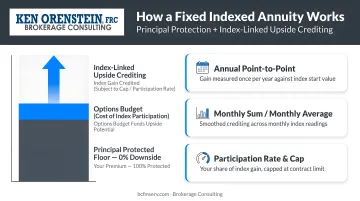
When you fund an FIA, your premium goes into the insurance company's general account. The insurer then does two things with it:
- Invests the bulk in fixed income instruments (Treasuries, bonds) to protect your principal
- Buys index options with a portion of the earned interest, funding whatever upside credit you may receive
This options-budget structure, documented by the American Academy of Actuaries, is why FIAs can offer index-linked growth without putting principal at risk. The options either pay off (when the index rises) or expire worthless (when it falls) — but your core deposit remains intact either way.
Two things to know during accumulation:
- Most contracts allow up to 10% annual withdrawal without penalty, per NAIC guidance
- The IRS imposes a 10% penalty on withdrawals before age 59½, separate from any surrender charges
How Interest Gets Credited
At the end of each contract term — typically one year — the insurer measures how the chosen index performed between two points (called annual point-to-point). Then it applies the contract's crediting rules:
- Index up → interest is credited based on contract terms (cap, participation rate, or spread)
- Index flat or down → no interest is credited, but no value is lost
The annual reset feature matters here. Once interest is credited, it's locked in permanently. A bad market year after a good one can't claw back what you've already earned — a meaningful advantage over direct market exposure for anyone prioritizing downside protection.
Most FIA contracts offer multiple index options — commonly the S&P 500, Russell 2000, and MSCI EAFE — along with proprietary volatility-controlled indexes. Crediting methods vary by contract and carrier — the three most common are annual point-to-point, monthly average, and monthly sum. Because each method performs differently depending on market conditions, comparing them across carriers before committing is one of the more consequential steps in the selection process. Ken Orenstein at Brokerage Consulting does exactly that, reviewing crediting structures across competing carriers to align each contract with a client's income and growth goals.
The Distribution Phase
Once the accumulation phase winds down, the contract gives you flexibility in how you draw income:
- Annuitize — convert the contract value into a guaranteed income stream
- Systematic withdrawals — take scheduled payments while the account continues to grow
- Activate a lifetime income rider — if you added one at issue, this guarantees income regardless of account balance
Tax note: Distributions are taxed as ordinary income since growth was tax-deferred. For non-qualified annuities, only the earnings portion — not your original principal — is taxable on withdrawal.
Key Features That Shape Your FIA Returns
Three contract mechanics determine how much of the index's upside you actually receive. Each one can significantly change your credited interest — even when the underlying index performs identically.
Cap Rates
A cap is the maximum interest rate the insurer will credit in a given term, regardless of how high the index climbs.
Example: If the index gains 14% but your cap is 6%, you receive 6%.
Caps vary by carrier and contract, and — critically — insurers can adjust them at renewal. The American Academy of Actuaries notes that non-guaranteed elements like caps are typically reviewed and adjusted regularly, sometimes monthly.
Participation Rates
A participation rate determines what percentage of the index gain gets credited to your account.
Example: If the index gains 10% and your participation rate is 70%, you receive 7%.
Kiplinger has cited participation rates ranging from 60% (with principal protection on S&P 500 mirroring strategies) to 100–150% on certain one-year strategies. These figures vary significantly by contract — which is why side-by-side comparisons across carriers matter.
Spreads
A spread (sometimes called a margin or asset fee) subtracts a fixed percentage from the index gain before crediting.
Example: With a 2% spread and a 9% index gain, you receive 7%.
Spreads are typically an alternative to caps, not an addition to them. Some contracts use a cap. Some use a spread. Some use a participation rate. Rarely all three at once.
Here's how the three limiters compare at a glance:
| Mechanism | How It Works | Example (10% Index Gain) |
|---|---|---|
| Cap Rate | Maximum interest credited | Cap of 6% → you receive 6% |
| Participation Rate | % of index gain credited | 70% rate → you receive 7% |
| Spread | Fixed % subtracted from gain | 2% spread → you receive 8% |
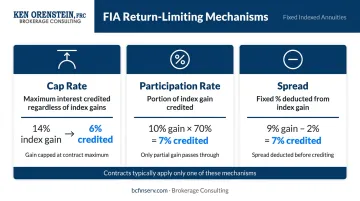
Each contract uses one of these — occasionally two — so identifying which applies is the first step in any carrier comparison.
The 0% Floor
The floor is the contractual guarantee that your account value cannot decrease due to index performance. NAIC confirms that FIA interest is guaranteed never to be less than 0%, even when the index declines.
You accept limited upside — through caps, participation rates, or spreads — in exchange for the guarantee that down markets don't touch your principal. For retirees or pre-retirees who can't afford a sequence-of-returns hit, that protection often justifies the ceiling.
Pros and Cons of Fixed Index Annuities
Advantages
- Principal protection — the 0% floor means market crashes don't reduce your account value
- Tax-deferred growth — no annual tax drag on credited interest during accumulation
- Locked-in gains — the annual reset prevents future losses from erasing past credits
- Lifetime income options — riders can guarantee income you can't outlive
- Death benefit provisions — many contracts pass remaining value to named beneficiaries
Each of those advantages comes with a corresponding trade-off worth understanding before you commit.
Limitations
- Capped upside — strong market years are partially forfeited; you won't keep a 25% S&P 500 gain
- Illiquidity — surrender periods of 5–10 years mean early exits cost money
- Rider fees — Kiplinger reports guaranteed lifetime withdrawal benefit riders typically cost 0.95% to 1.25% of the income base annually, which reduces net returns
- Renewal risk — caps and participation rates can be adjusted at renewal, affecting future performance
- Complexity — contract terms vary enough across carriers that meaningful comparison requires a side-by-side carrier review
The Right Frame for FIAs
FIAs occupy a specific role in a retirement strategy: a protected income foundation that keeps floor income intact regardless of what markets do. They work alongside a diversified portfolio, not instead of one.
Who Is a Good Fit for a Fixed Index Annuity?
The Core Profile
The strongest FIA candidates share a few characteristics:
- Within 5–15 years of retirement, or already retired
- Have accumulated savings they cannot afford to expose to market loss
- Don't need immediate liquidity from those funds
- Want growth potential above what fixed products offer, without equity risk
At Brokerage Consulting, Ken Orenstein typically works with clients who have a minimum of $250,000 available as an investable lump sum — enough capital to make FIA placement meaningful within a broader income strategy.
Federal Employees as Strong Candidates
Federal employees with FERS pensions are often particularly well-positioned for FIAs. FERS already provides a guaranteed income base through its three-component structure: the Basic Benefit Plan, Social Security, and the Thrift Savings Plan. An FIA adds a third layer of protection — tax-deferred growth on additional savings without layering in market risk on top of an already-anchored retirement base.
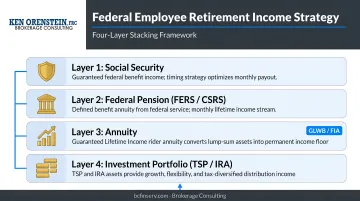
Ken Orenstein's practice frames retirement income across four layers: Social Security, pension income (FERS), guaranteed lifetime income via annuities, and discretionary portfolio assets. For federal employees, the FIA typically fills Layer 3, supplementing the FERS base rather than competing with it.
Who Should Look Elsewhere
FIAs are less suitable for:
- Younger investors with long time horizons who can absorb equity risk for higher long-term returns
- Anyone who may need access to those funds before the surrender period ends
- Clients whose income needs are already fully covered by pension and Social Security
Determining fit means looking at the full picture: existing income sources, timeline, liquidity needs, and tax situation. No single factor decides it. That's why Ken Orenstein's no-cost initial consultation walks through each of these variables, including side-by-side FIA comparisons across multiple carriers on caps, participation rates, income rider growth rates, and surrender schedules. Phone, virtual, and in-person options are available.
Frequently Asked Questions
What does FIA mean in finance?
In personal finance and retirement planning, FIA stands for Fixed Index Annuity — an insurance contract where interest credits are linked to a market index without direct market investment. In other contexts, FIA also refers to the Futures Industry Association, so the distinction matters depending on the conversation.
Is an FIA better than a 401(k)?
They serve different purposes. A 401(k) is an employer-sponsored retirement savings account with pre-tax contributions and direct market investment. An FIA is an insurance product with index-linked credits and a principal protection floor. Many retirees use both as complementary tools — the 401(k) for long-term growth, the FIA for protected income.
How much does a $500,000 fixed annuity pay per month?
For a $500,000 immediate fixed annuity at age 65, Kiplinger cited June 2024 quotes of approximately $3,120/month for a male and $2,950/month for a female. FIA payouts differ — they depend on accumulated contract value, crediting history, and any income rider terms, not a fixed payout schedule.
What is the $1,000-a-month rule for retirees?
This rule holds that every $1,000/month of desired retirement income requires roughly $240,000 in savings, based on a 5% withdrawal rate — so $4,000/month implies about $960,000. Treat it as a starting estimate; actual needs vary with retirement length, expenses, and other income sources.
Can you lose money in a fixed index annuity?
You cannot lose principal due to index performance — the 0% floor guarantees that. However, surrender charges for early withdrawals and annual fees from optional income riders can reduce your account value. Understanding all contract costs before purchasing is essential.
Are fixed index annuities a good fit for federal employees?
Often yes. Federal employees with FERS pensions already have a guaranteed income foundation, making an FIA a natural complement for tax-deferred growth on additional savings without adding market risk. Whether it fits depends on your retirement timeline, existing assets, and income needs — a federal retirement advisor like Ken Orenstein can map your FERS pension, TSP balance, and savings into a coordinated income strategy.