
This article explains what the GMIR is, how it functions across fixed and fixed-index annuities, what regulatory frameworks govern it, and how it affects real retirement planning decisions.
Key Takeaways
- The GMIR is the lowest interest rate an insurance company is contractually obligated to credit to your annuity — it cannot go lower, ever
- Actual credited rates are typically higher than the GMIR; the floor only activates when market conditions deteriorate
- Most relevant for fixed annuities and fixed-index annuities; the rate is set at contract issuance and locked in
- Under NAIC Model Law #805, state-mandated floors range from 0.15% to a 3% cap; some states (e.g., Washington) set a 1% minimum
- State floors vary — always check your contract's specific GMIR, not just the national model
- Conservative investors, near-retirees, and anyone prioritizing principal protection benefit most from understanding this guarantee
What Is the Guaranteed Minimum Interest Rate?
The GMIR is a contractual provision written into fixed and fixed-index annuity contracts. It specifies the absolute lowest rate of interest the insurance company will credit to your annuity's value — no matter what markets do, what renewal rates drop to, or what economic conditions prevail.
Per the NAIC Buyer's Guide for Fixed Deferred Annuities, a fixed deferred annuity guarantees that your money will earn at least a minimum interest rate, defined plainly as "the lowest rate the annuity can earn." That rate is stated in your contract and disclosure, and it cannot change while you own the annuity.
Three Rates You Need to Distinguish
Many annuity buyers conflate three different rates — which can lead to accepting a low renewal rate without realizing you had a contractual floor to fall back on:
- GMIR (Guaranteed Minimum Interest Rate): The contractual floor, fixed at issuance, cannot go lower
- Initial declared rate: The rate actually credited when you purchase — often higher than the GMIR
- Renewal rate: The rate credited after the initial term — can fluctuate, but never below the GMIR
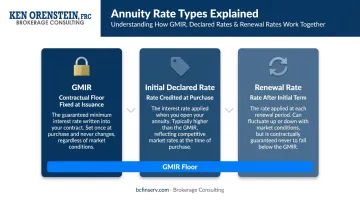
The GMIR is a design parameter, not a market response. It doesn't move when the Fed cuts rates or when bond yields compress. That stability is precisely what state regulators set out to protect.
The Regulatory Foundation
State insurance departments set minimum floors on what insurers can offer as a GMIR. NAIC Model Law #805 — the Standard Nonforfeiture Law for Individual Deferred Annuities — governs minimum nonforfeiture values nationally. The current formula is tied to the 5-year Constant Maturity Treasury rate, reduced by 125 basis points, capped at 3% and floored at 0.15%.
States can — and do — vary from this model. Washington uses the same 87.5% premium base but explicitly requires the resulting rate be "not less than one percent." Missouri's statute uses older language with different thresholds for single versus flexible-consideration contracts (those accepting ongoing premium payments). There is no single national floor; the GMIR on your contract depends on where you live.
Where to Find the GMIR in Your Contract
Look for it in:
- The contract's declaration or specification page
- The policy schedule or guaranteed elements disclosure
- The annuity illustration provided before purchase
NAIC Model Regulation #245 requires that "guaranteed elements" — including credited interest rates, benefits, values, and formula elements — be disclosed at issuance. Before signing, confirm the GMIR is explicitly stated.
How the Guaranteed Minimum Interest Rate Works
The insurer is legally obligated to credit at least the GMIR each year for the life of the contract. That obligation holds regardless of renewal rate changes, zero index returns, or broader economic downturns.
How GMIR Applies Across Annuity Types
Fixed Annuities and MYGAs
Declared rates are guaranteed for a fixed term — 3, 5, 7, or 10 years depending on the product. At renewal, the insurer sets a new declared rate. That rate can drop significantly from the original, particularly in a falling-rate environment. But it cannot go below the GMIR.
Athene's disclosure language is a clean example of standard contract practice: renewal interest rates are declared on each contract anniversary and are "not below the contract's guaranteed minimum interest rate." For MYGA holders at renewal, this matters. If your 5-year MYGA was paying 4.5% and renews into a 2.3% environment, the GMIR is the hard stop on how far the rate can fall.
Fixed-Index Annuities (FIAs)
Index-linked interest is determined through caps, participation rates, spreads, or combinations — not a fixed credited rate. In a year when the index returns zero (or negative), the insurer credits zero index interest, not a loss.
The GMIR operates on a separate track: it applies to the minimum guaranteed value, not the full account value. Per SEC Release 33-8996, the insurer "guarantees a minimum value, typically a percentage of purchase payments accumulated at a specified interest rate." These are distinct mechanisms: the GMIR sets the floor; caps and participation rates determine the ceiling.
Variable Annuities
GMIR provisions in variable annuities are structurally different. Guarantees are typically embedded in living benefit riders rather than the base contract. The three common rider types are:
- GLWBs (Guaranteed Lifetime Withdrawal Benefits)
- GMIBs (Guaranteed Minimum Income Benefits)
- GMABs (Guaranteed Minimum Accumulation Benefits)
Each carries separate fees and mechanics. If you hold a variable annuity, distinguish carefully between what the base contract guarantees and what the rider guarantees.
The Minimum Guaranteed Value (MGV) and the 87.5% Base
The GMIR doesn't apply to 100% of your premium in the way some buyers assume. Under current NAIC Model Law #805, the minimum nonforfeiture calculation uses 87.5% of gross considerations (premiums paid) as the net-consideration base. That 87.5% accumulates at the GMIR rate, compounded annually.
The SEC has noted that at 87.5% compounded at 1%, it takes approximately 13 years for the minimum guaranteed value to reach 100% of purchase payments. At contract maturity, death, or annuitization, the policyholder receives the highest of three values:
- The accumulation value (actual account growth)
- The cash surrender value (what you'd receive if you exit early)
- The minimum guaranteed value (87.5% of premium × GMIR, compounded)
That "highest of three" structure is the real consumer protection. In a prolonged low-return environment, the minimum guaranteed value can become the operative payout.

Guaranteed Minimum Interest Rate: Examples in Action
The following scenarios show how a GMIR functions in two common annuity types — a fixed-index annuity and a MYGA at renewal. Each illustrates the floor in practice, not just in theory.
Scenario 1 — Fixed-Index Annuity With a 1% GMIR
You invest $100,000 in a fixed-index annuity. The contract applies a 1% GMIR to 87.5% of premium ($87,500) as the minimum guaranteed value base.
| Year | Index Credits | Minimum Guaranteed Value (87.5% × 1% compounded) | Accumulation Value |
|---|---|---|---|
| 1 | 0% | $88,375 | $100,000 |
| 2 | 0% | $89,259 | $100,000 |
| 3 | 7% (capped at 5%) | $90,151 | $105,000 |
In years 1 and 2, the index returns nothing. The accumulation value holds at $100,000 — no loss, but no gain. Meanwhile, the minimum guaranteed value compounds steadily via the GMIR.
In year 3, the index delivers gains above the floor, pushing the accumulation value to $105,000. At maturity, you receive whichever value is higher.
If the index had returned zero for all 10 years of the contract, you'd receive the minimum guaranteed value at maturity — principal protected, GMIR credited throughout.
Scenario 2 — MYGA at Renewal
You purchase a 5-year MYGA at 4.5% — the initial declared rate. When the term ends, prevailing rates have dropped. The insurer sets the renewal rate at 2.8%. Your contract carries a 2% GMIR.
- Without the GMIR, the insurer could theoretically renew at any rate
- With the GMIR, 2% is the hard floor — the renewal rate cannot go lower
- That 0.8% difference (2.8% vs. 2%) is modest in percentage terms, but on $200,000 over 5 years, the gap is meaningful
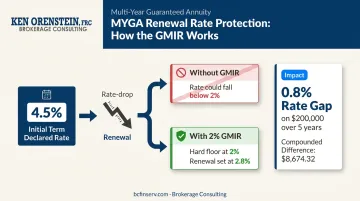
Most MYGA contracts include a surrender-free window at renewal — so if the declared rate falls short of your expectations, you're not locked in. Knowing the GMIR before purchase tells you the worst-case renewal scenario.
Typical GMIR Ranges and What Determines Them
The common shorthand — "GMIRs typically run 1% to 3%" — is partially accurate but oversimplified. Current NAIC Model Law #805 supports a range from 0.15% to 3% depending on the CMT-based formula. Some states, like Washington, hold a 1% floor. Older contracts from higher-rate periods may carry GMIRs of 3% or higher as legacy provisions.
Factors That Influence Where Insurers Set the GMIR
Interest rate environment: Insurers set GMIRs relative to prevailing rates when the product is designed. The NAIC's analysis of life insurer economics shows that the spread between what insurers earn on their general-account portfolios and what they credit to policyholders compressed to 0.63% in 2020 from 1.1% in 2018. When spreads compress, new products tend to carry lower GMIRs — the insurer has less room to absorb the obligation.
General account investment portfolio: Life insurer general accounts held nearly $7 trillion in financial assets at year-end 2024, according to Federal Reserve data, including $3.58 trillion in debt securities and $1.96 trillion in annuity reserves. Bonds represent 67.6% of invested assets per NAIC 2024 data.
The GMIR promise is only as durable as the insurer's bond portfolio. That's why AM Best and similar ratings matter when evaluating whether a guarantee will actually hold over a 10- or 20-year contract term.
State regulatory minimums: Each state insurance department sets a floor below which GMIRs cannot go, independent of what the insurer might prefer. The floors differ — Washington requires 1%, while the current NAIC model allows as low as 0.15%:
- Check your state insurance department's website for the current minimum
- Confirm the floor before signing, not after
- Compare across contract options if you're in a state with a higher floor (it limits how low carriers can go)
Common Misconceptions About Guaranteed Minimum Interest Rates
Misconception 1: "The GMIR is what I'll earn"
The GMIR is the worst-case floor, not the expected return. In most market conditions, declared or index-credited rates run higher. The GMIR only becomes the operative rate when conditions deteriorate enough to push returns to the floor. A 2020 LIMRA/Secure Retirement Institute study found that consumers who correctly answered at least 7 of 10 annuity-knowledge questions viewed annuities positively at a rate of 63%, versus only 27% among less-informed consumers — understanding the distinction between floor and expected return is part of that knowledge gap.
Misconception 2: A higher GMIR automatically makes a product better
Products with higher GMIRs frequently offset that obligation with lower initial declared rates, tighter caps, or narrower participation rates. The III's analysis of equity-indexed annuities confirms this: smaller guaranteed minimums can leave more premium available for index options, while higher market rates free more funds for higher caps.
Comparing GMIRs across products without reviewing the full contract terms is like judging a loan only by its floor payment.
Misconception 3: The GMIR and the declared rate are interchangeable
They are not, and conflating them causes real planning errors. The declared rate is what you're earning today; it can change at renewal. The GMIR is the contractual hard stop below which the declared rate can never fall. Treating them as equivalent leads to overconfidence in how much an annuity will accumulate over time.
That distinction matters when evaluating real contracts. An independent advisor can identify where the GMIR sits relative to the cap, participation rate, and surrender structure — not just compare headline rates. Ken Orenstein at Brokerage Consulting reviews full contract terms across multiple carriers to surface exactly these differences.
Frequently Asked Questions
What is the guaranteed minimum interest rate?
The GMIR is the lowest interest rate an insurance company is contractually obligated to credit to a fixed or fixed-index annuity. It cannot change while you own the policy and is disclosed in the contract and accompanying disclosure documents at issuance.
How is the GMIR set by insurance companies?
Insurers set the GMIR based on the prevailing interest rate environment, the yield on their general-account investment portfolio, and state regulatory minimums. Once set at issuance, it is fixed for the life of the policy.
Does the GMIR change after I buy an annuity?
No — for the vast majority of contracts, the GMIR is locked in at issuance and does not change. Some products allow adjustments at renewal within regulatory limits. Confirm the specific terms before purchase.
What is the difference between the GMIR and the declared rate?
The declared rate is what is actually credited to your annuity each period; it can rise or fall at renewal. The GMIR is the contractual floor the declared rate can never breach. In favorable conditions, the declared rate will be higher than the GMIR.
Does the GMIR apply to all annuity types?
GMIR provisions are most common in fixed and fixed-index annuities, where they protect the minimum guaranteed value. Variable annuities handle guarantees differently, typically through living benefit riders (such as GLWBs and GMIBs) with their own mechanics and fees rather than a base-contract GMIR.
Is a higher GMIR always better?
Not automatically. A higher GMIR often comes paired with lower declared rates, tighter caps, or narrower participation rates. Review the full contract terms — including the surrender schedule and fee structure — before treating the GMIR as the deciding factor.