
Introduction
When most people hear "simple annuity," they assume it means a basic or entry-level product. That's a reasonable assumption — but it's wrong. In finance, "simple" has a precise meaning that fundamentally changes how payments and interest interact, and confusing the two can lead to real miscalculations.
A simple annuity has one defining feature: the payment frequency and the interest compounding frequency match. Monthly payments with monthly compounding. Quarterly contributions with quarterly compounding. That alignment is what makes the math tractable, and it's the key distinction from a general annuity.
LIMRA's 2025 data shows U.S. retail annuity sales hit a record $464.1 billion in 2025, reflecting growing demand from retirees seeking predictable income. Understanding how these products are structured — starting with the simple annuity — directly shapes how you evaluate payout amounts, interest accumulation, and income reliability.
This article covers:
- What a simple annuity is and how it's defined
- How it differs from general and ordinary annuities
- How payments are calculated
- When it fits into a retirement income strategy
Key Takeaways
- A simple annuity = payment frequency matches compounding frequency (e.g., monthly payments, monthly compounding)
- "Simple" describes math alignment, not product complexity or risk level
- Four types exist: ordinary simple, simple due, ordinary general, and general due — distinguished by payment timing and compounding alignment
- Present value tells you what lump sum you need today; future value tells you what regular contributions will grow to
- For retirement income, simple annuity structures underpin SPIAs and fixed annuities: predictable, guaranteed payments with transparent math
What Is a Simple Annuity?
The Defining Feature
A simple annuity is a series of equal, periodic payments where the payment frequency and the interest compounding frequency are identical. Monthly payments with monthly compounding, or annual payments with annual compounding. That alignment in frequency — not the payment size or product type — is what makes an annuity "simple."
Before layering in that qualifier, it helps to understand what an annuity is at its core: a contract involving a continuous stream of equal periodic payments made over a fixed time frame, from one party to another, to fulfill a financial obligation.
Every legitimate annuity shares four characteristics:
- Continuous — no breaks or skipped periods
- Equal — the same dollar amount every time
- Periodic — payments occur at the same interval throughout
- Time-bound — exists within a defined start and end date
If any one of these is missing, the arrangement isn't a single annuity by definition.
What "Simple" Actually Means
"Simple" refers to how interest compounds — at the exact same rate payments are made. That alignment simplifies the underlying calculations significantly.
Compare that to a general annuity, where payment frequency and compounding frequency differ. A general annuity requires an extra conversion step to align frequencies before you can calculate accurate payment amounts.
Practical example:
| Product | Payment Frequency | Compounding Frequency | Annuity Type |
|---|---|---|---|
| Car loan | Monthly | Monthly | Simple annuity |
| Canadian mortgage | Monthly | Semi-annual | General annuity |
| Quarterly savings plan | Quarterly | Quarterly | Simple annuity |
The table above shows why this distinction matters in practice: the same monthly payment cadence can classify an annuity differently depending entirely on how the interest compounds.
Simple Annuity vs. General Annuity vs. Ordinary Annuity
These terms address two completely separate dimensions of annuity structure. Conflating them is one of the most common sources of confusion.
The Two Dimensions
Dimension 1 — Frequency alignment:
- Simple = payment and compounding frequencies match
- General = payment and compounding frequencies differ
Dimension 2 — Payment timing:
- Ordinary = payments made at the end of each period
- Due = payments made at the beginning of each period
Combining these creates four distinct annuity types.
The Four Types
| Type | Payment Timing | Frequencies | Common Example |
|---|---|---|---|
| Ordinary Simple Annuity | End of period | Match | Car loans, personal loans, fixed-income products |
| Simple Annuity Due | Beginning of period | Match | Car leases (first payment collected at signing) |
| Ordinary General Annuity | End of period | Differ | US mortgages (monthly payments, semi-annual compounding) |
| General Annuity Due | Beginning of period | Differ | Certain structured finance products |
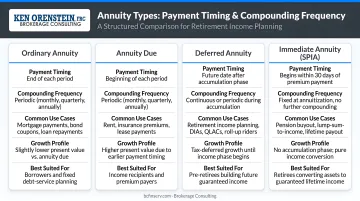
The ordinary simple annuity is the most common structure in everyday transactions — the first payment arrives one full interval after the annuity starts. The general annuity variants require a frequency conversion before standard formulas apply.
A Common Misconception
In casual conversation, people often use "annuity" or "simple annuity" to describe an income annuity product from an insurance company — a SPIA, a fixed annuity, that kind of thing. That usage is understandable, but it conflates a product category with a mathematical structure.
This article uses the technical definition: simple annuity describes the relationship between payment frequency and compounding frequency. The same foundational math governs fixed income annuity products — knowing whether your SPIA or fixed annuity uses matched or mismatched frequencies directly affects how you compare payout amounts across carriers.
How a Simple Annuity Works: Present Value and Future Value
Present Value — What You Need Today
Present value (PV) answers: How much do I need to invest as a lump sum today to fund a specific series of future payments, given a known interest rate?
For retirees, this is the crucial planning question. If you want $1,500 per month for 20 years, PV tells you exactly how large a lump sum is required to sustain that income at a given rate.
The key variables:
- R = payment amount per period
- i = periodic interest rate (annual rate ÷ compounding periods per year)
- n = total number of payment periods (years × payment frequency)
In a simple annuity, because payment and compounding frequencies match, you use these variables directly without any conversion step.
Future Value — What You'll Accumulate
Future value (FV) answers: If I contribute a fixed amount each period, how much will I have at a future date given compounding interest?
This is the accumulation question — relevant for savers building toward retirement rather than drawing down from it.
Both concepts become concrete quickly with real numbers. Here's how each plays out using a 5% annual rate, compounded monthly.
A Worked Example
Scenario 1: Accumulation (FV). Say you want to save monthly to reach $250,000 over 20 years at a 5% annual interest rate, compounded monthly.
Here's the logic:
- Periodic interest rate (i) = 5% ÷ 12 = 0.4167% per month
- Number of periods (n) = 20 × 12 = 240 months
- Target future value = $250,000
Working through the future value formula for an ordinary simple annuity, the required monthly contribution comes to approximately $611 per month.
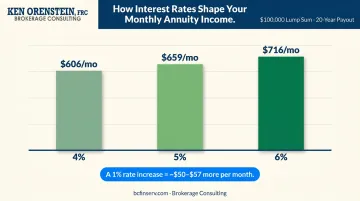
Scenario 2: Income conversion (PV). Flip the problem: if you have a $100,000 lump sum and want to convert it to monthly income over 20 years at 5% annual compounding monthly, the present value formula yields approximately $659 per month.
That monthly figure shifts noticeably as rates move. For the same $100,000 lump sum over 20 years:
| Annual Rate | Estimated Monthly Income |
|---|---|
| 4% | ~$606/month |
| 5% | ~$659/month |
| 6% | ~$716/month |
A one-point rate difference produces roughly $50–$57 more per month — which compounds to tens of thousands of dollars over a 20-year payout. This is why locking in an annuity when rates are favorable can have a lasting impact on your retirement income.
Real-World Examples of Simple Annuities
Products That Qualify as Simple Annuities
You likely interact with simple annuity structures already without calling them that:
- Monthly car loans with monthly compounding interest
- Monthly installment savings plans where contributions and compounding align
- Quarterly investment contributions to an account compounding quarterly
- Fixed immediate annuities (SPIAs) where monthly income payments align with monthly compounding
Products That Don't Qualify
These are often called "annuities" colloquially but don't meet the simple annuity definition:
- Traditional mortgages — monthly payments, semi-annual compounding (general annuity)
- Variable payment plans — payments aren't equal, violating the periodicity requirement
- Irregular payment schedules — breaks the "continuous and periodic" rule
The distinction matters because applying simple annuity formulas to a general annuity structure produces incorrect payment calculations. You'd either over- or underestimate what a given lump sum generates.
Connection to Retirement Income Products
That qualification framework applies directly to real products. When an insurance company offers a fixed immediate annuity paying monthly income with interest compounded monthly, it functions as a simple annuity structurally. The same formulas apply, which means you can use simple annuity math to verify payment projections, compare carriers, and spot miscalculations before signing anything.
Simple Annuities as a Retirement Income Tool
Why Predictability Matters
The core appeal of a simple annuity in retirement is that nothing varies. Payment amount, frequency, and interest rate are all fixed and aligned. There's no market exposure, no sequence-of-returns risk, and no surprises.
For retirees covering essential monthly expenses — housing, utilities, healthcare — that predictability has real value. You know exactly what's coming in, every period, for the duration.
How It Works in Practice
For federal employees and pre-retirees transitioning off a paycheck, the present value framework answers a concrete planning question: How much principal do I need to generate my target monthly income?
Here's how the math works in practice:
- Total essential expenses: $3,000/month
- Social Security income: $1,400/month
- Guaranteed income gap: $1,600/month
Working backward through the present value calculation tells you the exact lump sum required at the current interest rate — a concrete number you can act on.
Ken Orenstein at Brokerage Consulting runs these calculations as part of personalized retirement income planning for federal employees and retirees. The practice covers SPIAs and Fixed Annuities that convert lump sums — from TSP rollovers, pension buyouts, or inheritances — into reliable monthly income.
Interest Rate Timing
The rate environment at purchase directly shapes your income. Higher rates mean a given lump sum generates more monthly income — or a smaller lump sum hits the same monthly target. Lower rates compress output for a fixed principal.
This makes the rate environment at purchase a critical variable. Consulting with an advisor who can compare income amounts across multiple carriers, as Ken Orenstein does operating as an independent broker, locks in competitive rates when you're ready to convert.
Pros and Limitations of Simple Annuities
Pros and Limitations of Simple Annuities
Simple annuities offer meaningful structural advantages — but they come with real trade-offs worth understanding before committing capital.
Key Benefits
- Payment predictability — fixed income every period, no market-dependent variability
- Straightforward math: matched payment and compounding frequencies make pricing transparent and easy to verify
- Long-term income planning — present value formulas let you calculate precisely what principal generates a target income
- Longevity protection — structured as lifetime income, eliminates the risk of outliving your savings
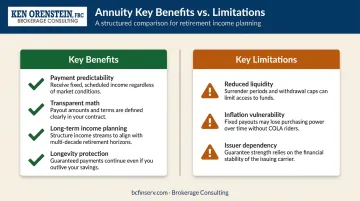
Those strengths come with limitations that matter just as much in the planning process.
Key Limitations
- Reduced liquidity — once a lump sum is committed to an immediate annuity, that capital is generally inaccessible
- Inflation vulnerability — fixed payments lose purchasing power over long time horizons; a $1,600/month payment in 2025 buys less in 2045. Inflation-adjusted riders exist but typically reduce the starting payment
- Issuer dependency — guarantees are only as strong as the insurer's claims-paying ability. Brokerage Consulting evaluates carriers using A.M. Best, Moody's, S&P, and Fitch ratings before making recommendations, since rating downgrades can signal real risk to guaranteed income streams
Frequently Asked Questions
What is a simple annuity?
A simple annuity is a series of equal, periodic payments where the payment frequency and the interest compounding frequency are the same — for example, monthly payments with monthly compounding. That alignment is the defining feature, and it makes the math more straightforward than a general annuity, where the two frequencies differ.
How much would a $100,000 simple annuity pay per month?
At a 5% annual rate compounded monthly over 20 years, a $100,000 present value generates approximately $659 per month. At 6%, that rises to roughly $716/month; at 4%, it drops to about $606/month. Higher rates or shorter payout terms produce larger monthly payments for the same lump sum.
What is the difference between a simple annuity and a general annuity?
In a simple annuity, the payment frequency matches the compounding frequency (monthly payments, monthly compounding). In a general annuity, they differ — monthly payments with semi-annual compounding, for example. General annuities require an additional frequency conversion step before payment amounts can be accurately calculated.
Is a simple annuity the same as an ordinary annuity?
No. These terms describe different characteristics. "Ordinary" refers to when payments are made (at the end of each period). "Simple" refers to whether payment and compounding frequencies match. An ordinary simple annuity combines both: end-of-period payments with matching frequencies.
Are simple annuity payments taxable?
Tax treatment depends on funding source. Qualified annuity payments (funded with pre-tax dollars, such as a traditional IRA or 401(k) rollover) are generally fully taxable as ordinary income. Non-qualified annuity payments are only partially taxable, covering the earnings portion via an exclusion ratio. Consult a tax advisor for your specific situation.
What factors affect simple annuity payment amounts?
Three variables drive the calculation: the principal amount (present value), the periodic interest rate, and the number of payment periods. A higher rate or fewer periods produces larger individual payments, which is why locking in during higher-rate environments can work in your favor.