
Introduction
Most variable annuity buyers focus on subaccount performance, surrender charges, or income rider payout rates. The mortality and expense (M&E) charge — the fee that funds the contract's core insurance guarantees — is rarely examined closely, even though it often represents the largest single annual cost in the contract.
The M&E charge is not a generic insurance surcharge. It reflects actuarially priced exposure to two distinct risks: dying sooner than expected, and outliving your account balance by years or decades.
How that risk is defined and priced determines whether a variable annuity fits your retirement plan — and whether the cost aligns with the guarantees you're actually receiving.
This article covers:
- What mortality risk means in precise actuarial terms
- How the M&E charge is structured and disclosed in your contract
- What factors drive costs higher or lower across different products
Key Takeaways
- Mortality risk is the insurer's exposure to paying a guaranteed death benefit when the account value drops below the guaranteed floor
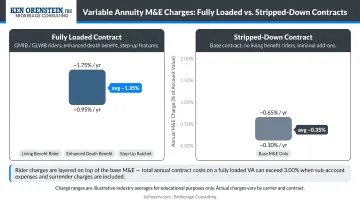
- The M&E charge typically runs 0.40% to 1.75% annually (averaging near 1.25%) and offsets both mortality risk and longevity risk
- Because the M&E charge is a percentage of subaccount value, the dollar amount fluctuates with market performance
- Richer guarantees (stepped-up death benefits, lifetime income riders) push charges toward the upper range; stripped-down contracts sit near the lower end
- Your real annual cost includes M&E charges, rider fees, and subaccount expense ratios — not the M&E charge alone
What Mortality Risk Represents in a Variable Annuity
Mortality risk, in the context of a variable annuity, is the probability that the insurer must pay a guaranteed death benefit at a point when the account value is lower than that guarantee — creating a net payout that exceeds what the account can fund.
That's the core definition. But the M&E charge actually covers three distinct exposures:
- Mortality risk — the policyholder dies earlier than actuarial projections, and the death benefit exceeds current account value
- Longevity risk — the policyholder lives longer than projected, requiring the insurer to continue guaranteed income payments beyond what the account can support
- Expense risk — the insurer's guarantee that contract administrative costs will not increase over the life of the contract
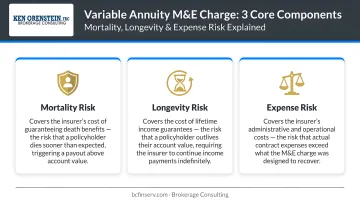
As the SEC's Variable Annuities guide explains, the M&E charge compensates the insurer for all insurance risks assumed under the contract — not just death benefit exposure. This three-part coverage structure is why every contract holder pays the M&E charge, regardless of whether they ever trigger the death benefit.
Why Variable Annuities Create Dynamic Mortality Exposure
Variable annuities carry a structural feature that makes mortality risk more complex than in fixed products: the account value fluctuates with market performance.
When markets fall, the gap between the guaranteed death benefit floor and the actual account value widens. The insurer's net exposure grows. When markets rise and the account value climbs above the guaranteed benefit, that gap narrows, and so does the insurer's risk. This dynamic has no equivalent in fixed annuity contracts.
Factors That Influence Mortality Risk in the Real World
Insurers build mortality assumptions from standardized tables, then adjust for the specific demographics and behavior patterns of their actual contract holders.
Regulatory Mortality Tables and Real-World Adjustments
The foundation for variable annuity reserve calculations is the 2012 IAM Basic Table, which NAIC's Valuation Manual (VM-21) designates as the mortality basis for variable annuity reserve calculations. Insurers start there, then apply adjustments based on the specific demographics and guarantee profiles of their contract holders.
Anti-Selection and Rider Type
Milliman's 2021 Variable Annuity Mortality Study found the lowest mortality rates among contracts with guaranteed lifetime income features — including GLWB and guaranteed minimum withdrawal benefits. Policyholders who elect lifetime income riders tend to be healthier and longer-lived than those who select death-benefit-only contracts.
This creates a pattern actuaries call anti-selection: the people most likely to benefit from a longevity guarantee are precisely the ones who purchase it. Anti-selection directly shapes how insurers price and reserve for lifetime income riders.
External Shocks to Baseline Assumptions
Real-world mortality can diverge sharply from baseline projections. That same 2021 study documented that VA contract mortality increased by 11% in 2020 due to COVID-19. The spike affected insurer reserve requirements and showed how external shocks can overwhelm actuarial assumptions built from years of pre-pandemic data.
The M&E Charge: Typical Range and Cost Structure
The M&E charge is expressed as an annualized percentage of the variable annuity's subaccount value, deducted continuously or periodically from the separate account assets.
Nominal Range Under Standard Conditions
Both the SEC and Morningstar's annuity glossary cite approximately 1.25% annually as a common benchmark. Morningstar's typical range is 1.00% to 1.50% of subaccount average daily net assets.
Contract-level EDGAR filings show the spread in practice:
| Contract Type | M&E / Base Contract Fee |
|---|---|
| Advisory/no-frills (Monument Advisor) | 0.24% annually |
| Advisory class (Equitable Investment Edge ADV) | 0.20% M&E |
| Standard contract (Thrivent VA Account A) | 1.25% M&E |
| Standard class (Equitable Investment Edge Select) | 0.75% M&E |
M&E charges apply only to funds held in the variable subaccounts. Amounts allocated to the insurer's fixed account or general account options are not subject to this charge, so the effective fee exposure depends partly on how the contract is invested.
What Drives Costs Higher
Contracts with richer guarantees carry higher M&E charges because each additional guarantee layer increases the insurer's actuarial exposure:
- Stepped-up death benefits that lock in market gains create a higher guaranteed floor, expanding potential NAR (net amount at risk)
- Guaranteed minimum income benefits (GMIB) add longevity exposure that must be reserved for separately
- Guaranteed lifetime withdrawal benefits (GLWB) at favorable payout rates increase the probability of sustained payments beyond account value
- Older applicants at issue carry shorter life expectancy at the time of contract, increasing the probability of near-term payout
When none of those guarantee layers are present, costs drop considerably. Stripped-down variable annuities without living benefit riders can carry M&E charges in the 0.20%–0.60% range — a direct result of removing the guarantees that push charges higher on fully loaded contracts.
How M&E Charges Are Disclosed and Compared
The SEC's Form N-4, effective September 23, 2024, requires M&E charges to appear in the prospectus Fee Table under Base Contract Expenses. The Key Information table must also disclose minimum and maximum base contract fees when fees vary by contract class.
Where to Find the Charge in the Prospectus
Look for the "Annual Contract Expenses" or "Base Contract Expenses" table, where the M&E charge appears separately from:
- Underlying subaccount expense ratios (investment management fees)
- Administrative fees
- Optional rider charges
The total cost of ownership is the sum of all layers. Treating the M&E charge as the only relevant fee significantly understates the true annual cost of a variable annuity contract.
What the Contractual Maximum Means
NAIC Variable Annuity Model Regulation MO-250 requires that asset charges used to determine net investment return cannot exceed the rate stated in the contract. The M&E charge you pay today is fixed at the rate in your contract — but insurers retain the right to charge up to the maximum rate disclosed in the prospectus.
Before purchasing, verify the gap between the current charge and the contractual maximum. A contract showing a 1.25% current charge with a 1.75% maximum carries real repricing risk if the insurer moves toward that ceiling.
Comparing Contracts Meaningfully
That repricing risk is one reason comparing contracts on M&E rate alone misses the point. A 1.25% charge on a contract with a robust lifetime income guarantee and a stepped-up death benefit may represent better value than a 0.80% charge on a bare-bones contract — or it may not, depending on your retirement income situation.
Ken Orenstein at Brokerage Consulting walks clients through this side-by-side evaluation, mapping each contract's fee structure to actual income projections — including GLWB rider comparisons and 1035 exchange implications — so the numbers reflect your retirement picture, not just the prospectus.
Common Misunderstandings About Variable Annuity Mortality Charges
"The M&E charge is just a life insurance fee"
The most persistent misconception. In reality, the M&E charge funds three distinct guarantees — not just a death payout. Every annuity holder benefits from the M&E charge, not only those who trigger the death benefit:
- Death benefit — provides a guaranteed minimum payout to beneficiaries
- Lifetime income floor — ensures income payments can't be reduced by insurer expenses
- Expense guarantee — caps the insurer's ability to raise contract costs over time
"The M&E charge is a fixed cost"
Because the charge is assessed as a percentage of account value, the dollar amount is not fixed. In a strong bull market, a policyholder pays more in absolute dollars for the same contractual coverage than they would after a significant market decline. For long-term cost projections, this variability matters more than the stated percentage alone.
"Comparing M&E charges to mutual fund expense ratios is apples-to-apples"
It isn't. A mutual fund expense ratio pays for portfolio management — nothing more. The M&E charge pays for actuarially priced risk transfer: the three guarantees covered above, underwritten by the insurance carrier and held contractually regardless of market conditions. FINRA's variable annuity resources describe the product as a hybrid with both securities and insurance components. Those insurance components carry insurance pricing that has no equivalent in pure investment management overhead — comparing the two numbers directly misleads more than it informs.
Frequently Asked Questions
Does a variable annuity have mortality risk?
Yes — on the insurer's side. The insurer accepts mortality risk in exchange for the M&E charge, guaranteeing a death benefit even if the account value falls below the guaranteed amount. This risk transfer is a core feature of the contract, not an incidental cost.
How safe are variable annuities?
Variable annuities are not FDIC-insured and carry investment risk within subaccounts. The insurance guarantees are backed by the issuing insurer's financial strength. Most states provide guaranty association protections of up to $250,000 in present value of annuity benefits, though coverage terms vary by state.
What is a typical mortality and expense risk charge in a variable annuity?
M&E charges typically range from approximately 0.40% to 1.75% annually, with a common benchmark near 1.25%. The specific rate depends on which guarantees are included and the policyholder's age at issue.
Can the M&E charge in my variable annuity increase over time?
The current rate is fixed as specified in your contract. However, the insurer may charge up to the maximum rate disclosed in the prospectus. Review the gap between current and maximum rates before purchasing, as a wide gap represents a risk worth understanding.
How does a living benefit rider affect the mortality risk charge?
Living benefit riders such as GLWB or GMIB increase the insurer's longevity exposure and typically result in higher total contract charges. Some insurers price these as a separate rider fee on top of the M&E charge; others bundle costs differently — always evaluate the total annual charge, not individual line items.
Is the M&E charge worth paying?
The answer depends on your total fee cost, time horizon, risk tolerance, and existing income sources such as Social Security or a pension. Compare all charge layers — M&E, rider fees, and subaccount expenses — against the income and death benefit guarantees being purchased.