
There's no universal answer here. The right age depends on which type of annuity you're buying, what you need it to do, and where your other income sources stand. This article breaks down the timing factors that actually matter.
Key Takeaways
- The prime buying window for most people falls between ages 50 and 70
- Buying in your 50s or early 60s lets a deferred annuity compound tax-deferred longer before income begins
- Delaying to your late 60s or early 70s produces higher monthly payments, since shorter life expectancy raises your payout rate
- The IRS 59½ rule creates a practical floor: withdrawals before that age trigger income tax plus a 10% penalty
- Annuity type matters as much as age — immediate, deferred, fixed, indexed, and variable products suit different life stages
Why Age Matters When Buying an Annuity
Payout Rates Are Tied to Life Expectancy
Insurers price annuity income using actuarial life expectancy tables. The older you are when income starts, the fewer years they expect to pay — which translates directly into larger monthly checks for the same premium.
The difference is significant. According to Annuity.org's April 2026 SPIA payout table, a $100,000 single-premium immediate annuity pays:
| Age | Male (Single Life) | Female (Single Life) |
|---|---|---|
| 60 | $530/month | $503/month |
| 65 | $625/month | $590/month |
| 70 | $750/month | $703/month |
| 75 | $920/month | $859/month |
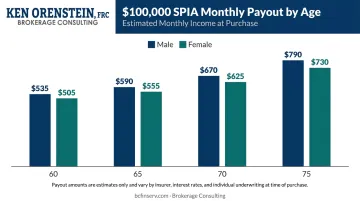
Note: Actual payouts vary by insurer, state, and prevailing interest rates.
A 75-year-old receives $390 more per month than a 60-year-old for the exact same premium. Over 10 years, that gap adds up to more than $46,000 in additional income.
The IRS 59½ Rule
IRS Topic 410 is unambiguous: withdrawals from a tax-deferred annuity before age 59½ trigger ordinary income taxes plus a 10% federal penalty on the taxable portion. This rule effectively makes annuities a poor fit for anyone who might need access to those funds in the near term.
Insurer Age Limits
Most carriers impose maximum issue ages on their products. Once you pass a certain threshold, which varies by product type and insurer, some options simply disappear. Deferred annuities with long accumulation phases are typically unavailable past age 80 or 85 depending on the carrier. At that point, your realistic choices narrow to immediate income products — SPIAs being the most accessible.
Best Age to Buy an Annuity Based on Your Retirement Goals
The "best age" isn't a single number. It shifts based on what you need the annuity to accomplish.
Ages 45–55: Accumulation and Early Positioning
Deferred annuities (MYGAs and fixed indexed annuities) can make sense for buyers in this range who are focused on tax-deferred accumulation. But two constraints deserve serious attention before committing:
- The 59½ rule: Any premature withdrawal before 59½ carries the 10% IRS penalty, which creates real risk if your financial situation changes
- Surrender periods: Deferred annuities carry surrender charge schedules that decline gradually over a set period ; buying at 48 with a long surrender schedule means limited access to those funds for years
Buyers in this stage generally still have decades to benefit from market growth in other vehicles. An annuity is rarely the first priority here. The question isn't just whether an annuity can work at this age ; it's whether other tax-advantaged accounts (IRA, 401(k), TSP for federal employees) are already maximized first.
Ages 55–65: Transition and Pre-Retirement Positioning
This is the most active planning window. LIMRA's Income Annuity Buyers Metrics shows that deferred income annuity (DIA) buyers averaged 60.2 years old with a 7.5-year average deferral period , meaning they bought around 60 with plans to start income around 67–68. Variable annuity buyers with guaranteed living benefit (GLB) riders averaged 62.5 years old.
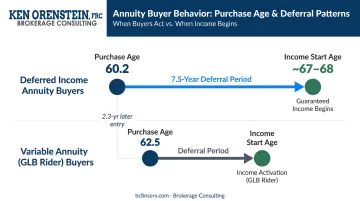
One common approach: buy a fixed or indexed annuity with an income rider, set the income start date at 70 or later, and let the guaranteed income base grow during the deferral period.
Federal employees face a different calculation. FERS and CSRS pensions already provide a guaranteed lifetime income base, with Social Security as a second layer of guaranteed income. That existing coverage reduces the urgency to buy an annuity primarily for income replacement. For federal clients in this age range, annuities more often serve supplemental roles:
- Supplemental income : filling the gap between pension plus Social Security and actual spending needs
- Principal protection : deploying TSP balances into a fixed indexed annuity to avoid sequence-of-returns risk while maintaining some growth potential
- Legacy planning : structuring death benefits for a surviving spouse or heirs
Ken Orenstein at Brokerage Consulting, who authored The Informed Fed: A Survival Guide to Federal Employee Benefits and specializes in federal retirement planning, works through exactly this integration , evaluating where an annuity fits alongside FERS/CSRS rather than treating it as the primary income source.
Ages 65–75: Income Conversion and Guaranteed Payout Focus
For most retirees, this is when annuity income actually starts. Immediate annuities (SPIAs) become the primary product, or income gets activated from a deferred contract purchased years earlier. LIMRA's data shows SPIA buyers averaged 71.7 years old , clustering squarely in the early-to-mid 70s.
The payout advantage is clear from the table above: waiting from 65 to 70 increases monthly income by $125/month (male) for the same $100,000 premium. Waiting to 75 adds another $170.
The 70–75 window is widely cited as the sweet spot for starting lifetime income. Payouts are meaningfully higher, most buyers have a clearer picture of their health and longevity, and Social Security claiming decisions (which also reward delay) are typically settled by then.
Delaying past 75 does create trade-offs. Fewer product types remain available, and a shorter expected payout horizon changes the cost-benefit math , particularly for deferred products that need time to accumulate.
Signs You're Ready to Buy an Annuity
Before purchasing, three readiness indicators should align:
- Income gap exists. Your projected Social Security, pension, and other guaranteed income falls short of essential monthly expenses — and you want to close that gap with something contractual, not market-dependent.
- Volatility is no longer acceptable. You're close to or in retirement, and a market downturn would meaningfully disrupt your income plan. The runway to recover simply isn't there anymore.
- Liquidity is already covered. You hold sufficient liquid assets outside the annuity for emergencies and near-term needs — locking up these funds won't compromise your financial flexibility.
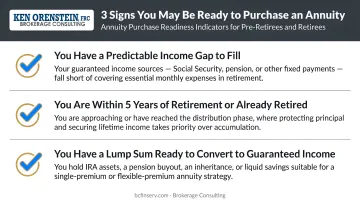
Not every box needs to be perfectly checked before taking the next step — sometimes the gray areas matter most. If you're working through whether these conditions apply to your situation, a no-cost initial consultation with Ken Orenstein at Brokerage Consulting — available by phone, virtually, or in person — is a practical starting point. Ken specializes in guaranteed lifetime income planning for federal employees, pre-retirees, and retirees. He can help confirm whether the readiness indicators are met for your specific income picture.
When You Should NOT Buy an Annuity
Annuities don't fit every situation. Avoid them if:
- You're under 50 with a long investment horizon. IRS penalty exposure, surrender charges, and capped upside make most annuity products a poor trade when you have decades to compound wealth in equities.
- Your floor income already covers essential spending. If Social Security plus a FERS/CSRS pension fully funds your baseline expenses, adding an annuity creates illiquidity without meaningful benefit. In the flooring strategy, if Layers 1 and 2 already cover the floor, Layer 3 isn't needed.
- You anticipate needing the funds during the surrender period. Withdrawing early from a deferred annuity triggers surrender charges and tax penalties at the same time — a costly combination if major expenses like healthcare or a housing transition are on the horizon.
What Happens If You Buy at the Wrong Age
Buying Too Young
Over-committing to an annuity before 50 creates two distinct costs:
- Early-withdrawal penalty: Any funds needed before 59½ face the IRS 10% early-distribution penalty on top of ordinary income taxes.
- Opportunity cost: Capital locked into an annuity over a 20–30 year horizon misses the higher compounding potential of equities during your peak accumulation years.
Each year you stay in the wrong product, both costs grow quietly in the background.
Buying Too Late
The opposite timing mistake carries its own costs. Waiting past a carrier's maximum issue age means deferred annuity options may disappear entirely, leaving only immediate income products.
When the expected payout period shrinks, the underlying math shifts — the income guarantee that made the product attractive becomes harder to justify economically. Tax-deferred growth that could have accumulated inside a deferred contract over several years is simply gone.
Frequently Asked Questions
Should I buy an annuity at 47 to retire at 55?
Retiring from federal service at 55 doesn't automatically exempt annuity withdrawals from the IRS 59½ penalty — that rule applies to standalone annuity contracts regardless of employment status. Certain annuitization elections can avoid the penalty, but the product structure and payout method must be set up correctly. At 47, consult an advisor before committing to any deferred product.
What do financial experts like Dave Ramsey and Warren Buffett say about annuities?
Both are generally skeptical: Ramsey has raised concerns about fees and commissions, and Buffett prefers low-cost index funds. Fee-based retirement specialists draw a clearer line — annuities provide contractual income guarantees that investments are not designed to replicate, regardless of cost.
Is 60 too early to buy an annuity?
No. Buying a deferred annuity at 60 and activating income at 70 is a well-established strategy. LIMRA data shows DIA buyers average 60.2 years old with roughly 7.5 years of deferral. The product choice and income start date matter more than the purchase age alone.
What is the 59½ rule and how does it affect annuity purchases?
The IRS imposes a 10% penalty on withdrawals from tax-deferred annuities before age 59½, on top of ordinary income taxes owed on the taxable portion. This rule makes annuities impractical as liquid assets for anyone who may need the funds before that threshold.
At what age should you NOT buy an annuity?
Most financial professionals advise against annuity purchases before age 50 — liquidity needs, penalty exposure, and stronger long-term growth alternatives make the case hard to justify. Exceptions exist for early retirement planning or specific asset protection goals.
How does age affect monthly annuity payout amounts?
Older buyers receive larger monthly payments for the same premium because insurers use life expectancy tables to price income. On a $100,000 premium, a 75-year-old starting a SPIA receives $920/month versus $750/month for a 70-year-old, because the insurer expects to pay for fewer years.