
Retirement planning isn't a single decision. It spans lifestyle choices, income strategy, healthcare funding, Social Security timing, and tax management. Getting clarity on the right questions—before you need the answers—creates time to course-correct, optimize savings, and avoid costly last-minute choices.
This guide organizes those questions into clear categories so you know where to focus. And while these questions apply broadly, certain groups face added complexity. Federal employees navigating FERS, TSP, and FEHB coordination face decisions that are often irrevocable—making structured planning especially critical.
Key Takeaways
- Retirement planning spans lifestyle, income, healthcare, Social Security, and legacy — and each area requires its own set of decisions.
- The most urgent decisions involve when to retire, where your income will come from, how healthcare gets funded, when to claim Social Security, and how to manage taxes on withdrawals.
- Answering these early gives you time to adjust while you still have flexibility to change course.
- A retirement advisor can map all of these decisions together so nothing falls through the cracks.
Questions About Your Retirement Vision, Lifestyle, and Timing
Start With the "What," Not the "When"
Most people frame retirement planning around a target date. But the more useful question is: what does your retirement actually look like? Travel, relocation, part-time work, hobbies that cost money, hobbies that don't—these lifestyle choices directly determine the financial targets you need to hit.
Getting that clarity early matters. EBRI's 2024 Spending in Retirement Survey found that average retiree life satisfaction fell to 6.9 out of 10 in 2024, down from 7.4 in 2020, and lifestyle alignment with expectations dropped from 6.8 to 5.7 over the same period.
That gap points to one thing: retirement readiness isn't only financial. Emotional readiness, a sense of purpose, and identity outside of work all shape whether retirement feels satisfying.
The Timing Decision Has Real Trade-Offs
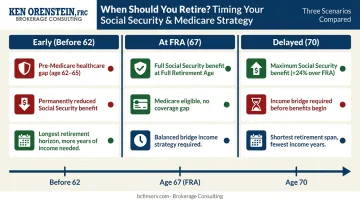
Retiring before 62 means you'll likely be funding healthcare out of pocket until Medicare eligibility at 65. It can also permanently reduce your Social Security benefit. Waiting until 70, on the other hand, maximizes Social Security but requires another income source to bridge the gap.
Many workers expect a phased transition. EBRI data shows 50% of workers in 2025 expected to ease into retirement gradually—but only 27% of retirees reported actually doing so, with 73% stopping full-time work abruptly. If a gradual transition is part of your plan, build in a contingency for an abrupt exit—because the odds favor it.
Plan for a Long Retirement
According to SSA's 2022 period life tables, a 65-year-old man can expect to live approximately 17.5 more years; a woman, roughly 20 more years. Many retirees will live well into their 80s or 90s. A retirement spanning 25 to 30 years demands a different financial approach than one lasting 10 to 15—particularly around portfolio longevity, inflation, and healthcare cost escalation.
Key questions to answer before retiring:
- What will I do with my time, and what will that cost annually?
- Do I have a plan to cover health insurance before Medicare at 65?
- Have I pressure-tested my plan against living to 90 or beyond?
- Am I emotionally ready to leave my professional identity behind?
Questions About Savings, Income Sources, and Monthly Expenses
How Much Is Actually Enough?
The 4% rule is the most common starting point: withdraw 4% of your portfolio annually, and it should last 30 years. That means needing roughly $2.5 million to generate $100,000 per year. But Morningstar's 2026 retirement income research now estimates the safe starting withdrawal rate at 3.9% for a 30-year horizon—meaning a $100,000 annual need requires closer to $2.56 million. These rules of thumb are useful starting points, not guarantees. A personalized plan pressure-tested for your specific timeline matters more than any formula.
Map Every Income Stream
Before retirement, identify every source of income you'll have:
- Social Security — timing this decision permanently affects your monthly benefit
- Pensions — including FERS or CSRS for federal employees
- TSP, 401(k), or IRA withdrawals — traditional vs. Roth account taxation differs significantly
- Rental or investment income — if applicable
- Part-time or consulting work — if you plan a phased transition
SSA data shows that Social Security provides 50% or more of income for 37% of retired men and 42% of retired women. That level of dependency on a single income source carries real risk. Diversifying across multiple streams reduces exposure to any one account or program.
Catch-Up Contributions for Those 50 and Older
Knowing your income sources is only half the picture—what you accumulate before retirement matters just as much. If you're behind on savings, the IRS allows additional contributions beyond standard limits:
| Account Type | 2025 Standard Limit | Age 50+ Catch-Up | Ages 60–63 (SECURE 2.0) |
|---|---|---|---|
| 401(k) / TSP / 403(b) | $23,500 | +$7,500 | +$11,250 |
| IRA (Traditional/Roth) | $7,000 | +$1,000 | N/A |
Federal employees in their early 60s have a meaningful catch-up window. The SECURE 2.0 provision for ages 60–63 allows contributions up to $34,750 into TSP in a single year.
Pension Lump Sum vs. Monthly Annuity
How you accumulate savings matters, but so does how you convert them to income. The lump sum vs. annuity decision is one of the most consequential choices retirees face:
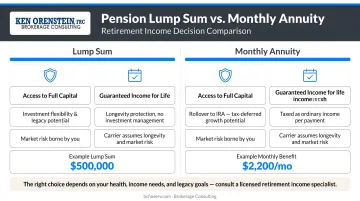
- Lump sum — offers flexibility and investment potential, but requires discipline and carries longevity risk (outliving the money)
- Monthly annuity — provides predictable income for life, removing longevity risk; the trade-off is less flexibility and no growth potential
Over 20 years, a $500,000 lump sum invested at a 6% average return could outperform a $2,500/month annuity—but only if markets cooperate and withdrawals stay disciplined. The annuity wins when markets underperform or longevity runs longer than average.
Federal employees navigating FERS pension elections, survivor benefit options, or TSP distribution strategies benefit most from advice that treats these decisions as interconnected. Ken Orenstein at Brokerage Consulting is a Federal Retirement Consultant (FRC) and author of The Informed Fed: A Survival Guide to Federal Employee Benefits, a practical resource covering TSP distribution strategies, FERS retirement timing, and pension election trade-offs.
Questions About When and How to Claim Social Security
The Claiming Age Spectrum
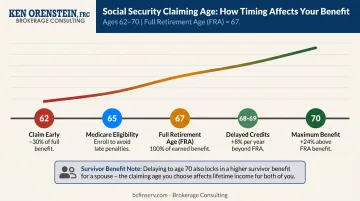
Social Security benefits can start as early as 62, but claiming early comes at a permanent cost. For anyone born in 1960 or later, full retirement age (FRA) is 67. Claiming at 62 reduces your monthly benefit by 30%. Waiting past FRA earns 8% more per year of delay, up to age 70.
That decision is permanent. A benefit reduced at 62 stays reduced for life, affecting not just your income but your spouse's survivor benefit.
Claiming trends have shifted. In 1995, over 49% of men and 55% of women claimed at 62. By 2023, those figures dropped to 22.5% of men and 24.0% of women—a sign that more retirees understand what early claiming actually costs over a lifetime.
Spousal and Survivor Benefits Require Coordination
The benefit rules for married couples involve two separate calculations worth understanding:
- Spousal benefit: A spouse can receive up to 50% of the worker's primary insurance amount at their own FRA
- Survivor benefit: If the higher-earning spouse dies first, the surviving spouse can receive up to 100% of that benefit—but only if they wait until their own FRA to claim
These figures aren't independent. The higher-earning spouse's claiming age directly shapes the survivor income the lower-earning spouse may rely on for years or decades, which is why couples need to coordinate rather than decide separately.
Working While Claiming Before FRA
If you claim Social Security before FRA and continue working, the earnings test applies. In 2025, benefits are temporarily reduced $1 for every $2 earned above $23,400. For those reaching FRA in 2025, the threshold is $62,160. These reductions are not permanent—SSA recalculates your benefit at FRA—but they can meaningfully reduce your monthly checks for several years before that adjustment kicks in.
Questions About Healthcare and Medicare in Retirement
Healthcare is one of the most consistently underestimated retirement expenses. Fidelity's 2025 estimate puts the average out-of-pocket healthcare cost for a retired couple at $345,000—and that excludes long-term care.
Understanding Your Medicare Options
Medicare eligibility begins at 65. Your Initial Enrollment Period runs 7 months—starting 3 months before your birthday month and ending 3 months after. Missing it without qualifying coverage triggers late-enrollment penalties.
The main coverage paths:
- Original Medicare (Parts A & B) — hospital and outpatient coverage with cost-sharing gaps
- Medicare Advantage (Part C) — private plan alternative that bundles Parts A, B, and D, with network restrictions
- Medigap (Supplement) — bridges Original Medicare's cost-sharing gaps; Plan G is the most common choice for new enrollees
Federal employees with FEHB coverage face a more complex decision: whether to keep FEHB alongside Medicare, coordinate the two, or transition to a different plan entirely.
These trade-offs involve premium costs, provider access, and how the two systems interact. An independent Medicare broker — one representing multiple carriers — can be especially useful here, since the right answer varies by individual situation.
Long-Term Care: The Gap Medicare Won't Fill
Medicare covers skilled nursing facility care for up to 100 days per benefit period—and does not cover long-term custodial care at all. Yet according to the Administration for Community Living, someone turning 65 today has nearly a 70% chance of needing some form of long-term care, with women averaging 3.7 years of need and men 2.2 years.
Current costs from CareScout's 2025 data: assisted living runs $6,200/month, a semi-private nursing home room $9,581/month, and a private room $10,798/month.
Options for funding long-term care:
- Traditional long-term care insurance
- Hybrid life/LTC policies
- Self-funding through dedicated savings or annuity income
The Pre-65 Coverage Gap
Retiring before 65 leaves a coverage gap that catches many people off guard. Options include COBRA continuation (at up to 102% of the full premium), marketplace plans, or a spouse's employer plan.
The gap is often expensive and underplanned. Federal employees face an added wrinkle: FEHB coverage can be lost entirely if continuous enrollment isn't maintained into retirement.
Questions About Taxes, Withdrawals, and Protecting Your Legacy
How Different Accounts Are Taxed
Withdrawal strategy has a significant impact on how much of your money you actually keep:
- Traditional 401(k)/IRA/TSP withdrawals — taxed as ordinary income
- Roth IRA/Roth TSP withdrawals — tax-free if rules are met
- Social Security — up to 85% may be taxable depending on combined income
Social Security taxation is based on combined income (half of SS benefits + all other income). For single filers, up to 50% of benefits becomes taxable above $25,000, and up to 85% above $34,000. For married filers, the thresholds are $32,000 and $44,000 respectively.
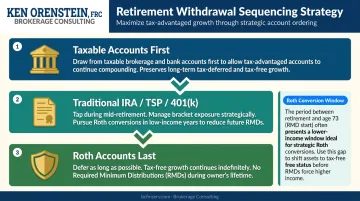
Sequencing withdrawals across account types can lower your lifetime tax bill considerably. A common approach:
- Draw from taxable accounts first
- Defer Roth withdrawals as long as possible
- Convert traditional IRA funds to Roth in low-income years
Required Minimum Distributions
The IRS requires minimum annual withdrawals from traditional retirement accounts beginning at age 73 under current law (rising to 75 in 2033 under SECURE 2.0). Missing an RMD triggers a 25% excise tax on the shortfall—reduced to 10% if corrected within two years.
RMD planning should start well before age 73. Large traditional IRA balances can push you into higher tax brackets and increase Social Security taxation once distributions begin. Strategic Roth conversions during low-income years — the gap between retirement and age 73 — can meaningfully reduce that future pressure.
Estate Planning Is Not Just for the Wealthy
Basic estate planning applies to anyone with a retirement account or real property:
- Will — directs asset distribution at death
- Beneficiary designations — must be kept current; they override your will
- Durable power of attorney — authorizes someone to act on your behalf financially
- Healthcare directive — documents your medical wishes
The risk of outdated beneficiary designations is real. TSP specifically states that a beneficiary designation overrides a will, prenuptial agreement, or court order—and the DOL's advisory report cites cases where retirement assets were paid to ex-spouses because participants never updated their forms.
Frequently Asked Questions
What are the biggest retirement planning mistakes?
Claiming Social Security too early, underestimating healthcare costs, failing to account for inflation, and lacking a tax-efficient withdrawal strategy are the most common pitfalls. A close second: not updating beneficiary designations after major life events like divorce or remarriage.
What are some good retirement planning questions?
The most productive questions span six categories:
- When and how you want to retire
- Where your income will come from
- How healthcare gets funded
- When to claim Social Security
- How to manage taxes on withdrawals
- What you want to leave behind
The best questions are specific to your situation—not generic.
What are the 5 P's of retirement planning?
Various advisors frame retirement readiness around Purpose, People, Place, Portfolio (finances), and Perspective. The framework is useful because it addresses both financial and non-financial dimensions. A well-funded retirement with no sense of direction still falls short.
What is the 30-30-30-10 rule for retirement planning?
The 30-30-30-10 rule is an informal budgeting heuristic, not an established retirement standard. Different versions divide income across housing, savings, investments, and discretionary spending. Treat any fixed formula as a rough starting point—individual circumstances vary too much for a one-size-fits-all rule.
When should I start planning for retirement?
The earlier the better—ideally in your 20s or 30s, when compounding has the most time to work. That said, meaningful planning at any age improves outcomes; starting at 55 or 60 can still shift the trajectory. Ken Orenstein at Brokerage Consulting offers no-cost consultations by phone, virtual, or in-person at (888) 315-3608.