Introduction
Retirement without a pension is an income problem. When your retirement paycheck depends on variable annuity performance that swings with the market, a single bad stretch of returns in the years before you stop working can permanently shrink what you receive for the rest of your life.
A Guaranteed Minimum Income Benefit (GMIB) rider is designed to solve exactly that problem. Added to a variable annuity contract, it guarantees a minimum lifetime income stream regardless of how your investments perform — giving you a floor when markets can't be trusted to cooperate on your timeline.
The problem is that GMIB gets mentioned often but explained poorly. Most people don't understand how the benefit base actually grows, what "exercising" the rider means, or how a single large withdrawal can permanently reduce guaranteed income they've spent years building.
Key Takeaways
- A GMIB rider guarantees a minimum lifetime income stream independent of your annuity's actual market value
- The insurer tracks a separate benefit base — growing at a contractually set rollup rate — that determines your guaranteed income, not your account balance
- You must wait a mandatory period (typically 10+ years) before exercising the GMIB
- Rider charges are deducted annually from your account value; one SEC-filed contract shows 1.40% currently (capped at 2.50%)
- Unlike a GLWB, GMIB requires full annuitization — the two riders are not interchangeable
What Is a GMIB and Why Is It Used in Variable Annuities?
A GMIB rider is an optional add-on to a variable (or indexed) annuity contract. The insurance company commits to paying you a minimum lifetime income — calculated from a separately maintained benefit base — regardless of how your underlying investments perform. If markets crater in the five years before you retire, your guaranteed income doesn't crater with them.
The Problem Variable Annuities Create
Variable annuity payouts are tied to investment performance. A sustained market decline during your accumulation phase can meaningfully reduce what you actually receive. The GMIB addresses this by separating your guaranteed income calculation from your account's market value.
This matters most for retirees without a traditional pension to fall back on. According to the Bureau of Labor Statistics, only 14% of private-industry workers had access to a defined benefit plan as of March 2025. And per the EBRI's 2024 Spending in Retirement Study, 61% of retirees do not receive guaranteed income from a workplace pension or annuity beyond Social Security. For that majority, a GMIB can provide the income floor a pension would have.
A Note on Names and Availability
GMIB goes by different names depending on the insurer — GRIP, GIA, Income Guard — but all refer to the same structural feature. Not every carrier offers it. NAIC classifies GMIB specifically as a variable annuity living benefit, though some indexed annuity contracts may include similar guarantees; confirm availability with the specific carrier's contract documents.
One area where naming confusion runs especially deep: the difference between GMIB and its close cousin, the GLWB. They sound similar but work very differently.
GMIB vs. GLWB: A Critical Distinction
These two riders are frequently confused. The difference is structural and consequential:
| Feature | GMIB | GLWB |
|---|---|---|
| Access method | Full annuitization required | Withdrawals while contract stays intact |
| Account value after exercise | No longer accessible | Remains accessible |
| Income flexibility | Fixed lifetime stream | Can adjust within limits |
| Irreversibility | Yes — permanent | No — contract continues |
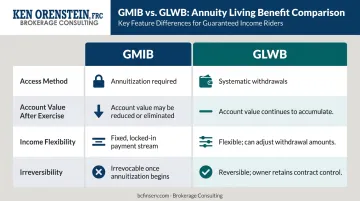
GMIB locks in your income in exchange for the contract. GLWB lets you keep both the income stream and continued access to the contract value.
How a GMIB Rider Works
Every GMIB annuity maintains two parallel figures simultaneously:
- Account value — what your variable subaccounts are actually worth based on market performance
- GMIB benefit base — a separate, contractually maintained value that grows at a guaranteed rollup rate
When you exercise the GMIB, your income is calculated from whichever figure produces the higher payout.
The Benefit Base and Rollup Rate
The benefit base typically starts at your initial premium. It grows each contract year at the rollup rate specified in your contract, regardless of what markets do. One Equitable contract filed with the SEC shows an initial rollup of 7% for the first seven contract years, with renewal rates tied to 10-Year Treasury yields plus 2.00%, capped at 10.0%.
The benefit base can also reset upward on eligible contract anniversaries if your account's market value has grown past it, locking in investment gains permanently.
Concrete Example
Say you fund a variable annuity with $100,000 and elect a GMIB rider with a 7% rollup rate. After 10 years, your benefit base has grown to approximately $196,700 through compounding, even if market performance left your actual account value at, say, $140,000.
At exercise, your income is calculated from the $196,700 benefit base, not the lower market value. The benefit base is only half the equation, though — the payout factor determines what income that base actually generates.
Payout Factors
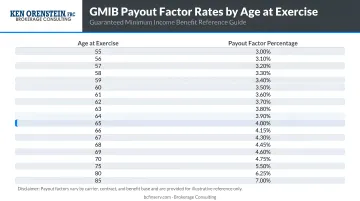
Once exercised, the benefit base is multiplied by a guaranteed annuity purchase factor (determined by your age and the payout option selected) to calculate your annual lifetime income. Per one Equitable SEC filing, single-life payout factors include:
- 3.050% at age 65
- 4.315% at age 80
- 6.925% at age 95
Waiting longer to exercise produces a noticeably higher annual payment. A 70-year-old exercising the GMIB receives a higher payout percentage than a 62-year-old, creating a deliberate trade-off between starting income sooner versus waiting for a larger stream.
The Annuitization Step
Exercising the GMIB means converting the benefit base into a lifetime income stream. You typically start receiving payments one year after the exercise date.
At that point, the annuity contract and its remaining market value are no longer accessible as a lump sum. The rider terminates, and lifetime income payments begin — this conversion is permanent.
Key Factors That Affect Your GMIB
The Waiting Period and Exercise Window
After funding your annuity, you must wait before the GMIB becomes exercisable. One SEC-filed Equitable contract requires a minimum 10-year wait from the Protected Benefit Account funding date. Other contracts vary by issue age — ranging from 10 to 15 years in the contracts reviewed.
Exercise is only available within a 30-day window following each eligible contract anniversary. Miss the window, and you wait another full year.
Withdrawals and the Benefit Base
Withdrawals are the most common way policyholders unintentionally erode their GMIB. The mechanics:
- Withdrawals up to the Annual Withdrawal Amount (AWA) do not reduce the benefit base, but they do reduce the rollup credit applied at year-end
- Excess withdrawals — anything above the AWA — reduce the benefit base on a pro-rata basis, proportional to the percentage of account value withdrawn
- The reduction can be larger in dollar terms than the withdrawal itself, permanently shrinking future guaranteed income
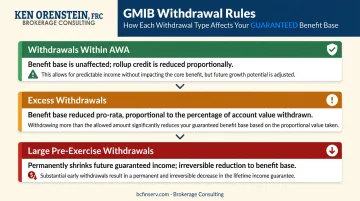
Per SEC-filed contract language: the GMIB benefit base "does not provide a Cash Value or any minimum account value or any death benefit and cannot be withdrawn." Large withdrawals taken before exercise don't tap the guarantee. They permanently reduce it.
Annual Rider Costs
The rider fee is deducted from the account value (not the benefit base) each year the rider is in force. Two specific SEC-filed examples:
- AXA Equitable: 1.15% currently, 2.30% maximum
- Equitable 2026 filing: 1.40% currently, 2.50% maximum
Add in the variable annuity's base Mortality & Expense (M&E) charges, administrative fees, and sub-account expenses, and all-in annual costs can exceed 3%. Over a 10-year accumulation period, that drag compounds — and needs to be weighed honestly against the income protection the GMIB provides.
Pros, Cons, and Common Misconceptions
What GMIB Does Well
Sequence-of-returns protection. Morningstar research found that nearly 70% of failed retirement simulations involved portfolios that lost value within the first five retirement years. The GMIB benefit base sidesteps this risk: it grows at the guaranteed rollup rate whether markets are up, down, or flat.
Longevity protection. Payments continue for life. For retirees without a pension, this addresses the core fear of outliving savings.
Where GMIB Falls Short
- Cost drag — annual fees reduce actual account value steadily, especially over 10+ year accumulation periods
- Irreversibility — once exercised, the lump sum is gone; income is fixed
- Complexity — FINRA has flagged variable annuities as a top source of investor complaints, with contract complexity cited as a primary driver
Those drawbacks are compounded by two misconceptions that trip up even informed buyers.
Two Misconceptions Worth Addressing Directly
"The benefit base is my account value." It is not. The benefit base is a calculation figure used solely to determine guaranteed income. It has no cash value, cannot be withdrawn, and does not function as a death benefit. These are separate numbers that often diverge significantly.
"I can withdraw my GMIB benefit base on demand." No — that's a GLWB. A GMIB is only accessible through annuitization. Taking excess withdrawals before exercise reduces the benefit base rather than accessing it.
When a GMIB Rider May Not Be Right for You
You Already Have Strong Guaranteed Income
If Social Security, a pension, and other guaranteed sources already cover your essential retirement expenses, the GMIB rider cost may add little practical value. Federal retirees with a FERS pension, for instance, often already have their income floor covered — which is why, at Brokerage Consulting, most GMIB discussions for federal employee clients arise only when they're seeking supplemental income beyond what pensions and Social Security already provide.
You Need Flexibility
GMIB requires eventual annuitization — a permanent conversion. If you expect to need lump-sum access, want to adjust income levels over time, or prefer keeping control over your assets, a GLWB or a fixed indexed annuity with a lifetime income rider likely serves you better — and keeps your options open.
Your Time Horizon Is Shorter
The mandatory waiting period of 10 or more years makes GMIB most valuable for annuitants in good health with a long retirement ahead. If you're purchasing the annuity in your mid-to-late 70s, or if health considerations suggest a shorter-than-average life expectancy, paying annual rider fees through a decade-long deferral period may not produce a favorable outcome.
Contract economics vary meaningfully by individual. Before committing, it's worth running side-by-side projections that factor in fees, rollup rates, payout factors, and your realistic life expectancy — the numbers can look very different from one contract to the next.
Not sure which scenario applies to you? Consider these signals that a GMIB rider may be the wrong fit:
- Your guaranteed income already covers essential living expenses
- You may need a lump sum or flexible withdrawals within the next decade
- You're purchasing in your mid-to-late 70s with a shorter expected deferral window
- Your contract's annual rider fees are high relative to the projected income benefit
Frequently Asked Questions
What is a guaranteed minimum income benefit (GMIB) annuity?
A GMIB annuity is a variable or indexed annuity contract that includes a GMIB rider — a feature that guarantees a minimum lifetime income regardless of market performance. Payouts are calculated from a separately maintained benefit base, not the annuity's actual account value. The SEC and NAIC both categorize it as a variable annuity living benefit rider.
How much does the GMIB rider cost?
Rider charges vary by contract and insurer. Two SEC-filed examples show current charges of 1.15% and 1.40% of the benefit base, with maximums of 2.30% and 2.50% respectively. Insurers may raise charges with advance notice, at which point you typically have the option to drop the rider.
What is the GMDB (Guaranteed Minimum Death Benefit) in a variable annuity contract?
A GMDB is a separate rider that guarantees a minimum payout to your beneficiaries upon your death. Unlike the GMIB (which guarantees lifetime income to you), the GMDB protects your heirs. Each rider carries its own cost and is elected separately.
How is a GMIB different from a Guaranteed Lifetime Withdrawal Benefit (GLWB)?
The key difference is annuitization. A GMIB requires you to fully annuitize the contract (surrendering the account value in exchange for a lifetime income stream) to access the guaranteed income. A GLWB allows guaranteed lifetime withdrawals while the contract stays intact and the account value remains accessible.
What happens if my annuity's market value is higher than the benefit base at exercise?
You receive whichever produces the higher income. If strong market performance means your actual account value generates a better payout than the GMIB benefit base, you benefit from that market performance. The guarantee only comes into play when the benefit base outperforms the market value.
Is there a waiting period before I can use my GMIB?
Yes. Most GMIB riders require a mandatory waiting period of 10 or more years from the funding date before the benefit becomes exercisable, depending on age at funding. Exercise is only available within a 30-day window following each eligible contract anniversary; miss that window and you wait until the next anniversary.