
The stakes are real. Taking a lump sum prematurely could push you into a higher tax bracket. Missing a distribution deadline could trigger penalties. Assuming you'll automatically inherit without a formal designation could send the asset through probate.
This guide covers what every annuity beneficiary needs to know: who qualifies, what rights you hold, what payout options exist, and how the tax rules work — including the differences between qualified and non-qualified annuities.
Key Takeaways
- Beneficiary rights activate only at death — you have no access to the annuity while the owner is alive
- Non-spouse beneficiaries face strict deadlines: 5 years for non-qualified annuities, 10 years for qualified annuities under the SECURE Act
- Spouses get unique advantages, including spousal continuation — the ability to assume the contract and defer taxes indefinitely
- Qualified annuity distributions are fully taxable; non-qualified annuities only tax earnings above your cost basis
- Don't take a lump sum without consulting an advisor — it's typically the least tax-efficient option and is irreversible
Types of Annuity Beneficiaries
Every annuity contract involves four parties: the insurance company, the owner (who controls the contract), the annuitant (whose life determines income calculations), and the beneficiary (who receives the death benefit).
The owner and annuitant may or may not be the same person. That distinction directly affects when and how the death benefit is triggered.
Primary vs. Contingent Beneficiaries
- Primary beneficiary: First in line to receive the death benefit
- Contingent beneficiary: Inherits only if the primary beneficiary dies before the owner
Some contracts allow a "per stirpes" or "children by representation" designation, meaning a deceased beneficiary's share passes equally to their surviving children. Not all carriers accept per stirpes language; Prudential's forms, for example, use "children by representation" instead.
Spouse, Non-Spouse, and Non-Person Beneficiaries
Who you name directly shapes the tax treatment and distribution rules that apply:
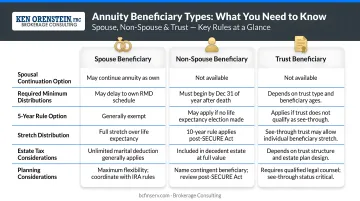
| Beneficiary Type | Key Benefit | Key Limitation |
|---|---|---|
| Spouse | Spousal continuation rights; can assume the contract | Must be named sole primary beneficiary |
| Non-spouse individual | May access stretch/life expectancy option | Subject to 5- or 10-year distribution rules |
| Trust, charity, or estate | Flexibility for estate planning | No life-expectancy stretch; 5-year rule applies; probate risk for estates |
State law adds another layer. In community property states, spouse consent may be required for beneficiary changes. Massachusetts requires a disinterested adult witness.
Your Rights as an Annuity Beneficiary
Your rights as a beneficiary are dormant until the owner or annuitant dies. While the owner is alive, you have no claim on the contract, no access to funds, and no say in how it's managed. Death documentation — typically a certified death certificate — is required before any insurer will process a claim.
Death Benefit Types
Once a claim is triggered, the amount you receive depends on which death benefit structure the contract uses:
- Standard death benefit: Pays the contract value at the time of death, subject to market fluctuations and any applicable charges
- Return of premium: Pays the greater of the account value or total premiums paid minus prior withdrawals — protecting the original investment if the market has declined
- Enhanced (stepped-up) death benefit: A rider that locks in the highest contract value on a predetermined schedule, potentially paying more than the current account value
What Happens If Payments Had Already Started
If the owner had already begun receiving annuity income before death, what you receive depends on the payout structure selected:
- Life-only annuity: Payments stop at the owner's death — no residual benefit
- Period-certain annuity: Payments continue for the remaining guaranteed term; if a 20-year payout was elected and the owner died in year 10, you receive the remaining 10 years of payments (or may take a lump sum equivalent)
What Happens Without a Named Beneficiary
No beneficiary designation means the annuity's remaining value is paid to the owner's estate and must pass through probate — a court-supervised process that is costly, slow, and part of the public record. Married owners should not assume the contract automatically transfers to a spouse. Without a proper designation in the contract itself, that assumption can be wrong.
Special Considerations: Minors, Trusts, and Government Benefit Recipients
Naming a minor as beneficiary creates an immediate operational problem: insurers cannot issue settlement checks directly to someone under 18. Prudential and Equitable both require a court-appointed legal guardian or custodian before processing the claim. That court process takes time and carries legal fees that reduce what your beneficiary ultimately receives.
A trust can resolve the minor-beneficiary problem, but it carries specific tax and distribution constraints:
- Trusts don't qualify as "individuals" under IRC Section 72(s)(4), so they can't use the life-expectancy stretch option for non-qualified annuities
- The 5-year distribution rule generally applies to trust beneficiaries of non-qualified annuities
- Special needs trusts require careful drafting to avoid disqualifying government benefit recipients from Medicaid or SSI
For special needs trusts in particular, the wrong drafting language can cost a beneficiary their Medicaid or SSI eligibility — making the trust review with a qualified tax advisor a necessary step before any designation is finalized.
Annuity Payout Options for Beneficiaries
Once a death benefit is triggered, you typically have several options for receiving the funds. The choice you make affects both the timing of your tax liability and how much you ultimately keep. There's no universally "best" option — it depends on your bracket, income needs, and timeline.
Lump Sum Payout
You receive the entire death benefit at once. It's simple and immediate, but it's usually the least tax-efficient option. For non-qualified annuities, IRS Publication 575 confirms that a single-sum distribution is taxable to the extent it exceeds unrecovered cost — meaning all the earnings hit your income in one year, potentially moving you into a higher bracket.
Installment Payments Over a Specified Period
You receive payments spread over a set number of years (commonly five or ten). This distributes your tax liability across multiple years, which can keep you in a lower bracket than a lump sum would. For non-qualified annuities, each payment is split using the exclusion ratio — a portion represents return of your cost basis (not taxable) and a portion represents earnings (taxable).
Stretch (Life Expectancy) Option
Some non-qualified annuity contracts allow individual beneficiaries to spread distributions over their own life expectancy. This maximizes the tax-deferral period while the remaining balance grows tax-deferred. However:
- Under IRC Section 72(s)(2), distributions must begin within 1 year of death
- Only individual beneficiaries qualify — trusts, estates, and charities cannot use this option
- Not all contracts offer it; confirm availability before counting on it
Spousal Continuation
A surviving spouse named as sole primary beneficiary can elect to assume the annuity contract as their own. Under IRC Section 72(s)(3), the spouse is treated as the new contract holder, which means:
- Tax-deferred growth continues indefinitely
- No immediate distribution requirement
- The spouse can name new beneficiaries
- Required distributions are deferred until the spouse's own death or election to begin payments
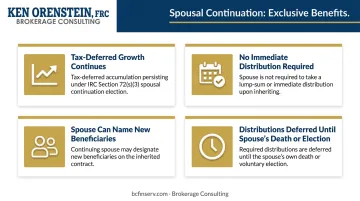
This is the most advantageous option available, and it's exclusively available to spouses — no other beneficiary type qualifies.
For federal employees, the decision is often more complex — TSP distributions, survivor annuities, and other FERS income sources all affect which payout approach makes the most sense. Ken Orenstein at Brokerage Consulting works with beneficiaries, including federal employees and seniors with inherited retirement assets, to identify the strategy that minimizes taxes and fits their financial picture. No-cost consultations are available by phone, virtually, or in person at (888) 315-3608.
Inherited Annuity Distribution Rules
Beneficiaries don't have unlimited time to access inherited annuity funds. The IRS imposes specific deadlines that vary depending on the type of annuity and the beneficiary's relationship to the deceased. Missing these deadlines can trigger penalties.
Non-Qualified Annuities: The Five-Year Rule
Under IRC Section 72(s)(1)(B), if an owner dies before the annuity starting date, the entire remaining interest must be distributed within 5 years of death. You can pace withdrawals however you like during that window — but the full amount must be out before the deadline closes.
Exception: If distributions are paid over the life or life expectancy of an individual designated beneficiary and begin within 1 year of death (per IRC Section 72(s)(2)), the 5-year rule doesn't apply.
Qualified Annuities: The Ten-Year Rule
For annuities held inside an IRA or qualified plan, the SECURE Act introduced a separate framework. Per IRS Publication 590-B, most non-spouse beneficiaries of owners who died after December 31, 2019 must fully deplete the account by the end of the 10th year following the owner's death.
Eligible designated beneficiaries — who may qualify for life-expectancy treatment instead — include:
- Surviving spouses
- Minor children of the deceased account holder
- Disabled or chronically ill individuals
- Individuals not more than 10 years younger than the decedent
Confirming your status with the plan administrator or a qualified advisor is worth the effort. Stretching distributions over a lifetime versus depleting the account in 10 years directly affects how much tax you owe each year.
Rollover into an Inherited IRA
Non-spouse individual beneficiaries of qualified annuities can roll proceeds into an inherited (beneficiary) IRA through a direct trustee-to-trustee transfer. Key rules for this option:
- Defers taxes until you take distributions
- RMDs apply if the original owner had already reached their required beginning date
- Trusts and estates are generally not eligible for this rollover
If you're unsure which distribution path applies to your situation, a licensed advisor can help you weigh the tax timing tradeoffs before you act.
Tax Implications of Inheriting an Annuity
Annuity death benefits are subject to ordinary income tax on the taxable portion — not inheritance tax or estate tax (though separate estate tax exposure may exist depending on the estate's size and jurisdiction). The structure and timing of your distributions directly affects how much tax you owe and when.
Qualified vs. Non-Qualified: What Gets Taxed
The tax wrapper determines your starting point:
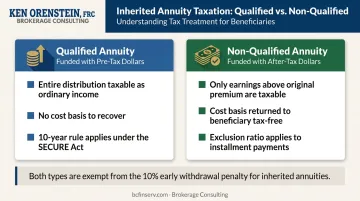
- Qualified annuities (funded with pre-tax dollars): The entire distribution is taxable as ordinary income — there's no cost basis to recover
- Non-qualified annuities (funded with after-tax dollars): Only the earnings above your original premium are taxable; the cost basis comes back to you tax-free
- Early withdrawal penalty: Distributions from inherited annuities are exempt from the 10% penalty under IRC Section 72(q)(2)(B) for non-qualified annuities and IRC Section 72(t)(2)(A)(ii) for qualified plans
Example: A non-qualified annuity pays a $160,000 lump-sum death benefit. The original owner's unrecovered cost basis was $100,000. Under IRC Section 72 and IRS Publication 575, only $60,000 is taxable — the $100,000 cost basis is returned tax-free.
The Exclusion Ratio and Spreading Tax Liability
When a non-qualified annuity pays out as a stream of payments rather than a lump sum, IRS Publication 939 explains that the General Rule applies. The tax-free portion of each payment is calculated by dividing the investment in the contract by the expected return. This exclusion ratio spreads your cost basis recovery across all payments.
Installment or stretch distributions keep each year's taxable income lower than a single lump sum — which typically means a lower effective tax rate over the full distribution period. Key advantages include:
- Smaller annual tax bills compared to taking everything at once
- More predictable income spread across multiple tax years
- Potential to stay within lower marginal tax brackets throughout the payout period
What to Do with an Inherited Annuity
There's no single right answer here. The best path depends on your tax bracket, income needs, age, and what other assets you're managing. What's consistent across every situation: don't act before you understand the consequences.
Evaluate Your Options Before You Act
Once you take a lump sum, it cannot be undone. You can't go back and elect installment payments or the stretch option after the fact. Before making any election:
- Contact the insurance company to learn exactly what options the contract allows — not all contracts offer every payout structure
- Request a benefits statement showing the full death benefit amount, contract value, and cost basis
- Consult a financial advisor before accepting any distribution — especially if the taxable amount is large
That conversation costs nothing and can save thousands in avoidable taxes.
Practical Uses for Inherited Annuity Funds
With a clear picture of your options, you can match the payout structure to your actual financial situation. Common directions beneficiaries take include:
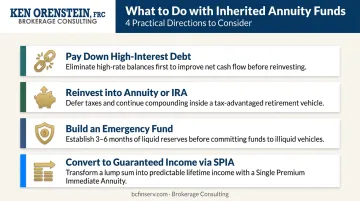
- Paying down high-interest debt, especially when installment income would otherwise go entirely toward debt service
- Reinvesting into a new annuity or IRA to keep the funds in a tax-advantaged account
- Building an emergency fund, a practical move for younger beneficiaries who don't yet rely on retirement income
- Converting to guaranteed income by placing a lump sum into an immediate annuity (SPIA) — something Ken Orenstein at Brokerage Consulting specifically helps beneficiaries evaluate
Getting Personalized Guidance
Inherited annuity decisions involve beneficiary elections, IRS deadlines, tax calculations, and long-term income planning — all at once, often while grieving. The cost of a wrong decision can be significant and sometimes irreversible.
Ken Orenstein at Brokerage Consulting offers no-cost initial consultations by phone, virtually, or in person. This includes federal employees managing inherited qualified retirement assets who need help working through these decisions. To schedule, call (888) 315-3608 or visit bcfinserv.com.
Frequently Asked Questions
What are the rules for inheriting an annuity?
The key rules depend on annuity type and your relationship to the deceased. Non-spouse beneficiaries of non-qualified annuities generally must withdraw all funds within 5 years. For qualified annuities (IRA or 401(k)-held), most non-spouse beneficiaries face a 10-year distribution deadline under the SECURE Act. Spouses have more flexibility, including spousal continuation rights.
Do beneficiaries pay taxes on inherited annuities?
Yes. Ordinary income tax applies to the taxable portion of distributions — not inheritance or estate tax. For non-qualified annuities, only the earnings above the original cost basis are taxed. Qualified annuity distributions are generally fully taxable since they were funded with pre-tax dollars.
What are the beneficiary payout options?
The main options are: lump sum, installment payments over a set period, stretch/life expectancy distributions (for individual beneficiaries of eligible contracts), spousal continuation (spouses only), and rollover into an inherited IRA (for qualified annuity proceeds).
How long does an annuity pay out after death?
It depends on the payout structure. A period-certain annuity continues payments for the remaining guaranteed term. A lump sum ends the annuity immediately. Most non-spouse beneficiaries must distribute the full value within 5 years (non-qualified) or 10 years (qualified) of the owner's death.
What is the best thing to do with an inherited annuity?
The right move depends on your tax bracket, age, income needs, and long-term goals. That said, taking a lump sum without first reviewing all options is almost always the costliest choice. Speaking with a financial advisor before making any elections can prevent mistakes that are difficult to reverse.
Does an immediate annuity have a death benefit?
Not always. Life-only (straight-life) payouts stop at the annuitant's death with nothing paid to beneficiaries. A "life with period certain" structure guarantees payments continue to a beneficiary for any remaining years in the guaranteed term if the annuitant dies early.